Vanessa Collingridge and the team answer listener’s historical queries and celebrate the way in which we all ‘make’ history.
Programme 5
30 October 2007
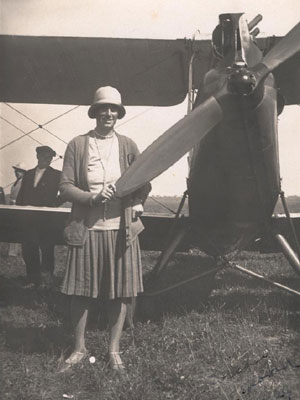
Winifred Spooner
Photo courtesy of Giovanni Giorgetti
The 95 year-old mother of a Making History listener recalled an aeroplane crash near Whitehaven in Cumbria some time in the late 1920s or early 1930s. The pilot was a woman, Winifred Spooner. So who was she?
Making History consulted the journalist and former Chair of the Women Pilot’s Association, Clare Walker who is writing a history of early women pilots “Women with Altitude”; and the author Mary Cadogan.
Winifred Spooner was born in 1900 and didn’t get a pilot’s licence until 1927. In 1928 she became the first woman to compete in the King's Cup Air Race and in 1929 the first woman to take part in the first International Challenge de Tourisme air race in which 55 aircraft from six countries competed. She won the following awards:
1928
Winner of the Siddeley Trophy for becoming the first aeroplane club aviator to cross the line in the King's Cup Air Race
1929
Winner of the Harmon Trophy as the world's outstanding aviatrix
She was one of the few women to hold a “B” or commercial pilot’s licence and in
1931 was the first British woman to earn her living as a private owner's personal pilot, flying air racer and MP Sir Lindsay Everard all over Britain, Europe, Turkey and the Middle East
She died aged 33 in 1933 from pneumonia.
Further Reading
Women with Wings: Female Flyers in Fact and Fiction by Mary Cadogan Publisher: Academy Chicago Publications; New Ed edition (1 Oct 2002) ISBN-10: 0897335120 ISBN-13: 978-0897335126
Berwick upon Tweed House
Ian Kille and his partner Diana Harris moved up to Berwick about 18 months ago. Since arriving in this historic town they have become absorbed by the history of their house in a street called Ravensdown which appears to consist of a Georgian-style property which has been added onto the an older, small house. They wanted to find out what age the house is and also work out why the soil in their garden is so much more fertile than that of neighbouring properties.
Making History consulted Adam Menuge of English heritage and local historian Francis Cowe.
Adam Menuge confirmed that the house is actually two properties in one. The smaller, cottage-style building at the back is early to mid-eighteenth century, the larger, more grand Georgian style property in front is early nineteenth century.
Francis Cowe suggests that the fertility of the soil is down to centuries of municipal waste management. Rubbish was deposited and burnt. This would have attracted birds such as Ravens and he thinks that the local street name confirms that Ian and Diana’s house is on the site of one of these ‘middens’.
Terry Statham has a passion for the Roman history of north-west England. He heard Making History’s item on the Roman forts of the Saxon Shore which mentioned 4th century fortifications along the Lancashire and Cumbrian coast. He suggested that we find out more about these and whether they tie in with those forts in East Anglia and south-east England.
Making History consulted Professor David Shotter, formerly of the University of Lancaster.
Professor Shotter indicated that the forts along the north-west coast were intended for defence against the Scotties based in Ireland. They weren’t part of a system as the so-called Saxon Shore forts appear to be. However, there is evidence that there were ‘fortlets’ down the Cumbrian coast that were associated with Hadrian’s Wall.
Roman Lancashire by W Thompson Watkin. Originally published in 1883 and recently republished by Azorabooks ISBN 978-0-9556699-0-3
Star Carr
Richard Daniel went to the Vale of Pickering to meet up with archaeologist Nicky Milner to find out more about environmental damage to one of Europe’s finest Mesolithic sites.
Discovered by chance in 1947, excavations revealed hunting artefacts that had been preserved in the water-logged peat for 10,000 years. But, in recent years, the finds from excavations have been less well preserved. The fear is that modern water management, including the demands of agriculture, have lowered the water table and allowed precious archaeological material to dry out.
British Archaeology September/October 2007 (Council for British Archaeology)
Clark, J.G.D. 1954. Excavations at Star Carr, Cambridge.
Chatterton, R. 2003. Star Carr reanalysed. In J. Moore and L. Bevan (eds.) Peopling the Mesolithic in a northern environment, Oxford: Archaeopress, British Archaeological Reports International Series 1157, 69-80.
Conneller, C.J. 2003. Star Carr recontextualised, in J. Moore and L. Bevan (eds.), Peopling the Mesolithic in a northern environment, Oxford: Archaeopress, British Archaeological Reports International Series 955, 81-86.
Conneller, C. 2004. Becoming Deer: corporeal transformations at Star Carr. Archaeological Dialogues 11.1, 37-56.
Conneller, C. and T. Schadla-Hall, 2003. Beyond Star Carr: the Vale of Pickering in the tenth millennium BP, Proceedings of the Prehistoric Society 69, 85-105.
Lane, P.J. and Schadla-Hall, R.T. 2004. The many ages of Star Carr: do `cites' make `sites'? In A. Barnard (ed.) Hunter-gatherers in History, Archaeology and Anthropology, Oxford, 145-62.
Mellars, P. and Dark, P., 1998: Star Carr in context, Cambridge: McDonald Institute Monographs.
Milner, N. 2006. Subsistence. In C. Conneller and G. Warren (eds.) Mesolithic Britain and Ireland. New approaches. Tempus
Pollard, C.J., 2000. Ancestral places in the Mesolithic landscape, in C. Conneller (ed.). New approaches to the Palaeolithic and Mesolithic, Archaeological Review from Cambridge 17.1, 123-138.
Vanessa has presented science and current affairs programmes for BBC, ITV, Channel 4, Channel 5 and Discovery and has presented for BBC Radio 4 & Five Live and a regular contributor to the Daily Telegraph and the Mail on Sunday, Scotsman and Sunday Herald.
Contact Making History
Send your comments and questions for future programmes to: Making History BBC Radio 4 PO Box 3096 Brighton BN1 1PL












 Vanessa has presented science and current affairs programmes for BBC, ITV, Channel 4, Channel 5 and Discovery and has presented for BBC Radio 4 & Five Live and a regular contributor to the Daily Telegraph and the Mail on Sunday, Scotsman and Sunday Herald.