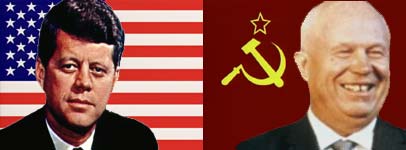
October 1962 - The Soviet Union installs near range nuclear missiles in Cuba, just 90 miles off the coast of the United States. With armed forces on both sides at their highest state of readiness the fate of millions of people rests upon the ability of two men, John F. Kennedy and Nikita Khrushchev, to reach a compromise and avoid nuclear war.
Radio 4 marks the 40th anniversary of the 14 days when the world held its breath.
 |
|
Kennedy's Secret Tapes
Wednesday 16 October, 8.00pm (repeated Saturday 19 October, 10.15pm)
 Anthony Howard draws on the secret tapes made by President Kennedy to tell the inside story of what went on in the White House during the crisis period. Anthony Howard draws on the secret tapes made by President Kennedy to tell the inside story of what went on in the White House during the crisis period.
Few, if any, of Kennedy's advisors were aware that their meetings with the President were being taped during the crisis when the world came the closest it's ever been to nuclear war. They reveal that the United States had decided to carry out a limited strike against the missiles in Cuba but drew back when the consequences became clearer.
 Listen to the Programme Listen to the Programme
| |
|
|
|
Crisis Diary
Monday 21 - Monday 28 October, 8.55am
 In a sequence of 8 short programmes, Chris Lowe charts the day by day events of 40 years ago from October 21 to October 28. In a sequence of 8 short programmes, Chris Lowe charts the day by day events of 40 years ago from October 21 to October 28.
Beginning on the eve of President Kennedy's first public address to the nation through to Krushchev's climbdown, and set against the background of the unfolding crisis, the programmes focus on the memories of ordinary men and women who felt nuclear armageddon was a hair's breadth away.
| |
|
|
|
Book of the Week: The Crucible in History
Monday 21 - Friday 25 October, 9.45am (repeated 12.30am)
 Arthur Miller's 1950s drama of the Salem Witch Trials accurately reflects the political frenzy of the Cold War era. Arthur Miller's 1950s drama of the Salem Witch Trials accurately reflects the political frenzy of the Cold War era.
The author reads his memoir of those times of repression and cowardice, taking us with wit, perception, and generosity, through his own understanding of an earlier America in turmoil.
| |
|
|
|
The Cuban Missile Crisis as seen from Moscow and Havana
Wednesday 23 October, 8.00pm (repeated Saturday 26 October, 10.15pm)
 The US version of it's role in the crisis is well documented but until now the Soviet and Cuban sides of the story have remained untold. The US version of it's role in the crisis is well documented but until now the Soviet and Cuban sides of the story have remained untold.
Using newly declassified documents from the KGB archive and interviews with key Kremlin insiders, the BBC's former Moscow Correspondent Allan Little analyses what Khrushchev was doing placing missiles in Cuba and how he handled the escalating crisis.
| |
|
|
|
The Saturday Play: Cuba
Saturday 26 October, 2.30pm
 Scots poet and playwright, Liz Lochhead, remembers vividly the events of the time, and depicts a very personal betrayal between two young girls. Scots poet and playwright, Liz Lochhead, remembers vividly the events of the time, and depicts a very personal betrayal between two young girls.
Barbara Proctor and Bernadette Griggs are best friends. They both believe the world is about to end, suddenly everything pales into insignificance beside their highly imaginative fears. Daring each other on, they decide to spend their last days taking on the establishment and making a stand for women and peace.
| |
|
|
|
Alistair Cooke's Letter on Cuba
Monday 28 October, 8.00pm
 Alistair Cooke has been broadcasting his weekly Letter from America since 1946. Alistair Cooke has been broadcasting his weekly Letter from America since 1946.
In this special edition of the programme Cooke re-reads a contemporary Letter from America from October 1962 encapsulating the mood of the nation.
| |
|
|
|
The Missile Crisis Reunion
Monday 28 October, 8.15pm
 This month Havana is hosting an international conference to commemorate the Missile Crisis anniversary. This month Havana is hosting an international conference to commemorate the Missile Crisis anniversary.
Julian Pettifer joins the key surviving participants who will be attending and examines new documentation which the Cuban government has promised to release.
| |
|