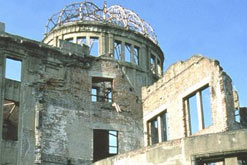
What were the events that brought World War II to an end?
Programme details
August 2005
A short series of radio pieces to mark the 60th anniversary of the events which brought WW2 to an end: the nuclear attacks on Hiroshima and Nagasaki and the Japanese surrender.
August 1945 takes the form of daily diary, tracking the unfolding events day by day, "in real time", 60 years on.
Presenter Chris Lowe takes us through the events from 3 August - a few days before the anniversaries of the two atomic bomb attacks - through to the first bomb attack on Hiroshima (6 August) and the second on Nagasaki (9 August). The series concludes on 14 August, the anniversary of the surrender of Japan.
The packages draw together contemporary news reports, archive recordings and interviews with veterans and survivors. You can hear from scientists who worked on the Manhattan Project and from military and political staff involved in decision-making and the bombing missions.
The series also features the accounts of Japan's 'Hibakusha', the survivors of the nuclear attacks, and of British prisoners of war who witnessed the bombings and their aftermath.
Each 3-4 minute piece will run as the final feature of the Today programme (Monday to Saturday) and Broadcasting House (Sundays).
The programmes are made by the team responsible for Crisis Diary in 2002 - a similar series which tracked the unfolding events of the Cuban Missile Crisis on its 40th anniversary.
3 August 1945 Truman, Atlee and Stalin return from the Potsdam conference near Berlin. War in Europe is now over, but in the Far East the conflict still rages. Listen to the diary piece for 3 August
4 August 1945 The former US Defense Secretary, Robert McNamara, considers the effectiveness of the American fire-bombing of Japan. Listen to the diary piece for 4 August
6 August 1945 This day marks one of the most momentous events of the 20th century - the destruction of the Japanese city of Hiroshima by an atomic bomb. Listen to the diary piece for 6 August
9 August 1945 Two decisive events take place - the atomic bombing of Nagaski and Operation August Storm, the Soviet invasion of Manchuria. Listen to the diary piece for 9 August
14 August 1945 The unconditional surrender of Japan. Within hours, the Emperor broadcasts to his people. Japanese civilians remember their feelings of shock, relief and despair. Allied troops and POWs recall their elation on hearing that the war was finally over. Listen to the diary piece for 14 August
The BBC is not responsible for the content of external sites