


So You Want to Be A Scientist2012 Experiments - Art and Emotion
Original Idea

Name: Dara Djavan Khoshdel
Occupation: Student
Age: 24
Location: Bournemouth
Question: Is it possible to predict the financial value of a painting by measuring people's emotional response?
Background
Dara wanted to find out if people react more strongly to expensive artworks, even when they don't know how much the paintings cost.
He determined emotional reaction by measuring 'microsweating', how much people sweat when they look at each painting. The theory is that we sweat a tiny amount when we see something that arouses our senses.
Results
Our data showed that there was no correlation between the monetary value of the painting and the emotional response to that particular painting as measured through microsweating.
We hypothesised that the emotional response to an artwork is reflected in the monetary value of that artwork. If conductance increases with value, we would expect the line to have a positive upwards slope, but what we actually found was that the slope was fairly flat.
People varied widely in their response. A separate analysis of variance showed that picture identity did not affect size of the galvanic skin response.
Gathering Data
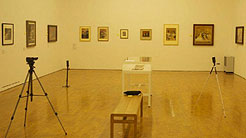
Twelve volunteers took part in the experiment which was held at Modern Art Oxford in March 2012. They viewed a dozen pictures featured in the Graham Sutherland exhibition.
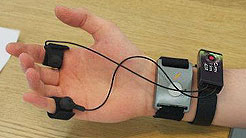
The emotional response of people viewing the artworks was measured using a galvanometer. This analyses the electrical resistance of the skin, which is lowered slightly when we sweat.
Follow Dara's Research Diary on Facebook
To talk to Dara about his experiment, click 'like' to follow his Facebook research diary.
Scientific Mentor

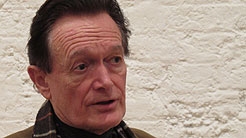
Martin Kemp, Emeritus Prof of the History of Art, University of Oxford
Speciality: science and art (left)
Andrew Parker, Prof of Physiology, University of Oxford
Speciality: vision and cognition (right)

Amateur Scientist Research Diaries
- Find out about Izzy's noise experiment
- Follow this noise experiment on Facebook
- Find out about William's face experiment
- Follow this face experiment on Facebook
- Find out about Val's fashion experiment
- Follow this fashion experiment on Facebook
- Find out about Dara's art experiment
- Follow this art experiment on Facebook
In Collaboration with
Last On
Available to listen
Ancient horses; Uncertainty; How cutlery affects taste
How 700,000-year-old horse DNA could change the way scientists study evolution.
BBC iD
BBC iDBBC navigation
BBC links

BBC © 2014The BBC is not responsible for the content of external sites. Read more.
This page is best viewed in an up-to-date web browser with style sheets (CSS) enabled. While you will be able to view the content of this page in your current browser, you will not be able to get the full visual experience. Please consider upgrading your browser software or enabling style sheets (CSS) if you are able to do so.
