


So You Want to Be A Scientist2010 Experiments - John Rowlands: Noctilucent Clouds
Original Idea
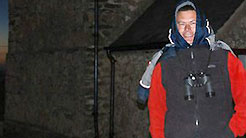
To investigate the frequency and brightness of noctilucent clouds, believed to be linked to climate change. The sun is currently climbing slowly out of a century-low in activity, and so there is a chance to study noctilucent cloud and solar cycle.
Introduction
We modified the original idea slightly into an experiment we can complete in the given timeframe. We focused on how atmospheric waves control the day-to-day variability of noctilucent clouds over the UK summer.
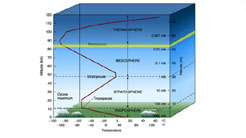
Noctilucent clouds appear between mid May and mid-August. They occur at about 82km altitude (yellow line) in the mesosphere, eight times higher than normal weather clouds and the coldest naturally-occurring place on the planet.
The 5-day planetary wave forms just below NLC heights (about 80km). It has a wave number of 1, meaning that there is one cold phase and one warm phase. Each phase passes any fixed point on the surface every 5 days, although it varies between 4 and 7 days in practice.
Method
We used satellites and radars to monitor the fluctuating temperature and winds of the mesosphere almost in real time. This data was used to try and predict nights when the clouds are more likely to occur, verifying predictions with observations from cloudspotters across the UK and Europe.
Results
The initial submission was to examine solar cycle influences on NLC displays. A simple comparison of displays reveals a marked reduction in high-elevation NLC displays in 2010, apparently following an increase in solar activity. Further work over many years is clearly required for any firm conclusions to be drawn, although a link is known.
There was a strong bias towards the post-local midnight half of the night, which had been anecdotally noted by amateur observers in the past. The likely explanation for the bias is thermal atmospheric tides - a flow of warm and cold air that follows the Sun over the surface of Earth as it rotates. The coldest part of the tide is expected just after local midnight, which is reflected in the timings of first NLC sighting.
Conclusions
Water ice nucleates around tiny meteoric dust particles, which then give rise to NLC displays, such as that depicted in the central image. There are no known accounts of NLC prior to the late 19th century and links with climate change are suggested.
Scientific Mentor
Prof Nick Mitchell, Director of Centre for Space Atmospheric & Oceanic Science, University of Bath
I lead a group studying the physical processes that connect the different layers of the Earth's atmosphere. We are particularly interested in the role of atmospheric waves in coupling the lower atmosphere to the atmosphere at heights near 100 km, effectively the edge of space.

Amateur Scientist Research Diaries
- Find out about Izzy's noise experiment
- Follow this noise experiment on Facebook
- Find out about William's face experiment
- Follow this face experiment on Facebook
- Find out about Val's fashion experiment
- Follow this fashion experiment on Facebook
- Find out about Dara's art experiment
- Follow this art experiment on Facebook
In Collaboration with
Last On
Available to listen
Ancient horses; Uncertainty; How cutlery affects taste
How 700,000-year-old horse DNA could change the way scientists study evolution.
Related Links
On Radio 4
On bbc.co.uk
Related Links
On bbc.co.uk
Elsewhere on the web
- Noctilucent Cloud Spotting Guide: John Rowland's tips for spotting NLC
- Noctilucent Clouds A video of the phemomena from NASA
- Noctilucent Cloud: Observers' Homepage Community of NLC spotters
- Facebook: John Rowland's observing page - add url
BBC iD
BBC iDBBC navigation
BBC links

BBC © 2014The BBC is not responsible for the content of external sites. Read more.
This page is best viewed in an up-to-date web browser with style sheets (CSS) enabled. While you will be able to view the content of this page in your current browser, you will not be able to get the full visual experience. Please consider upgrading your browser software or enabling style sheets (CSS) if you are able to do so.
