


So You Want To Be A Scientist?Homing Snails Experiment: About Ruth's Mentor
Scientific mentor
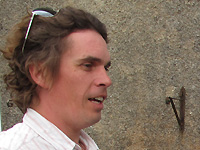
Dr Dave Hodgson,
School of Biosciences,
University of Exeter
What do you research?
I study the mechanisms that help to maintain biodiversity. I am interested in the population dynamics and behaviour of all organisms, but especially invertebrates.
What is the outline of your Radio 4 experiment?
The 'Homing Snails' experiment comes in two stages.
First, Ruth our amateur scientist will perform trials to determine whether snails do indeed have a homing instinct. Early signs suggest that their homing instinct is actually rather strong.
Second, she will recruit members of the public to ask the question, 'How far will snails travel to get home?' The answer will help gardeners decide how to rid themselves of these important garden pests efficiently and humanely.
What do you think is interesting about this experiment and how will it contribute to your research field?
As the world's human population grows, there is intensifying pressure on our crops and livestock to feed us. Renewed interest in 'local food' and 'homegrown crops' means that the public are exposed to all of the pests and crop diseases that have plagued farmers for millennia. And yet we are motivated to treat animals humanely.
This experiment is a fascinating mixture of behaviour, animal-plant interactions, applied ecology and citizen science. The fact that such apparently simple organisms can find their way home is already exciting: the idea that they can do this over long distances is a fascinating hypothesis.
What can amateurs contribute to scientific research?
Citizen science is a great way to raise awareness of the natural world and the need to conserve biodiversity. While amateurs sometimes lack the scientific rigour and objectivity required of professional scientists, the general public remains an incredible, untapped resource for information.
Our goal therefore is to engage the public in large scale experiments, and share the scientific method of hypothesis testing. This will help stem the spread of 'bad science', and give the public an insight the work of scientists.
What do you hope will come out of this project?
I sincerely hope that a national project on snail homing behaviour will provide results of sufficient rigour to
- (a) be publishable in the scientific literature
- (b) be of interest to a wide audience, and
- (c) provide useful information to gardeners
Snails in the news
- Snail-loving BBC Radio 4 amateur scientist of the year (from the UKRC).
- Grandma proves snails have a homing instinct (from BBC Newsround)
- Snail study homes in on win for amateur scientist Ruth (from Herald Express)
- Snail survey gran homes in on award (from The Daily Mirror)
- Snails have homing instinct, amateur scientist discovers (from The Daily Telegraph)
- Snails that find their way home (from The Daily Express)
- Snail SatNav! Amateur scientist proves that even if you move the slimy pests away, they'll find their way back (from The Daily Mail)
- Study: Snails can find home, sweet home (from UPI)
- Snail sat-nav triumphs in contest (from Pallab Ghosh Science correspondent, BBC News)
- Snails 'have a homing instinct' (from Pallab Ghosh Science correspondent, BBC News)
- Sequin and the snails (from the PM blog)
- Do snails have a 'homing instinct'? (from Metro)
- Grandmother wins Radio 4 science project (from Digital Spy)
- Snail homing instinct confirmed by science (from Boing Boing)
- The Great British Snail Swap (from Garden Rant blog)
The Experiments
So You Want To Be A Scientist?
Last On
Available to listen
Ancient horses; Uncertainty; How cutlery affects taste
How 700,000-year-old horse DNA could change the way scientists study evolution.
Related Links
On Radio 4
On bbc.co.uk
BBC iD
BBC iDBBC navigation
BBC links

BBC © 2014The BBC is not responsible for the content of external sites. Read more.
This page is best viewed in an up-to-date web browser with style sheets (CSS) enabled. While you will be able to view the content of this page in your current browser, you will not be able to get the full visual experience. Please consider upgrading your browser software or enabling style sheets (CSS) if you are able to do so.
