

Local Navigation
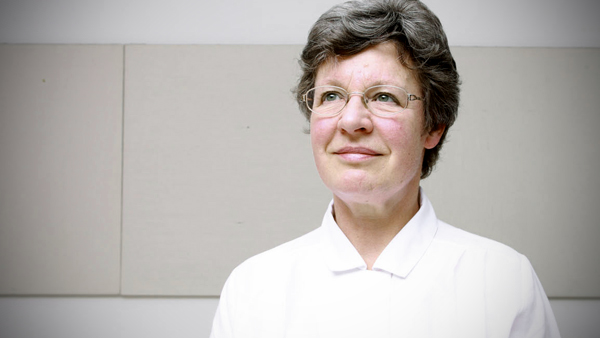 Jocelyn Bell BurnellPhysicist and Astronomer| From The Life Scientific
 most recentJohn SulstonBiologist | From The Life Scientific
 Nicky ClaytonProfessor of Comparative Cognition | From The Life Scientific
 Matthew TaylorChief Executive of the RSA | From Brain Culture: Neuroscience and Society
 Geoff BunnPsychologist| From A History of the Brain
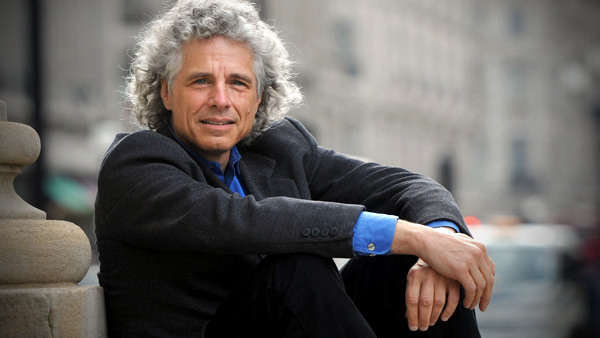 Steven PinkerCognitive Psychologist| From The Life Scientific
 Paul NurseGenetics and cell biology| From The Life Scientific
 Jim Al-KhaliliTheoretical Physicist| From The Life Scientific
Physicist and Astronomer
The first-ever female president of the Institute of Physics, Jocelyn Bell Burnell forged her own path through the male-dominated world of science. She was famously snubbed by the Nobel Prize committee for her discovery of pulsars.
"It's not been easy and I hope it will be easier for younger women, as our sensitivity grows."
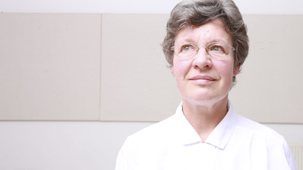
"The world's not fair and it's how you cope with the world's unfairnesses that counts."
Listen: What kind of physics... ?
"I knew I was good at Physics... it was a question of what kind of Physics I would do." "Radio Astronomy - very new, really going places, things happening."
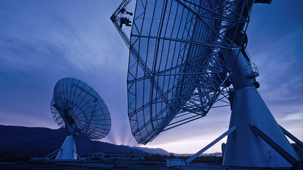
The visible part of the spectrum has been described as like listening to Beethoven and only being able to hear the middle octave.
 Over the course of the 19th century, physicists from Thomas Young, through Michael Faraday to Henri Becquerel made discovery after discovery, gradually piecing together a radically new picture of reality. They explored the light beyond the visible spectrum, connected electricity and magnetism, and eventually showed that heat, light, radio and mysterious new phenomena like 'X-rays' were all forms of 'electromagnetic wave'. (2009)
 Plans are advancing for the biggest radio on Earth, an array of up to 3000 radio telescopes across a continent. The rewards could be, quite literally, astronomical, with 50 times the sensitivity of anything before and the ability to detect alien broadcasts from distant solar systems and even to image the gaps in dusty discs where planets may orbit. (2011)
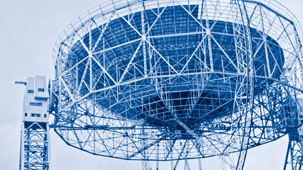
Britain's first Radio Telescope was built by Bernard Lovell at Jodrell Bank in the 1950s, it is also known as 'the big ear'.
Heather Couper presents a narrative history of astronomy. Since the dawn of modern humans more than 100,000 years ago, people have been looking into the sky in wonder. (2008)
 Peter Curran meets the astronomers at Jodrell Bank Observatory. For 50 years, astronomers at the Jodrell Bank worked with colleagues around an iconic radio telescope that famously spotted Sputnik. But now most of the Jodrell tribe are leaving their telescope in the middle of the Cheshire countryside and moving to Manchester. The telescope will survive as it is a listed building, but will the tribe? (2010)
 Among the contributors to the programme are astronomers Sir Bernard Lovell and Sir Patrick Moore. In 1961 Lovell was establishing Jodrell Bank as one of the world's great centres for space research. Now 97, he reflects on his confidence shown in this 1961 Daily Telegraph that Russia would be first to the moon. Lovell also talks of his role in the use of Jodrell Bank as an early warning indicator of a soviet missile attack on Britain. (2011)
"I spent the first two years building the equipment... it was pretty heavy physical work."
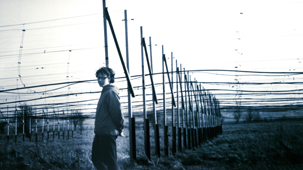
"It was a massive telescope, it covered an area of fify-seven tennis courts. One hundred and twenty miles of wire and cable went into it."
In the week that celebrated the golden anniversary of Yuri Gagarin shooting into space - You and Yours found out about the ordinary mortals doing astronomy in their backyards. (2011)
 The night sky above Exmoor National Park has been awarded a special protection status. It has been granted International Dark-Sky Reserve (IDR) status by the International Dark-Sky Association. (2011)
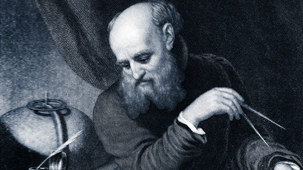
Italian astronomer and mathematician Galileo Galilei built his first telescope in 1609. Using it he saw craters and mountains on the Moon. The next year he discovered four moons orbiting Jupiter.
Galileo did not invent the telescope, but was the first to record his observations and to realise their significance. (2008)
 Melvyn Bragg and guests discuss the history of optics. From telescopes to microscopes, from star-gazing to the intimacies of a magnified flea. As Galileo turned his telescope to the heavens in the early 1600s, Kepler began to formulate a theory of optics. (2007)
Find out more about Galileo Galilei, watch TV clips from programmes about Galileo and listen to Radio clips at the BBC Science site.
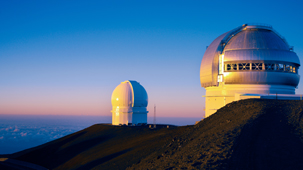
"When we switched that radio telescope on it worked first time. They don't normally do that."
The European Extremely Large Telescope could be the size of the Royal Albert Hall's dome, but twice as high. It will have a mirror 42 metres in diameter and cost up to 1 billion Euros to build. But just what will the Europe's Extremely Large Telescope allow scientists to do? (2008)
 Jonathon Amos follows the engineers and astronomers who are working on the biggest telescope ever sent to space, in one of the most important missions in the history of European spaceflight (2011)
 Andrew Luck-Baker meets today's telescope builders and astronomers (2009)
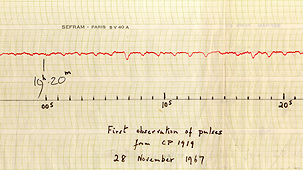
"Just occasionally... there was this additional signal that didn't look exactly like a quasar, didn't look exactly like low-level interference..."
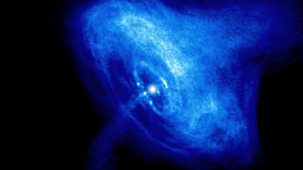
"This was a signal I couldn't explain, so it troubled me." "It came in as this string of pulses, equally spaced pulses."
Find out more about pulsars and watch related TV clips on the BBC Science website.
In this brain-boggling session from Professor Feynman, the scientist reveals how imagination leads the way when trying to understand such cosmic phenomena as black holes, quasars and pulsars. He also provides a fascinating explanation as to why Earth's mountains are no higher than Everest. (1983)
Watch Professor Dame Jocelyn Bell Burnell explain what pulsars are and how they got their name. (2010)
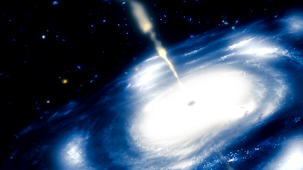
Mysterious objects emitting radio waves were first identified in 1963 by radio astronomers who called them quasi-stellar radio sources, or quasars.
Heather Couper presents a narrative history of astronomy including the discovery of a distant object over 2 billion light years away. At its heart was something 40 times more luminous than a normal galaxy yet no bigger than the solar system. These mysterious powerhouses were named quasi-stellar radio sources, now abbreviated to quasars. (2008)
Astronomers have discovered the most distant quasar ever seen. This one, discovered during a survey by the UK InfraRed Telescope in Hawaii and reported in Nature, is so distant that we are seeing it as it was 12.9 billion years ago, a mere 770 million years after the Big Bang. (2011)
Astronomers have spied a monster black hole - the brightest object yet seen in the early Universe. (2011)
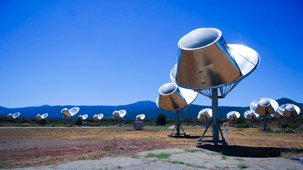
Because of the regular nature of the signal from pulsars their nickname became 'LGM1' - Little Green Men 1.
Series in which physicist Brian Cox and comedian Robin Ince take a witty, irreverent and unashamedly rational look at the world according to science. Robin and Brian are joined by alien abduction expert Jon Ronson and Seth Shostack from the SETI Institute in California to discuss science conspiracies, UFOs and the search for ET. (2009)
Astronomers have now detected hundreds of planets orbiting stars other than our own. Many of them are gas giants but some could be rocky bodies not dissimilar to our own Earth. And of course, the question most people would like answered is do they harbour life? (2010)
Two-part programme exploring the popular motif in science fiction of an all-women society surviving without men. Presented by writer Sarah Hall. (2011)
British scientists are playing a leading role in a planned 1 billion pound telescope which will hunt for is life in other galaxies. (2011)
"It was only over the next few years as these neutron stars... were found by other astonomers... that we began to realise the magnitude of the discovery we had made."
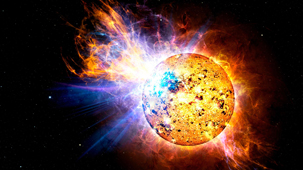
"They [pulsars] are the end-point of the life of big, massive stars. Stars which explode catastrophically."
 Melvyn Bragg and guests discuss the life cycle of stars. Stars, like everything else in the universe, are subject to change. They are born among vast swirls of gas and dust and they die in the stunning explosions we call supernovae. (2003)
Infrared radiation was discovered by William Herschel two centuries ago, but only recently has infrared astronomy come of age. (2008)
Astronomers have discovered what they say is the mightiest neutron star yet. The super-dense object, which lies some 3,000 light-years from Earth, is about twice as massive as our Sun. (2010)
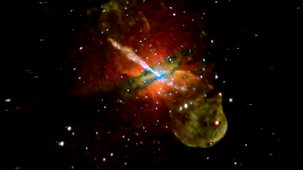
"They [pulsars] certainly made black holes much more credible."
A black hole seems to defy notions of common sense and even of normal physics. Light, information and travellers would have no escape from its gravity. At its heart, matter and even space and time would be squashed out of existence. Yet there is a small theoretical chance that someone entering a spinning black hole might survive to emerge in another universe. (2008)
 Melvyn Bragg and guests Frank Close, Jocelyn Bell Burnell and Ruth Gregory discuss the Vacuum of Space. (2009)
Jocelyn Bell Burnell's discovery of pulsars paved the way for black holes' acceptance. Black holes are regions of space where gravity is so powerful even light cannot escape their grasp. They can form when stars many times more massive than the Sun burn out and collapse in on themselves.
"They did not know what to do with a young female scientist. You were young and female you were page three."
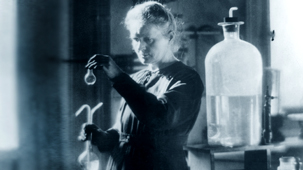
"My colleagues thought I was not serious because I was working part-time."
Two-thirds of the British public are unable to name a single famous female scientist, according to an ICM poll. (2010)
 Michael Hoskins tells the story of William and Caroline Herschel, the famous brother and sister astronomy team who between them discovered Uranus and transformed our view of the Universe. (2011)
 Kirsty Young's castaway is space scientist Maggie Aderin-Pocock. She has, she says, a special relationship with the moon, one that started when she first saw The Clangers as a small child. As a teenager she made her own telescope so she could study the moon more closely. Now she makes highly technical optical equipment for satellites, but says she still harbours desires to go into space - her dream job is building a telescope on the moon. (2010)
Series of biographical discussions with Matthew Parris. BBC Science Correspondent Pallab Ghosh explains how Marie Curie achieved fame through her work on radioactivity. (2007)
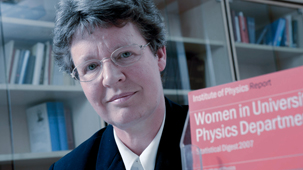
"I do wonder a bit what it's done to me as a woman... am I now a she-male?"
Is the recession threatening efforts to encourage women into science, engineering and technology? Jane Clarke, Assistant Director of the UKRC and Caroline Walters, HR Director at BT discuss. (2010)
When this interview was recorded Jocelyn Bell Burnell had recently been appointed President of the Institute of Physics - the first woman to hold the title. Her appointment followed a long and highly distinguished career in physics, though it was her discovery of pulsars which gained her PhD supervisor a Nobel Prize that she is still most known for. She joined Jane Garvey to discuss her career and what can be done to get more women interested in physics. (2008)
 Lisa Jardine on the importance of science education for national prosperity, and a failed attempt in the late 19th century to change our culture to be more pro-science. (2010)
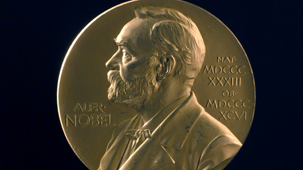
"I believe the Nobel Prize committee didn't even know I existed." "Science was perceived as being done by men - senior men, maybe with a whole fleet of minions..."
Quentin Cooper presents his weekly digest of science in and behind the headlines. As the UNESCO Women in Science Awards are announced, Material World asks why so few top scientists are women. (2011)
Material World will be shedding light on the woman who has been called by some 'the dark lady of DNA'. It is 50 years since the death of Rosalind Franklin, the woman who made a major contribution to the discovery of the structure of DNA. Quentin meets Nobel laureate Sir Aaron Klug who worked with Rosalind Franklin in the 1950s to discuss her life, legacy and incredible contribution to science and medicine. (2008)
 Actress Jenny Agutter champions the life and work of pioneering Austrian physicist Lise Meitner, one of the scientists responsible for the discovery of nuclear fission. (2010)
Select a scientist to explore more about their life, work and inspiration. Choose a subject to discover even more from the Radio 4 Archive & beyond. You can download programmes to listen to later or stack them up to listen to in Your Playlist below.

BBC © 2014The BBC is not responsible for the content of external sites. Read more.
This page is best viewed in an up-to-date web browser with style sheets (CSS) enabled. While you will be able to view the content of this page in your current browser, you will not be able to get the full visual experience. Please consider upgrading your browser software or enabling style sheets (CSS) if you are able to do so.

