 The second series of America charts the development of the United States, exploring three key themes: Empire, Liberty and Faith. (In three series)
Monday - Fridays 3.45pm
Omnibus - Friday 9pm
Series 2 - 19 January - 27 February 2009
Week 7 - North & South
The 90 Day War
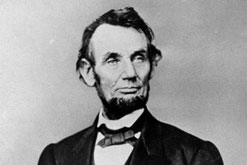
Abraham Lincoln's victory in the 1860 election drove seven southern states to declare independence and secede from the Union, creating the Confederate States of America. They were convinced, wrongly, that Lincoln wanted to abolish slavery.
The first shots of the civil war were fired at Fort Sumter, near Charleston, on 12th April 1861. Five days later Virginia, the most populous and industrialised southern state, opted for secession; 11 states eventually formed the Confederacy. The hopes of both sides for a quick, easy war were dashed by the first large battle, at Bull Run (known as Manassas by Confederates), near Washington on 21st July, where the Northern army was routed.
The Killers Take Command
A more aggressive spirit began to appear on both sides, personified in the rising star of the Union armies, Ulysses S. Grant, who proved his mettle defeating the Confederates at the Battle of Shiloh in April 1862, and the Confederate general Robert E. Lee.
In the late summer of 1862, Lee marched into Maryland, hoping to prompt European mediation and put pressure on Lincoln. The opposing armies met at Sharpsburg (also known as Antietam) on 17th September. The battle was the single bloodiest day of the war but was militarily inconclusive; Lee was forced to withdraw to Virginia.
'Forever Free'
The Battle of Antietam gave Lincoln the confidence to make his Emancipation Proclamation on 22nd September 1862, declaring that from January 1863 all slaves in rebel states were free. He had gone to war to preserve the Union, not free the slaves, but had slowly moved towards supporting emancipation.
The Proclamation had little immediate impact but was seen by black leaders as pivotal; blacks flocked to join the Union armies. It also discouraged the British government from recognising the Confederacy, which never received the European support it so desperately sought.
In the South, the slave system was crumbling anyway, as slave owners went to fight and slaves took advantage of the chaos to flee. Northerners knew that the four million slaves could be of decisive importance in bolstering their armies while the slaves' absence would sap the South's war effort.
The Confederates took the Emancipation Proclamation as yet more proof that the South was right to secede but in 1865 an acute manpower shortage forced them to allow slaves into their army, in return for an offer of post-war freedom. The measure had no military effect, but it was hugely symbolic. Military service had always been a mark of full citizenship, and yet Southern slavery rested on the assumption that most blacks were incapable of being citizens.
The 200,000 black servicemen in the North demonstrated the falseness of the South's theory of slavery. And yet there wasn't equality in the North - blacks eventually received equal pay but mostly fought in segregated units and faced continued discrimination.
'A New Nation'
After a bloody 3 day battle (1st-3rd July 1863) at Gettysburg in Pennsylvania, the Confederate army was forced into retreat. A day later, the Confederate city of Vicksburg fell to Grant, splitting the Confederacy and giving the Union control of the Mississippi. This was a turning point in the war.
On 19th November Lincoln gave his famous Gettysburg Address at the dedication of a new national cemetery at the battlefield. He redefined the civil war not only as a struggle for the union but for equality in a united, democratic, nation and resolved that 'these dead shall not have died in vain'.
War Behind the Battle Lines
The conflict dragged on through 1864 but the South was nearing collapse. Northern generals were now waging total war, designed to break both Confederate armies and civilians. With double the population and four-fifths of the industry, the North's war effort was nearly self-sustaining, whereas the South relied heavily on imports. The Northern blockade began to bite and food shortages sapped morale. The fall of Atlanta in early September was a major blow to the Confederates.
Lincoln feared that resentment against the inequalities of the draft and what seemed like an unending war would harm his election chances. However, boosted by Atlanta's capture, on 8th November 1864 he was re-elected.
Episode summaries by Victoria Kingston.