 The third series of America charts the Post-War era.
Monday - Fridays 3.45pm
Omnibus - Friday 9pm
Series 3: 1 June - 10 July
Detente and Discontent
America in Retreat?
In August 1974 Vice President Gerald Ford became President after Nixon's resignation over Watergate. Ford announced a full pardon for Nixon, aiming to draw a line under the affiar, but his popularity plummeted and his presidency never really recovered.
Even a strong president would have struggled in the 1974 oil crisis. The 1973 Arab-Israeli war caused prices at America's pumps to rise by 50%, in a country that assumed cheap gas was its birthright. The fuel crisis passed but a more durable legacy was 'stagflation' - a combination of stagnant growth and soaring inflation that lasted for the rest of the decade. America coped better than most developed countries, but 8% inflation and 7% unemployment were shocking after the long post-war boom.
The legacy of Vietnam was equally unsettling. In April 1975, the U.S. evacuated its last personnel from Saigon; by the end of the summer, the rest of Indochina had followed Vietnam in going communist. In March 1976, Soviet-backed Marxist guerrillas took over Angola, opening a new Cold War battlefront in Africa.
In America, this provoked growing scepticism about the process of 'détente' begun by Nixon. The Americans had hoped this would prevent the Soviets stirring up trouble around the world, but in Moscow, America's acceptance of nuclear parity and its evident international weakness post-Watergate encouraged the belief that the world was now ripe for revolutionary change.
In 1976, Ford saw off a right-wing challenge for the Republican nomination from Ronald Reagan, but lost the presidential election to Democrat Jimmy Carter.
A Constitutional Abortion
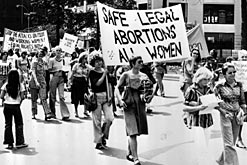
In the landmark 1973 case Roe versus Wade, the U.S. Supreme Court ruled that abortion was a constitutional right. Until then, it was criminalized in most states, with laws which had been enacted mainly to protect women from back-street abortionists. By the 1960s, such laws were regarded by feminists as violating a woman's right to control her own body.
Roe versus Wade began in Texas. Jane Roe was the pseudonym of Norma McCorvey, poor, divorced, pregnant and wanting an abortion. She became a test case for two female lawyers, Sarah Weddington and Linda Coffee. Henry Wade was the local District Attorney who sought to uphold state law.
The case went all the way to the Supreme Court. Its controversial decision became a fault-line in American society, around which the arguments for (pro-choice) and against (pro-life) abortion would polarize. It also became the centrepiece of the new Christian Right's campaign to bring God back into politics and reverse the rights revolution.
The 'Silent Majority' Finds Its Voice
The transformation in the Republican Party's fortunes, from the nadir of Nixon and Watergate, to Reagan's landslide victory in 1980, reflected a conservative revival which had been brewing since the 1960s. It was a response by those Nixon called America's 'Silent Majority', focusing on issues of sex, race and family, underpinned by mounting opposition to what was perceived as Washington's increasing intrusion into people's lives.
This opposition was exemplified in the campaign, led by Phyllis Schlafly, wife of an Illinois lawyer, to block the proposed Equal Rights Amendment (ERA), to the Constitution. This affirmed that equal rights should not be denied on grounds of sex. ERA passed through Congress in March 1972, and was soon well on its way to the required ratification by three-quarters of state legislatures, but Schlafly's campaign stalled this momentum.
Another conservative grass-roots movement of the period was not nationally organised like the anti-ERA campaign, but had similar roots. It was opposition to the enforced racial integration of schools. Despite the 1954 Supreme Court ruling that segregated schools were unconstitutional, there had been little progress in desegregation. In 1969, school boards in Charlotte, North Carolina, tried the radical approach of large-scale busing of children to schools to try and achieve racial balance. There was a backlash from the white middle-class. Some moved their children to fee-paying schools, and others moved to suburbs beyond the reach of the busing.
Busing accelerated the phenomenon known as 'white flight', which left downtown areas largely to blacks. One positive result was increased political opportunity for African-Americans. In 1964 there were around 500 elected black officials; by 1980, there were 4,000, with black mayors in major cities like Detroit and Atlanta. Yet these black politicians were running inner cities whose tax revenues had been eroded by white flight, exacerbating their social and economic problems.
Putting God Back Into Politics
Many liberals thought that evangelical Protestantism had been killed off by modern secular society, but it remained a potent force in the American heartland. In the 1960s and 1970s, thousands of American evangelical Protestants saw what they regarded as a relentless campaign to exclude God from the American way of life.
One major affront was the Supreme Court decisions of 1962-1963 to outlaw prayers and bible readings in schools. The Court's decisions were widely flouted and millions of people, especially in the South, signed petitions for a constitutional amendment to protect school prayer.
Another simmering issue was school textbooks and curricula. This became a cause celebre in 1974 when Alice Moore, the wife of an evangelical minister in West Virginia, won significant support for her campaign against profanity and unpatriotic and 'leftist' attitudes in textbooks. There was a mass boycott of schools, and violence flared before a compromise was eventually reached.
By the late 1970s there were various moral issues offending conservative Christians, but the rallying point for all these was abortion. It was initially Catholic Americans who took the lead in opposing abortion; only gradually did evangelical Protestants began to join in. The renowned Virginian pastor Jerry Falwell teamed up with leading Catholic pro-lifers to launch the Moral Majority. It became one of the most powerful grassroots religious movements in U.S. history and took religion into the heart of national politics.
'Keeping Faith'
In January 1977, Jimmy Carter was inaugurated as President. As an evangelical Christian, he seemed like a natural ally of the new Moral Majority movement of conservative evangelicals, but ultimately Carter's Christianity pushed him to the left, not the right.
Carter had run as an outsider, both from Washington politics, tarnished by Watergate, and also from the old guard of Southern conservatives and Northern unions who controlled the Democratic Party. The newly mobilized women's vote was particularly important to Carter but he had to avoid being labelled as too radical on equality issues. On the even more sensitive issue of abortion, Carter tried to please both pro-choice and pro-life camps, and succeeded in offending both. This fence-sitting was typical of Carter's position on many sensitive issues as he tried to placate old and new Democrats.
Many conservative Americans were alienated by Carter's foreign policy too. He insisted America must transcend its Cold War fixation with the U.S.S.R. and commit itself to freedom and human rights. Believing U.S. ownership of the Panama Canal was an imperialist relic, Carter proposed giving it back to Panama, an issue out of which the Republicans made huge political capital. Carter was further undermined by events in Iran. In 1979 the American-backed Shah of Iran was replaced by an Islamic Republic, and militants took 52 Americans hostage in the U.S Embassy in Teheran. A rescue mission authorised by Carter failed, with the loss of 8 American lives.
Now perceived as weak, and with inflation and unemployment hitting Americans hard, Carter lost the 1979 election to Ronald Reagan. Carter had been elected on a tide of leftward resentment about Watergate and Vietnam, only to fall victim to a rightward surge as Americans became disenchanted with moral corrosion at home and international decline.
Episode summaries by Victoria Kingston.