

16:30 - 17:30
Sean Rafferty presents a selection of music and guests from the arts world.
LATE JUNCTION |  | |
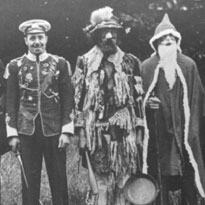 Christmas Champions Christmas Champions commissioned specially for Late Junction Credits: Voice of Herbie Smith recorded by Simon Evans Singer/violinist: Chris Wood Narrator/author: Hugh Lupton In a special commission for Late Junction, Chris Wood and Hugh Lupton delve into the mystery of the season with a sideways look at the Mummers' play - presenting a celebration, in words and music, of one of England's strangest and most resilient midwinter traditions. Mummers' Plays, folk dramas originally performed silently and revolving around the legend of St. George, have been performed in England, Scotland, Wales and Ireland for hundreds of years. Using a combination of field recording, music, narrative, poetry and song, Chris and Hugh's piece explores this mystic tradition, incorporating the memories of Herbie Smith, who performed in the mummers play 'The Seven Champions' as a boy in Kent during the 1930s. His voice acts as a melodic frame, around which verbal and musical improvisations are woven. The piece begins with Herbie remembering the various characters of the play: "Grandfather Christmas, he's dead now, died in Orpington hospital...." , which serves as a prelude to one of the recurring counterpoints of the piece: the endurance of tradition and the mortality of those that carry it and the linear nature of a human life set against the circular nature of seasonal change and the traditions and rituals that celebrate it. Each Mummers' play was different, with different scripts and characters. What remains central to all the plays is the death and resurrection theme. So a doctor always appears, Saint George is usually present, as is his nemesis, the Turkish Knight or the dragon. A Johnny Jack character is simply there to collect the money and in the Lancashire 'Pace Egging' play (performed at Easter) the character who collects the money is called 'Old Tosspot', because he carries a box into which you toss your money. Herbie's account is full of humour and wry tales of the hardships of the 1930s, which never slips into sentimentality, and doesn't let us forget that the Mumming was as much driven by poverty and the need to collect money, as by adherence to tradition. At the heart of the piece is the central (most humorous and most archaic) moment of the play: the bringing back to life of the slain hero by the quack doctor. It can also be seen to represent the death and resurrection of the light during this bleak midwinter season. In the context of Chris and Hugh's piece it serves as a metaphor for the way that the forgotten dead who have acted out the drama in the past are somehow revived when the characters of the play are inhabited again. England 's folk music is at its richest over the twelve days of Christmas, 'composed' almost exclusively by unschooled, anonymous musicians and nearly always sung. Christmas Champions is about the way that tradition offers us, with our four score years and ten, the opportunity to enter a deeper place where we take on the mantle not only of the characters in the play but of those who have inhabited those parts before us. 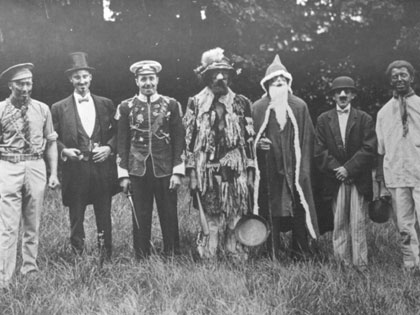 Participants in a Mummers play in the 1930s, featuring the characters: Scots & Scars, The Doctor, Saint George, Bold Slasher, Grandfather Christmas, Johnny Jack and The Turkish Knight | | Related Links on radio 3 on bbc.co.uk on the web The BBC is not responsible for the content of external websites. |
| | |
 Listen to Christmas Champions
BBC iD
BBC iDBBC navigation
BBC links

BBC © 2014The BBC is not responsible for the content of external sites. Read more.
This page is best viewed in an up-to-date web browser with style sheets (CSS) enabled. While you will be able to view the content of this page in your current browser, you will not be able to get the full visual experience. Please consider upgrading your browser software or enabling style sheets (CSS) if you are able to do so.
