| | | | | | | | | | | | | | | | | Feature: Europe | |
Roots Music in Russia
by Alexander Kan
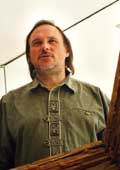 Sergey Starostin's nomination for the Radio 3 World Music Awards might finally put Russia in the spotlight of the world music community's attention. With a few exceptions - mostly from ubiquitous Tuva - the enormously rich and diverse ethnic heritage of the huge post-Soviet continent has largely remained terra incognita. Sergey Starostin's nomination for the Radio 3 World Music Awards might finally put Russia in the spotlight of the world music community's attention. With a few exceptions - mostly from ubiquitous Tuva - the enormously rich and diverse ethnic heritage of the huge post-Soviet continent has largely remained terra incognita.
Ironically, world music, the way it is understood now, had been blossoming in the USSR long before the term was invented. Party ideologists thought of 'folk' music as 'the working masses' genuine spirit' and forcibly imposed it upon 'decadent' jazz and pop. A compromising folk-rock of the time was not any closer to genuine ethnic music than the pseudo-folk of pompous official orchestras and choirs.
Dmitry Pokrovsky, musician and ethnomusicologist, was a pioneer in reviving genuine Russian ethnic music in the 1970s. At that time his Ensemble's performances, based on proper ethnic tradition, were as explosive and diversive as any radical jazz or rock. His experiments with Paul Winter's ecological jazz, Arkhangelsk Jazz Group and the renown Ganelin Trio paved the way towards the future more creative symbiosis of ethnic Russian song with various rhythmic idioms.
Unlike in African, Latin, Oriental or even Celtic cultures, Russian traditional song - often melancholic and broody - is not based on a strong rhythmic foundation. Its pensive mood must have been one of the reasons why the Russian version of world music has so far remained out of the focus of the mostly dance-oriented and hedonistic global trend.
Another reason is political. After the euphoric fascination with all things Soviet - red star, hammer and sickle, Gorbachev, perestroika and glasnost - the pendulum moved to another extreme. Russia, seen throughout the 1990s as a country of poverty, crime, the Chechen war, prostitution, and ever drunken Yeltsin, was not a likely supplier of cultural imports.
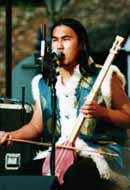 The most successful Russian world music acts - Huun Huur Tu and Yat-Kha (last year's winner in the Asia category) - come from Tuva, a small region in Eastern Siberia with its incredible throat singing tradition. Although technically from Russia Tuva tends to be represented as a nation of its own. The most successful Russian world music acts - Huun Huur Tu and Yat-Kha (last year's winner in the Asia category) - come from Tuva, a small region in Eastern Siberia with its incredible throat singing tradition. Although technically from Russia Tuva tends to be represented as a nation of its own.
Even after the collapse of the Soviet empire, Russia remains a multi-ethnic country and nowhere is this melting-pot diversity more evident than in the new ethnic-based music. One of the most striking examples is the work of pianist and composer Misha Alperin. Brought up on the boisterous sounds of Jewish, Moldavian and Gypsy weddings of the South, after a few years in Moscow he settled in Norway. His most ambitious project involves his Moscow Art Trio (with this year's nominee Sergey Starostin), Huun Huur Tu and Bulgarian female choir Angelite.
Starostin has grown into a major force on the Russian scene. As singer and instrumentalist he is responsible for the ethnic component in the music of Farlanders, a rare example of a group where authentic Russian songs are organically blended with an upbeat funky rhythm.
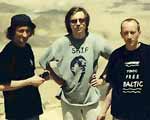 He also sings and plays with Volkovtrio and VeDaKi or Vershki Da Koreshki (Roots and Sprouts) an international formation where 'sprouts' (conservatory trained bass player Vladimir Volkov and pianist Alexei Levin) join forces with 'roots' (musicians from Tuva, Mali, India) with effect of trans-ambient world sound. He also sings and plays with Volkovtrio and VeDaKi or Vershki Da Koreshki (Roots and Sprouts) an international formation where 'sprouts' (conservatory trained bass player Vladimir Volkov and pianist Alexei Levin) join forces with 'roots' (musicians from Tuva, Mali, India) with effect of trans-ambient world sound.
Similarly trans-ambient but even more rocky is Ole Lukkoye's 'imaginary folklore' with singer Svakha's floating voice. The most recent addition to the scene is NeTe - a powerful mix of 'skomorokh' absurdist song tradition and harsh sounds of free jazz.
Hopefully for world music fans, Sergei Starostin will be just an introduction to this vibrant new Russian scene.
Alexander Kan is producer/presenter of Open Music - a programme about world, new and experimental music programme at the BBC Russian Service. He is a contributor to a number of Russian and British music magazines, and artistic consultant for SKIF (a new music festival in St.Petersburg). Before coming to work for the BBC in 1996, he was art director of the Open Music festival in St.Petersburg.
More Russian music on Radio 3:
Yat-Kha win the Asia/Pacific category in the 2002 R3 Awards
Why awards? read on
| |
| | 
AWARDS HOMEPAGE
FEATURES
AUDIENCE AWARD
SCREENSAVER
AWARDS PHOTOS
NOMINEES:
Alka Yagnik
Bembeya Jazz
DuOuD
Eliza Carthy
Ellika and Solo
Gotan Project
Kasse Mady Diabaté
Kayhan Kalhor
Kimmo Pohjonen
Lila Downs
Los de Abajo
Mahwash and Ensemble Kaboul
Mariza
Oi Va Voi
Ojos de Brujo
Omar Faruk Tekbilek
Orchestra Baobab
Papa Noel and Papi Oviedo
Salif Keita
Samira Said
Sergey Starostin
Susana Baca
Te Vaka
Tony Allen
Trilok Gurtu
Yair Dalal
Youssou N'Dour
Yusa
OUR PARTNERS:
fRoots magazine
The Rough Guide to World Music
Serious International Music Producers
Songlines Magazine
WOMEX
BBC Asian Network
BBC World Service
BBC London Live
OTHER LINKS:
Worldbeat at Radio Wales
Mondomix
Ocean Music Venue
| | |
|