In this programme
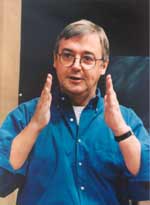 Ulysses Comes Home
Director Graham Vick's versions of works by Berg, Beethoven and Bernstein have made opera speak with a new voice and to new audiences. So, it is no surprise that his latest offering, a production of Monteverdi's opera, Ulysses Comes Home, continues to challenge preconceptions of both performance method and space. Birmingham Opera Company productions involve hundreds of people from the local community performing alongside professional singers and musicians. For this production, the performance will take place in a disused ice-rink in the centre of Birmingham. However, while the conventions of opera production are challenged, no compromise is made on the quality of the performance as the values and standards of the company remain rigorously high. Graham Vick, along with professional and amateur members of the opera company, explains the ethos of the collaboration.
Birmingham Opera Company's production of Monteverdi's Ulysses Comes Home directed by Graham Vick opens at Planet Ice in Birmingham on April 29th
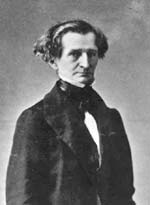 Berlioz: A Musical Madhouse
For more than thirty years, composer Hector Berlioz wrote music criticism for newspapers and journals in Paris. His criticism was funny, scurrilous and outspoken and his collection of essays, The Musical Madhouse, is a fine example of Berlioz at his most irreverent. Composers, impresarios and audiences are treated to the same caustic wit, but the writing also creates a vivid picture of 19th century musical life. Tom talks to the translator of this collection, Alastair Bruce, and to French music specialist, Richard Langham Smith, about Berlioz's double life as composer and critic, and asks why these writings have not been translated into English before now.
The Musical Madhouse (Les Grotesques de la musique), Written by Hector Berlioz and Translated and edited by Alastair Bruce is published in paperback by the University of Rochester Press at £17.99. ISBN 1580461824
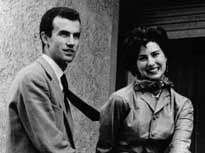 Nuria Schoenberg Nono
Nuria Schoenberg Nono has a unique connection with the history of 20th century music. Daughter of the composer, Arnold Schoenberg, and wife of the late avant-garde Italian composer, Luigi Nono, she has dedicated her life to these men and their music. She first met Luigi Nono at the world premiere of Schoenberg's unfinished opera, Moses und Aron, in Hamburg in 1954. Initially, Nono's music attempted to communicate his radical left-wing politics with a view to changing society, but in his later years, his compositions became more intimate and private. Nuria tells Tom about her astonishing life, and her relationship with her husband.
You can hear a concert of Nono's music with the London Sinfonietta and Oliver Knussen on Performance on 3 on 28th April here on BBC Radio 3
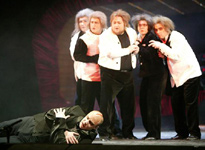 Rosenthal's Children
Opera retains its power to shock at the Bolshoi Theatre in Moscow in a new production from librettist Vladimir Sorokin and composer Leonid Desyatnikov: The Children of Rosenthal. But, is this really down to the content of the opera, or more to do with political censorship of culture in Putin's Russia? It's a story of a scientist who clones five great composers, from Mozart to Tchaikovsky, but politicians are in uproar because of its alleged pornographic content. BBC Correspondent Dasha Pushkova reports from Moscow on whether this scandal is simply a story of moral protest about a new work


