

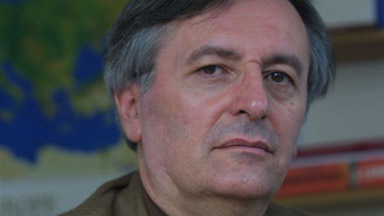
16: Daniel in the Lion's Den: John Gray Being Green can be Dangerous
Description
Do humans really have the capacity to control the environment? Philosopher John Gray, author of the bestselling Straw Dogs and one of Britain's most audacious and original thinkers, argues that to think that we can 'save the planet' is absurd or even dangerous.
We need to look to technological fixes - including some that "Greens" fear and reject.
View this event in the schedule
Audio and video
Broadcast in Night Waves 5 Nov 2008 21:15 Radio 3.
Audio available in iPlayer for 7 days after broadcast.
Audio on this page is available in perpetuity.
The video for this event will be available in perpetuity from late next week.
Recommended BBC programmes and websites
Night Waves - Radio 3's flagship arts and ideas programmme.
Arts and Ideas messageboard - join in or start a discussion around this topic.
On the web
Bloggers talking about climate change - results page from technorati.com.
Robert, Glasgow
It's shocking how unrealistic the audience were. Most of them seemed outraged by the fact someone was stating that the world can't collectively stop this from happening. We in the west have grown up with the belief that we can save the world, create world peace, etc. This is a real puncture to our self-image. Global warming isn't a Hollywood movie with easy or nice answers- hopefully with time we'll become more hard headed and finally leave this saviour/fantasy complex behind.
jason palmer,london
Let us face facts, humanity is doomed, we made a mess of the planet and no way to fix that exists. GAME OVER
John Moy, Essex
During his contribution 'Being green is dangerous', John Gray came so close to stating the problem in useful terms, that it is all the more amazing that he managed to sail straight past those opportunities without even noticing them.Firstly, he glossed over 'renewables' as something that he cannot imagine holding a solution, and he is absolutely correct. This is, indeed, a failure of imagination. The sun pours down energy onto this planet in copious quantities, has done so for the past four-and-a-half billion years, and will continue to do so for a similar period into the future. At present, almost all of this energy is allowed to bounce off into space, utterly wasted, a fact which leads him to dismiss the sun as no solution to the problem.Secondly, he mentions the ambition among the emerging powers for industrialisation, as well as the vested interested in oil and coal, as stumbling blocks. Right again. But than he goes on to deny that politics can contribute to the solution. This is done, apparently, on the grounds that the politicians we have at the moment think in very parochial and short-term ways. They do, of course, and that is because politicians are followers, not leaders, though this hasn't prevented plans for a Europe-wide DC grid powered by the sunlight which falls onto a small area of the Sahara desert. This is exactly the sort of initiative which can put us on the right road, and John Gray, once again, dismisses it as meaningless.If only he could shrug off the impoverished patterns of thought on this subject which seem to have gripped the entire world, and open his mind to the real possibilities, he could stop accusing us all of failing to appreciated the scale of the problem, and himself begin to appreciate the scale of the solutions which are both necessary and available, if only we get the politics right. If we can do that, the economics will follow.My advice to him would be firstly to visit the Sahara desert to see what he is dismissing, then to visit China to see what pollution is doing to the people there, then to have a look at forecasts of the long-term costs of the oil and coal, which will be desperately needed as raw materials for industry, and which are in truth not merely far too polluting to burn, but too valuable also.
jason palmer,london
In theory we could all join VHEMT and cease to breed but I think pretending the issue will go away is more in our nature, he made some good points and I thought some of the people in the audience rather rude.
jason palmer, london
I agree that nuclear power could be part of the solution, we do not know what will actually work so we have to try everything. Though I actually think it is against human nature to stop technological progress or reduce breeding so we shall just keep going towards ecological problems that will naturally reduce our number to a level the planet can sustain.
Donncha Deasy
Grey indeed - an old thatcherite trying to change its spots; how predictable, how pathetic. Nuclear power is not a risk due to 'human error', it systematically degrades the wider environment - the 'low-level' emissions in cooling water are concentrated up the food chain until the genetically mutated result is the catch which fisheries from the Irish Sea have for decades been forced to destroy. The 'Lovelock Fallacy' that nuclear power is acceptable will result in a planet poisoned by plutonium, a legacy that the dominant species emerging from the next climate adjustment (yes, that is inevitable) will curse us for.


Your thoughts