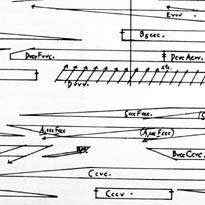
Williams Mix, Cage's first composition for tape recorder, a work for eight tracks of 1/4-inch magnetic tape, already goes to the limits of the medium. Commenting on his score, Cage explains: "This is a score (192 pages) for making music on magnetic tape. Each page has two systems comprising eight lines each. These eight lines are eight tracks of tape and they are pictured full-size so that the score constitutes a pattern for the cutting of tape and its splicing. All recorded sounds are placed in six categories ... Approximately 600 recordings are necessary to make a version of this piece. The composing means were chance operations derived from the I-Ching." The categories that Cage refers to are as follows: A (city sounds), B (country sounds), C (electronic sounds), D (manually produced sounds), E (wind produced sounds) and F ("small" sounds, which need to be amplified). The score for the realisation of the work also contains indications for pitch, timbre, dynamics and a rhythmic structure.
Though it is possible to create infinite versions of the piece using Cage's instructions the only realisation of this score to date was carried out by Cage himself between 1952 and 1953. In spite of the assistance of Earl Brown, David Tudor, Ben Johnston and Louis and Bebe Barron with editing and splicing the recorded tapes, completing this four-minute long sound montage took approximately a year. The premiere performance was staged with 4 stereo tape recorders and 8 speakers.




 Listen Live
 help
help