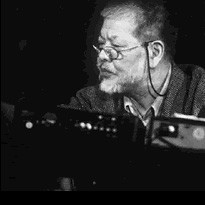
Japanese artist, writer, theorist and composer Yasunao Tone (pronounced Toe-ney), born in 1935, is part of a whole generation of post-war iconoclasts who followed in the wake of John Cage's discovery of indeterminacy, determined to shake music and art out of their enslavement to the high art, romanticist ideals of the 19th century. Since the early 1960s he has moved like a shadow through the Tokyo, New York and European avant-gardes, leaving few tangible traces, but equally at home with the Fluxus crowd, Downtown improvisers and European electronica experimentalists. His creative work in the areas of improvisation (he was a member of Japan's first free improvisation unit, Group Ongaku), automatism, inter-media and paramedia art, event music, and the deliberate disruption of technology tends to burn with a slow fuse - by the time its relevance and importance becomes apparent, Tone has invariably moved on to something else.
While his career in the avant-garde may span over forty years, in his work Tone has consistently returned to a limited and methodologically narrow range of concerns. Absolutely central, though, is the relationship between text and meaning, and in particular the nature of processes that can transform texts into sound. Perhaps this interest in pure process was natural, given the fact that when Tone joined Group Ongaku he had no prior musical experience and had just completed his university thesis on surrealist literature. Number, one of his earliest composed pieces from 1961, indicates that he was fascinated by the potential of textural transformation right from the start. The piece was constructed around tape recording of numbers being enunciated. This tape was then played back at maximum volume with the playback itself being recorded at a minimum input level. This was repeated several times, distortion increasingly layered on distortion until the original number recitation was obscured under the accumulation of audio detritus. The piece is a neat illustration of the importance of process to Tone's work - it is process (preferably with an element of unpredictability) itself that creates the texture of the work, simultaneously obliterating and rewriting the original text's signifiers.
Tone revisited the possibilities of this kind of textural process in 1976 (not entirely coincidentally the same year that Derrida's Of Grammatology was first published in English), creating Voice and Phenomenon , an important piece which both expanded into the area of visual music and created a bridge to his current work. In Voice and Phenomenon a tape of Chinese T'ang dynasty poetry was synchronised to a slideshow of found photographic images. The images were based upon the constituent parts of the Chinese ideograms that made up the original poetic text. Each ideogram contains several elements, so for each vocalised element there were several images. While the slides were projected on to a screen, Tone used a closed circuit video to add an overlay of calligraphy, inscribing the text in real-time. Here a process of logographic decoding was combined with a multi-sensory, inter-media approach to the text. The following year Tone rearranged the piece to add a closer but simultaneously less predicable element to its processes. The new Voice and Phenomena did away with the temporally controlling element of the pre-recorded tape, instead adding an oscillator connected to a light sensor. This arrangement allowed the projected images themselves to 'play' the oscillator without any human input, the play of light and shadow altering pitch and thus creating unique sounds for each image.
In the eighties drawing upon the work of Gerard Genette in his Paratext: Thresholds of Interpretation, Tone began to refer to this kind of work as "paramedia". The term is a complex amalgamation of meanings, speaking on one level to the ways in which a medium can be diverted away from its original purpose by its users. An additional level highlights the transformative processes by which ideas were chewed up as they are translated from one media to another (for example, from image to sound), their original signification radically altered. The dynamic concept of paramedia raises a fascinating question about the relationship between sound and meaning, namely should sound be a simple vehicle for the transmission of meaning, or should it rather create autonomous zones that allow listeners to facilitate their own meanings? Tone has also spoken of paramedia in terms of a parasite, hitching a ride on a linguistic host and nibbling away at its meaning until the parasite alone remains.
These kinds of questions have been brought to their fullest flowering in an ongoing CD-ROM project based upon the 4516 poems of the 8th century Man'yôshû , Japan's oldest collection of poetry. Tone has been working on this project since 1996, and seems to have been drawn to the Man'yôshû in particular by its archaic, complex and unstable orthography. The Man'yôshû uses Chinese characters to represent the very different semantic and phonetic qualities of Japanese, but it also incorporates sophisticated, magico-linguistic games. As an indication of the complexity of this orthography, 8th century Japanese contains just eighty distinct sounds but in the Man'yôshû these sounds are represented by 1500 different characters. This complexity proved tailor-made for Tone's paramedia techniques - by digitizing each of the poems and using music software to convert the pixellized data into a waveform, he has created a vast sound library of distinctly different instant compositions, stuttering and intense bursts of sound that obliterate the original texts' meanings in an ice-storm of jaggedly splintered digital noise. In recent performances, Tone has further transformed his texts by recording them on to CDRs and then 'wounding' the disks with scratches, holes, pinholed pieces of scotch tape and so on. This abuse of the physical matter of Tone's texts is designed to introduce further elements of unpredictability into the equation - as the CD player struggles to read the data, its error-correcting software extrapolates and compensates, adding new layers of complexity to the original poetic texts.
Tone's ongoing concerns with the parasitic alteration of language whisper subtly in the ear of our post-modern culture with its permeable borders, media overload and growing exile communities. He shows us ways to disturb the restrictive injunctions that govern our use of technology, to alter the dictates of official texts to carve out our own meanings.
Alan Cummings has written widely on contemporary Japanese music for magazines in the UK (including regular contributions in The Wire), US, Europe and Japan. He also teaches classical Japanese literature at the School of Oriental and African Studies in London.




 Listen Live
 help
help