BBC HomeExplore the BBC
This page has been archived and is no longer updated. Find out more about page archiving.


Accessibility help
Text only
BBC Homepage
BBC Music
BBC Radio 3

Radio 3

Contact Us

Like this page?
Send it to a friend!

Dots and Lines - Online Exhibition - Springtails
springtails
boredomresearch
Vicky Isley & Paul Smith have been collaborating as boredomresearch for four years. boredomresearch are interested in building computational works, inspired by simple rules found in natural systems. Recent projects have used the complexity of decentralised systems and simple algorithms like those used in cellular automata to create observable digital entities. They aim to create engaging digital works, developing themes and crossing boundaries between science, art and technology.
boredomresearch have produced a number of interactive sound applications, online projects and computational soundscapes which have been shown both nationally and internationally at events such as, Transmediale.05, international media arts festival in Berlin; FILE04 International digital festival in Brazil; Electrohype festival in Sweden, Garage festival in Germany, Data:base Media Event in Dublin and within online exhibitions such as soundtoys.net, e-2.org and mobilegaze.com. 
Springtails

SpringtailsDevelopment Date: 2002
Tips: Trigger the small springtails on the landing pads & base of work by prodding them with your cursor.

Open the Artwork

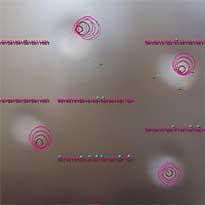
Springtails is a colony of 'electronic insects' that react when touched by a user's cursor. As they catapult around their environment, the insects strike chimes, and in effect, compose an incidental sound piece.

These insects are arranged in a visual environment comprised of a series of horizontal levels, which curiously resemble the 'lines' of a conventional score. The "Springtails' themselves are scarcely more substantial than 'dots', thus creating a compelling visual metaphor with a traditional music score. Springtails , however, is far from a traditional music system. It employs a method of computation, which scientists refer to as 'artificial life'. In artificial life programmes scientists use computers to model naturally occurring phenomena. bordedomresearch were inspired to use artificial life techniques to create Springtails after observing real insects. After watering a potplant, the two artists became transfixed by the behaviour of tiny creatures called springtails, which infested the pot. They observed chance collisions between members of the colony, which triggered surges of motion. Gently touching one insect would cause it to 'ping' to another location. Occasionally this would be a location already occupied by another springtail, on which event they would both 'ping'. Bordedomresearch have recreated this naturally occurring process within the digital space of the computer.

As well as being a fascinating and compelling environment to interact with, Springtails is also raises the issue of agency within the musical composition process. It is the insects which generate sounds by their movement. Users can cause the insects to move, but can not completely control their behaviour. So in this case, are the insects themselves the 'musicians'? Is the role of the user a 'conductor' perhaps, prompting the entomological musicians to 'play' by moving? In this case, the insect's visual environment could indeed be said to be the score.

Cut and Splice
Related Links
on radio 3
on bbc.co.uk
on the web
The BBC is not responsible for the content of external websites.


About the BBC | Help | Terms of Use | Privacy & Cookies Policy