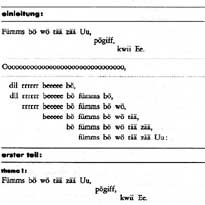
On hearing Hausmann's sound poem "fmsbw" in 1921, Schwitters immediately recognized the great potential of Sound Poetry and with great logic and concentration, he built up a totally abstract piece, "Sonata in Urläten." Hausmann had, in 1918 developed his 'optophonetics' that used typographic variations in size to indicate proportionate variations in pitch and volume. Optophonetics is an open code, of low denotation that nevertheless permits a wide range of imaginative interpretation. Over the years, the Schhwitters Sonata grew in both size and variations, and realizing that some phonetic notation for the Sonata was essential if it was not to die with him, he finally published his notations as the last number of his Merz magazine in 1932.
Comments on my Ursonate by Kurt Schwitters
The sonata consists of four movements, an introduction, an end, and a cadence in the fourth movement. The first movement is a rondo with four motifs, which are especially indicated in this text of the sonata. It is rhythm, strong and weak, loud and silent, dense and spacious, etc. I do not want to explain the delicate variations and compositions of the themes ...
Signs in my UrsonateThe letters applied are to be pronounced as in German. A single vocal sound is short ...
Letters, of course, give only a rather incomplete score of the spoken sonata. As with any printed music, many interpretations are possible. As with any other reading, correct reading requires the use of imagination. The reader himself has to work seriously to become a genuine reader. Thus, it is work rather than questions or mindless criticism that will improve the reader's receptive capacities. The right of criticism is reserved to those who have achieved a full understanding. Listening to the sonata is better than reading it. This is why I like to perform my sonata in public. But since it is not possible to give performances everywhere, I intend to make a gramophone recording of the sonata...
Kurt Schwitters is generally acknowledged as the twentieth century's greatest master of collage. Just as collage is essentially the medium of irony, so Schwitters' life is characterized by paradox and enigma. Schwitters' revolution came late - he was 32 at the time of the first Merz exhibition - but Merz changed his life radically. He suddenly found himself at the forefront of contemporary art and quickly allied himself with the avant-garde, including various European Dada groups, the Bauhaus (Schlemmer, Klee, Kandinsky, Feininger, Gropius) and the new generation of Contructivists from Eastern Europe and the Netherlands (Lissitsky, Moholy-Nagy, Theo van Doesburg). By now his fantasy knew no bounds and over the next decade he undertook radical experiments in such fields as abstract drama and poetry, cabaret, typography, multimedia art, body painting, music, photography and architecture. He published a Merz magazine that appeared irregularly from 1923-32 and founded what was to become a successful advertising agency in 1924.
For thirteen years (1923-36) he worked on an extraordinary construction that came to be known as the Merzbau; it was what we would now call an Environment and eventually spread to eight rooms of his house in Hannover. Its original name was the 'Cathedral of Erotic Misery' and its contents were as shocking as anything produced by radical young artists today.
With the rise of National Socialism in Germany after 1929, Schwitters found himself in serious difficulties. As the artistic community emigrated or went into hiding, so Schwitters was robbed of much of the impetus that was crucial to his art. The death of his father and of Theo van Doesburg in 1931 mark the start of a new phase of his work, as Schwitters himself makes clear in 'New Merz Picture ', with its contemplative mood and coarse dabs of colour. The sombre restraint of Pino Antoni is likewise in sharp contrast to the works of the exuberant early Merz period.
Schwitters kept a low profile during the Third Reich and emigrated to Norway in January 1937, for reasons that have never been satisfactorily explained. But the Gestapo were certainly on his trail, and in summer 1937 his pictures were displayed at the infamous 'Entartete Kunst' exhibition in Munich. Clearly his return to Germany was blocked forever.
Depressed at abandoning the Hannover Merzbau to an uncertain fate, Schwitters completed a similar construction in Oslo, but in 1940 Nazi troops invaded Norway and he was forced to flee for his life. He finally landed in England, where he was interned until November 1941. Yet the Merz pictures of this turbulent period give little indication of the fact that Schwitters suffered from poor health and time and again found himself in life-threatening situations. Merzbild Alf is often cited as an example of his brief interest in Surrealism: it is difficult to imagine that Spring Door , the superb Glass Flower and Merzbild with Rainbow , with their sparks of light and swinging rhythms, were created at a time of increasing isolation and despair for the artist.
After release from internment, Schwitters lived until 1945 in bombed-out London, where the unfamiliar surroundings gave him fresh inspiration for Merz pictures. He made light of his heap of problems in Difficult , echoed the dismal fabric of wartime Britain and the blows of fate in the ironically-named Heavy Relief , reworked the great masters in inimitable tongue-in-cheek Merz fashion in Die heilige Nacht and recalled the dark days of the Nazi regime in the sinister black shapes and blood-red background of Hitler Gang (named after a film). He was fascinated by the comics sent in letters from compatriots in the USA and used them in his famous For Kate , a collage now regarded as a forerunner of Pop Art.
In 1945 he moved with his young companion, Edith Thomas, to Ambleside in the English Lake District, where, financed by the Museum of Modern Art in New York, he started on a new Merzbau that came to be known as the Merz barn. At his death he had completed only one wall, now to be found in Newcastle University. Sadly, no other of Schwitters extraordinary Merzbau constructions have survived. He died at the age of sixty, poverty-stricken and neglected, but in the knowledge that his work would one day be recognized as that of a genius. As he saw, the language of Merz now finds common acceptance and today there is scarcely an artist working with materials other than paint who does not refer to Schwitters in some way. In his bold and wide-ranging experiments he can be seen as the grandfather of Pop Art, Happenings, Concept Art, Fluxus, multimedia art and post-modernism.
"Through all the tribulations of his life, Schwitters stood his ground with his undogmatic, non-élitist and democratic creation of Merz, which conjured up its own magic from the rejected and the discarded: small wonder that the Nazis found Schwitters' art subversive and tried to eradicate it. And in our own age of increasing extremism, his message is as valid as it ever was".
Gwendolen Freundel
Courtesy of the Kurt und Ernst Schwitters Stiftung,Hannover
The foundation of the Kurt und Ernst Schwitters Stiftung is mainly due to the Schwitters family with the support of the NORD/LB Norddeutsche Landesbank, the Savings Bank Foundation of Lower Saxony, the Neider-sachsische Lottostiftung, the Cultural Foundation of the Federal States, the State Minister at the Federal Chancellery for Media and Cultural Affairs, the Ministry for Science and Culture of the Land of Lower Saxony and the City of Hanover.




 Listen Live
 help
help