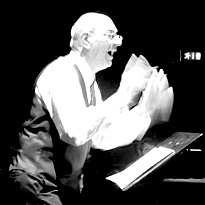
Borges, that most exciting of modern Spanish writers, showed us fantastic beasts, libraries with endless staircases leading up and down to infinity, and a man writing every word of Don Quixote as though it is a new book. At least one of his students learned from him that the unexpected can tell us who we are, that paradoxes are productive, and that humor can be a very serious vocation: the brilliant, sarcastic, charming, arrogant, multitalented, and extremely tall Mauricio Kagel.
Most of Kagel's early works, written when he was a restless young polymath in Buenos Aires, tend to experiment with the notation and production of music, with film and time, and with increasingly unexpected transposition of elements from one medium into another. His first famous works from the years after he arrived in Germany, the Sexteto de cuerdas , Anagrama and Transición II, involve a structured quasi-serial technique that is subverted by uncontrollable elements and exaggerated demands for precision, implying a sharp but subtle critique of formal control and structured systems.
Many of these works initially look 'normal' on the page (if, for you, normal musical scores include those by Boulez and Stockhausen), but a closer look reveals complex surprises. Among my favorites are those passages in Transición II where the players must spin little dials they have cut out and attached to their scores to figure out their next pitches. This all seems fairly precise, but as of course they are dragging dots across lines of score at constantly changing angles that have little or nothing to do with actual pitch, they end up creating a very detailed, very difficult serial score out of operations that are actually playfully chaotic. Kagel later wrote articles on this technique, calling it 'rotation' and treating it half-seriously as an innovative serial technique - but the constant ironies of his writing suggest that he was aware from the first of the slightly parodic aspect of this idea which, like so many of others in his work, both illuminates and ridicules whole worlds of endeavor.
As Kagel settled into his rather lengthy stride in the 1960s, he began producing an extraordinary variety of meticulously constructed works in every possible genre, and in some that seemed impossible at the time. Although surface techniques in each work vary enormously - even more so because the technique of each work tends to be a concerted attack on any possible expectations the performers or audience might have - there are underlying concepts and values that are remarkably consistent over the decades. Since Kagel has always dedicated himself to the possibilities of anarchism and liberation, so most of his works focus on opening up the new and the radical; they generally do this by creating some system of subversive gestures of paradox, disjunction, and irony. The sound materials often involve unusual or exotic instruments, or regular instruments employed in unusual ways; major examples include Exotica , which uses a variety of non-Western instruments played by Westerners in tribal makeup, or Music for Renaissance Instruments, which suggests the liberated nightmares of an early music ensemble.
The sprawling landscape of Acustica for experimental sound objects and loudspeakers was assembled between 1968 and 1970, while real political change seemed imminent and while Kagel was writing his first and most radical anti-opera Staatstheater . Acustica has many pages, as does Staatstheater, each of which is a separate, flexible module of musical and theatrical activity. These works aren't really scores in the traditional sense as much as they are catalogues of possibilities - instruments are given new sounds by being altered (a ukelele gets a paper clip across the strings); instruments like whistles and castanets, traditionally 'below the salt', are given solo roles; and objects that one would hardly expect to see jostling for space on a concert stage are given entirely new roles - a walkie-talkie reorients antennae like a dowsing rod, and a damaged bellows wheezes percussively.
As with many of Kagel's works, this is not only a catalogue of experiments, but also a deconstruction of an entire field of activity. Such 'instrumental theatre' (Kagel's own term, for which he has become famous) shows us what we don't know about music, by using methods typical of deconstruction - taking the margins to the center and the center to the margins, inverting basic concepts and hierarchies, and essentially forcing an entire system of ideas to implode, thus showing its limitations and what we are missing when we follow it too dogmatically. Staatstheater does the same things in different ways - the opera soloists are forced to sing an ensemble, the chorus has a "debut" of sixty simultaneous solos, the ballet is for non-dancers, and the entire forces of the traditional opera house do calisthenics over enormously amplified chords at the end. After such a performance, it would be impossible for the denizens of the opera house to take their positions for granted - the prima donna looks over her shoulder at her understudy, the janitor looks askance at the conductor, and the oppression implicit in tradition begins to show cracks in its façade.
In the same way, performers who participate in Acustica may find the keys of their normal instruments feeling slightly odd or restrictive; the ways they define themselves, as performers or composers or technicians, might start to loosen from their moorings. Later that same week, they may find themselves thinking differently about the busker they pass in the tube station, or they may try something new while playing a Beethoven sonata; they may even wonder if they should be talking about their music, or possibly drawing it instead. And the audience might start to wonder why they're sitting night after night in darkened rooms, watching other people make music happen: why don't I get to do that? What else could I be doing with music, or even about music? And of course, ultimately, as you sit there reading about all this, perhaps you cannot help wondering: what else might I be missing?




 Listen Live
 help
help