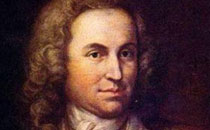
Johann Sebastian Bach (1685-1750)
St Matthew Passion, BWV244 (1727)
Download the text and translation as a .pdf file
In 1879 the English composer Ethel Smyth attended a performance of the St Matthew Passion, given in Bach's own church, St Thomas's, Leipzig. She later recalled the impression it made on her: 'I despair of giving an idea of the devoutness of the audience ... It was not only that the church seemed flooded with the living presence of Bach, but you felt as if the Passion itself, in that heart-rending, consoling portrayal, was being lived through as at no other moment of their lives by every soul in the vast congregation.
Smyth's reaction is one we can recognise without much difficulty today. The St Matthew Passion is still performed more often than not during Holy Week, and such occasions continue to be invested with something of the sombre reverence of a religious celebration. Despite the fact that it rarely any longer forms part of an actual service, the work is for many a vital and meaningful component of the Easter experience. Indeed, one might go so far as to suggest that for non-churchgoers nevertheless moved by the story of Christ's sacrifice, attending a performance of the St Matthew Passion can actually be a sort of substitute for going to church.
This continuing impact is in spite of the fact that Bach's great masterpiece is more widely known today than ever before. In the composer's own time it would not have been known outside Leipzig , the town in which he lived and worked for the last 27 years of his life, and even there it received no more than a handful of performances under his direction. After his death it lapsed into obscurity, at a time when, if Bach was remembered at all, it was as a famous organist and master fuguist, not as one who could stir the emotions or inspire religious feeling. Only when Mendelssohn rediscovered it and performed it in Berlin in 1829, to general acclaim and wonder, did it begin to enter into wider consciousness. Yet even today, when time and dissemination through recordings have made it familiar to a greater number of people, the St Matthew Passion is a work that can affect its listeners profoundly in live performance, as if it and the story it tells were being heard for the first time. 'It is not given only to believers to be moved by it,' wrote the Bach scholar Malcolm Boyd of the work a few years ago, and while it is true that the same might be said of the emotional tenor of Holy Week itself, there is no denying that there is a monumental and sustained power in this music that is equalled by few other works of man. Boyd goes on: 'Bach's supreme achievement is a work of profound humanity, and the most monumental dramatic masterpiece before Wagner's Ring.' One could add that it is a piece in which audiences may still - as, one senses, did Ethel Smyth - feel themselves in the presence of a musical deity: Bach himself.
When Bach became Leipzig 's Cantor in 1723, the tradition of performing as part of Good Friday Vespers sophisticated Passion settings of the sort represented by the St Matthew was just two years old in the town. Previously, a much older species of purely biblical Passion had persisted there, in which the words of the Evangelist and individuals in the story were delivered in plainchant, and those of the crowd by a chorus singing in simple chordal style. In this matter Leipzig lagged well behind the more cosmopolitan cities of North Germany, where the modern oratorio-type Passion, with instruments accompanying an assortment of recitatives and arias setting lyrical, non-Gospel texts, had been current since the end of the previous century. By 1721, however, progressive members of Leipzig 's Town Council were looking to update the town's church music, and Johann Kuhnau, the ageing and conservative Cantor, had been persuaded to produce a concerted Passion that went some way at least towards the newer, more operatic style. Kuhnau's death the following year gave the Council the opportunity to install a more genuinely forward-looking Cantor, and after Bach's appointment the performance on Good Friday of a large-scale oratorio Passion with instruments became established Leipzig practice. The performances alternated between the town's two main churches, St Thomas's and St Nicholas's, and Bach's first Passion, the St John, was heard in St Nicholas's in April 1724. His second, the St Matthew, probably received its first performance in April 1727 in St Thomas's.
The Council can hardly have anticipated what Bach gave them, however. The St Matthew Passion is a piece conceived on a scale without precedent, longer than any previous work of its kind, and written for larger forces - two choruses, two orchestras, and an extra group of sopranos (or boy trebles) for the opening chorus - than almost any other of its composer's works.
The work's construction, too, is detailed and complex, presenting the story, as it does, in four parallel strands. At its core is the narrative material, the text of the Gospel itself sung in recitative by a tenor representing the Evangelist, with Christ's words sung by a bass, also in recitative but this time accompanied by a portentous 'halo' of string chords; in addition, the smaller roles of certain other characters (Judas and Pilate, for instance) are taken by solo voices, while the utterances and exclamations of the crowd are voiced, succinctly but tellingly, by the chorus. As a foil to this narrative element, there are the reflective episodes provided by the numerous arias (and one duet) in which the action stops, as in Baroque opera, and a relevant emotion or reaction is explored; all of these have texts furnished by Bach's contemporary, Christian Friedrich Henrici (known as Picander). The third strand is the meditative and communal element represented by the chorales; these German hymns would have been extremely familiar to Bach's contemporaries, and while their role as 'entry points' may or may not have been literal in the sense of the congregation actually joining in, they would certainly have provided them with moments of recognition and identification. Finally there are the momentous choruses that frame the work, acting as massive structural pillars and bearing mass witness to the events as they unfold before us.
Perhaps the most striking thing to emerge from all this - not least because it is not something we are used to associating with Bach - is the dramatic force of the work. The old description of the St Matthew Passion as 'the best opera Bach never wrote' may be glib, but there is no denying that the composer here demonstrates a musico-dramatic skill that one could wish he had had more opportunities to apply elsewhere. It runs deeper, furthermore, than such obviously theatrical moments as the rending of the temple veil or the crowd scenes. The sequence from Christ's prayers on the Mount of Olives through to the end of Part 1, for example, is superbly handled. Jesus' announcement to the sleeping disciples that the hour of his betrayal is at hand accelerates the drama and propels it forcefully into the next scene, where a soprano-alto duet ('So ist mein Jesus nun gefangen') seems to watch Christ's arrest in horror-struck slow motion as outraged onlookers shout for his release before exploding into the turbulent chorus 'Sind Blitze, sind Donner in Wolken verschwunden?'. The scene ends powerfully with the Evangelist starkly relating how the disciples forsook Jesus and fled.
It is true that the constraints of the Gospel text elsewhere pose problems of momentum - surely no opera libretto would ever bother with the fleeting contribution of Pilate's wife, for instance - but such oddities must be viewed in the context of Bach's overall dramatic pacing of the work, in which the reflective movements play just as vital a part as the recitatives. Peter's denial is moving enough as it is related by the Evangelist, with his deeply expressive melisma on the word 'weinete' ('wept'); but how much more heart-rending the whole scene becomes when we hear the alto aria that immediately follows. And who could deny the dramatic impact of the soprano's interruption of the trial scene, answering Pilate's enquiry 'What evil hath he done?' with the mock-ingenuous 'He has done good to us all'?
In the end, perhaps the finest and most meaningful achievement of the St Matthew Passion is exactly this way in which Bach blurs the distinction between the work's several layers, between the lyrical and the dramatic. The great opening chorus has, in addition to its architectural role, a dramatic element in the form of a dialogue between the two choirs, with the first urging the faithful to witness Christ's troubles, the second answering with cries of 'Whom?', 'How?', 'Where?'. It thus becomes a huge tableau, in which the early-20th-century Bach scholar C. S. Terry saw 'a band of Roman soldiers; in their midst the Man of Sorrows staggering under the Cross's burden: a sad procession moving forward slowly: Zion and her daughters in the distance awaiting it expectant'. And in what is perhaps the key moment of the entire work, the words of the centurion and those around him - 'Truly this was the son of God' - are magnified by Bach's brief but fervent choral setting into a universal statement of Christian doctrine: from being simply part of the story, it becomes an expression of timeless religious faith.
It is this meeting of worlds - Bach's with that of the New Testament - that lies at the heart of the St Matthew Passion. Its multiple layers of musical and dramatic argument, and the way in which the emphasis shifts constantly between them, helps to support its vast span; but it also lifts the work high above the level of functional church music and turns it into one of the profoundest creations of Western art.
Programme note © Lindsay Kemp/BBC