 | "Serenata"
"Sarah Vaughan"
 | 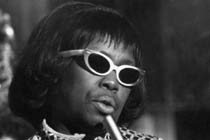 |
Like many of her American jazz counterparts Sarah Vaughan's musical career began in church.
By the time she was 12 years old she was a regular presence at the Mount Zion Baptist Church Choir, as both organist and singing solo, in her home town of Newark, New Jersey. However if it had been left to a certain record executive she would never have had a singing career:
 | |
"Somehow she seemed to find the kind of notes that made delicate nerves jump"
|
Endowed with perfect pitch she could pick up complex arrangements with ease. This stood her in good stead when she started playing in Billy Eckstine's band. It was here that she began jamming with Charlie Parker and Dizzy Gillespie when they were experimenting with a jazz style that would become bebop. Relying heavily on improvisation, bebop also used complex chord structures and regularly changed keys, something that Vaughan had no trouble with. In fact she used her voice like Parker or Gillespie would use their instruments and indeed learnt much about phrasing and intonation from them.
In a 1981 interview with John Dunn she talks about her 'schooling' with the burgeoning bebop scene:
 | |
I'm very proud that I was raised up with Dizzy Gillespie & Charlie Parker" |
 | A remarkable feature of Vaughan's voice is her huge range. She could go from a contralto low D and up to an accurate high C. What was particularly interesting was her use of portamento to get from note to note which she brilliantly displays in the second part of the "Serenata" clip. |  |
Unlike many singers Vaughan’s range actually widened the older she got. Differing on the people you speak to or the point in her career, she could range between 3 and a half octave and 4 octaves. She was as confident in the baritone as she was in the soprano register, although she was probably strongest singing alto parts.
Vaughan was a self-termed "jazz informed singer" and the early work she did with the Billy Eckstine band was her most satisfying. Moving with the times she later began to sing more commercial songs with orchestra backed recordings.
In 1960 she signed with Roulette Records and in May recorded "Serenata" for the label. Recorded in New York with the Joe Reisman Orchestra it made the Top 40 in both American Billboard and the UK charts peaking at #37. A Latin tinged number it was a double A side with the song "Lets" that was recorded during the same session. The music was composed by Leroy Anderson, the arranger for the Boston Pops orchestra who was a key figure in American light music. The lyrics were penned by Mitchell Parish of "Star Dust" fame.
Very recently the tune cropped up on Wayne Shorter's Allegria album as a six minute concerto for sax soprano, woodwind quartet, cello and rhythm section.
| |
"I don't know how many octaves Sarah could sing but it sounded like she sang millions of them" |
Songwriting tips Leroy Anderson's music beautifully underpins Vaughan's voice, but how do you go about writing music? Leroy Anderson's music beautifully underpins Vaughan's voice, but how do you go about writing music?
Find out more about writing music in our Guide
| | Test your knowledgeHave a go at the "Serenata" quiz! |
|
Like this song? Try these...Stardust
Nat "King" Cole
 | | | DON'T MISS | | | |  | | Doves
Special guests on Dermot's show this week
| |
|
|

 Full Schedule



 Newsletter sign-up