
Celebrating Shostakovich
Friday 3/10/25, 7.30pm
Brangwyn Hall, Swansea


Dmitry Shostakovich
Violin Concerto No. 1 in A minor 39’
INTERVAL: 20 minutes
Dmitry Shostakovich
Symphony No. 7 in C major, ‘Leningrad’ 69’
Ryan Bancroft conductor
Clara-Jumi Kang violin


The concert is being recorded by BBC Radio 3 for broadcast in November in In Concert; it will be available for 30 days after broadcast via BBC Sounds, where you can also find podcasts and music mixes.
Introduction
Welcome to tonight’s concert, for which we’re delighted to welcome back our Principal Conductor Ryan Bancroft for a Shostakovich double-bill in this, the 50th-anniversary year of the composer’s death.
Shostakovich’s mastery is everywhere apparent in the two contrasting pieces on the programme. We begin with his First Violin Concerto, written for the legendary Soviet violinist David Oistrakh, who famously begged the composer a moment of respite to ‘wipe the sweat off my brow’. To play it this evening, we’re delighted to welcome back stellar musician Clara-Jumi Kang.
To finish, Shostakovich’s epic ‘Leningrad’ Symphony, a piece written at the height of the Second World War and which the composer claimed was a response to the Nazi invasion of Russia. But as always, Shostakovich’s true subject matter – possibly a protest against the Soviet regime itself – is far more subversive than might initially appear in a work that marries defiance, elegy and pure fury.
Enjoy!
Lisa Tregale
Director
Please respect your fellow audience members and those listening at home: mobile phones may be kept on but on silent and with the brightness turned down; other electronic devices should be switched off during the performance. Photography and recording are not permitted.
Dmitry Shostakovich (1906–75)
Violin Concerto No. 1 in A minor, Op. 77(1947–55)

1 Nocturne: Moderato
2 Scherzo: Allegro
3 Passacaglia: Andante – Cadenza –
4 Burlesque: Allegro con brio – Presto
Clara-Jumi Kang violin
S hostakovich wrote his First Violin Concerto at a turbulent time for musical freedom in the Soviet Union. Although the chaos of the Second World War distracted Soviet authorities from show trials and purges, by the late 1940s the government was again cracking down on artistic expression. In February 1948 the Communist Party Central Committee published a blistering rebuke of leading Soviet composers, Shostakovich among them. Most of Shostakovich’s music was banned from performance, and he lost his positions at the Moscow and Leningrad conservatories. For the next few years he had to support his family by writing patriotic cantatas and scoring politically orthodox films.
And yet, Shostakovich continued to compose in his own way. He was increasingly interested in Baroque music, which can be seen in this concerto’s structure: four movements alternating slow–fast–slow–fast. The opening Nocturne is sombre, with the soloist dominating in sharply dissonant phrases. Bassoons offer contrapuntal echoes, and the woodwind provide complimentary colour, with a brief glimpse of light as the celesta chimes at the movement’s midpoint.
The ensuing Scherzo is a wild dance, with clarinet and strings intoning a 2/4 Klezmer-inspired theme. This movement also introduces for the first time in his output Shostakovich’s musical signature: the notes D–E flat–C–B (spelling D–S–C–H in German notation).
The third movement, marked Andante, is a passacaglia, a type of Baroque theme and variations in which the bass line motif is repeated. Here, the bass is an oppressive figure, as nine increasingly tense variations, featuring the other instruments, demonstrate.
A blistering cadenza breaks through the sombreness. The effect unmoors the violin, suspending it and the listeners in a liminal space. The soloist’s line, increasingly intense, recalls themes from earlier movements, including the D–S–C–H motif and the klezmer theme.
Still loud and frantic, the finale gives the soloist very little time for a break. (Indeed, the great David Oistrakh, for whom the work was written, begged Shostakovich for a rest to ‘wipe the sweat off my brow’). Titled ‘Burlesque’, the finale moves with a relentless beat from the timpani, quoting Stravinsky’s Petrushka in a gesture to the absurd and the untameable.
Programme note © Margaret Frainier
INTERVAL: 20 minutes
Dmitry Shostakovich
Symphony No. 7 in C major, Op. 60, ‘Leningrad’ (1942)
1 Allegretto
2 Moderato (poco allegretto)
3 Adagio
4 Allegro non troppo
Shostakovich’s Seventh Symphony occupies a unique place in the history of symphonic music, as much for the narratives surrounding it as for its musical content. Begun as the Nazi army blockaded Leningrad (St Petersburg) in 1942, the idea that the Soviet Union’s leading composer was writing a symphony about current events had enormous propagandistic value. Close friends as well as the public in general embraced the idea of the Seventh as a direct response to the war, and the fervour with which early audiences responded to the symphony was quickly picked up by other Allied nations.
Shostakovich made a point of explaining the direct connections between the Nazi invasion and the symphony’s first three movements in widely circulated notes. However, the composer privately admitted that the composition was motivated by a much broader agenda. A family friend recalled Shostakovich saying that ‘real music is never tied to a theme’. Considering Shostakovich’s later comments that the Seventh was also about the Soviet system, it is perhaps best to think of this symphony as ‘about terror, slavery, and oppression of the spirit’, rather than a specific historical event.
The first movement is written in a misshapen sonata form and immediately sets up the idea of conflict. An expansive string theme is echoed by the woodwinds and segues into an ostinato march, which is then inverted and given machine-gun rhythm on the horns in a brutally repetitive development. A more meditative section follows, with solo bassoon and clarinet, followed by a suggestion of a ‘Requiem aeternam’ on the horns.
The second movement is the shortest of the four, with a quiet lyricism interrupted by shrill woodwinds and brass. This leads to another brief and bleak ostinato, slightly different from the first movement. Harps attempt to break up the rhythm, but the bass clarinet intones the main melody, leading to a reprise of the movement’s beginning.
In the third movement warm strings are contrasted with fortissimo, agitated woodwinds, bringing to mind the idea of conflict and battle. A poignant flute solo stirs up more unease, exploding into the movement’s central section. Violins restate the flute’s theme in unison, over pizzicato accompaniment. A loud central section, marked Moderato risoluto, brings the orchestra firmly back to the sense of struggle heard in the final moments of the first movement.
The finale begins quietly, building slowly, until the orchestra bursts into a massive C major restatement of the symphony’s opening theme. This triumph is augmented by the return of a drum, insinuating the constant presence of conflict and battle.
The length (70 to 80 minutes) and weightiness of the Seventh Symphony led some critics to deride it as pretentious, and much ink has been spilled attempting to pinpoint Shostakovich’s true motivations. Is it pro- or anti-Soviet? An elegy for the victims of Stalinist purges and Nazi atrocities? Perhaps the work’s power lies in the fact that it is ‘about’ all these things, and more.
Programme note © Margaret Frainier
Help Us Improve Our Online Programmes.
Please take this 5-minute survey and let us know what you think of these notes.
Programme Survey
You may also like:
If you’ve enjoyed the concert today, bring friends and family and come along to this forthcoming concert. As an existing audience member, you can buy tickets for these for £7 using promotion code NOWYOU when buying online.
Themes & Variations
Thursday 16/10/25, 7:30pm
BBC Hoddinott Hall, Cardiff
Shostakovich Theme and Variations
Shostakovich Piano Concerto No. 2
Haydn Symphony No. 6, ‘Le Matin’
Brahms Variations on a Theme of Joseph Haydn
Jaime Martín conductor
Alim Beisembayevpiano
INVENTIVE | CHARMING | DISTINGUISHED
In a second nod to Shostakovich in the 50th-anniversary year of his death BBC NOW’s Principal Guest Conductor Jaime Martín presents a programme including his Theme and Variations and Second Piano Concerto.
Written in his teens, the Theme and Variations reveals a fresh, confident voice, while the later concerto bursts with his trademark wit, colour and lyricism – composed as a playful birthday gift for his son Maxim.
Exploring further sets of themes and variations, Brahms’s Variations on a Theme of Haydn show his fascination with musical lineage, while Haydn’s own Symphony No. 6, ‘Le Matin’ opens the programme with brightness and charm.
Biographies
Ryan Bancroft conductor


Ryan Bancroft grew up in Los Angeles and first came to international attention in 2018, when he won both First Prize and Audience Prize at the Malko Competition for Young Conductors in Copenhagen. Since September 2021 he has been Principal Conductor of BBC National Orchestra of Wales. He is also Artist-in-Association with the Tapiola Sinfonietta and, since September 2023, has been Chief Conductor of the Royal Stockholm Philharmonic Orchestra.
After beginning his tenure as Chief Conductor in Stockholm with the orchestra’s first performance of Sven-David Sandström’s The High Mass, his second season included performances of Mahler and Bruckner symphonies, alongside world premieres by Chrichan Larson and Zacharias Wolfe, and collaborations with renowned soloists including Leif Ove Andsnes, Maxim Vengerov and Víkingur Ólafsson.
This season he has made debuts with the Boston and Finnish Radio Symphony orchestras, Deutsches Symphonie-Orchester Berlin at the Berlin Philharmonie and the WDR Symphonieorchester in Cologne.
Ryan Bancroft has a passion for contemporary music and has performed with Amsterdam’s Nieuw Ensemble, assisted Pierre Boulez in a performance of his Sur incises in Los Angeles, premiered works by Sofia Gubaidulina, John Cage, James Tenney and Anne LeBaron, and has worked with improvisers such as Wadada Leo Smith and Charlie Haden. He studied at the California Institute of the Arts, Royal Conservatoire of Scotland and in the Netherlands.
Clara-Jumi Kangviolin

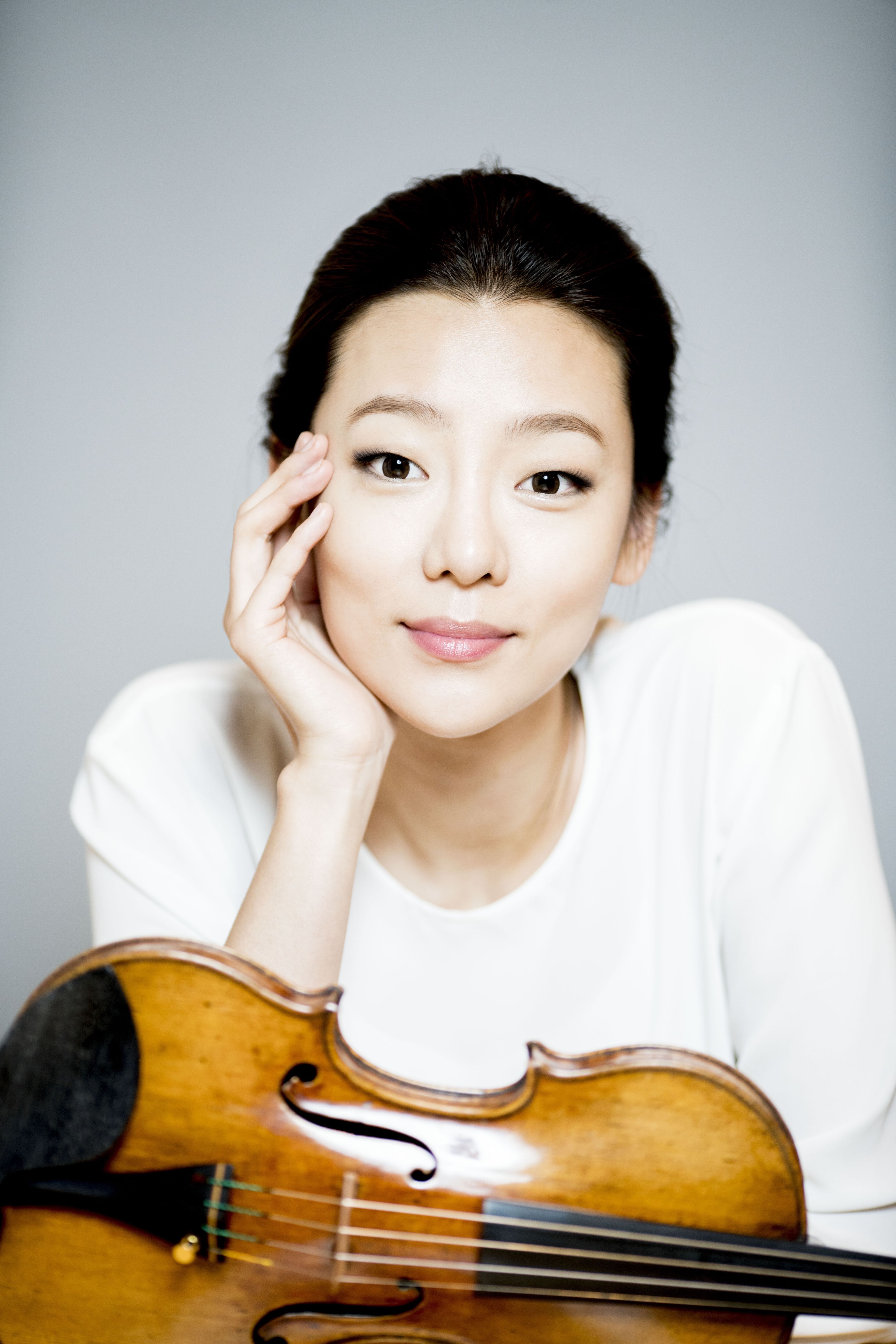
Marco Borggreve
Marco Borggreve
Born to Korean parents and raised in Germany, Clara-Jumi Kang is internationally renowned for her musicality and virtuosity. Her many awards and accolades include first prizes at the Indianapolis, Sendai and Seoul violin competitions.
She is Artist-in-Residence with the Royal Stockholm Philharmonic Orchestra this season. Other recent and forthcoming highlights include festival appearances at the BBC Proms, Hollywood Bowl and debuts at the Salzburg Festival and with the Accademia Nazionale di Santa Cecilia, West–Eastern Divan Orchestra, Atlanta and Shanghai Symphony orchestras, National Arts Centre Orchestra, Ottawa and the Netherlands Philharmonic Orchestra. She returns to the Israel and Seoul Philharmonic orchestras and gives a recital tour across Korea, as well as at the Boulez Saal in Berlin, Hong Kong City Hall, and venues in Rome and Turin.
Since making her concerto debut with Hamburg Symphony Orchestra at the age of five, she has regularly worked with leading conductors, including Paavo Järvi, François-Xavier Roth, Stéphane Denève, Vasily Petrenko, Daniel Harding, Jaap van Zweden, Kazuki Yamada, Eva Ollikainen, Ryan Bancroft, Juanjo Mena, Lahav Shani, Thierry Fischer, Charles Dutoit, Christian Reif, Anja Bihlmaier, Kevin John Edusei and Long Yu. In 2012 she was selected as one of the top 100 ‘Most promising and influential people of Korea’ by the Korean newspaper Dong-A Times and was awarded the Daewon Music Award; in 2015 she was named Kumho Musician of the Year.
Her discography includes Modern Solo, an album of Brahms and Schumann with Yeol Eum Son and a cycle of Beethoven sonatas with Sunwook Kim. She also regularly appears at chamber music festivals and collaborates with renowned musicians including Janine Jansen, Gidon Kremer and Mischa Maisky.
Clara-Jumi Kang took up the violin at the age of three and studied with Zakhar Bron, Dorothy DeLay and Christoph Poppen, as well as receiving guidance from Daniel Barenboim.
She plays the ‘Thunis’ Stradivarius from 1702, on generous loan from KIA.
BBC National Orchestra of Wales
For over 90 years, the BBC National Orchestra of Wales, the only professional symphony orchestra in Wales, has played an integral part in the cultural landscape of the country, occupying a distinctive role as both a broadcast and national orchestra, and serving as an ambassador of Welsh culture, regularly performing music created in Wales and championing Welsh composers and artists.
Part of BBC Cymru Wales and supported by the Arts Council of Wales, BBC NOW performs a busy schedule of concerts and broadcasts, working with acclaimed conductors and soloists from across the world, including its Principal Conductor, the award-winning Ryan Bancroft.
The orchestra is committed to working in partnership with community groups and charities, taking music out of the concert hall and into settings such as schools and hospitals to enable others to experience and be empowered by music. It undertakes workshops, concerts and side-by-side performances to inspire and encourage the next generation of performers, composers and arts leaders, and welcomes thousands of young people and community members annually through its outreach and education projects.
BBC NOW performs annually at the BBC Proms and biennially at the BBC Cardiff Singer of the World competition, and its concerts can be heard regularly across the BBC – on Radio 3, Radio Wales and Radio Cymru. On screen, music performed by BBC NOW can be heard widely across the BBC and other global channels, including the soundtrack and theme tune for Doctor Who, Planet Earth III, Prehistoric Planet, The Pact and Children in Need.
Based at BBC Hoddinott Hall, Cardiff Bay, BBC NOW utilises a state-of-the-art recording studio with a camera system for livestreams and TV broadcasts to bring BBC NOW’s music to a broader audience across Wales and the world. For more information about BBC NOW please visit bbc.co.uk/now
Patron
HM King Charles III KG KT PC GCB
Principal Conductor
Ryan Bancroft
PrincipalGuest Conductor
Jaime Martín
Conductor Laureate
Tadaaki Otaka CBE
Composer-in-Association
Gavin Higgins
First Violins
Jens Lynen
Nick Whiting sub-leader
Gwenllian Hâf MacDonald
Terry Porteus
Suzanne Casey
Alejandro Trigo
Emilie Godden
Ruth Heney **
Kerry Gordon-Smith
Anna Cleworth
Carmel Barber
Žanete Uškāne
Zhivko Georgiev
Anya Birchall
Gary George-Veale
Second Violins
Anna Smith *
Kirsty Lovie #
Ros Butler
Sheila Smith
Michael Topping
Katherine Miller
Joseph Williams
Lydia Caines **
Vickie Ringguth
Roussanka Karatchivieva
Rowan Patterson
Sali-Wyn Ryan
Elizabeth Whittam
Frances Richards
Violas
Alex Thorndike #
Tetsuumi Nagata
Peter Taylor
Lydia Abell
Catherine Palmer
Lowri Taffinder
Robert Gibbons
Laura Sinnerton
Dáire Roberts
Carl Hill
Sharada Mack
Cellos
Morwenna Del Mar
Jessica Feaver
Sandy Bartai
Alistair Howes
Carolyn Hewitt
Rachel Ford
Kathryn Graham
Katy Wright
Celia Camacho Carmena
January Johnnsen
Double Basses
David Stark *
Christopher Wescott
Emma Prince
Antonia Bakewell
Chris Kelly
Hannah Turnbull
Imogen Fernando
William Priest
Flutes
Matthew Featherstone *
John Hall †
Lindsey Ellis
Alto Flute
John Hall
Piccolo
Lindsey Ellis †
Oboes
Amy McKean †
Ben Marshall
Cor anglais
Clarinets
Alison Lambert
William White †
Lenny Sayers +**
Raphael Hitchen
E flat Clarinet
William White
Bass Clarinet
Bassoons
Jarosław Augustyniak *
Rhiannon Carmichael
David Buckland
Contrabassoon
David Buckland †
Horns
Meilyr Hughes
John Davy
Flora Bain
Marcus Bates
Tom Taffinder
Neil Shewan
Dave Ransom
Neil Mitchell
Trumpets
Robert Samuel
Corey Morris †
Lewis West
Will Morley
Stuart Essenhigh
Giovanni Re
Trombones
Simon Wills
David Whitson
Stephen Turton
Martyn Hunter
Bass Trombone
Tuba
Timpani
Percussion
Scott Lumsdaine
Rhydian Griffiths
Christina Slominska
Max Ireland
Phil Hughes
Sarah Mason
Sam Jowett
Phil Girling
Harps
Bethan Semmens
Piano/Celesta
Catherine Roe Williams
* Section Principal
The list of players was correct at the time of publication
Director Lisa Tregale
+ Green Team member
Keep up to date with BBC National Orchestra of Wales
Listen to our BBC Radio 3 broadcasts via the BBC Sounds app. Visit our website and follow us on Facebook and Instagram
To help us improve our online concert programmes, please take this 5-minute survey
Produced by BBC Proms Publications


