
Elemental Explorations
Thursday 29/9/22, 7.30pm (Theatr Brycheiniog, Brecon),
Friday 30/9/22, 7.30pm (The Riverfront, Newport)


Max Bruch
Kol nidrei (10’)
Fazil Say
Never give up UK premiere (25’)
INTERVAL (20’)
Fabien Waksman
Protonic Games UK premiere (12’)
Ludwig Van Beethoven
Symphony No. 7 (36’)
Nil Venditti Conductor
Camille Thomas Cello


The concert in Brecon is being recorded by BBC Radio 3 for future broadcast in Afternoon Concert and the New Music Show. It will be available to stream or download for 30 days after broadcast via BBC Sounds, where you can also find podcasts and music mixes. Visit bbc.co.uk/now for more information on future performances.
Introduction
Welcome to tonight’s concert, in which BBC National Orchestra of Wales is conducted for the first time by rising star Nil Venditti.
Two works receiving their UK premieres rub shoulders with a pair of masterpieces from the past. Bruch’s Kol nidrei is one of his most powerfully effective pieces, the cello offering a keening lament over plush orchestral colours. Playing it this evening is the young cellist Camille Thomas, who is also the soloist in Fazil Say’s politically inspired concerto Never give up, a visceral musical response to terrorist atrocities.
Beethoven’s Seventh Symphony may be very familiar to us, but it’s put in a fresh context by being prefaced by Fabien Waksman’s Protonic Games, a work that takes tiny fragments of the Beethoven and reworks them in a highly energetic manner
Please respect your fellow audience members and those listening at home. Turn off all mobile phones and electronic devices during the performance. Photography and recording are not permitted.
Max Bruch (1838–1920)
Kol nidrei (1880)

Kol nidrei, subtitled ‘Adagio on Two Hebrew Melodies for cello and orchestra’, is one of Bruch’s s best-known works. It was inspired to a large extent by the composer’s long-standing association with Cantor Abraham Lichtenstein, with whom he had worked in Berlin. Through Lichtenstein, Bruch became familiar with the haunting melody of ‘Kol nidrei’, which was traditionally sung in the synagogue on the eve of Yom Kippur (the Day of Atonement). His transcription, published in 1881, faithfully projects what his biographer Christopher Fifield describes as the melody’s contrasting elements of ‘remorse, resolve and triumph’ by breaking it up into a sequence of almost breathless three-note patterns in the solo cello as it engages in increasingly impassioned dialogue with the orchestra.
The storm subsides with the introduction of an entirely new and wonderfully heartfelt melody in the major key. This is initially announced by the orchestra with prominent harp arpeggios before being taken up by the cello, which spins a long lyrical line that eventually brings the music to a calm and reflective conclusion. Here Bruch, who was at the time conductor of the Liverpool Philharmonic, quotes directly from the middle section of British-Jewish composer Isaac Nathan’s arrangement of ‘O Weep for Those that Wept by Babel’s Stream’ which also formed the basis of one of Bruch’s Three Hebrew Songs composed at roughly the same time.
Kol nidrei received its first performance at a concert in Liverpool in 1881 with Bruch conducting and Robert Hausmann as soloist.
Programme note © Erik Levi
Further Listening: Jacqueline du Pré; Israel Philharmonic Orchestra/Daniel Barenboim (Warner Classics 9029622248)
Further Reading: Max Bruch: His Life and Works Christopher Fifield (Gollancz)
Fazil Say (born 1970)
Never give up (2016–17)
UK premiere

1 Never give up
2 Terror elegy
3 Song of hope
Camille Thomascello
As he did in his ‘Gezi Park’ series [prompted by the brutal police reaction to a peaceful sit-in in 2013 against the redevelopment of an Istanbul park that then spread to protests across Turkey], Fazıl Say makes reference to current political events in his new cello concerto [2017]. According to the composer, Never give up is an ‘outcry for freedom and peace’, focusing on the ‘harrowing terrorist attacks in Europe and Turkey’. This is most evident in the central movement: harsh note repetitions on the percussion alternate with screaming glissandos in the woodwind – passages marked with the performance instructions ‘Kalashnikov’ and ‘like a scream’ in the score. Nevertheless, the work concludes on a hopeful note with traditional Turkish rhythms accompanied by peaceful birdsong and the sound of waves in the strings.
Programme note © Schott Music
Further Listening: Camille Thomas; Brussels Philharmonic Orchestra/Stéphane Denève (DG 4838564)
INTERVAL: 20 minutes
Fabien Waksman (born 1980)
Protonic Games (2012)
UK premiere

I’ve always been fascinated by Beethoven’s ability to fashion a large form stemming from musical micro-matter. Think of the opening four-note motif of the Fifth Symphony, for example, which drives the whole of the first movement.
Solving infinitely large mysteries by starting with the infinitely small is exactly what the particle physicists at the CERN research centre in Geneva have been trying to do, with the help of the remarkable Large Hadron Collider, the world’s largest particle accelerator, in which proton beams collide at a velocity approaching the speed of light, creating impacts of extraordinary power.
Protonic Games seeks to recall these high-energy collisions, which result in unstable particles that haven’t existed since soon after the Big Bang.
This double homage to Beethoven and those researching into what cannot be seen rests musically on seven motifs taken from Beethoven’s Seventh Symphony, most of them barely recognisable to the ‘naked ear’. In fact, I have significantly varied the character and, especially, the speed of these ‘micro motifs’ – true particles of musical matter that form a material that is teeming and extremely fast-moving.
The particles clash, ceaselessly colliding, and these explosions give rise to further elements, which themselves transform continually.
The opening section – explosive in character – gives way to a gentle choir of strings which in turn leads to music that is more contrapuntal, with contrasted tonal colours. After a recollection of the opening, an inexorable acceleration, restlessly drawing in more and more of the motifs, leads to a radiant chord, closing the piece in an ecstatic mood.
On 4 July 2012, a few months after the world premiere of Protonic Games, CERN researchers announced the discovery of the Higgs boson, also known as the ‘God particle’.
Programme note © Fabien Waksman, translation by Edward Bhesania © BBC
Ludwig Van Beethoven (1770–1827)
Symphony No. 7 in A major, Op. 92 (1811–12)
1 Poco sostenuto – Vivace
2 Allegretto
3 Presto – Assai meno presto – Presto
4 Allegro con brio
Wagner was only partly right when he called Beethoven’s Seventh ‘the apotheosis of the dance’. It’s even more fundamental than that. Rhythm really is it: the Seventh thrills with Beethoven’s obsessive focus on what he can make from just a few rhythmic cells, which he turns into structural building blocks with maniacal relentlessness.
Rhythm is inescapably the point of the main part of the first movement, whose dotted-rhythm Morse code is drummed out in nearly every bar, just as it’s drilled into our listening consciousness; rhythm is the catalyst for the ever-intensifying machine for mourning of the second movement; the third-movement scherzo is a vertiginous symphonic catapult, a challenge for us to keep up with the pace; and the finale puts a folk tune on rhythmic steroids, creating a churning centripetal force that sucks in the limits of the musical universe along with all of us listening and everyone playing.
But the Seventh does even more than that. This isn’t a piece about revolutionary ideas or heroes, it’s not a spiritual journey from darkness to light, it’s not about humanity’s relationship with nature, and it’s not about a composer showing how he can break through the conventions of previous generations. He’d done all of that – and more – in his previous six symphonies. In this work he addresses not only our brains, but our bodies too. It’s a sensory overload that pummels and pounds its way into all of the frequency-receiving parts of our anatomy: not only our ears, but our stomachs, our loins, our limbs, our feet, all of the parts of us that are made to move with and be moved by music.
The Seventh is the symphony as pure visceral experience, a piece that explodes fiercely and violently out of the bounds of the concert hall and into all the vibrating, resonating places of our bodies – an earthy apotheosis of symphonic grooving!
Programme note © Tom Service
Further Listening: Vienna Philharmonic Orchestra/Carlos Kleiber (DG 4474002)
Further Reading: Beethoven Barry Cooper (OUP)
Help us Improve Our Online Programmes.
Please take this 5-minute survey and let us know what you think of these notes.
Programme Survey
Biographies
Nil Venditti conductor

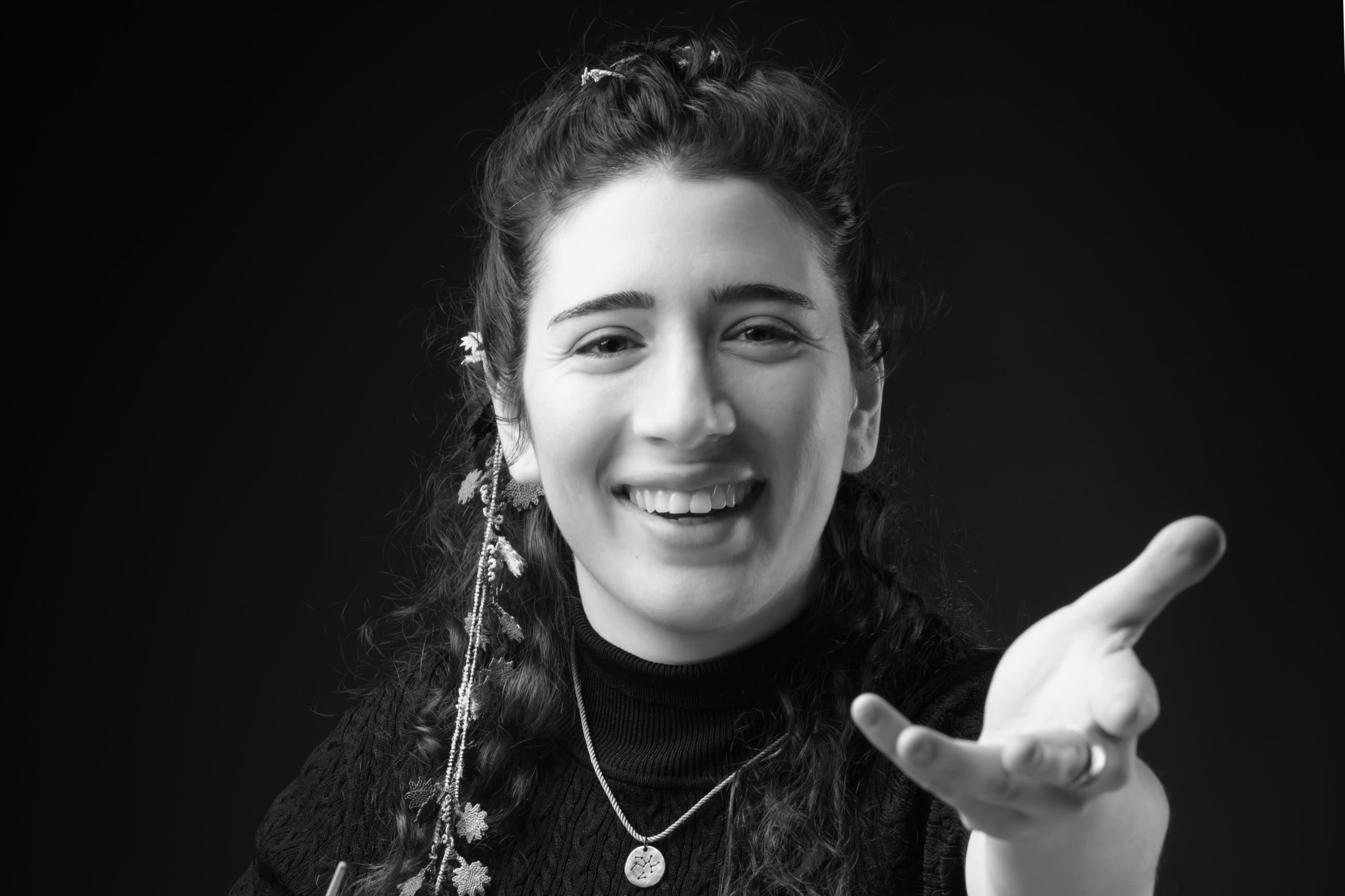
Photo: Alessandro Bertani
Photo: Alessandro Bertani
Italo-Turkish conductor Nil Venditti is fast establishing relationships with major orchestras and ensembles around the world. Highlights from recent seasons include collaborations with the Orchestre National du Capitole de Toulouse, Orchestre National de Lille, Orchestre National Bordeaux Aquitaine, the Netherlands and Royal Liverpool Philharmonic orchestras, Ulster Orchestra, Lucerne Symphony Orchestra, Camerata Salzburg, Stuttgart Chamber Orchestra and Irish National Opera, as well as Orchestra della Toscana, of which she was Principal Guest Conductor (2020–22).
Highlights this season include returns to the Orchestre de Pays de Béaune, Stuttgart Chamber Orchestra and Transylvania State Philharmonic. She also makes debuts with the Belgrade, Dresden and Galicia Royal Philharmonic orchestras, Asturias, Basle, Castilla y León and Helsingborg Symphony orchestras, Orchestra of Paris Opéra, Orchestre de Mulhouse, Orchestre National des Pays de la Loire, Deutsche Kammerphilharmonie Bremen, Orchestra of Staatstheater Stuttgart, Extremadura Orchestra, Zurich Tonhalle Orchestra, Helsinki Chamber Orchestra, Dalarna Sinfonietta and Royal Northern Sinfonia. In Turkey, she collaborates with the Antalya, Istanbul and Izmir State Symphony orchestras. She makes her US debut next spring with the San Francisco Conservatory of Music Orchestra.
Her repertoire encompasses the Classical and Romantic eras up to the early 20th century. She also has a particular interest in contemporary programming, with a focus on the music of Fazil Say (whose Fifth Symphony she will premiere at the Bremen Festival), Peter Maxwell Davies, Fabien Waksman, Lepo Sumera, Caroline Shaw and Nicola Campogrande (including his Concerto for audience and orchestra). In the opera house she has conducted Così fan tutte, L’elisir d’amore, The Lighthouse, Carmen, Tosca and Irish National Opera’s first virtual reality community opera, Out of the Ordinary.
Camille Thomas cello

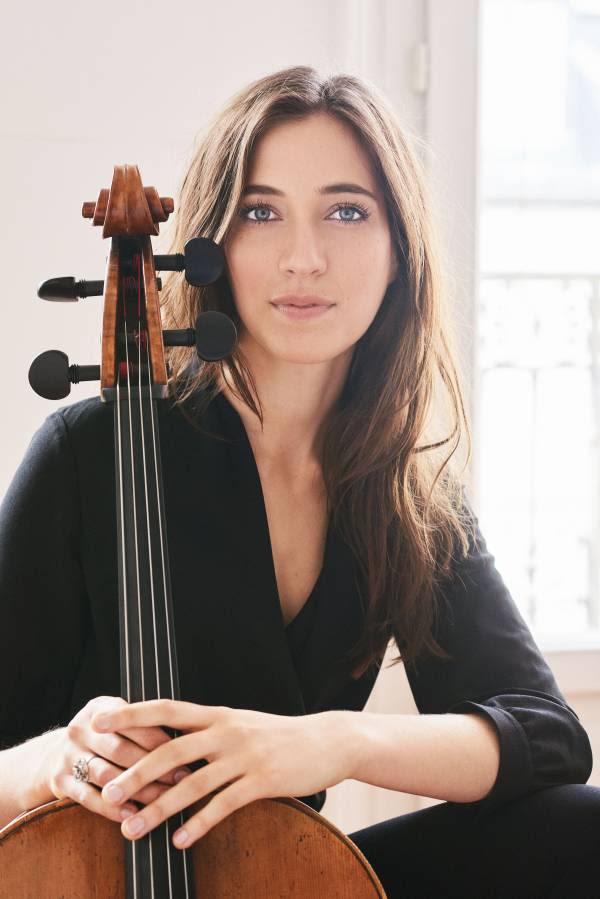
Camille Thomas was born in Paris in 1988. She began playing cello at the age of four, making rapid progress that led to lessons with Marcel Bardon. She moved to Berlin in 2006 to study with Stephan Forck and Frans Helmerson at the Hanns Eisler Hochschule für Musik, and continued her training with postgraduate lessons with Wolfgang-Emanuel Schmidt at the Franz Liszt Hochschule für Musik in Weimar.
She signed an exclusive recording contract in 2017, releasing an album of Saint-Saëns and Offenbach followed by a second, Voice of Hope, which features the world-premiere recording of Fazil Say’s Never give up, which receives its UK premiere tonight.
Recent highlights include her debut with the Los Angeles Philharmonic at the Walt Disney Concert Hall performing Elgar’s Cello Concerto; a residency with the Arthur Rubinstein Łódź Philharmonic; and tours of North America and Asia.
She has worked with leading conductors, including Darrell Ang, Stéphane Denève, Mikko Franck, Paavo Järvi, Kent Nagano and Marc Soustrot, and with orchestras such as the Deutsche Kammerphilharmonie Bremen, Orchestra dell’Accademia Nazionale di Santa Cecilia, Sinfonia Varsovia, Hamburg Philharmonic State Orchestra, Lucerne Festival Strings, Orchestre National Bordeaux Aquitaine and Brussels Philharmonic.
Camille Thomas plays the 1730 ‘Feuermann’ Stradivarius on loan from the Nippon Music Foundation.
BBC National Orchestra of Wales
For over 90 years, BBC National Orchestra of Wales has played an integral part in the cultural landscape of Wales, occupying a distinctive role as both broadcast and national symphony orchestra. Part of BBC Wales and supported by the Arts Council of Wales, it has a busy schedule of live concerts throughout Wales and the rest of the UK. The orchestra is an ambassador of Welsh music and champions the works of contemporary composers.
It performs annually at the BBC Proms and biennially at the BBC Cardiff Singer of the World competition, and can be heard regularly across the BBC: on Radio 3, Radio Wales and Radio Cymru, as well as providing the soundtracks for some of your favourite television programmes.
Highlights of this season include the Elemental Explorations concerts in Brecon and Newport with Nil Venditti, Disney’s Fantasia in concert, Britten and Elgar with the orchestra’s much-loved Conductor Laureate Tadaaki Otaka, an all-new Gaming concert with gaming music legend Eímear Noone and a CoLaboratory concert with the sensational cellist Abel Selaocoe.
Alongside its busy schedule of live concerts, BBC NOW works closely with schools and music organisations throughout Wales, regularly delivering workshops, side-by-side performances and young composer initiatives to inspire and encourage the next generation of performers, composers and arts leaders and make music accessible to all. To find out more visit bbc.co.uk/bbcnow
Patron
HM King Charles III KG KT PC GCB
Principal Conductor
Ryan Bancroft
Conductor Laureate
Tadaaki Otaka CBE
Composer-in-Association
Gavin Higgins
Composer Affiliate
Sarah Lianne Lewis
First Violins
Lesley Hatfield leader
Nick Whiting associateleader
Gwenllian Hâf MacDonald
Terry Porteus
Suzanne Casey
Carmel Barber
Kerry Gordon-Smith
Anna Cleworth
Juan Gonzalez
Gary George-Veale
Amy Fletcher
Second Violins
Anna Smith *
Ros Butler
Sheila Smith
Vickie Ringguth
Barbara Zdziarska
Joseph Williams
Katherine Miller
Tom Grundy
Michael Topping
Beverley Wescott
Violas
Rebecca Jones *
Alex Thorndike #
Tetsuumi Nagata
Ania Leadbeater
Catherine Palmer
Laura Sinnerton
Robert Gibbons
Dáire Roberts
Cellos
Jesper Svendberg ‡
Keith Hewitt #
Jessica Feaver
Sandy Bartai
Carolyn Hewitt
Rachel Ford
Alistair Howes
Double Basses
David Stark *
Fabián Galeana
Christopher Wescott
Claire Whitson
Flutes
Jonathan Burgess ‡
John Hall
Oboes
Amy McKean
Sarah-Jayne Porsmoguer
Clarinets
Natalie Harris
Lenny Sayers
Bassoons
Sarah Sesu ‡
Alexandra Davidson
Horns
Tim Thorpe *
Neil Shewan †
William Haskins
Trumpets
Sam Kinrade
Robert Samuel
Ed Burfield
Trombones
Miri Wallich
Jake Durham
Bass Trombone
Darren Smith †
Timpani
Steve Barnard *
Percussion
Chris Stock *
Mark Walker †
Harp
Valerie Aldrich-Smith †
* Section Principal
† Principal
‡ Guest Principal
# Assistant Principal
The list of players was correct at the time of publication
Director Lisa Tregale +
Orchestra Manager Zoe Poyser +
Assistant Orchestra Manager Vicky James **
Orchestra Administrator Nick Olsen
Orchestra Coordinator, Operations Kevin Myers
Business Coordinator Caryl Evans
Head of Artistic Production Matthew Wood
Artists and Projects Manager Eleanor Phillips
Orchestra Librarian Eugene Monteith **
Producer Mike Sims
Broadcast Assistant Jacob Perkins
Head of Marketing and Audiences Sassy Hicks
Marketing Coordinator Amy Campbell +
Digital Producer Yusef Bastawy
Social Media Coordinator Harriet Baugh
Education Producers Beatrice Carey, Rhonwen Jones **
Audio Supervisors Simon Smith, Andrew Smillie
Production Business Manager Lisa Blofeld
Stage and Technical Manager Steven Brown
Assistant Stage and Technical Manager Dave Rees
+ Green Team member
** Diversity & Inclusion Forum