
Folk Fusions – Japan meets Eastern Europe
Saturday 24/2/24, 7.30pm


Tōru Takemitsu
Three Film Scores12’
Kikuko Kanai
Capriccio Okinawa UK premiere 25’
INTERVAL: 20 minutes
Franz Liszt
Piano Concerto No. 2 21’
Antonín Dvořák
The Wood Dove 19’
Nodoka Okisawaconductor
Iyad Sughayer piano

This concert was supported by small grant from the Daiwa Anglo-Japanese Foundation and BBC NOW would like to thank the foundation for their help.


The concert is being recorded by BBC Radio 3 for future broadcast inRadio 3 in Concert. It will be available for 30 days after broadcast via BBC Sounds, where you can also find podcasts and music mixes.
Introduction
Welcome to this evening’s concert, in which BBC NOW is conducted by Nodoka Okisawa, making her debut here in Cardiff.
It’s fitting that the first half of the programme celebrates the music of her native Japan: though Tōru Takemitsu may be remembered for music of the utmost delicacy and refinement, he was also a huge fan of film, and contributed some 90 soundtracks, of which Three Film Scores offers a piquant snapshot.
From a generation earlier, Kikuko Kanai was the first woman to unite a Western classical style with the folk music of her own birthplace, the Okinawa Islands. Today marks the UK premiere of her evocative Capriccio Okinawa.
We find ourselves back in Europe after the interval, first for Liszt’s heady Second Piano Concerto, for which we’re delighted to welcome back Iyad Sughayer as soloist. The composer packs exhilarating virtuosity and aching lyricism into this fantasy-like piece. And finally to Dvořák: the title of his tone-poem The Wood Dove might sound innocent enough, but it relates the story of a dark Czech folk tale of murder and deception, brilliantly evoked through Dvořák’s ear for colour.
Enjoy!
Matthew Wood
Head of Artistic Production
Please respect your fellow audience members and those listening at home. Turn off all mobile phones and electronic devices during the performance. Photography and recording are not permitted.
Tōru Takemitsu (1930–96)
Three Film Scores(1994–5)

1 Music of Training and Rest
2 Funeral Music
3 Waltz
Tōru Takemitsu, born in Tokyo in 1930, was the first Japanese composer to achieve worldwide fame. He was largely self-taught, his education truncated by military service in his mid-teens; in due course his compositions mingled eclectic influences, from Debussy and Berg to Boulez, Cage and Feldman.
Having been at odds with the traditional music of Japan, which at first he associated with his traumatic experiences at war, he ultimately came to accept it, while also returning to an essentially melodic language. ‘I am old-fashioned,’ he wrote. ‘What I desire to reach through the communication of melody is beyond the pleasure and sorrow experienced during this continuation. Yet I cannot simply call that for which I reach eternity.’
His expertise embraced literature, philosophy and the natural world; and with an almost obsessive passion for film, he composed around 90 movie scores, including Akira Kurosawa’s 1985 masterpiece Ran, a Japanese version of King Lear.
His Three Film Scores for string orchestra dates from 1994–5 and involved the reworking of music from José Torres (1959), Black Rain (1989) and Face of Another (1966). The premiere was at the CineMusic Festival in Gstaad, Switzerland, on 9 March 1995, in which the English String Orchestra was conducted by William Boughton.
The opening ‘Music of Training and Rest’ is by turns energetic and sinuous, inflected with jazz and blues. ‘Funeral Music’ forms a slow movement full of anguished, closely wrought harmonies. Finally, ‘Waltz’ is catchy but strangely shadowy, completing a suite that forms the perfect introduction to its composer’s multifaceted world.
Programme note © Jessica Duchen
Kikuko Kanai (1906–86)
Capriccio Okinawa(1974, rev. c1981)
UK premiere
1 Good Harvest Dance
2 Shrine Maidens’ Dance
3 Hatoma Island Dance
Capriccio Okinawa (1974, revised c1981) is one of Kikuko Kanai’s most ambitious compositions. The hallmark of her mature style, evident here, is an amalgam of Western musical techniques and Okinawan folk melodies and dances. Kanai drew lifelong inspiration from the history, nature and culture of the islands which she called home.
The first movement, ‘Good Harvest Dance’, is based on the energetic Stick Dance transmitted across generations on Miyako Island. In the bright sunshine, muscular young men dance, marking time with loud shouting and stirring up onlookers – in contrast to the refined dancing of the Okinawa mainland.
The second movement, ‘Shrine Maidens’ Dance’ evokes the atmosphere of ancient ritual. Long ago in Okinawa, it is said, the sisters and daughters of lords were given the position of female Shinto priests in order to pray for good harvests, bountiful fishing and safe passage by sea. The families of tradespeople and travellers gathered on a mountain around the shrine maidens, who led the prayers with singing and dancing.
The third movement, ‘Hatoma Island Dance’, features the folk song Hatoma-bushi, about which Kanai wrote: ‘This dance with a rhythmical tune is loved by all the people and sung and danced by them.’ The melody is played on the sanshin, a plucked instrument native to Okinawa made with snakeskin; like the Japanese shamisen, of which it is the precursor, it has three strings. This movement replaces the original finale called ‘Karate’, which was dodecaphonic, a style of composition that briefly interested Kanai.
Programme note © Maiko Kawabata
INTERVAL: 20 minutes
Franz Liszt (1811–86)
Piano Concerto No. 2 in A major (1839–57, rev. 1861)
Adagio sostenuto assai – Allegro agitato assai – Allegro moderato – Allegro deciso – Marziale un poco meno allegro – Allegro animato
Iyad Sughayer piano
Despite having drafted around 20 works for piano and orchestra, Franz Liszt left just two numbered piano concertos among his hundreds of compositions. Both are powerful pieces, requiring big doses of personality from their performer, yet as rich in reflective, mystical passages as in pianistic bling.
Liszt was an inveterate reviser of his works, often taking years or even decades to perfect their final versions. This was particularly true with those that started life in his years as a superstar virtuoso. He had been a child prodigy and his father, who had played the cello in Haydn’s orchestra at the Esterházy estate, took him from Hungary to Paris to study. But, after his father’s death, the youthful Liszt rather lost his way, until he experienced an epiphany on attending Paganini’s recital in the French capital in 1832. Within a few years, Liszt had succeeded in transforming himself into the Paganini of the piano.
Between 1838 and 1847 he toured far and wide – adored by women, respected by his peers, feared by would-be rivals (though few actually could rival him, as Sigismond Thalberg discovered to his cost, in an attempted ‘piano duel’) and regarded with suspicion by Clara Schumann and the violinist Joseph Joachim, who considered him a superficial showman. His itinerant existence left Liszt too little time for his own music. It was only once he decided to give up performing and dedicate himself to composing and teaching from a home base in Weimar that he gave many of his earlier manuscripts a thorough overhaul.
Sketches for the Second Piano Concerto go back to the 1830s, but the piece was not premiered until 1857, when Liszt’s pupil Hans von Bronsart performed it with the composer conducting. It was finally published in the early 1860s. Played in one unbroken span, it is effectively a giant fantasy with two principal themes that return throughout, continually transformed.
The woodwind introduce the first idea; the piano elaborates it and breaks into a cadenza, which then establishes the second theme, a demoniac march with terse rhythmic accompaniment. This is transformed initially into a scherzo and then an Allegro moderato section, with the soloist weaving filigree decoration around the strings. The opening theme returns, triumphantly combined with the march, until the soloist ushers in an emollient episode of reflection amid the bombast. Eventually a high-octane coda full of scintillating virtuoso pianism closes the work on a high.
Programme note © Jessica Duchen
Antonín Dvořák (1841–1904)
The Wood Dove, Op. 110 (1896, rev. 1897)
Antonín Dvořák composed his first symphonies while struggling to support his young family, giving piano lessons and playing viola in the Bohemian Provisional Theatre Orchestra. He was well into his thirties when his music, entered for a competition for a financial stipend, caught the eye of Johannes Brahms, who was on the jury. Brahms recommended him to the music publisher Simrock, offering him a much-needed breakthrough.
That connection, though, does not mean that Dvořák was entirely a conservative, Brahmsian composer. He professed to an ‘unbounded admiration’ for Wagner (he even played in a concert Wagner conducted in Prague in 1863), and Liszt’s pioneering symphonic poems were a tremendous influence. In 1896 he wrote four such works, each based on a ballad by Karel Jaromír Erben (1811–70), The Wood Dove among them. Its first performance on 20 March 1898 took place in Brünn (Brno), conducted by Leoš Janáček; Gustav Mahler was on the podium for the Vienna premiere.
It tells the story of a woman who poisons her husband, then marries a younger man, only to be forced to face her crime by the song of the wild dove. A fatalistic ‘curse motif’ recurs inexorably, like a leitmotif. The opening funereal music, which at times verges on the Mahlerian, gives way to wedding celebrations, complete with love duet. But then, in a tree above the dead husband’s grave, the wild dove appears with a message of doom – ‘The unhappy themselves find their graves.’ The funeral march returns, this time for the wife. Perhaps the ending, in the major, offers hope of redemption.
Programme note © Jessica Duchen
Help Us Improve Our Online Programmes.
Please take this 5-minute survey and let us know what you think of these notes.
Programme Survey
You may also like:
Rachmaninov 2 with Martyn Brabbins
Friday 8/3/24, 7.30pm
Brangwyn Hall, Swansea
Saturday 9/3/24, 7.30pm
BBC Hoddinott Hall, Cardiff
Grace Williams Elegy for Strings
Nielsen Violin Concerto
Rachmaninov Symphony No. 2
Martyn Brabbins conductor
Liya Petrova violin
EXQUISITE | RESONATING | THRILLING
Grace Williams shows an early hint of the highly individual music she would compose in later years in tonight’s concert opener, her Elegy for Strings. From the dramatic Praeludium to its introspective Adagio, Nielsen offers, in his Violin Concerto, a thrilling journey through harmony, gesture and mood. We’re delighted to welcome as soloist the Bulgarian virtuoso Liya Petrova, winner of the 2016 Nielsen Violin Competition.
Among the most famous of Rachmaninov’s output is his Second Symphony, and there’s little wonder why! Dynamic brilliance, melodious triumph and exquisite beauty reign in this deeply emotional outpouring of music. To conduct, we welcome back BBC NOW favourite Martyn Brabbins.
Let All the World in Every Corner Sing
Friday 22/3/24, 7.30pm
BBC Hoddinott Hall, Cardiff
NunesGarcia Overture ‘Zemira’
J. S. Bach Cantata No. 82, ‘Ich habe genug’
Haydn Symphony No. 26, ‘Lamentatione’
Vaughan Williams Five Mystical Songs
Harry Bicket conductor
Julien Van Mellaerts baritone
BBC National Chorus of Wales
MAGNIFICENT | SPIRITUAL | SPELLBINDING
The subtle spirit of Easter permeates this concert, with Harry Bicket returning to the helm of BBC National Orchestra and Chorus of Wales. The evening kicks off with Brazilian composer José Maurício Nunes Garcia’s Zemira Overture, followed by Bach’s sublime cantata ‘Ich habe genug’ performed by baritone Julien Van Mellaerts. With its text recounting the purification of Mary and a desire to escape earthly misery and to be reunited with Jesus, this work is a perfect fit for any Easter concert.
It is less well known that Haydn’s Symphony No. 26 was written for Easter, although the music contains plentiful hints, not least its Sturm und Drang (‘storm and stress’) style, its minor key and a thundery atmosphere underpinning Passiontide plainsong quotations more pertinent for a church than the concert hall. Also composed for Easter is Vaughan Williams’s Five Mystical Songs, which sets texts from The Temple: Sacred Poems by Welsh poet and priest George Herbert. Intrinsically spiritual and direct in delivery, the five movements range from quiet and meditative to triumphant shouts of praise.
Bartók’s Concerto for Orchestra
Thursday 9/5/24, 7.30pm
BBC Hoddinott Hall, Cardiff
Friday 10/5/24, 7.30pm
Brangwyn Hall, Swansea
Caroline Shaw The Observatory UK premiere
Ravel Piano Concerto in G major
Bartók Concerto for Orchestra
Giancarlo Guerrero conductor
Sergio Tiempo piano
COLOURFUL | DYNAMIC | ENTHRALLING
Caroline Shaw’s The Observatory (which receives its UK premiere) was inspired by a trip to the Griffin Observatory near the Hollywood Bowl; it explores in sound new ways of looking at the universe, melding old and new with chaos and clarity, in a tantalising stream of consciousness.
Ravel’s atmospheric Piano Concerto, a rich mix of lyricism, evocative orchestration and virtuoso piano writing, is performed by the inimitable Sergio Tiempo as he makes his debut with BBC NOW. The virtuosity continues in Bartók’s brilliant, folk-inflected Concerto for Orchestra, which closes this breathtaking programme, conducted by the illustrious Grammy Award-winning Costa Rican conductor Giancarlo Guerrero.
Biographies
Nodoka Okisawa conductor

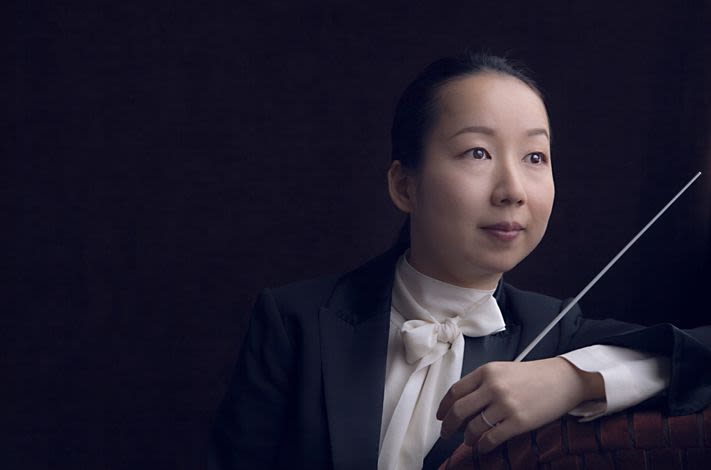
Photo: Felix Broede
Photo: Felix Broede
Nodoka Okisawa is currently Chief Conductor of the City of Kyoto Symphony Orchestra, a three-year post she took up in April 2023.
Her competition successes include the 2019 International Besançon Competition for Young Conductors, where she was awarded First Prize, the Orchestra Prize and the Audience Prize, and the 2018 Tokyo International Conducting Competition.
From 2020 to 2022 she held a scholarship at the Karajan Academy of the Berliner Philharmoniker and was also assistant to Kirill Petrenko. Highlights during that time included conducting the Solidarity Concert for Ukraine in March 2022 and, two months later, the joint anniversary concert with Kirill Petrenko to mark the 50th anniversary of the Karajan Academy.
This season she also makes her debuts with the Basel Chamber Orchestra and Québec and Winnipeg Symphony orchestras, among others. She also make her subscription debut with the NHK Symphony Orchestra, Tokyo, and returns to the Munich and Tokyo Symphony orchestras, having been Artist-in-Residence with the former last season.
She is a regular guest with leading orchestras in Japan, including the Yomiuri Nippon Symphony Orchestra, Japan and New Japan Philharmonic orchestras and Orchestra Ensemble Kanazawa. She made her debut at the Seiji Ozawa Matsumoto Festival in 2022, conducting Mozart’s The Marriage of Figaro.
Nodoka Okisawa attended numerous masterclasses, including those given by Neeme and Paavo Järvi and Kurt Masur. In 2019 she was selected for the Riccardo Muti Italian Opera Academy in Tokyo.
Last year she was given the Hideo Saito Memorial Fund Award by the Sony Music Foundation. Born in Aomori, Japan, she learnt to play the piano, cello and oboe from an early age, before studying conducting at the Tokyo University of the Arts with Ken Takaseki and Tadaaki Otaka and subsequently at the Hochschule für Musik Hanns Eisler Berlin with Christian Ehwald and Hans-Dieter Baum.
Iyad Sughayer piano

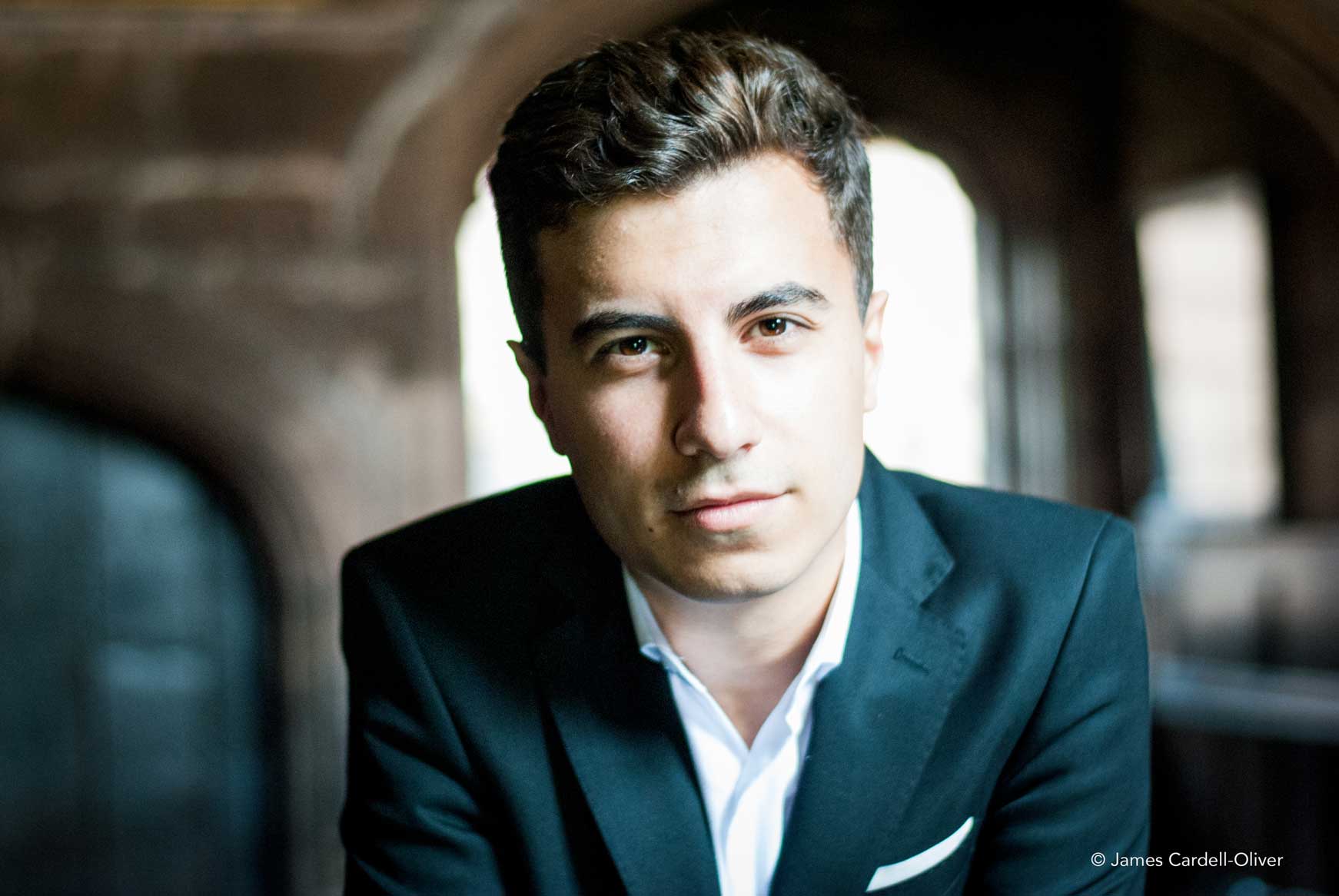
Photo: James Cardell-Oliver
Photo: James Cardell-Oliver
The Jordanian-Palestinian pianist Iyad Sughayer was chosen as ‘One to Watch’ by International Piano Magazine. He was a prizewinner at the Young Classical Artists Trust International Auditions in 2021. He has released two warmly acclaimed albums of Khachaturian, the second of which features tonight’s orchestra, conducted by Andrew Litton.
Highlights of this season include performances at the Berlin Konzerthaus, Amsterdam Concertgebouw, Lammermuir Festival and Barber Institute, Birmingham, as well as a series of recitals at the Leicester International Music Festival, performing the complete Mozart piano sonatas alongside newly commissioned pieces.
Last season he returned to Wigmore Hall and gave recitals in the Royal Concert Hall Nottingham’s International Piano series and at Perth Concert Hall and the Bath Festival. Previously, he has given recitals at the Brighton, Lake District, Castleton and Musique d’Abord festivals, Bridgewater Hall and Stoller Hall in Manchester, Leeds Town Hall, the Laeiszhalle, Hamburg, Steinway Hall in New York and Dubai Opera House. He also regularly collaborates with oboist Armand Djikoloum, with forthcoming concerts across the UK.
In 2020 he contributed to a BBC Arabic documentary London Lockdown, in which he took part as a character and recorded the soundtrack for the music.
As soloist he has appeared with orchestras including the BBC Philharmonic, Manchester Camerata, European Union Chamber Orchestra and the Amman and Cairo Symphony orchestras.
In 2022 he co-founded and launched a new specialist music school, the Mashrek Academy of Music, with the Mashrek International School in Amman, with the aim of nurturing a new generation of creators and musicians in Jordan.
Born in Amman, Iyad Sughayer studied at Chetham’s School of Music, the Royal Northern College of Music and Trinity Laban Conservatoire, where he won the college’s prestigious Gold Medal. In 2021 he was made an Associate of the RNCM.
BBC National Orchestra of Wales
For over 90 years, BBC National Orchestra of Wales has played an integral part in the cultural landscape of Wales, occupying a distinctive role as both broadcast and national symphony orchestra. Part of BBC Wales and supported by the Arts Council of Wales, it has a busy schedule of live concerts throughout Wales, the rest of the UK and the world.
The orchestra is an ambassador of Welsh music and champions contemporary composers and musicians; its concerts can be heard regularly across the BBC – on Radio 3, Radio Wales and Radio Cymru.
BBC NOW works closely with schools and music organisations throughout Wales and regularly undertakes workshops, side-by-side performances and young composer initiatives to inspire and encourage the next generation of performers, composers and arts leaders.
The orchestra is based at BBC Hoddinott Hall in Cardiff Bay, where its purpose-built studio not only provides the perfect concert space, but also acts as a broadcast centre from where its live-streamed concerts and pre-recorded content are presented as part of its popular Digital Concert Series.
For further information please visit the BBC National Orchestra and Chorus of Wales’s website: bbc.co.uk/now
Patron
HM King Charles III KG KT PC GCB
Principal Conductor
Ryan Bancroft
Conductor Laureate
Tadaaki Otaka CBE
Composer-in-Association
Gavin Higgins
Composer Affiliate
Sarah Lianne Lewis
First Violins
Nick Whiting leader
Martin Gwilym-Jones sub-leader
Gwenllian Hâf MacDonald
Terry Porteus
Juan Gonzalez
Emilie Godden
Rebecca Totterdell
Carmel Barber
Anna Cleworth
Žanete Uškāne
Gary George-Veale
Paul Mann
Amy Fletcher
Anya Birchall
SecondViolins
Anna Smith *
Sheila Smith
Beverley Wescott
Lydia Caines
Roussanka Karatchivieva
Joseph Williams
Vickie Ringguth
Michael Topping
Ilze Abola
Katherine Miller
Elizabeth Whittam
Barbara Zdziarska
Violas
Francis Kefford ‡
Tetsuumi Nagata
Peter Taylor
Anna Growns
Catherine Palmer
Lowri Thomas
Lydia Abell
Robert Gibbons
Charlotte Limb
Carl Hill
Cellos
Joely Koos ‡
Raphael Lang
Sandy Bartai
Alistair Howes
Rachel Ford
Carolyn Hewitt
Keith Hewitt
Kathryn Graham
Double Basses
David Stark *
Christopher Wescott
Mike Chaffin
Richard Gibbons
Matt Clarkson
Flutes
Matthew Featherstone *
John Hall †
Lindsey Ellis
Piccolo
Lindsey Ellis †
Oboes
James Hulme ‡
Maddy Aldis-Evans
Amy McKean †
Cor anglais
Amy McKean
Clarinets
Nick Carpenter *
Kie Umehara
Lenny Sayers
Bass Clarinet
Lenny Sayers †
Bassoons
Jarosław Augustiniak *
Jules Postel
Alex Davidson
Contrabassoon
Alex Davidson
Horns
Jonathan Bareham ‡
Meilyr Hughes
Neil Shewan †
Flora Bain
John Davy
Trumpets
Philippe Schartz *
Robert Samuel
Corey Morris † **
Trombones
Donal Bannister*
Huw Evans
Bass Trombone
Darren Smith †
Tuba
Ben Thomson
Timpani
Phil Hughes
Percussion
Phil Girling *
Andrea Porter
Rhydian Griffiths
Sarah Mason
Harp
Valerie Aldrich-Smith †
Piano/Combo Organ/Celesta
Catherine Roe Williams
Sanshin
Robin Uechi
* Section Principal
† Principal
‡ Guest Principal
# Assistant String Principal
** Principal in Liszt
The list of players was correct at the time of publication
Director Lisa Tregale
Orchestra Manager Vicky James
Assistant Orchestra Manager Nick Olsen
Orchestra Coordinator, Operations Kevin Myers
Business Coordinator Caryl Evans
Orchestra Administrator Eleanor Hall +
Head of Artistic Production Matthew Wood
Artists and Projects Manager Victoria Massocchi **
Orchestra Librarian Katie Axelsen (paternity cover)
Producer Mike Sims
Broadcast Assistant Kate Marsden
Head of Marketing and Audiences Sassy Hicks
Marketing Coordinator Amy Campbell-Nichols +
Digital Producer Yusef Bastawy
Social Media Coordinator Harriet Baugh
Education Producers Beatrice Carey, Rhonwen Jones **
Audio Supervisors Simon Smith, Andrew Smillie
Production Business Manager Lisa Blofeld
Stage and Technical Manager Steven Brown +
Assistant Stage and Technical Manager Josh Mead
BBC Wales Apprentice Jordan Woodley
+ Green Team member
** Diversity & Inclusion Forum