Boulez at 100
Thursday 6/3/25, 7.30pm
BBC Hoddinott Hall, Cardiff


Pierre Boulez
Livre pour cordes 11’
Alban Berg
Violin Concerto 22’
INTERVAL: 20 minutes
Pierre Boulez
Mémoriale 7’
Olivier Messiaen
Les offrandes oubliées 11’
Richard Wagner
Tristan und Isolde – Prelude und Liebestod 17’
Daniel Cohen conductor
Ava Bahari violin
Matthew Featherstone flute
BBC Hoddinott Hall is certified by EcoAudio and we’re proud to be supporting the BBC in becoming a more sustainable organisation. For more information on the BBC’s net-zero transition plan and sustainability strategy please visit https://www.bbc.co.uk/aboutthebbc/documents/bbc-net-zero-transition-plan-2024.pdf


This concert is being recorded by BBC Radio 3 for future broadcast in In Concert and is being livestreamed via the BBC NOW website; it will be available for 30 days after broadcast via BBC Sounds, where you can also find podcasts and music mixes.
Introduction

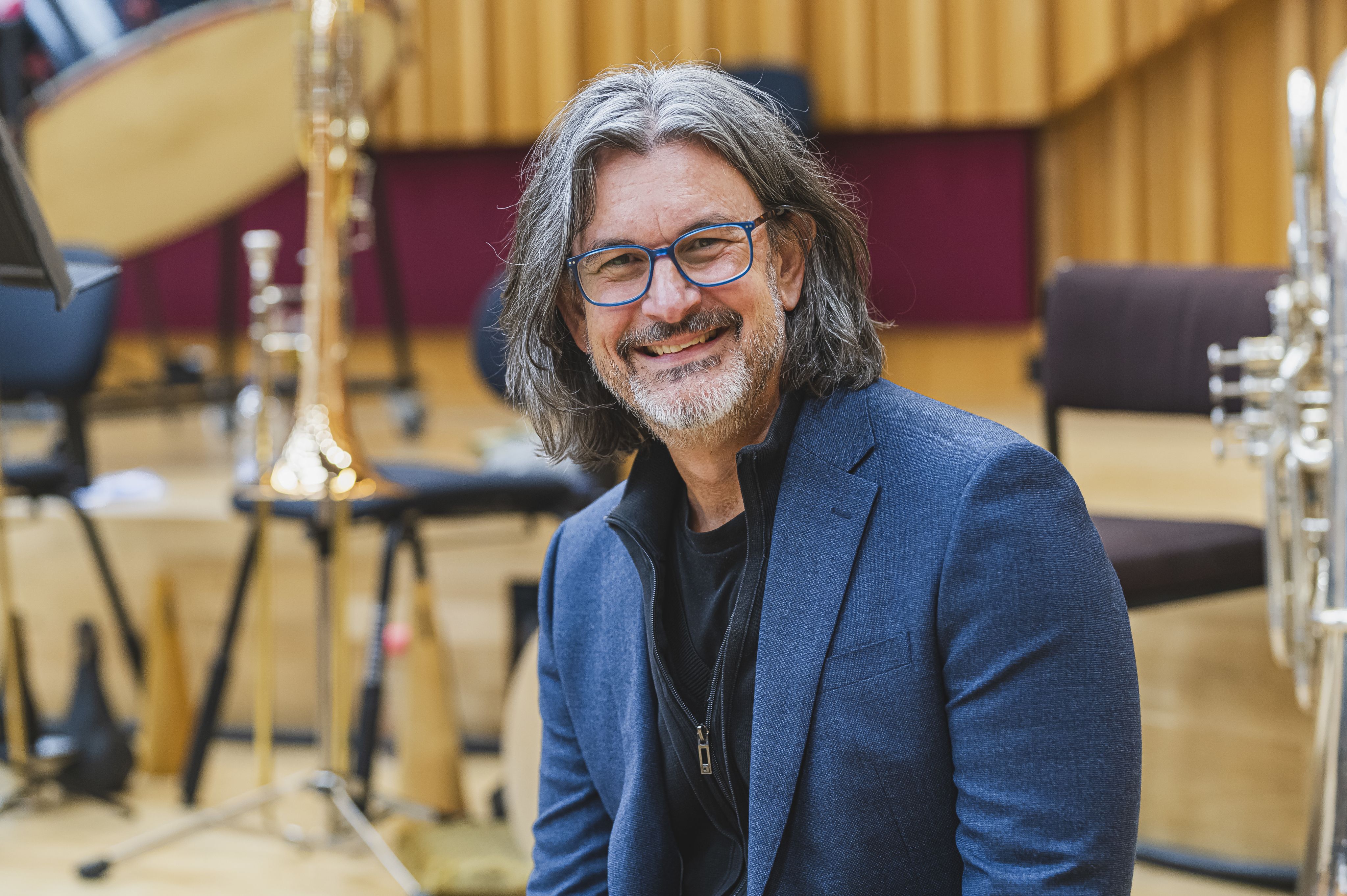
Photo: Kirsten McTernan
Photo: Kirsten McTernan
Welcome to tonight’s concert, in which we mark the 100th birthday of Pierre Boulez (which falls on 26 March). He was such a powerful voice through the second half of the 20th century and into the 21st that he influenced, both as composer and conductor, the very course of music itself. To conduct, we’re delighted to welcome Daniel Cohen, who enjoyed a close association with Boulez, having been his assistant at the Lucerne Festival for several years. Two contrasting works by Boulez begin each half of the concert: Livre pour cordes and Mémoriale; in the latter BBC NOW Principal Flute Matthew Featherstone takes the limelight for a piece that uses extended techniques to question what the instrument itself can do.
Ava Bahari is one of the rising stars of the violin world and tonight – her debut with BBC NOW – sees her playing Berg’s extraordinarily powerful Violin Concerto, a work whose profound emotional weight is on a par with the final offering: Wagner’s Prelude and Liebestod from his groundbreaking music drama Tristan und Isolde. This had pushed the boundaries of 19th century music as daringly as Boulez was to do. From Boulez’s teacher Messiaen we have Les offrandes oubliées, which abounds in glistening sounds entirely characteristic of this French master.
Enjoy!
Matthew Wood
Head of Artistic Planning and Production
Please respect your fellow audience members and those listening at home: mobile phones may be kept on but on silent and with the brightness turned down; other electronic devices should be switched off during the performance. Photography and recording are not permitted.
Pierre Boulez (1925–2016)
Livre pour cordes(1968, rev. 1989)

Pierre Boulez was an inveterate reviser and rethinker of his own music. His monumental orchestral work Pli selon pli, for example, began life in 1957 but didn’t reach its final form until 1989. It’s perhaps more useful to think of certain pieces by Boulez as perpetual works in progress, of which we experience just a snapshot at a particular moment.
You could go further with tonight’s opening piece, and argue that it was never even entirely completed. Boulez’s Livre pour cordes (‘Book for Strings’) began life as the Livre pour quatuor (‘Book for Quartet’) for string quartet, composed by the 24-year-old Boulez in 1949 (or rather four out of its six projected movements were – Boulez added a fifth in 1959). He quickly realised, however, that the quartet was fiendishly difficult to play, later explaining: ‘I felt that the best way of bringing out everything in the original composition would be to orchestrate it. But in an orchestral work one can no longer have the same point of view; so I rethought the music completely.’ Even then, though he’d originally planned to orchestrate the entire Livre pour quatuor, he later left his 1968 orchestral string version at just the earlier work’s opening movement.
Even as it stands, the Livre pour cordes raises fundamental questions about musical last words, about the ways in which ensembles and musical substance might reflect or influence a composer’s changing visions. And it does so through some of Boulez’s most sensuous, dream-like music, in a piece whose gritty, angular figures sit alongside gently glowing textures or even silences, whose large string orchestra is often broken down into a dense interweaving of multiple solo parts, and whose closing gesture might seem closer to pure sound than to intricately constructed music.
Programme note © David Kettle
Alban Berg (1885–1935)
Violin Concerto(1935)
Part 1
1 Andante –
2 Allegretto
Part 2
3 Allegro –
4 Adagio
Ava Bahari violin
The 1935 Violin Concerto was the final piece that Alban Berg completed, and it indeed serves as something of a requiem – for the composer himself, and for the daughter of close friends.
Manon Gropius was the first-born child of Alma Mahler-Werfel (née Schindler) and her second husband, Bauhaus founder and architect Walter Gropius. Manon was an aspiring actress but died suddenly of polio in April 1935 at the age of just 18. Berg knew the family well and was devastated by her death. He’d been commissioned by US violinist Louis Krasner to write a Violin Concerto and was determined that the new piece should serve as a memorial for Manon, tellingly dedicating it ‘to the memory of an angel’.
Krasner’s initial idea was for a heartfelt work using pioneering serial methods – in which a piece’s music is derived from a single, egalitarian ordering of the 12 notes of the chromatic scale (all the black and white notes on a keyboard) – that would genuinely capture an audience’s imagination. Berg’s conception of a concerto of high emotion and deep tragedy, and one conveyed through the strict stipulations of serialism, seemed like the ideal response to Krasner’s demands. And what Berg produced has every right to stake its claim as the most expressive, immediately accessible piece of serial music in the repertoire.
Berg achieved his remarkable expressiveness by loosening some of the rigours of serialism to admit some old-fashioned consonant tonality. His ordering of notes (or ‘row’, in serialist jargon) is actually a succession of familiar major chords, plus a final four notes that correspond precisely with the opening of one of Bach’s most austere, despairing chorales, ‘Es ist genug’ (‘It is enough’). Indeed, Berg quotes Bach explicitly in the concerto’s second movement, first in the violin’s solo line, then using four clarinets to do a passable impression of a rural church organ.
From the start, Berg conceived his concerto as an instrumental requiem for Manon, with its four movements – divided into two parts – depicting her birth, her short life, her death and finally her transfiguration as she soars heavenward via Berg’s ever-ascending row. Even more tragically, however, the Violin Concerto would also serve as Berg’s own requiem. While he was composing the work at his summer retreat on the Wörthersee in Austria, he was stung by a wasp on his back and – in the days before antibiotics – suffered months of painful infection before finally succumbing to septicaemia in the early hours of Christmas Eve 1935.
Programme note © David Kettle
INTERVAL: 20 minutes
Pierre Boulez
Mémoriale(1971, rev. 1985)
Matthew Featherstone flute
Like the Livre pour cordes that opened tonight’s concert, Boulez’s Mémoriale is a work with a long and somewhat complicated genesis. What later became Mémoriale began in 1971 as … explosante-fixe …, Boulez’s tribute to fellow composer Igor Stravinsky, who’d died earlier that year. Boulez originally conceived … explosante-fixe … with several elements left up to its performers (not even its instrumentation was specified). But when he came to make his own realisation of the piece, and despite revising it several times, he still felt dissatisfied. He withdrew the piece entirely in all its versions, though …explosante-fixe… ultimately reappeared in 1991 as a work for solo flute, live electronics, two further flutes and ensemble.
Six years earlier, however, some of the original music from … explosante-fixe … had already re-emerged in Mémoriale, a work with a particular personal resonance for Boulez. He had grown close to the Canadian flautist Lawrence Beauregard, one of the principal players in the crack new music group Ensemble Intercontemporain that Boulez had founded in 1976. Beauregard, however, died in 1985 at the age of just 28, and Boulez accordingly reworked music that had originally been conceived as a tribute to Stravinsky into a touching paean to his young colleague.
Despite its origins, however, Mémoriale is more of a celebration than a funeral dirge, even if its mood remains somewhat restrained. Boulez places the flute centre stage, and makes full use of the instrument’s sonic capabilities in a line that’s never less than beguilingly lyrical, supported by muted gestures from its ensemble of strings and horns. Most significantly, however, Mémoriale is perhaps the closest that Boulez came to embracing more traditional, consonant-sounding tonality: it comes to rest, again and again, on a unison note (E flat) across the entire ensemble, a note sustained at the piece’s delicate close by the horns, once the flute has fallen silent.
Programme note © David Kettle
Olivier Messiaen (1908–92)
Les offrandes oubliées – méditation symphonique(1930)
Très lent – Vif – Extrêmement lent
One of the earliest of Messiaen’s works to have lodged itself in the repertoire, Les offrandes oubliées (‘The Forgotten Offerings’) comes from the end of his student days and the beginning of his professional career. He had just had a set of pieces published for the first time, the Préludes for piano. As a brilliant improvising organist studying the instrument at the Paris Conservatoire with the great Marcel Dupré, Messiaen made such an impression that, in 1931, he was appointed to one of Paris’s plum church posts, as organist at La Trinité. Here he caused a stir with the exploratory nature of his Sunday performances, but the church authorities backed him and he stayed as organist there until the end of his life – and not just nominally: he could still be heard improvising there after services into the 1980s. There was thus a ready hearing for Les offrandes oubliées, his first substantial composition for orchestra, when it was premiered that same year.
In its inspiration from Christian literature and Roman Catholic ritual, Les offrandes oubliées is already typical of what would follow: the three linked movements represent respectively the agony of Christ on the cross, the sins of humanity and the sacrament of communion. To the ear, Les offrandes oubliées may not seem to be one of its composer’s most typical works, but it is still unmistakably his own. Messiaen is almost alone among the major figures of the 20th century’s avant-garde years in leaving a substantial contribution to several repertoires that shows no sign of evaporating. Perhaps that is because, although he was responsible for teaching and encouraging the generation that included Pierre Boulez, and in mid-life appeared to some extent to be influenced by the avant-garde, he was not fundamentally part of it. The large-scale pieces he wrote at the end of his life confirm that, beneath the fantastic overlay of rhythms and bird songs, a solid sense of harmonic progression and even symphonic form persisted.
Les offrandes oubliées shows that basis coming together: the influence of Debussy, rather more of the French organ composers, and the liking for augmented and added-note harmonies that he later codified into his own system of scales. But, while the language is a developing one, the personality is formed: expressive tenderness offset by violence, a capacity to suggest utter calm and uncontrolled force. The extremes of spiritual experience, secured by the confidence of faith, rise to a translation of ecstatic visions into overwhelming sound.
Programme note © Estate of Robert Maycock
Richard Wagner (1813–83)
Tristan und Isolde (1859) – Prelude und Liebestod
Tristan und Isolde is Wagner’s most revolutionary opera. It tells of the accidental, all-encompassing love between two people – a love so strong it can only be fully realised through death.
Tristan is purposefully overwhelming, philosophically and emotionally. Wagner’s music does the legwork. Much of it is founded on the broad implications of the four-note ‘Tristan chord’, a leading chord that leads nowhere. Unable to resolve musically – and by implication, sexually – the chord sets in motion a huge crescendo of longing.
We hear the Tristan chord at the start of the opera’s Prelude, after three preliminary notes on low strings. A broad, arch-like structure is set in motion.
The opera’s pivotal moment comes when Isolde, having held the dying Tristan in her arms, sees their love continuing in death. Isolde sings her Verklärung (her transfiguration, often referred to as her Liebestod – ‘love death’), played here by orchestra alone.
The Liebestod solves the riddle of the Tristan chord. Eventually, the orchestra runs aground on the key of C sharp major, forcing a standard resolution into G sharp. Through the portal of the Tristan chord, the music then floats on to B major. You don’t need to recognise those keys to sense a shift in the music’s footing, and its sure discovery of the ecstasy of true love.
Programme note © Andrew Mellor
Help Us Improve Our Online Programmes.
Please take this 5-minute survey and let us know what you think of these notes.
Programme Survey
You may also like:
Expressions of Folk
Thursday 1/5/25, 7.30pm
BBC Hoddinott Hall, Cardiff
Friday 2/5/25, 7.30pm
Brangwyn Hall, Swansea
Holst Capriccio
Stravinsky Symphonies of Wind Instruments
Sir James MacMillan Where the Lugar meets the Glaisnock world premiere
Vaughan Williams In the Fen Country
Stravinsky Symphony in Three Movements
Sir James MacMillan conductor
David Childs euphonium
IMPRESSIONIST | RESONANT | RESPLENDENT
Snippets of folk-like tunes weave together in Holst’s kaleidoscopic Capriccio. Taking an equally central role in Stravinsky’s Symphonies of Wind Instruments are the Russian folk elements in a piece that explores the original meaning of ‘symphony’ – that of ‘sounding together’ – with short litanies between the different instruments that draw together contrasting episodes at three different but still related speeds.
Welsh euphonium player David Childs steps into the solo spot for the world premiere of Sir James MacMillan’s concerto Where the Lugar meets the Glaisnock. It is the folk music of England that provides the inspiration for Vaughan Williams’s In the Fen Country; this symphonic impression portrays the warmth of nature, juxtaposed with the bleak beauty of the Fens, and is an early work that offers a glimpse of the mature language of Vaughan Williams. We end with Stravinsky, this time with his response to the atrocities of the Second World War, his Symphony in Three Movements. To conduct we’re delighted to welcome Sir James MacMillan.
Reformation & Invigoration
Livestream
Friday 15/5/25, 7.30pm
BBC Hoddinott Hall, Cardiff
Mozart The Marriage of Figaro – overture
Jörg Widmann Violin Concerto No. 2 UK premiere
Mendelssohn Symphony No. 5, ‘Reformation’
Jörg Widmann conductor
Carolin Widmann violin
STYLISH | DRAMATIC | VIVACIOUS
Busy whispers and buzzing excitement lead to thrilling climaxes in Mozart’s ever-popular overture to his opera The Marriage of Figaro. Witty, scampering and joyful throughout, it’s the perfect opener to any concert. Mendelssohn’s Fifth Symphony was written to mark the 300th anniversary of a seminal moment in the founding of the Protestant Reformation; it journeys through dramatic outbursts, aria-like solos and jaunty chorales towards triumph in the face of reform. To conduct we’re delighted to welcome Jörg Widmann, who is making his debut with BBC NOW.
Violinist Carolin Widmann has made a name internationally as one of the finest performers of the Classical and Romantic repertoire, so it comes as little surprise that when they were youngsters she told her brother Jörg that he was crazy asking her to try out some extended techniques! His Second Violin Concerto is written for and dedicated to Carolin, and in it, the solo line functions as the work’s narrator, giving the violin its own voice and exploring the virtuoso Romantic style in which Carolin revels.
Biographies
Daniel Cohenconductor

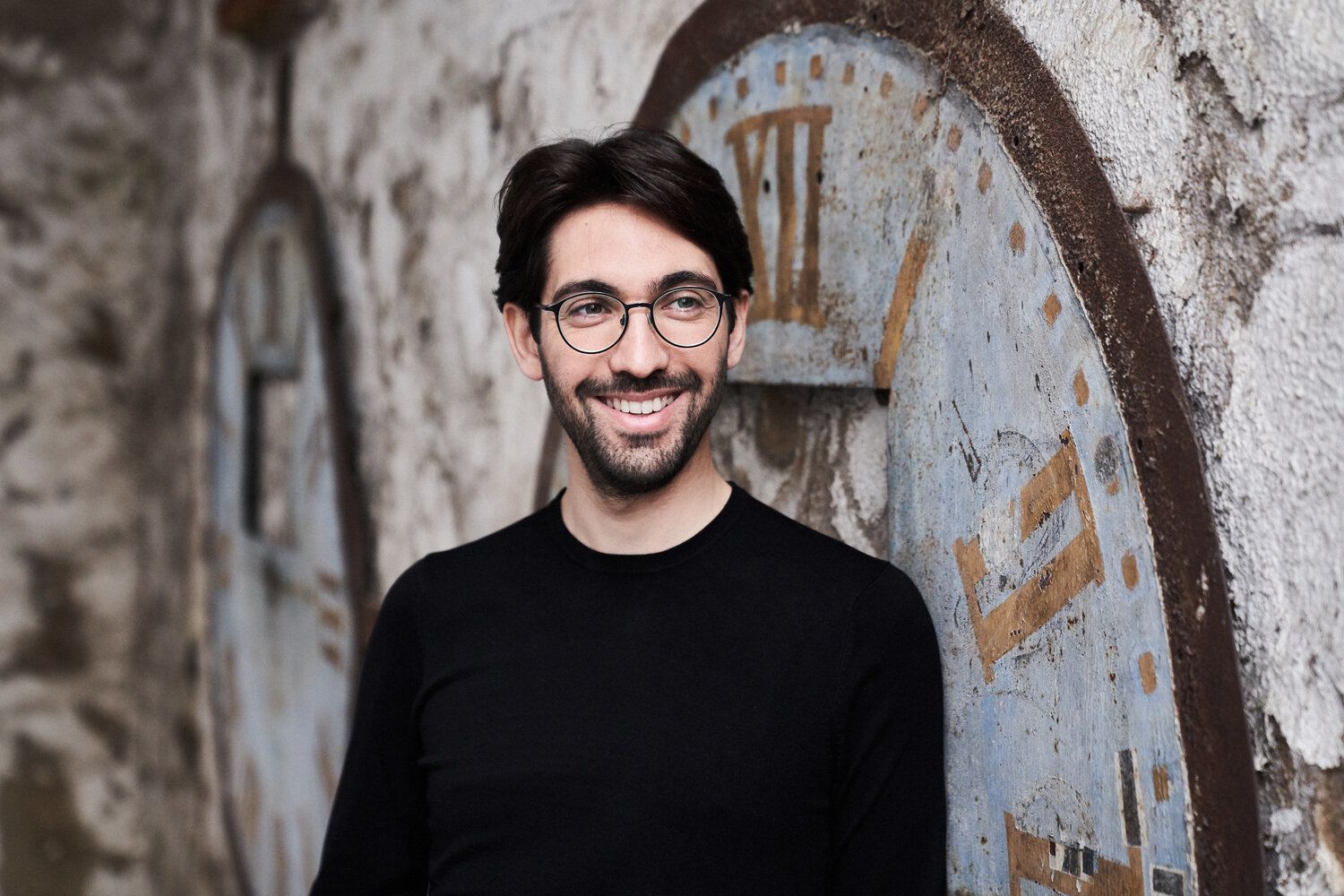
Daniel Cohen has been the General Music Director of the Staatstheater Darmstadt since 2018 and has recently renewed his contract until the 2026/27 season. Recent highlights in there include Wagner’s Lohengrin, Berg’s Lulu, Offenbach’s The Tales of Hoffmann, Richard Strauss’s Elektra and Verdi’s Otello. This season he returns to Darmstadt for new productions of Wagner’s Tristan und Isolde and Berg’s Wozzeck.
He maintains regular links with Berlin’s opera houses, having previously been Kapellmeister at the Deutsche Oper Berlin; he made his debut at the Staatsoper Unter den Linden in the 2016/17 season.
Internationally, he has appeared with the Canadian Opera Company, Israeli Opera, Palermo’s Teatro Massimo, Theater Essen and Norwegian Opera and at the Macerata Opera and Bregenz festivals.
In the symphonic field, he has conducted the Staatskapelle Berlin, the Dresden, Helsinki, Israel and Los Angeles Philharmonic orchestras, the Basel, MDR, Munich and RTÉ National Symphony orchestras, Orchestra of the Maggio Musicale in Florence, Lausanne Chamber Orchestra and Salzburg Camerata, among others. In 2021 he recorded the Hindemith Clarinet Concerto with Sharon Kam and the Frankfurt Radio Symphony Orchestra.
He also has a keen interest in contemporary music: in 2009/10 he was Pierre Boulez’s assistant at the Lucerne Festival and from 2011 to 2013 was a participant in the Lucerne Festival Academy Composer Project, which was directed by Boulez and included his debut at the KKL concert hall.
Daniel Cohen trained at London’s Royal Academy of Music and was for many years a violinist in the West–Eastern Divan Orchestra, where he was also Daniel Barenboim’s assistant. In the 2013/14 season he was a Dudamel Fellow with the Los Angeles Philharmonic, followed a year later by a position as Conducting Fellow at Tanglewood.
Ava Bahari violin

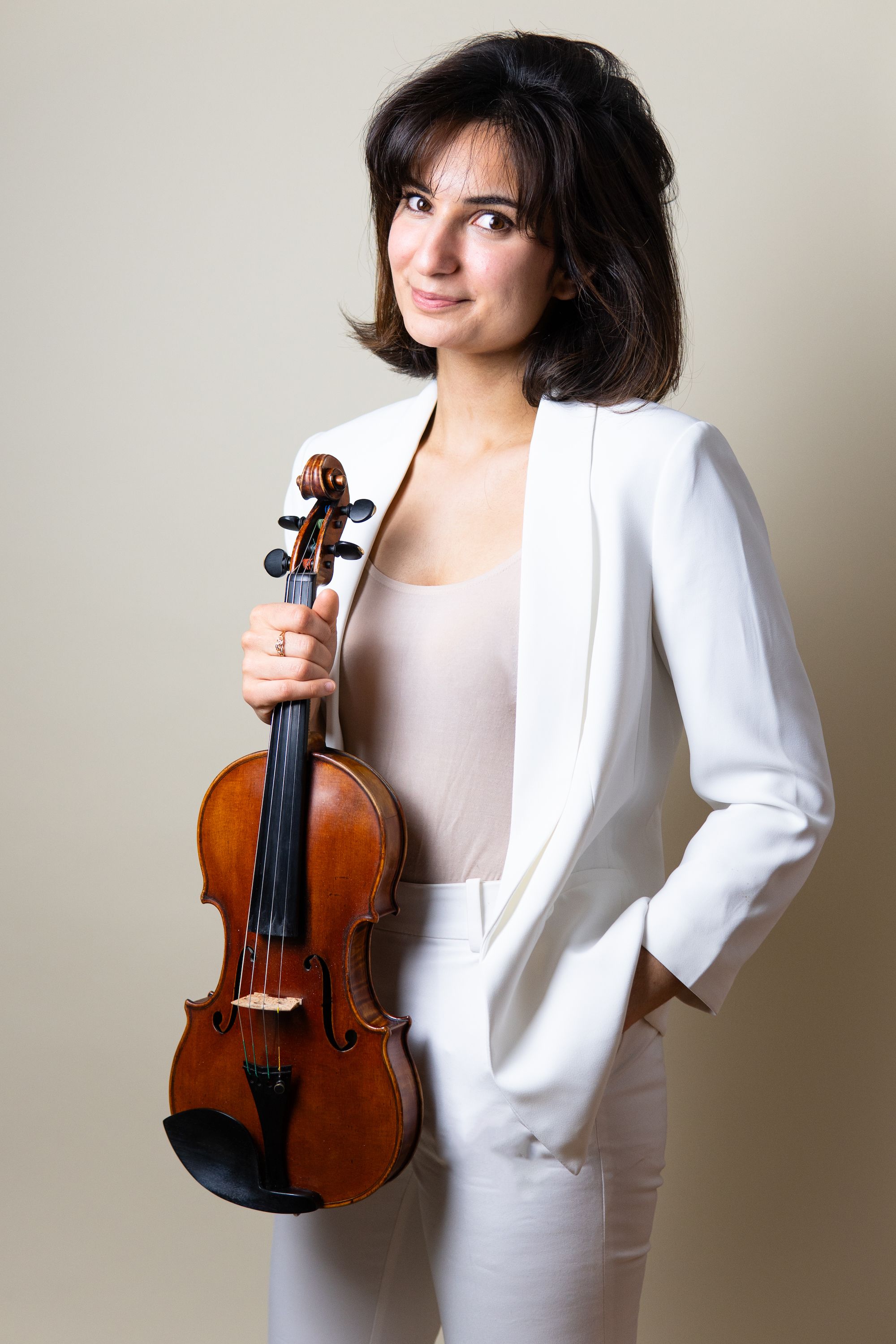
Sylvain Barrès
Sylvain Barrès
Ava Bahari is a highly accomplished Swedish violinist with a refreshing appetite for unusual repertoire. She has received numerous awards, including Third Prize at the Premio Paganini Competition in Genoa, Fourth Prize at the Concours International Tibor Varga in Sion in 2021 and First Prize at the Aurora Music Competition in Stockholm in 2019.
She has worked with conductors such as Santtu-Matias Rouvali, Pekka Kuusisto and Ryan Bancroft. She has also performed with esteemed orchestras, including the Gävle, Gothenburg, Malmö and Odense Symphony orchestras, Baden-Baden and Royal Stockholm Philharmonic orchestras and the Orchestra of Teatro Carlo Felice.
This season she is Artist-in-Residence with the Gothenburg Symphony Orchestra and performs with the Philharmonia, Helsinki Philharmonic and Iceland and Tokyo Symphony orchestras, among others.
A keen chamber musician, she has appeared at renowned festivals, including Schleswig-Holstein, Aix-en-Provence and Santander; and has collaborated with artists such as Kirill Gerstein, Daniel Hope, Adrien La Marca and Camille Thomas, to name a few.
Recital highlights include a Paganini concert at Seoul Arts Center, a recital on the ‘Stauffer’ Guarneri del Gesù of 1734 at Museo del Violino, Cremona, and a concert at the Konzerthaus Berlin.
Ava Bahari studied at the Hochschule für Musik Hanns Eisler Berlin and the Accademia Stauffer in Cremona. She plays on a violin by G. F. Pressenda, made in Turin in 1829, on loan from the Deutsche Stiftung Musikleben.
Matthew Featherstone flute


Matthew Featherstone is Principal Flute of BBC NOW and has also appeared as Guest Principal Flute with Britten Sinfonia, BBC Symphony Orchestra, London Philharmonic Orchestra, BBC Philharmonic, Royal Scottish National Orchestra, Ulster Orchestra, RTÉ Orchestra and the Academy of St Martin in the Fields.
He was awarded the Royal Over-Seas League Wind Prize in 2012. As a solo recitalist he has travelled round the UK with programmes of flute and piano repertoire launched by his work as a recitalist under the Countess of Munster Recital Scheme. He has performed concertos with orchestras in the UK, as well as in France and China. These include flute concertos by Lowell Liebermann and Nielsen and Mozart’s Concerto for flute and harp (with Catrin Finch). As a keen chamber musician, he enjoys performing with Trio Anima, his flute, harp and viola trio. They released their debut album, Between Earth and Sea,in 2022.
Matthew Featherstone also works as a beatboxer, session singer and songwriter, and released his debut EP in 2019.
BBC National Orchestra of Wales
For over 90 years, the BBC National Orchestra of Wales, the only professional symphony orchestra in Wales, has played an integral part in the cultural landscape of the country, occupying a distinctive role as both a broadcast and national orchestra, and serving as an ambassador of Welsh culture, regularly performing music created in Wales and championing Welsh composers and artists.
Part of BBC Cymru Wales and supported by the Arts Council of Wales, BBC NOW performs a busy schedule of concerts and broadcasts, working with acclaimed conductors and soloists from across the world, including its Principal Conductor, the award-winning Ryan Bancroft.
The orchestra is committed to working in partnership with community groups and charities, taking music out of the concert hall and into settings such as schools and hospitals to enable others to experience and be empowered by music. It undertakes workshops, concerts and side-by-side performances to inspire and encourage the next generation of performers, composers and arts leaders, and welcomes thousands of young people and community members annually through its outreach and education projects.
BBC NOW performs annually at the BBC Proms and biennially at the BBC Cardiff Singer of the World competition, and its concerts can be heard regularly across the BBC – on Radio 3, Radio Wales and Radio Cymru. On screen, music performed by BBC NOW can be heard widely across the BBC and other global channels, including the soundtrack and theme tune for Doctor Who, Planet Earth III, Prehistoric Planet, The Pact and Children in Need.
Based at BBC Hoddinott Hall, Cardiff Bay, BBC NOW utilises a state-of-the-art recording studio with a camera system for livestreams and TV broadcasts to bring BBC NOW’s music to a broader audience across Wales and the world. For more information about BBC NOW please visit bbc.co.uk/now
Patron
HM King Charles III KG KT PC GCB
Principal Conductor
Ryan Bancroft
PrincipalGuest Conductor
Jaime Martín
Conductor Laureate
Tadaaki Otaka CBE
Composer-in-Association
Gavin Higgins
First Violins
Zhivko Georgiev
Anya Birchall
Rebecca Totterdell
Second Violins
Anna Smith *
Gary George-Veale
Frances Richards
Violas
Ania Leadbeater
Charlotte Limb
Cellos
Tabitha Selley
Jonathan Few
Double Basses
Antonia Bakewell
Ben Havinden Williams
Callum Duggan
Flutes
Piccolo
Oboes
Amy Till
Cor anglais
Clarinets
Jennie Joy Porton
Bass Clarinet
Alto Saxophone
Jennie Joy Porton
Bassoons
Contrabassoon
Horns
Trumpets
Corey Morris †
Trombones
Dafydd Thomas †
Bass Trombone
Tuba
Timpani
Percussion
Harry Lovell-Jones
Harp
* Section Principal
† Principal
‡ Guest Principal
# Assistant String Principal
The list of players was correct at the time of publication
Director Lisa Tregale
Orchestra Manager Liz Williams
Assistant Orchestra Manager Nick Olsen **
Orchestra Personnel ManagerKevin Myers
Business Coordinator Georgia Dandy **
Orchestra Administrator Eleanor Hall +**
Head of Artistic Planning and ProductionMatthew Wood
Artists and Projects Manager Victoria Massocchi **
Orchestra Librarian Naomi Roberts **
Producer Mike Sims
Broadcast Assistant Emily Preston
Head of Marketing and Audiences Sassy Hicks
Marketing Coordinator Amy Campbell-Nichols +
Digital Producer vacancy
Social Media Coordinator Harriet Baugh
Education Producers Beatrice Carey, Rachel Naylor maternity cover
Audio Supervisors Simon Smith, Andrew Smillie
Production Business Manager Lisa Blofeld
Stage and Technical Manager vacancy
Assistant Stage and Technical Manager Josh Mead +
+ Green Team member
** Diversity & Inclusion Forum