
Expressions of Folk
Thursday 1/5/25, 7.30pm
BBC Hoddinott Hall, Cardiff
Friday 2/5/25, 7.30pm
Brangwyn Hall, Swansea


Gustav Holst
Capriccio 6’
Igor Stravinsky
Symphonies of Wind Instruments 12’
Sir James MacMillan
Where the Lugar meets the Glaisnock world premiere c23’
INTERVAL: 20 minutes
Ralph Vaughan Williams
In the Fen Country 14’
Igor Stravinsky
Symphony in Three Movements 22’
Sir James MacMillan conductor
David Childs euphonium
BBC Hoddinott Hall is certified by EcoAudio and we’re proud to be supporting the BBC in becoming a more sustainable organisation. For more information on the BBC’s net-zero transition plan and sustainability strategy please visit https://www.bbc.co.uk/aboutthebbc/documents/bbc-net-zero-transition-plan-2024.pdf




The concert in Cardiff is being broadcast live by BBC Radio 3 in Radio 3 in Concert and via the European Broadcasting Union. The concert in Swansea is being recorded for future broadcast in Classical Live; they will be available for 30 days after broadcast via BBC Sounds, where you can also find podcasts and music mixes.
Introduction
Welcome to tonight’s concert, for which we’re delighted to welcome Sir James MacMillan to conduct a programme that juxtaposes 20th-century music with a brand new concerto.
We begin with a rarity by Holst: the innocent title of his late Capriccio gives little hint of the mischievously subversive delights within.
Subversion is present too in the pair of Stravinsky works we hear tonight, both of which offer an individual take on the meaning of the word ‘symphony’. In his Symphonies of Wind Instruments Stravinsky takes the Ancient Greek sense of the word – that of ‘sounding together’ – and turns it into a tour de force of wind-only textures. In the Symphony in Three Movements, by contrast, each one of its sections explores a different way of moving, with a march, a slow dance and a finale that begins at a moderate tempo but gradually speeds up.
The title of Sir James MacMillan’s euphonium concerto, Where the Lugar meets the Glaisnock, takes us back to the town where he grew up, and memories of his grandfather, who was a coal miner and an amateur euphonium player. Tonight’s premiere is given by David Childs, dedicatee of the work and a figure renowned for his advocacy of the instrument.
Vaughan Williams’s early In the Fen Country offers a hugely evocative orchestral rendering of a landscape typified by huge skies.
Enjoy!
Lisa Tregale
Director
Please respect your fellow audience members and those listening at home: mobile phones may be kept on but on silent and with the brightness turned down; other electronic devices should be switched off during the performance. Photography and recording are not permitted.
Gustav Holst (1874–1934)
Capriccio(1932)

Holst’s Capriccio, composed in New York in 1932, begins conventionally enough, with an elegiac melody on the solo viola, gradually joined by other instruments, and expanding richly over a chordal backdrop. So far, so pastoral. Yet things soon become as eccentric as the work’s original title – Mr Shilkret’s Maggot: Nathanial Shilkret was the leader of a New York radio orchestra, who had asked Holst for a piece based on folk tunes. The title also quite probably refers to a 1927 novel by Sylvia Townsend Warner entitled Mr Fortune’s Maggot, which is prefaced with the epigraph ‘MAGGOT: a whimsical or perverse fancy’.
Following the opening gambit, and in a whimsical and perverse change of mood, Holst introduces the marimba, piano and glockenspiel alongside fragments of melody. The sound of a marching band emerges, then vanishes, then appears again; later on, lush strings and harp deliver a soaring melody straight out of Hollywood. Towards the end, piano and marimba join forces with a solo violin before – and why not? – a swaggering brass conclusion. Imogen Holst later published the work, with the less enigmatic title of Capriccio.
Programme note © Lucy Walker
Igor Stravinsky (1882–1971)
Symphonies of Wind Instruments
(1920, rev. 1947)
Stravinsky would sometimes use the word ‘symphony’ in the Ancient Greek sense, meaning simply ‘sounding together’, rather than a traditional developing form. The Symphonies of Wind Instruments is the most extreme example of this, akin to a compositional treatise on how to layer the orchestral woodwind and brass in striking and colourful ways. It is constructed from highly contrasted blocks of sound, which are often quite static and austere in effect.
Stravinsky wrote Symphonies a few years after The Rite of Spring, and concurrently with his initial attempts to complete Les noces, for which he struggled to decide on an instrumentation (he eventually settled on a solution with no wind instruments, and in fact no sustaining instruments at all – the complete inverse of Symphonies).
Like those two great ballets, Symphonies is interlaced with folk tunes (or rather, authentic-sounding forgeries that Stravinsky wrote himself). These mimic the playful stress patterns of Russian speech, and create unpredictable rhythms and changes in metre. While this technique conjures up chaos and brutality in The Rite and a wild celebratory atmosphere in Les noces, here these melodies are melancholic and eerie, meandering between the denser textures.
Symphonies ends with a reworking of Stravinsky’s recent piano piece in memory of Debussy, who had died in 1918, giving this otherwise abstract piece an elegiac profundity and, perhaps more importantly for Stravinsky, the sense of a ritual or, better still, a rite.
Programme note © Tom Owen
Sir James MacMillan (born 1959)
Where the Lugar meets the Glaisnock
(2024)
world premiere
David Childseuphonium
The title of this work refers to the little Ayrshire town of Cumnock where I grew up. Two rivers (the Lugar and the Glaisnock) meet in this place. This is a concertante piece for solo euphonium and strings, and is an affectionate recollection of my early years there. It is dedicated to the memory of my grandfather George Loy, a coal miner in the town and an amateur euphonium player who played in colliery bands in the area in the first half of the 20th century. The piece is also dedicated to the soloist David Childs who commissioned it.
Written in one through-composed movement lasting about 25 minutes it begins with a slow, expressive and solitary solo from the euphonium before being joined by some solo string players. The music begins to ebb and flow as the full ensemble join in. The mood becomes more animated before going through the first of many metric modulations which throw the music forward into faster tempos.
Gradually the music becomes more and more energetic before a series of loud, violent chords takes us back to the opening slow tempo. Here now, though, the melodies seem more sonorous and song-like, evoking the folk song and plainchant which have figured so much in my music over the years.
The metric modulations pick up again, pushing the music forward into ever faster territory. Slower writing intervenes again, chorale-like and ecstatic on the strings but eventually accompanying the soloist with soft, ponderous chords which rise from the lowest to the highest orchestral sounds. The opening melody returns for a final time before the music culminates in an unexpected coda – joyous, motoric and repetitive on the strings with frantic, virtuosic bursts of energy on the euphonium. The final moments are serene.
Programme note © Sir James MacMillan
INTERVAL: 20 minutes
Ralph Vaughan Williams (1872–1958)
In the Fen Country(1904, rev. 1935)
Vaughan Williams’s In the Fen Country is a relatively short piece, and was considered somewhat slight, even inauthentic, at its first performance in 1909 (‘Though the theme is fragrant of the soil,’ wrote The Times reviewer, ‘it appears to be only in the style of folk-music, not an actual specimen.’) Yet in hindsight it represents a very significant point in Vaughan Williams’s output; prior to its composition in 1904 orchestral works in the composer’s catalogue are marked as lost, destroyed or withdrawn. In the Fen Country was the first to survive, and Vaughan Williams revised it several times over the years.It was followed by the Norfolk Rhapsodies, the famous Fantasia on a Theme by Thomas Tallis and the extraordinary roster of nine symphonies. Though clearly influenced by late Romantic German composers, particularly Richard Strauss, this ‘fragrant’ piece bears early, very distinctive traces of Vaughan Williams’s own voice.
As The Times reviewer noted, it is folk-like rather than folk-based. It opens with an evocation of a flat, open landscape: a melancholy solo melody, played with appropriate plangency by the cor anglais, featuring a distinctive semiquaver ‘turn’. The cor is joined by solo viola, then clarinet and horn whose solitary themes stand in expressive contrast to the fuller orchestral textures. Other elements drift in and out of focus, such as a horn chorale in sumptuous triads, which periodically travels to other sections of the ensemble. A sultry interlude for high strings and pulsing woodwind leads to a luxuriously scored section in a dreamy waltz-time. A horn call brings the attention back to the stark landscape, and a subtle, exquisite fade towards the end.
Programme note © Lucy Walker
Igor Stravinsky
Symphony in Three Movements
(1942–5)
1 [Allegro]
2 Andante –
3 Con moto
Every time Stravinsky received a commission from an orchestra he responded with a symphony: the Symphony of Psalms (1930) for Boston, the Symphony in C (1938–40) for Chicago, the Symphony in Three Movements for New York. All of them are titled meaningfully, the Symphony in Three Movements presenting us indeed with three movements but also with three different ways of moving: march, slow dance, march–jog–race.
In his programme note for the first performance – which he himself conducted, in Carnegie Hall on 24 January 1946 – Stravinsky uncharacteristically remarked that the symphony had ulterior meanings and motivations, that it reflected ‘this our arduous time of sharp and shifting events, of despair and hope, of continual torments, of tension, and at last cessation and relief’. The first movement, he later said, was prompted by a documentary film of scorched-earth tactics in China, the third by ‘newsreels and documentaries … of goose-stepping soldiers’ and then by ‘the rise of the Allies’. There was also a film behind the slow movement, so Stravinsky said, giving its source as a draft he had made for the apparition of the Virgin in 1943’s The Song of Bernadette, on which he was replaced as composer by Alfred Newman.
The war may have influenced not only the images and circumstances of the symphony but also its style, since the threat to Russia seems to have reawakened the exiled Stravinsky’s sense of himself as a Russian composer. Soviet music, which he had scorned, began to seem relevant: in the summer of 1942, halfway through the first movement, he listened to a radio broadcast of Shostakovich’s ‘Leningrad’ Symphony. He also returned to Russian folk song during this period, and in the symphony seems to have been remembering his Russian ballets of 30 years or so before: The Rite of Spring is the only precedent for the sustained instrumental density and clamour of the outer movements, and the prominence of the piano in the orchestra recalls Petrushka.
Piano and huge chords at the opening make the march one of giant, cracked bells, alternating with gentler, more delicately scored music. The two are not so much first and second subjects as segments in a mosaic.
In the second movement the weightier instruments (trumpets, trombones and timpani) are omitted, and the solo piano is replaced by a solo harp. More than St Bernadette’s vision, the movement suggests an Arcadian calm.
The finale, with piano and harp together, has a variety of episodes that seem to be there only to delay the dinning close.
Programme note © Paul Griffiths
Help Us Improve Our Online Programmes.
Please take this 5-minute survey and let us know what you think of these notes.
Programme Survey
You may also like:
Notes of Love
Thursday 29/5/25, 7.00pm
Symphony Hall, Birmingham
Friday 30/5/25, 7.30pm
Brangwyn Hall, Swansea
Bartók Violin Concerto No. 1
Mahler Symphony No. 5
Ryan Bancroftconductor
James Ehnes violin
CAPTIVATING | WHIMSICAL | SPELLBINDING
There has been a long history of composers writing musical gifts for the women they loved, and tonight’s Season Closing Concert features two of the finest.
Unrequited love pervades in Bartók’s Violin Concerto. Written for the great Hungarian violinist Stefi Geyer, who was Bartók’s muse, this two-movement concerto is a musical showcase of her personality – lamenting melodies and whimsical leaps abound in this deeply personal rhapsodic outpouring. To perform it, world-renowned violinist James Ehnes returns to BBC NOW by popular demand.
Unlike Bartók, Mahler’s love was met, and in a token of love for his new wife, Alma, his Fifth Symphony blazes with trumpet fanfares, dance and joy – not to mention the radiant slow movement, surely his love song for his beloved.
Songs of Destiny
BSL Interpretation
Friday 20/6/25, 7.30pm
BBC Hoddinott Hall, Cardiff
Brahms Serenade No. 2
Brahms Schicksalslied
Stravinsky Symphony of Psalms
Ryan Bancroft conductor
BBC National Chorus of Wales
EXQUISITE | FERVENT | PICTORIAL
If historically serenades were intended as music for entertainment, then Brahms has most definitely excelled in his Serenade No. 2. This early work oozes Brahmsian character from the outset with its lilting warmth, lively cross rhythms, and plenteous melody to charm the listener.
Similarly characteristic, but more brooding in nature is Brahms’s heady setting of the poem Schicksalslied by Friedrich Hölderlin. In two verses contrasting the lives of the eternally blissful with those subjected to cruel fate, Brahms moves between the light and airy versus the tempestuous. Stravinsky, by contrast, uses modes reminiscent of traditional Gregorian chant, paired with fugal writing and ecstatic dance motifs, to portray the text of psalms in a pure work of genius, his Symphony of Psalms! To conduct BBC National Orchestra and Chorus of Wales in their final concert of the Cardiff season we’re delighted to welcome back Principal Conductor, Ryan Bancroft.
Biographies
Sir James MacMillanconductor

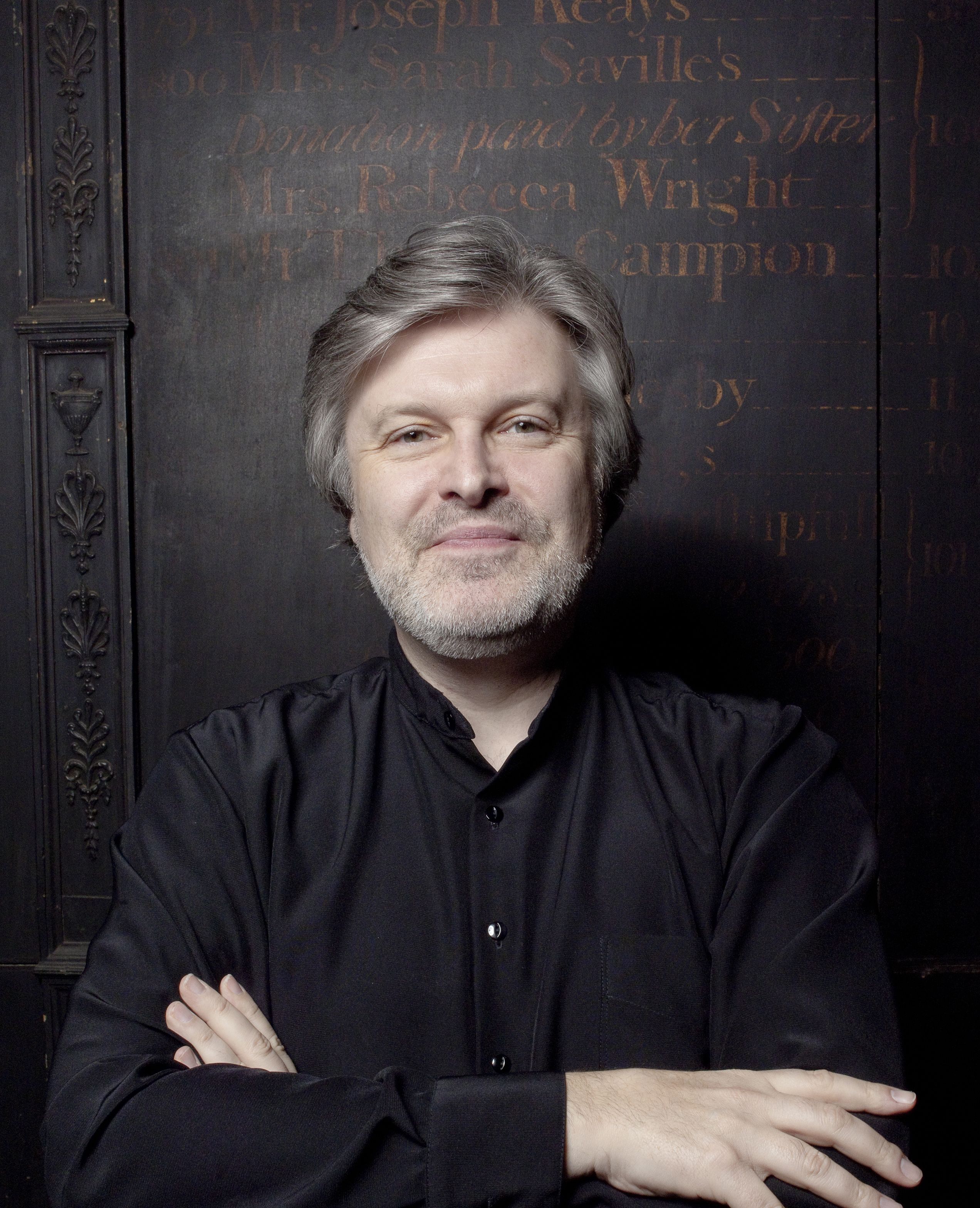
Philip Gatward
Philip Gatward
Sir James MacMillan is one of today’s most successful composers and performs internationally as a conductor. His musical language is flooded with influences from his Scottish heritage, Catholic faith, social conscience and close connection with Celtic folk music.
He first became internationally recognised after the success of The Confession of Isobel Gowdie at the BBC Proms in 1990. His prolific output has since been performed and broadcast around the world. His major works include percussion concerto Veni, Veni, Emmanuel, which has received close to 500 performances, a cello concerto for Mstislav Rostropovich and five symphonies. Recent major works include his Percussion Concerto No. 2 for Colin Currie, Violin Concerto No. 2 for Nicola Benedetti and his Symphony No. 5, written for The Sixteen, which was premiered at the Edinburgh International Festival in 2019. Most recently, several new works for chorus and orchestra have received their first performances, including his ChristmasOratorio given by the London Philharmonic in 2021 and Timotheus, Bacchus and Cecilia, premiered by the Cincinnati Symphony in 2023.
Sir James MacMillan enjoys a successful career as a conductor, and is praised for the composer’s insight he brings to each score. Conducting highlights include the Munich, Netherlands Radio and Rotterdam Philharmonic orchestras and the Baltimore, BBC, Danish Radio, Frankfurt Radio, Gothenburg and St Louis Symphony orchestras. He was Principal Guest Conductor of the Netherlands Radio Chamber Philharmonic until 2013 and Composer/Conductor of the BBC Philharmonic until 2009.
Highlights of the 2024/25 season include the world premiere of his Concerto for Orchestra (co-commissioned by the London Symphony Orchestra, Melbourne Symphony, Royal Stockholm Philharmonic, Auckland Philharmonia and Singapore Symphony) by the London Symphony Orchestra, conducted by Sir Antonio Pappano; and tonight’s world premiere of his euphonium concerto, Where the Lugar meets the Glaisnock. Elsewhere this season, he conducts the Hungarian National Philharmonic in his Christmas Oratorio, BBC Scottish Symphony in a celebration of Cumnock Tryst composers, Minnesota Orchestra, VocalEssence’s Festival of MacMillan, BBC Singers and Tallinn Chamber Orchestra. This year’s Stockholm Philharmonic Composer Festival is dedicated to MacMillan.
He founded music festival The Cumnock Tryst in 2014, which takes place annually in his native Ayrshire. In 2024, the festival celebrated its 10th anniversary by launching an International Summer School for Composers, directed by MacMillan and open to young composers worldwide.
He has conducted many of his own works on disc for a variety of record labels.
He was awarded a CBE in 2004 and a knighthood in 2015. He was appointed a Fellow of the Ivors Academy in 2024.
David Childs euphonium

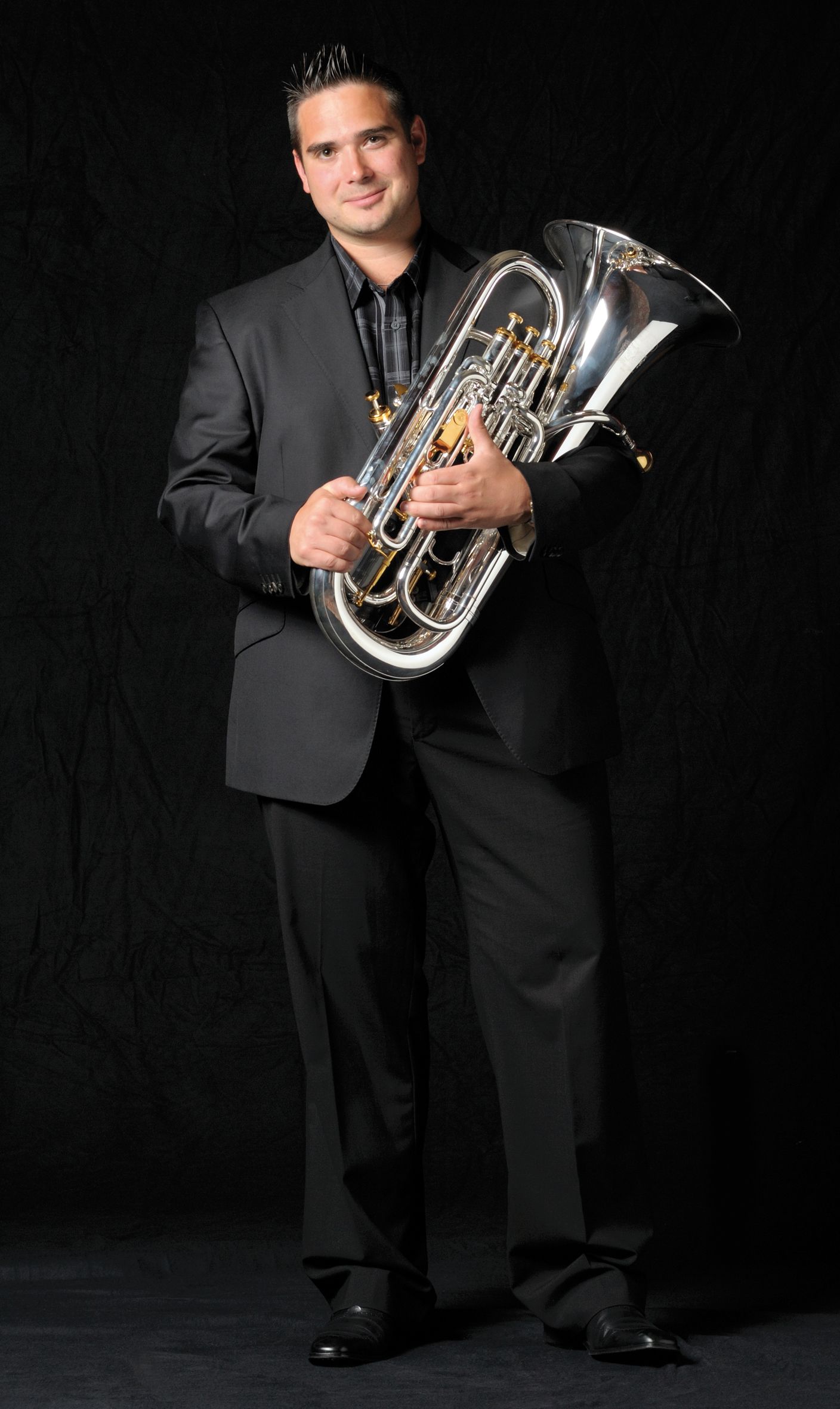
David Childs is regarded as one of the finest brass musicians of his generation, touring extensively throughout Asia, continental Europe and North America.
He has appeared as soloist with the BBC and RTÉ Concert orchestras, BBC, Royal and Royal Liverpool Philharmonic orchestras, Philharmonie Baden-Baden, Sinfonia Cymru, Welsh National Opera, Vancouver Symphony Orchestra and Orchestra da Camera Fiorentina, as well as with many of the finest brass bands and military bands in the UK and USA. He has made solo appearances at the Singapore, Harrogate, Cheltenham, Melbourne and New York festivals and at the BBC Proms. He has also given solo recitals at Wigmore Hall, Purcell Room and Bridgewater Hall, and performed concertos at the Royal Concertgebouw, Royal Albert Hall, Southbank Centre, Symphony Hall, Birmingham, Lincoln Center and Carnegie Hall, New York.
He is a keen advocate of new music and has premiered 16 concertos for euphonium. In 2022 he gave the first public performance of a new arrangement for euphonium of Ralph Vaughan Williams’s Tuba Concerto at the Last Night of the Welsh Proms.
He has been given many awards over the course of his career. He has also received several accolades as a recording artist, including two ITEA Excellence in Recording Awards, and can be heard on several labels.
He is a former member of several brass band ensembles, including the National Youth Brass Band of Great Britain, National Youth Brass Band of Wales, Brighouse and Rastrick, and Cory Band with which he was Principal Euphonium for 10 years under the baton of his father, Robert Childs.
David Childs is now a Distinguished Research Professor of Euphonium at the University of North Texas and holds positions as Visiting Professor at Tokyo’s Senzoku Gakuen College of Music and International Visiting Tutor at the Royal Welsh College of Music & Drama, where he was made a fellow last year. He is a founding member of Eminence Brass chamber ensemble.
BBC National Orchestra of Wales
For over 90 years, the BBC National Orchestra of Wales, the only professional symphony orchestra in Wales, has played an integral part in the cultural landscape of the country, occupying a distinctive role as both a broadcast and national orchestra, and serving as an ambassador of Welsh culture, regularly performing music created in Wales and championing Welsh composers and artists.
Part of BBC Cymru Wales and supported by the Arts Council of Wales, BBC NOW performs a busy schedule of concerts and broadcasts, working with acclaimed conductors and soloists from across the world, including its Principal Conductor, the award-winning Ryan Bancroft.
The orchestra is committed to working in partnership with community groups and charities, taking music out of the concert hall and into settings such as schools and hospitals to enable others to experience and be empowered by music. It undertakes workshops, concerts and side-by-side performances to inspire and encourage the next generation of performers, composers and arts leaders, and welcomes thousands of young people and community members annually through its outreach and education projects.
BBC NOW performs annually at the BBC Proms and biennially at the BBC Cardiff Singer of the World competition, and its concerts can be heard regularly across the BBC – on Radio 3, Radio Wales and Radio Cymru. On screen, music performed by BBC NOW can be heard widely across the BBC and other global channels, including the soundtrack and theme tune for Doctor Who, Planet Earth III, Prehistoric Planet, The Pact and Children in Need.
Based at BBC Hoddinott Hall, Cardiff Bay, BBC NOW utilises a state-of-the-art recording studio with a camera system for livestreams and TV broadcasts to bring BBC NOW’s music to a broader audience across Wales and the world. For more information about BBC NOW please visit bbc.co.uk/now
Patron
HM King Charles III KG KT PC GCB
Principal Conductor
Ryan Bancroft
PrincipalGuest Conductor
Jaime Martín
Conductor Laureate
Tadaaki Otaka CBE
Composer-in-Association
Gavin Higgins
First Violins
Jens Lynen
Gwenllian Hâf MacDonald
Terry Porteus
Suzanne Casey
Žanete Uškāne
Carmel Barber
Alejandro Trigo
Juan Gonzalez
Ruth Heney **
Kerry Gordon-Smith
Anna Cleworth
Zhivko Georgiev
Second Violins
Anna Smith *
Ros Butler
Sheila Smith
Michael Topping
Lydia Caines **
Katherine Miller
Roussanka Karatchivieva
Vickie Ringguth
Beverley Wescott
Joseph Williams
Amy Fletcher
Jane Sinclair
Violas
Alex Thorndike #
Tetsuumi Nagata
Peter Taylor
Robert Gibbons
Catherine Palmer
Laura Sinnerton
Lowri Taffinder
Lydia Abell
Anna Growns
Cellos
Reinoud Ford ‡
Raphael Lang
Sandy Bartai
Keith Hewitt
Carolyn Hewitt
Rachel Ford
Alistair Howes
Kathryn Graham
Double Basses
Christopher Wescott
Emma Price
Yat Hei Lee
Thea Sayer
Nigel Smith
Flutes
John Hall †
Lindsey Ellis
Piccolo
Oboes
Catriona Lockhart
Amy McKean †
Cor Anglais
Amy McKean
Clarinets
Isaac Prince
Lenny Sayers
Bass Clarinet
Lenny Sayers †
Bassoons
Georgie Powell
Alex Davidson
Contrabassoon
Alex Davidson
Horns
Meilyr Hughes
Dave Ransom
Tom Taffinder
Craig MacDonald
Trumpets
Robert Samuel
Corey Morris †
Trombones
Dafydd Thomas †
Bass Trombone
Tuba
Timpani
Percussion
Phil Girling
Andrea Porter
Harp
Deian Rowlands
Piano/Celesta
Catherine Roe Williams
* Section Principal
† Principal
‡ Guest Principal
# Assistant String Principal
The list of players was correct at the time of publication
Director Lisa Tregale
Orchestra Manager Liz Williams
Assistant Orchestra Manager Nick Olsen **
Orchestra Personnel ManagerKevin Myers
Business Coordinator Georgia Dandy **
Orchestra Administrator Eleanor Hall +**
Head of Artistic Planning and Productionvacancy
Artists and Projects Manager Victoria Massocchi **
Orchestra Librarian Naomi Roberts **
Producer Mike Sims
Broadcast Assistant Emily Preston
Head of Marketing and Audiences Sassy Hicks
Marketing Coordinator Amy Campbell-Nichols +
Digital Producer vacancy
Social Media Coordinator Harriet Baugh
Education Producers Beatrice Carey, Rachel Naylor maternity cover
Audio Supervisors Simon Smith, Andrew Smillie
Production Business Manager Lisa Blofeld
Stage and Technical Manager Josh Mead +
Assistant Stage and Technical Manager vacancy
+ Green Team member
** Diversity & Inclusion Forum