Lesley’s Lunchtime Concerts
Thursday 3/7/25, 2.00pm
BBC Hoddinott Hall, Cardiff
Friday 4/7/25, 2.00pm
Newport Cathedral


Joseph Haydn Symphony No. 64, ‘Tempora mutantur’ 21’
Caroline Shaw Punctum 11’
Antonín Dvořák Serenade for Strings 27’
There is no interval
Lesley Hatfield director/violin
BBC Hoddinott Hall is certified by EcoAudio and we’re proud to be supporting the BBC in becoming a more sustainable organisation. For more information on the BBC’s net-zero transition plan and sustainability strategy please visit https://www.bbc.co.uk/aboutthebbc/documents/bbc-net-zero-transition-plan-2024.pdf


The Hoddinott Hall concert is being recorded by BBC Radio 3 for future broadcast in Classical Live; it will be available for 30 days after broadcast via BBC Sounds, where you can also find podcasts and music mixes.
Introduction
Welcome to today’s concert, the last of our current season, in which our beloved leader Lesley Hatfield takes to the spotlight to direct the reduced forces of BBC NOW from the violin.
She begins with Haydn’s Symphony No. 64, a work whose nickname is more obscure than most – ‘Tempora mutantur’translates as ‘The Times are Chang’d’ and perhaps that is reflected in a work that is even more full of sudden shifts of mood, and swerves of musical direction than most.
Caroline Shaw’s Punctum was originally written for her own string quartet and takes inspiration from a specific photograph; today we hear it in an expanded version for string orchestra.
To end, Dvořák’s Serenade for Strings, a genial work full of beguiling melodies and catchy rhythms.
Enjoy – and I look forward to seeing you next season!
Lisa Tregale
Director
Please respect your fellow audience members and those listening at home: mobile phones may be kept on but on silent and with the brightness turned down; other electronic devices should be switched off during the performance. Photography and recording are not permitted.
Joseph Haydn (1732–1809)
Symphony No. 64 in A major, ‘Tempora mutantur’ (c1773)

1 Allegro con spirito
2 Largo
3 Menuet: Allegretto – Trio
4 Finale: Presto
Haydn composed over 100 symphonies, so it’s no surprise that some have remained better known than others. Those numbered in the fifties and sixties would appear currently to be among the least often performed, despite a former popularity that bequeathed handy identifying nicknames to some of them: ‘L’Impériale’ (No. 53), ‘The Schoolmaster’ (No. 55, once a favourite of Benjamin Britten’s), ‘Fire’ (No. 59), ‘Il Distratto’ (No. 60), ‘La Roxelane’ (No. 63) and ‘Laudon’ (No. 69). Perhaps the most enigmatic title of all, though, is ‘Tempora mutantur’, a label that became attached to Symphony No. 64, composed around 1773.
The full Latin tag is ‘Tempora mutantur, nos et mutamur in illis: Quomode? Fit semper tempore peior homo’ – ‘The Times are Chang’d, and in them Chang’d are we: How? Man, as Times grow worse, grows worse, we see’ – an epigram by the Welsh poet and schoolmaster John Owen (c1564–1622), who became successful enough through his published Epigrammata to be buried at St Paul’s Cathedral. It’s unclear how ‘Tempora mutantur’ relates directly to the symphony, although it is worth noting that, even by Haydn’s standards of wit and eccentricity, the work revels more than most in pulling the rug out from under its listeners’ expectations.
This is the case most notably in the slow movement, which starts out as a typically Haydnesque hymn-like Largo for muted strings but seems continually unable to finish what it starts – as if repeatedly losing its train of thought mid-sentence. Strange silences, interjections and melodic non sequiturs add to the disconcerting atmosphere until it draws to its oddly inconclusive close: time out of joint, perhaps.
As for the other movements, the opening Allegro con spirito pits a lyrical question for violins against a terse rejoinder for full orchestra – reversing the more common loud–soft launch – but then largely ignores the lyrical music to make great play instead of the lower strings’ accompaniment figure. The Menuet gathers itself together after the distracted Largo with a lusty theme based on the characteristic ‘Scotch snap’ rhythm heard at the beginning, while high horns give the central Trio a bracing outdoorsy feel. The Finale is a rondo, but one in which successive sections overlap and interrupt each other, veering off into unexpected minor keys with shock sudden dynamic contrasts. And, Haydn being Haydn, he knows just when to sign off, always leaving his audience wanting more.
Programme note © David Threasher
Caroline Shaw (born 1982)
Punctum (2009, arr. 2022)
Punctum is essentially an exercise in nostalgia, inspired by Roland Barthes’s description of the ‘unexpected’ in photographs and in particular by his extended description of the elusive ‘Winter Garden’ photo in his 1980 book Camera Lucida. Through modular sequences strung together out of context, the piece explores a way of saturating the palette with classicism while denying it form, and of disturbing the legibility of a harmonic progression in order to reinforce it later.
You could also say the piece is about the sensation of a particular secondary dominant in Bach’s St Matthew Passion.
Programme note © Caroline Shaw
Antonín Dvořák (1841–1904)
Serenade for Strings in E major(1875)
1 Moderato
2 Tempo di valse
3 Scherzo: Vivace
4 Larghetto
5 Finale: Allegro vivace
Although the origins of the serenade are to be found in musical performances intended to woo a lady, it wasn’t long before the term became associated with multi-movement instrumental works designed to give a relaxed and pleasant listening experience.
It is probably significant that Dvořák wrote his Serenade for Strings at a stage when he had already spent the best part of a decade writing weighty symphonies in a bid to show that he could lay claim to belong to the Classical succession of composers such as Beethoven, Schubert and Mendelssohn. But on reaching his early thirties, and having produced four ambitious symphonies (only one of which had by then been performed in its entirety), he seems to have taken stock of what he had so far achieved and to have decided that a slight change of direction might be required.
Programme note © Paula Kennedy
Help Us Improve Our Online Programmes.
Please take this 5-minute survey and let us know what you think of these notes.
Programme Survey
If you enjoyed today’s concert you may also like:
Beethoven 5
Sunday 21/9/25, 3.00pm
The Riverfront, Newport
Williams Hen Walia
Dvořák Violin Concerto
Beethoven Symphony No. 5
Nil Venditti conductor
Inmo Yang violin
DRAMATIC | STRIKING | CHARACTERFUL
BBC NOW audience favourite Nil Venditti takes to the podium in Newport this September with a programme of popular classics.
Barry-born Grace Williams’s Hen Walia takes its inspiration from folk tunes with the lullaby Huna Blentyn as its shining centrepiece. After thrilling audiences during his BBC NOW debut we’re delighted to welcome violinist Inmo Yang back to perform Dvořák’s warmly Romantic Violin Concerto. We end with a work that boasts possibly the most famous opening of any piece of classical music – Beethoven’s Fifth Symphony. Driving rhythms combine with drama, darkness and brilliance in this ultimate symphonic masterpiece.
Marches & Melodies
Thursday 25/9/25, 7.30pm
BBC Hoddinott Hall, Cardiff
Schumann, arr. Donal Bannister Four Marches
Finzi Clarinet Concerto
Franck Symphony in D minor
Gergely Madaras conductor
Nicholas Carpenter clarinet
RESPLENDENT | WARMING | JOYOUS
In a programme putting our fantastic musicians front and centre we kick off our 2025/26 season in BBC Hoddinott Hall with a showcase for our brass section – Schumann’s Four Marches, originally written for solo piano, makes a mighty impression in this arrangement by our Principal Trombonist Donal Bannister. Finzi’s Clarinet Concerto, which was premiered in Hereford at the 1949 Three Choirs Festival, remains one of his most popular works; to perform this piece, by turns soulful and virtuosic, BBC NOW’s Principal Clarinet Nicholas Carpenter steps into the spotlight.
Conductor Gergely Madaras finishes the evening with Franck’s Symphony in D minor – his last major work and only symphony. The gently lyrical and radiantly joyous themes of the first movement contrast with a second movement that fuses pizzicato strings beneath a haunting cor anglais solo with two scherzo trios. The symphony’s finale ingeniously reworks previous themes, to joyous effect.
Biographies
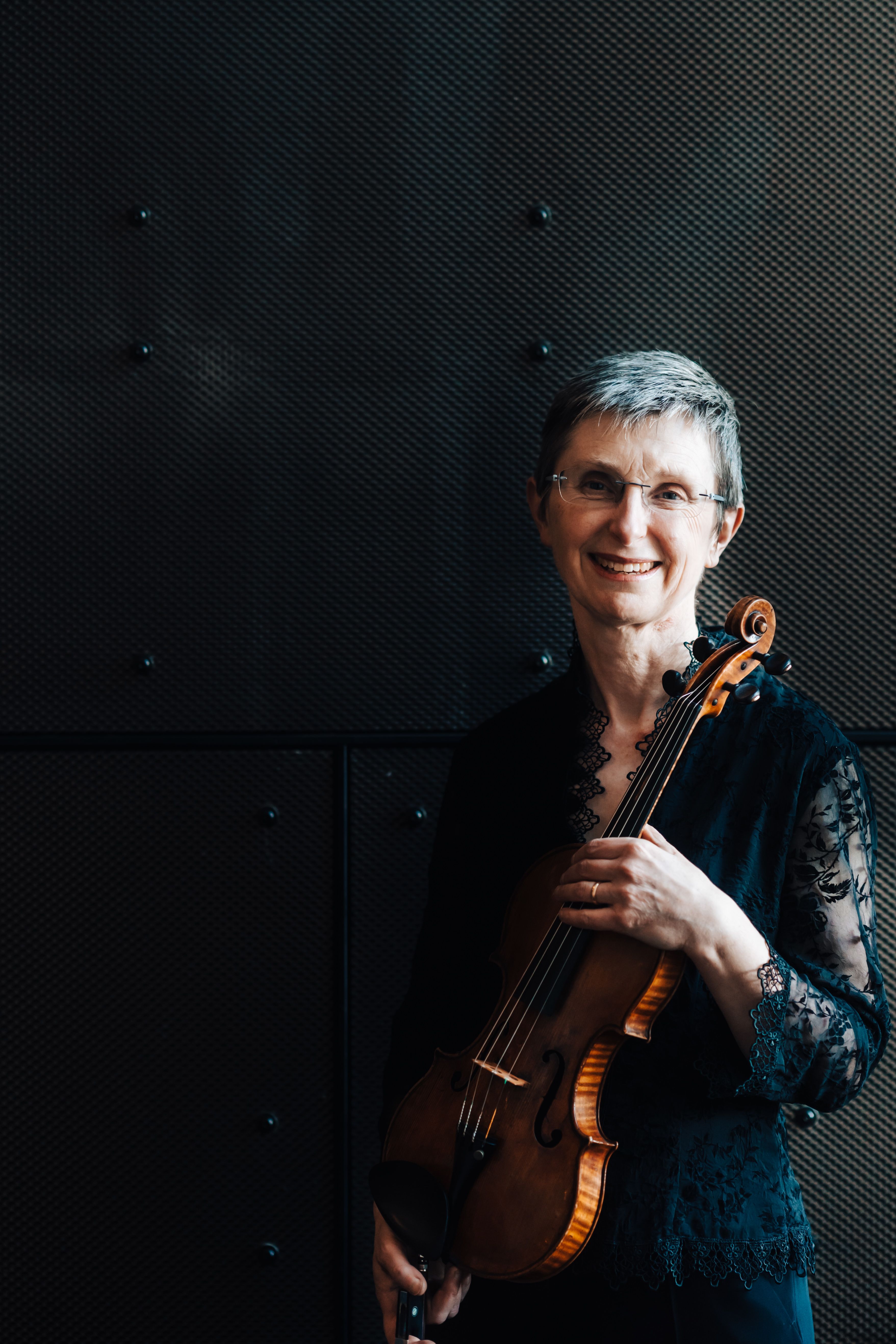
Lesley Hatfielddirector/violin

James Fear
James Fear
Lesley Hatfield leads a varied musical life, combining her role as leader of the BBC National Orchestra of Wales with chamber music, solo playing and teaching. During her early career, as a chamber musician and member of the Chamber Orchestra of Europe, she worked with Sándor Végh and Nicholas Harnoncourt, both of whom had a lasting impact on her musical approach. She was co-Leader of the Northern Sinfonia and Leader of the Ulster Orchestra before taking up her current position in 2004.
Chamber music has always been an important part of her musical life. She is a member of the Gaudier Ensemble and regularly participates as a guest in a wide range of ensembles and chamber music festivals. She has been a regular invited performer at the International Musicians Seminar Open Chamber Music at Prussia Cove since 1986, and is now also closely involved with outreach initiatives run by IMS in the wider community in Cornwall. She has appeared as guest leader, soloist and director with many orchestras around the UK and in Europe, has recorded for leading labels, and is regularly heard on BBC Radio 3.
Her position with BBC NOW has allowed her to play a central role in the thriving musical community in Wales for over 20 years and to act as an advocate for the crucial importance of music to all as food for the mind and soul.
She is much in demand as a teacher, and is actively involved as Patron of Making Music, Changing Lives, a Cardiff-based charity which seeks to transform the lives of children and the communities from which they come, through music and the opportunity to learn instruments. She is also a Trustee of the Albert and Eugenie Frost Trust, supporting young string players and encouraging chamber music at all levels throughout the UK and enabling the acclaimed string quartet residency at the Royal Welsh College of Music & Drama.
Lesley Hatfield is a Fellow of both the Royal Academy of Music and of the Royal Welsh College of Music & Drama.
BBC National Orchestra of Wales
For over 90 years, the BBC National Orchestra of Wales, the only professional symphony orchestra in Wales, has played an integral part in the cultural landscape of the country, occupying a distinctive role as both a broadcast and national orchestra, and serving as an ambassador of Welsh culture, regularly performing music created in Wales and championing Welsh composers and artists.
Part of BBC Cymru Wales and supported by the Arts Council of Wales, BBC NOW performs a busy schedule of concerts and broadcasts, working with acclaimed conductors and soloists from across the world, including its Principal Conductor, the award-winning Ryan Bancroft.
The orchestra is committed to working in partnership with community groups and charities, taking music out of the concert hall and into settings such as schools and hospitals to enable others to experience and be empowered by music. It undertakes workshops, concerts and side-by-side performances to inspire and encourage the next generation of performers, composers and arts leaders, and welcomes thousands of young people and community members annually through its outreach and education projects.
BBC NOW performs annually at the BBC Proms and biennially at the BBC Cardiff Singer of the World competition, and its concerts can be heard regularly across the BBC – on Radio 3, Radio Wales and Radio Cymru. On screen, music performed by BBC NOW can be heard widely across the BBC and other global channels, including the soundtrack and theme tune for Doctor Who, Planet Earth III, Prehistoric Planet, The Pact and Children in Need.
Based at BBC Hoddinott Hall, Cardiff Bay, BBC NOW utilises a state-of-the-art recording studio with a camera system for livestreams and TV broadcasts to bring BBC NOW’s music to a broader audience across Wales and the world. For more information about BBC NOW please visit bbc.co.uk/now
Patron
HM King Charles III KG KT PC GCB
Principal Conductor
Ryan Bancroft
PrincipalGuest Conductor
Jaime Martín
Conductor Laureate
Tadaaki Otaka CBE
Composer-in-Association
Gavin Higgins
First Violins
Fiona McCapra
Gwenllian Haf MacDonald
Terry Porteus
Carmel Barber
Kerry Gordon-Smith
Anna Cleworth
Ruth Heney
Žanete Uškāne
Alejandro Trigo
Second Violins
Anna Smith *
Kathrine Miller
Roussanka Karatchivieva
Ilze Abola
Violas
Alex Thorndike #
Tetsuumi Nagata
Lydia Abell
Anna Growns
Robert Gibbons
Catherine Palmer
Cellos
Jessica Burroughs ‡
Raphael Lang
Sandy Bartai
Keith Hewitt
Rachel Ford
Carolyn Hewitt
Double Basses
David Stark *
Alexander Jones #
Christopher Wescott
Emma Prince
Oboes
Rachel Harwood-White
Horns
John Davy
Meilyr Hughes
* Section Principal
The list of players was correct at the time of publication
Director Lisa Tregale
+ Green Team member