
Pathétique
Saturday 31/1/26, 3.00pm
BBC Hoddinott Hall, Cardiff


Sergey Prokofiev
Symphony No. 1 in D major, ‘Classical’ 14’
Sergey Rachmaninov
Piano Concerto No. 4 in G minor 26’
INTERVAL: 20 minutes
Pyotr Tchaikovsky
Symphony No. 6 in B minor, ‘Pathétique’ 45’
Gemma New conductor
Vadym Kholodenko piano
BBC Hoddinott Hall is certified by EcoAudio and we’re proud to be supporting the BBC in becoming a more sustainable organisation. For more information on the BBC’s net-zero transition plan and sustainability strategy please visit https://www.bbc.co.uk/aboutthebbc/documents/bbc-net-zero-transition-plan-2024.pdf




BROADCAST DETAILS TO COME
Introduction
A warm welcome to tonight’s concert, in which New Zealander Gemma New returns to BBC NOW to conduct an all-Russian programme that culminates in one of the greatest of all Romantic symphonies: Tchaikovsky’s ‘Pathétique’.
We begin, though, in impish mood with Prokofiev’s First Symphony, the ‘Classical’. In it, the young composer hoped to upset his former teachers at the St Petersburg Conservatoire, as he poked affectionate fun at the symphonies of Haydn and Mozart.
From the young Prokofiev to the mature Rachmaninov. His Fourth Piano Concerto was written after he’d settled in the USA and it’s possible to detect the influence of his adopted homeland in the way that jazz elements and tangy harmonies intermingle with the composer’s fabled songfulness. To perform it this evening we’re delighted to welcome Ukrainian pianist Vadym Kholodenko.
Enjoy!
Lisa Tregale
Director
Please respect your fellow audience members and those listening at home: mobile phones may be kept on but on silent and with the brightness turned down; other electronic devices should be switched off during the performance. Photography and recording are not permitted.
Sergey Prokofiev (1891–1953)
Symphony No. 1 in D major, Op. 25, ‘Classical’ (1916–17)

1 Allegro
2 Larghetto
3 Gavotte: Non troppo allegro
4 Finale: Molto vivace
In his diary, Prokofiev imagined the outrage his new symphony would provoke among his former Conservatoire professors: ‘Look, he won’t even let Mozart lie quiet in the grave but has to come poking at him with his mucky paws, tainting the pure pearls of Classicism with those ghastly Prokofiev dissonances.’ Prokofiev was breaking new ground with a modern symphony that played with the conventions of Viennese Classicism. He was not at all pleased when just a few years later, in Paris, it was Stravinsky who was hailed as the great trailblazer of neo-Classicism.
Prokofiev’s approach was quite different in any case. He saw his symphony as real Classicism, as a successor to the symphonies of Haydn and Mozart. If there were moments of mirth and naughtiness in Prokofiev’s symphony, there were just as many in the music of those Viennese masters. Unlike Stravinsky’s, his purposes were not fundamentally ironic, and he was not taking 18th-century music as mere fuel for the engine of modernism. Considering how Prokofiev’s career unfolded, his endless capacity for beautiful melody does indeed allow us to see him as a kind of 20th-century Mozart.
Rolling off the first fortissimo chord, the first-movement Allegro is spun out gracefully, using classically transparent orchestration to produce witty effects: here a pair of nasal oboes, there a cheeky flute solo. Prokofiev passes through a much wider range of keys than Haydn or Mozart would have done, but after each diversion to distant regions we always end up in the right place at the right time. The Classical sonata form is still there, shimmering with new colours. The occasional clouds that gather for a dramatic moment always disperse without consequence.
Prokofiev’s take on the Classical slow movement has many loving touches. A beautiful theme in the strings dissipates into little playful motifs in a way that hadn’t been heard since Mozart. The strings speak as a group, whether bowed or plucked, and the bassoon can be heard through them, adding a delicate touch of comedy. The overall sense of stability and contentment is coloured by a fleeting moment of melancholy.
The third movement is a gavotte instead of the normal Classical minuet. Prokofiev had already attempted a gavotte in his 10 Pieces for Piano, a suite of piano pieces all modelled on Baroque or Classical dances, such as the allemande or rigaudon. Like the village musicians that Mozart famously parodied, this gavotte is designedly clumsy and keeps making blunders, with conventional chord progressions that head off in the wrong direction, only to be steered back at the last moment.
The Finale was inspired by an idea from Prokofiev’s musicologist friend Boris Asafyev (the symphony’s dedicatee), who claimed that Russian music rarely expressed true joy. Prokofiev, an optimist by nature, decided that his Finale would make up for this deficiency and, to this end, he even set himself a steep compositional challenge by purging his harmony of minor chords. This works a treat, together with the flying string passages, the chattering flutes and oboes, and a heroically elaborate part for the timpanist. All of this came to Prokofiev in such a flash of inspiration that he ‘hugged himself with delight while composing’. Afterwards, he worried that the Finale’s irrepressible joy might be heard as ‘irresponsible’ (in the country’s difficult circumstances). But Russian music surely deserves at least this one burst of pure sunshine.
Programme note © Marina Frolova-Walker
Sergey Rachmaninov (1873–1943)
Piano Concerto No. 4 in G minor, Op. 40 (1925–6, rev. 1941)
1 Allegro vivace
2 Largo –
3 Allegro vivace
Vadym Kholodenko piano
This last of Rachmaninov’s piano concertos sounds remarkably youthful for a composer who was 53 years old at the time of its premiere in 1927. This seems even more remarkable when you consider the upheavals of revolution, displacement and the grinding years of travel that Rachmaninov endured, his time as a touring piano virtuoso preventing him from picking up his compositional pen for nearly a decade. During these wandering years, he clearly kept his ears open, however, and the result is obvious here. While we immediately recognise Rachmaninov’s of-another-time Romanticism and hear echoes of 1911’s Étude-tableau in C minor, there are strains of newer music, both the more daring tonalities of fellow composers such as Hindemith and Bartók, and the distinctive colours of American jazz.
Rachmaninov continued to revise the concerto throughout the remaining decades of his life, suggesting the work held deep meaning to him. While the Second and Third concertos appear to explore the conflict between melancholy and love, this one seems much more preoccupied with the idea of struggle and acceptance. The citations from Rachmaninov’s pre-Revolutionary past, the gestures towards 20th-century harmonic innovations and the jazzy strains perhaps imply that this work – more than anything else – allowed Rachmaninov to process his feelings towards the great upheavals his life had undergone.
The concerto launches straight into fire and fury, playing with rising and falling melodic motifs. In the first movement, thematic development continually surprises, with a meandering sound that builds, dwindles and is passed from section to section within the orchestra, and between the orchestra and soloist. We aren’t quite sure what we’re listening to, and indeed the tension builds until it seems as if the movement will end as abruptly as it began. Instead, the soloist accompanies as solo flute and oboe introduce a delicate theme, which builds to a crescendo before it is taken up by the violins. A brief coda brings back the bombast of the movement’s opening, which culminates in a dramatic climax.
The Largo opens introspectively, introduced by a piano solo that seems improvised, much as 19th-century virtuosos improvised between movements. But this quasi-improvisation is much more modern, swelling into rich chords clearly drawn from jazz. It is jazz, too, that provides the structure of the movement – with soloist and orchestra both riffing on the piano’s initial few bars, much like the great jazz orchestras of Fletcher Henderson and Duke Ellington, whom Rachmaninov adored.
The third movement bursts in with pounding energy, the soloist embarking on a furious cadenza. A colourful, circus-like melody twists and turns like a funfair ride, almost (but not quite) losing control. Ideas from the first movement return, including its searing finale, which breaks the spell as the pianist allows the chords to disintegrate into a short, ambiguous close.
Programme note © Margaret Frainier
INTERVAL: 20 minutes
Pyotr Tchaikovsky (1840–93)
Symphony No. 6 in B minor, Op. 74, ‘Pathétique’ (1893)
1 Adagio – Allegro non troppo
2 Allegro con grazia
3 Allegro molto vivace
4 Finale: Adagio lamentoso
Was it a grand musical suicide note, a submission to the forces of ‘fate’ that he’d struggled with for his whole life, even an admission of his homosexuality, and that it could no longer be tolerated in St Petersburg society? Few pieces have provoked quite as much speculation and rumour about secret meanings as Tchaikovsky’s Sixth Symphony.
In many ways, however, Tchaikovsky has only himself to blame. It was he who famously called it ‘a symphony with a secret programme’ (or story) in a letter to pianist Alexander Siloti in 1892, also writing to his friend Konstantin Romanov (grandson of Tsar Nicholas I) that ‘I have put my whole soul into this symphony’. A few days after its premiere, in October 1893, Tchaikovsky contracted cholera. It is widely thought that he’d been drinking unboiled water while the disease was circulating in St Petersburg, and by the time he allowed doctors to see him, it was too late.
Some have suggested that his fateful sip was the deliberate act of a depressive, or even that he was forced into a Socratic suicide by a kangaroo court of St Petersburg bigwigs after a homosexual affair was discovered. If not, why name the symphony the ‘Pathétique’?
In fact, the symphony’s title was his brother Modest’s idea, and the original Russian means something closer to ‘passionate’ or ‘emotional’ rather than simply ‘pathetic’. And, in truth, there’s little evidence to back up any of these far-fetched theories. Tchaikovsky had suffered depressive episodes throughout his life, but felt that working on the Sixth Symphony had actually raised his spirits. He began an E flat Symphony (later reworked into his Third Piano Concerto) but abandoned it when he realised it wasn’t what he hoped to express. When he arrived at the ideas for what became the ‘Pathétique’, however, he attacked his work with passion. He’d grappled with ‘fate’ in earlier works, too – most overtly in his Fourth and Fifth symphonies. The difference here was that Tchaikovsky portrayed fate winning the day, in a revolutionary denial of a conventional triumphant finale that would pave the way for symphonies by Mahler, Shostakovich and many others.
Rather than conveying a secret story, the true power of the ‘Pathétique’ lies in its audacious determination to replace the public optimism and joy of earlier symphonies with very private pain and sorrow. Its fundamental battle is launched in the first movement’s collision of hope and despair, energy and agony. Its two central movements serve almost as interludes, the second a lopsided but nonetheless sensual waltz in 5/4 time, the third offering an ironically hollow doppelgänger of a conventional triumphant finale. The symphony’s devastating true finale demonstrates Tchaikovsky at his most radical, as the music returns inescapably to its sorrowful opening theme, before simply slipping into silence at its close.
Programme note © David Kettle
Help Us Improve Our Online Programmes.
Please take this 5-minute survey and let us know what you think of these notes.
Programme Survey
You may also like:
If you’ve enjoyed the concert today, bring friends and family and come along to this forthcoming concert. As an existing audience member, you can buy tickets for it for £7 using promotion code NOWYOU when buying online.
BBC NOW – NOW!
Thursday 19/2/26, 7.30pm
BBC Hoddinott Hall, Cardiff
Isabella Gellis Valedictions UK premiere
Deborah Pritchard Trombone Concerto ‘Light Circle’ UK premiere
Justė Janulytė Confluere for chamber orchestraUK premiere
Hannah Eisendle AzinheiraUK premiere
Katherine Balch musica pyralisUK premiere
Jack Sheen conductor
Peter Moore trombone
CONTEMPORARY | ILLUMINATING | UNIQUE
Feel the thrill of discovery as BBC NOW – NOW! bursts back this spring with five dazzling UK premieres in one unforgettable night. Immerse yourself in Isabella Gellis’s enchanting Valedictions, Deborah Pritchard’s radiant Trombone Concerto ‘Light Circle’ with star soloist Peter Moore, and Justė Janulytė’s shimmering Confluere. Experience the sheer energy of Hannah Eisendle’s Azinheira and the magical nocturnal world of Katherine Balch’s musica pyralis. Led by rising conductor Jack Sheen in his BBC NOW debut, this is your chance to witness the future of music – live, bold, and breathtaking. Don’t miss it!
Book tickets for just £7 using promotion code NOWYOU https://www.bbc.co.uk/events/evr6gw
Biographies
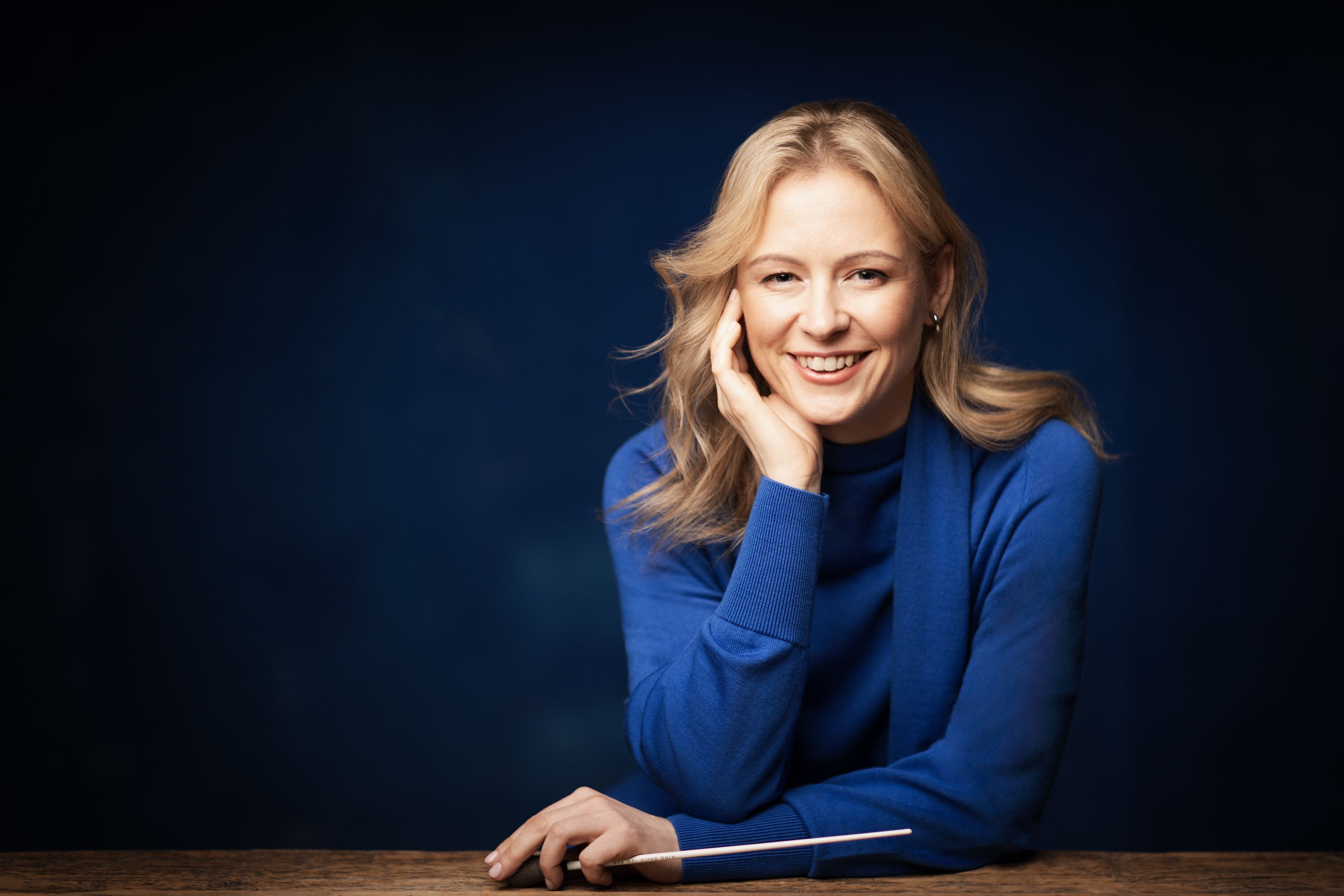
Gemma New conductor

Benjamin Ealovega
Benjamin Ealovega
New Zealand-born Gemma New is Artistic Advisor and Principal Conductor of the New Zealand Symphony Orchestra, and sought-after as a guest conductor worldwide. She was the recipient of the 2021 Sir Georg Solti Conducting Award and was appointed an Officer of the New Zealand Order of Merit in 2024.
Highlights of this season include debuts with the City of Birmingham, KBS, Nashville, Pittsburgh and SWR Symphony orchestras and Belgian National Orchestra, as well as with Houston Grand Opera in a production of Rossini’s The Barber of Seville. In the United States and Canada, she returns to lead the Atlanta, San Diego and Seattle Symphony orchestras and the National Arts Centre Orchestra in Ottawa. In Europe, she returns to the BBC Philharmonic, Orquesta y Coro Nacionales de España, Munich Radio Orchestra, BBC Scottish and Bochum Symphony orchestras and Orquesta Sinfónica de Castilla y León.
Now in her fourth season with the New Zealand Symphony Orchestra, she conducts performances in Wellington, Christchurch and Auckland, and gives the world premiere of a work by Tabea Squire, as well as collaborating with mezzo-soprano Joyce DiDonato and saxophonist Jess Gillam. Other NZSO highlights include Bruckner’s Symphony No. 7 and Mahler’s Sixth Symphony.
She regularly appears with top orchestras in North America and Europe, having conducted the BBC, Helsinki, Los Angeles and New York Philharmonic orchestras, Atlanta, Baltimore, Detroit, Montreal, National, St Louis, San Diego, San Francisco, Sydney and WDR Symphony orchestras, Philadelphia Orchestra, Cleveland Orchestra, Minnesota Orchestra, Hallé, Orchestre National de Lyon and Orquesta Nacional de España, among others.
A former Dudamel Conducting Fellow with the Los Angeles Philharmonic, she was previously Associate Conductor of the New Jersey Symphony Orchestra. In 2018 she was a Conducting Fellow at Tanglewood, where she led the world premiere of Michael Gandolfi’s In America.
She is committed to new music and made her Carnegie Hall debut in 2013 with works by John Adams and Andrew Norman. In 2010, she founded the Lunar Ensemble, a nine-member contemporary music ensemble that premiered 30 works over six seasons. Gemma New has conducted works by Thomas Adès, Anna Clyne, Kevin Puts, Steve Mackey, Aaron Jay Kernis and many others.
Gemma New holds a Master of Music degree in orchestral conducting from the Peabody Institute in Baltimore. She graduated with honours from the University of Canterbury in New Zealand with a Bachelor of Music in violin performance.
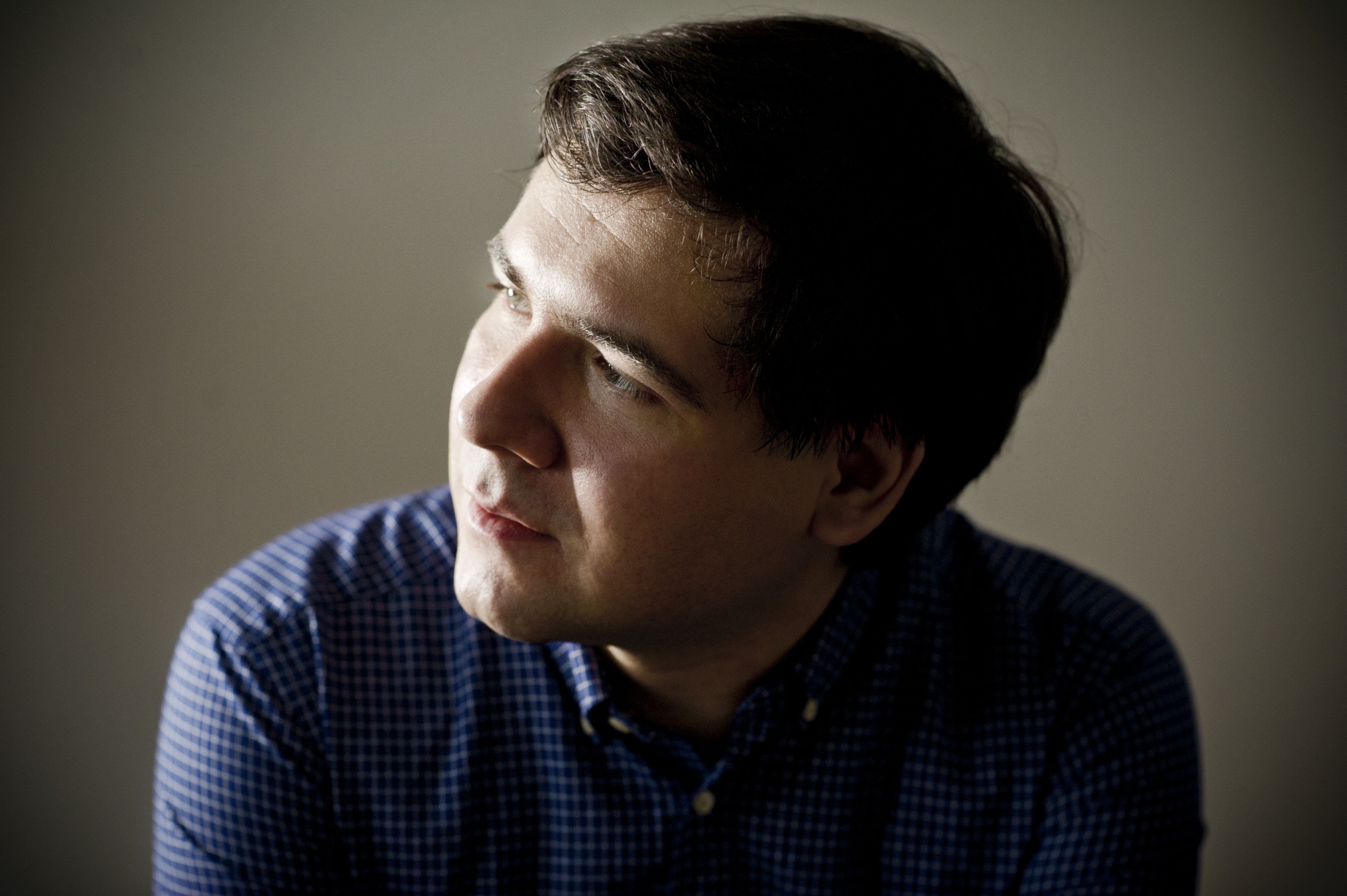
Vadym Kholodenkopiano

Jean-Baptiste Millot
Jean-Baptiste Millot
Vadym Kholodenko was Gold Medallist of the 2013 Van Cliburn International Piano Competition; his distinguished pianism and profound artistic gifts have led to invitations from many of the world’s finest orchestras and concert halls.
Recent and forthcoming concerto highlights include those with leading international orchestras such as the Atlanta, Cincinnati, Danish National, Indianapolis, Sydney, Tokyo Metropolitan and Vienna Symphony orchestras, Philadelphia Orchestra, Budapest Festival Orchestra, Filarmonica della Scala and London Philharmonic Orchestra. In recent seasons he has held the position of Artist-in-Residence with the Fort Worth Symphony Orchestra and the SWR Symphony Orchestra. In 2025 he made his BBC Proms debut.
He has forged strong musical partnerships with many of the world’s leading conductors, including Karina Canellakis, Myung-Whun Chung, Christoph Eschenbach, Iván Fischer, Marie Jacquot, Cristian Măcelaru, Susanna Mälkki, Gemma New, Sir Antonio Pappano, Dima Slobodeniouk, Thomas Søndergård, Krzysztof Urbański and Kazuki Yamada.
In recital he appears on the world’s leading stages. He is also in demand as chamber musician, enjoying collaborations with artists such as Clara-Jumi Kang, Anastasia Kobekina, Vadim Repin and the Belcea and Jerusalem string quartets. He has made numerous recordings with violinist Alena Baeva, with whom recent and forthcoming appearances include concerts in Florence, London and Paris.
He has an unusually large repertoire, and his discography includes solo works by J. S. Bach, Balakirev, Beethoven, Chaplygin, Kurbatov, Liszt, Medtner, Prokofiev, Rachmaninov, Rzewski, Schubert, Scriabin, Siloti, Stravinsky and Tchaikovsky, as well as concertos by Grieg, Prokofiev and Saint-Saëns. His latest release paired Beethoven’s ‘Diabelli’ Variationsand Rzewski’s The People United Will Never Be Defeated!.
Vadym Kholodenko was born in Kyiv, Ukraine, took his first piano lessons at the age of six, and began touring internationally at 13. He was educated at the Kyiv Lysenko State Music Lyceum and the Moscow State Tchaikovsky Conservatoire, studying with Natalia Gridneva, Borys Fedorov and Vera Gornostaeva. Prior to his success at the Van Cliburn, he won First Prize at the Sendai and Schubert piano competitions.
BBC National Orchestra of Wales
For over 90 years, the BBC National Orchestra of Wales, the only professional symphony orchestra in Wales, has played an integral part in the cultural landscape of the country, occupying a distinctive role as both a broadcast and national orchestra, and serving as an ambassador of Welsh culture, regularly performing music created in Wales and championing Welsh composers and artists.
Part of BBC Cymru Wales and supported by the Arts Council of Wales, BBC NOW performs a busy schedule of concerts and broadcasts, working with acclaimed conductors and soloists from across the world, including its Principal Conductor, the award-winning Ryan Bancroft.
The orchestra is committed to working in partnership with community groups and charities, taking music out of the concert hall and into settings such as schools and hospitals to enable others to experience and be empowered by music. It undertakes workshops, concerts and side-by-side performances to inspire and encourage the next generation of performers, composers and arts leaders, and welcomes thousands of young people and community members annually through its outreach and education projects.
BBC NOW performs annually at the BBC Proms and biennially at the BBC Cardiff Singer of the World competition, and its concerts can be heard regularly across the BBC – on Radio 3, Radio Wales and Radio Cymru. On screen, music performed by BBC NOW can be heard widely across the BBC and other global channels, including the soundtrack and theme tune for Doctor Who, Planet Earth III, Prehistoric Planet, The Pact and Children in Need.
Based at BBC Hoddinott Hall, Cardiff Bay, BBC NOW utilises a state-of-the-art recording studio with a camera system for livestreams and TV broadcasts to bring BBC NOW’s music to a broader audience across Wales and the world. For more information about BBC NOW please visit bbc.co.uk/now
Patron
HM King Charles III KG KT PC GCB
Principal Conductor
Ryan Bancroft
PrincipalGuest Conductor
Jaime Martín
Composer-in-Association
Gavin Higgins
First Violins
Gongbo Jiang
Martin Gwilym-Jones sub-leader
Gwenllian Hâf MacDonald
Terry Porteus
Suzanne Casey
Ruth Heney **
Emilie Godden
Kerry Gordon-Smith
Žanete Uškāne
Anna Cleworth
Alejandro Trigo
Carmel Barber
Zhivko Georgiev
Laura Senior
Second Violins
Kirsty Lovie #
Ros Butler
Sheila Smith
Beverley Wescott
Vickie Ringguth
Joseph Williams
Lydia Caines **
Michael Topping
Roussanka Karatchivieva
Katherine Miller
Elizabeth Whittam
Laurence Kempton
Violas
Tetsuumi Nagata
Peter Taylor
Lowri Taffinder
Lydia Abell
Robert Gibbons
Catherine Palmer
Laura Sinnerton
Anna Growns
Mungo Everett-Jordan
Cellos
Thomas Isaac
Jessica Feaver
Sandy Bartai
Alistair Howes
Rachel Ford
Carolyn Hewitt
Keith Hewitt
Kathryn Graham
Double Basses
David Stark *
Alexander Jones #
Emma Prince
Christopher Wescott
Imogen Fernando
Flutes
Matthew Featherstone *
John Hall †
Lindsey Ellis
Piccolo
Oboes
Amy McKean †
Russell Coates
Cor anglais
Clarinets
Nicholas Carpenter *
Bassoons
Horns
Tom Taffinder
Sarah Pennington
Flora Bain
John Davy
Trumpets
Robert Samuel
Trombones
Bass Trombone
Tuba
Timpani
Percussion
Elliott Gaston-Ross
Phil Girling
Andrea Porter
Rhydian Griffiths
Sarah Mason
* Section Principal
The list of players was correct at the time of publication
Director Lisa Tregale
+ Green Team member
Keep up to date with BBC National Orchestra of Wales
Listen to our BBC Radio 3 broadcasts via the BBC Sounds app. Visit our website and follow us on Facebook and Instagram
To help us improve our online concert programmes, please take this 5-minute survey
Produced by BBC Proms Publications