
Truths You Need to Hear
Thursday 7 October 2021, 7.30pm


A PDF version of this programme, including the sung texts, can be viewed here:
Anna Thorvaldsdottir
Dreaming 17’
devised by Davóne Tines
Concerto No. 1: SERMON – A Devised Concerto for Voice and Orchestra European premiere18’
INTERVAL: 20 minutes
Antonín Dvořák
Symphony No. 9 in E minor, ‘From the New World’ 40’
Please note: Davóne Tines’s ‘Concerto No. 1: SERMON’ contains racist language in reflecting its themes of inequality and injustice.
Davóne Tines bass-baritone/narrator
BBC Symphony Orchestra
Dalia Stasevska conductor


This concert is being broadcast live by BBC Radio 3 in Radio 3 in Concert. It will be available for 30 days after broadcast via BBC Sounds, where you can also find podcasts and music mixes.
Following their performance together at the First Night of the Proms this year, the BBC Symphony Orchestra and Principal Guest Conductor Dalia Stasevska reunite to explore the ways in which music can reflect the themes of identity and belonging.
Anna Thorvaldsdottir’s Dreaming seems to reflect the landscape and geology of her native Iceland, while at the same time questioning the nature of the conductor – at times calling for them to communicate by their presence alone rather than through the standard physical gestures with which they’re associated.
In his ‘devised concerto’ SERMON, American bass-baritone Davóne Tines presents a thoughtful and challenging sequence of music and poetry that explores racial injustice and what it means to experience life as a social outsider.
Dvořák’s most popular symphony, ‘From the New World’, is the result of the Czech composer in America being inspired by African American and Native American tunes. Embracing these influences, he was convinced that America’s indigenous music was the basis on which the country could form its own musical identity.
Anna Thorvaldsdottir (born 1977)
Dreaming (2008)


Dreaming is the first of a series of orchestral works by Anna Thorvaldsdottir, each lasting around 15 minutes and charting a process of gradual change akin to a shifting weather system. It was first performed in 2010 by the Iceland Symphony Orchestra, and won the Nordic Council Music Prize in 2012.
The piece treats a large symphony orchestra as a vaporous organism capable of autonomous growth and metamorphosis. The composer instructs the conductor to use their presence to draw out the music by methods other than beating time (at one point, the conductor is instructed to lead the orchestra via motionless presence alone). When individual instruments are given complete autonomy, the orchestra becomes, Thorvaldsdottir says, ‘an ensemble
of soloistic events’.
Like the Icelandic sky, the music can appear to change colour suddenly, despite (or perhaps because of) its slow speed. Eventually an obsessive motif built of two adjacent notes, picked out on the bright sound of celesta and percussion, forms a fixed horizon while shadowy melodies and a deep harmonic undertow take root below. Banging and steaming sounds suggesting natural Icelandic phenomena eventually transform into the gentle forces that carry the piece into half-silence before a cello epilogue.
Programme note © Andrew Mellor
Andrew Mellor is a journalist and critic based in Copenhagen, where he writes for national and international publications. His book The Northern Silence – Journeys in Nordic Music and Culture will be published next year (Yale UP)
Anna Thorvaldsdottir
Anna Thorvaldsdottir was born in 1977 in Borgarnes, 75km north of Reykjavík. It is hard to separate her home country’s vast expanses, volcanic temperament and precarious tectonics from the huge orchestral landscapes she carves out in her scores, even though her music is strong enough to be appreciated on its own terms.
Thorvaldsdottir’s distinctive and mesmeric handling of large groups of instruments has brought her commissions from orchestras on both sides of the Atlantic, as well as winning her the New York Philharmonic’s Kravis Emerging Composer Award. Back in her homeland she is Composer-in-Residence with the Iceland Symphony Orchestra.
A large number of Thorvaldsdottir’s scores are rooted in classic Nordic spectralism – music whose direction is controlled more by colour and texture than by opposing arguments. Many are strewn with instances of sudden blossoming, material coming into focus now and then while vital activity continues beneath the surface.
In addition to orchestral works, Thorvaldsdottir has written for solo instrumentalists, small and large ensembles, voices, dance and theatre.
The coming months see performances of her works given by the Slovak State Symphony Orchestra Košice, Royal Scottish National Orchestra, Royal Philharmonic Orchestra and the Tonkünstler Orchester.
Profile © Andrew Mellor
devised by Davóne Tines (born 1986)
Concerto No. 1: SERMON –
A Devised Concerto for Voice and Orchestra
European premiere


1 Recitation: ‘The Fire Next Time’ (excerpt) James Baldwin (1924–87)
Aria: ‘Shake the Heavens’ from ‘El Niño’ (1999–2000) John Adams (born 1947)
2 Recitation: ‘Hope’ Langston Hughes (1901–67)
Song: ‘VIGIL’ (2019) Igee Dieudonné (born 1991) and Davóne Tines, orch. Matthew Aucoin
3 Recitation: EXEGESIS jessica Care moore (born 1971)
Aria: ‘Malcolm’s Aria’ from ‘The Life and Times of Malcolm X’ (1986) Anthony Davis (born 1951)
Davóne Tines bass-baritone/narrator
Sermon is a work about individuality and connectedness, about isolation and marginalisation, and about truth and integrity. But above all it is a work about humanity, about finding strength in diversity and commonality in our differences. As Davóne Tines explains: ‘I wanted to share with an audience what it might mean to be a marginalised identity, wanting to be able to move in a way, or exist in a way, in spite of marginalisation.' Although the title, Sermon, suggests a lecture, Tines’s devised concerto goes much further than that, seeking deeper context and greater understanding. It is a concerto in the sense that Tines, as orator, is the soloist, and it is devised in that – with the sole exception of jessica Care moore’s poem, which was commissioned for the occasion – all of the works already exist. It is Tines’s curation that transforms these individual fragments into the unified piece you hear today.
Like all good sermons, Tines’s work falls into three parts, each pairing a poem or reading with a piece of music. The first part, the exposition, is an impassioned statement of intent. What would happen if the black man, ‘an immovable pillar’ in the white man’s world, were to move out of place? How would society deal with such perceived disruption? A reading from James Baldwin’s The Fire Next Time forms the preface to John Adams’s ‘Shake the Heavens’ from his oratorio El Niño which, like Baldwin’s text, ‘attacks our reality’. Adams alludes to the same coloratura-like shapes of Handel’s setting of the same text in his Messiah and yet, with pulsing strings and dissonant harmonies, disrupts and reframes it.
From this anger and incredulity, Tines diverts us to a more contemplative state: ‘Where there is darkness, we’ll bring light.’ Composed by Tines and Igee Dieudonné in memory of Breonna Taylor (who was killed at home by police in March 2020), and arranged for orchestra by Matthew Aucoin, ‘VIGIL’ escorts us into an almost ethereal world of soft, shifting textures, one which invites us to meditate on the idea of empathy and humanity. But ultimately we must face reality, and we must face an interrogation. Are we, collectively, comfortable with our actions? In her stark and uncompromising new poem, jessica Care moore asks us to confront uncomfortable truths. ‘Why do I still feel the need to prove or explain my humanity to you?’ she asks. ‘Why don’t you understand that we’re exhausted?’ The collective feelings of despair, anger and defiance are palpable but the overriding message is clear and direct: it is time for change.
Tines’s parting excerpt is taken from Anthony Davis’s opera X: The Life and Times of Malcolm X, which with its rapid-fire percussion and searing winds is just as uncompromising in its presentation of historical events. ‘My truth is white men killed my old man, drove my mother mad. My truth is rough, my truth could kill, my truth is fury.’ An agonising final statement – ‘you want the truth but you don’t want to know’ – is delivered starkly, the orchestra can do nothing but crumble into silence.
Programme note © Jo Kirkbride
Jo Kirkbride is Chief Executive of the Edinburgh-based Dunedin Consort and a freelance writer on classical music. She studied Beethoven’s slow movements for her PhD and writes regularly for the London Symphony Orchestra, London Philharmonic Orchestra, London Sinfonietta and Snape Proms.
John Adams
As a Harvard undergraduate in the 1960s, Adams embraced the directness of jazz and rock. On moving to California, where he taught and organised new-music concerts at the San Francisco Conservatory, he dabbled in electronic music, but in the late 1970s produced his first important works incorporating Minimalist processes – Phrygian Gates and the string septet Shaker Loops (later revised for string orchestra). An association with the San Francisco Symphony (1978–85) led to large-scale orchestral works, including Harmonium (1980–81), with choir; Grand Pianola Music (1982) featuring two piano soloists; and Harmonielehre (1984–5). Most of his six operas, including Nixon in China (1985–7), The Death of Klinghoffer (1989–91) and Doctor Atomic (2004–5), take their scenarios from American current affairs or history; the most recent, Girls of the Golden West, set during the California Gold Rush, was premiered in 2017. His concertos for violin and for piano have attracted soloists of the calibre of Leila Josefowicz and Yuja Wang. Also a sought-after conductor, he became the BBC Symphony Orchestra’s first Artist-in-Association in 2003.
Igee Dieudonné
Born in Utrecht, composer, producer and photographer Igee Dieudonné grew up in a diverse musical household, influenced by his father, a classical and electric guitarist, and his mother, a talented amateur jazz ballet dancer.
Rejected by two music conservatories on the grounds that his music was not sufficiently avant-garde, he abandoned this standard route into the profession in the belief that ‘the interpretation of art lies within the freedom of its creator, interpreter and those who experience it’.
He produces music under the pseudonym Ortolan (reflecting both the cruelty and the beauty of the hedonistic French delicacy named after the small songbird, drowned in brandy, then roasted and eaten whole, traditionally with the head shrouded in order to evade God’s gaze). He is currently working on a string quartet for the Alma Quartet. Further plans with Davóne Tines include arrangements of Brahms’s song ‘Die Mainacht’ for string quartet and also for orchestra, and there are discussions about an opera
Anthony Davis
From the start, Anthony Davis fused the styles of jazz and classical and the structures of composition and improvisation. ‘I’ve always been on some bridge somewhere, going somewhere or coming back,’ he has said. His early orchestral works Still Waters (1982) and Wayang V (1985) incorporated improvisational elements for himself (on piano), alongside jazz musicians James Newton (flute) and Abdul Wadud (cello).
Davis’s studies at Yale gave him a good grounding in musical history and theory but also proved frustrating in that ‘it didn’t acknowledge the contribution of Black Americans and the whole tradition of music that I thought was very important’.
Like John Adams, his operas draw on themes taken from close to home. His first, X: The Life and Times of Malcolm X, inspired by the Black civil rights activist assassinated in 1965, combined Davis’s wide-ranging musical influences with political subject matter. Among the topics explored in his subsequent four operas are the 1974 kidnapping of Patty Hearst (Tania, 1992) and the 1839 rebellion of African slaves aboard a slave ship (Amistad, 1997).
Profiles by Edward Bhesania © BBC
INTERVAL: 20 MINUTES
Antonín Dvořák (1841–1904)
Symphony No. 9 in E minor, Op. 95 ‘From the New World’ (1893)


1 Adagio – Allegro molto
2 Largo
3 Scherzo: Molto vivace
4 Allegro con fuoco
In June 1891 Dvořák was approached by Jeannette Thurber, a wealthy American patron of the arts, with an offer he could not refuse. Thurber planned to set up a new music conservatory in New York, and she wanted Dvořák to serve as its Director. A year later, encouraged both by the position’s generous salary and by the chance to discover ‘real American music’, Dvořák and his family arrived in America to begin what would become three of the most productive years of his life.
Although he was often homesick, Dvořák was fascinated by his new environment, taking every opportunity to discover and absorb the local culture, and actively seeking out the ‘real American music’ he had moved to America to find. Ragtime was hugely popular in the bars and dancehalls of New York, but it left little impression on Dvořák, who was much more interested in the African American spirituals that had been brought to his attention by Harry Burleigh – a Black National Conservatory student who would later become famous for publishing collections of spirituals. ‘I am now satisfied that the future music of this country must be founded upon what are called the Negro melodies,’ Dvořák declared. ‘This must be the real foundation of any serious and original school of composition to be developed in the United States.’
Little more than three months after his arrival in New York, Dvořák received his first significant commission – a new symphony for the New York Philharmonic. This was just the opportunity he had been looking for: the chance to put his research into American musical culture into practice. His sketchbooks show that he began work on the new symphony in January 1893 and completed it barely five months later. Although he gave this symphony the subtitle ‘From the New World’, it was not – as Dvořák was at pains to point out – simply an exercise in ethnography, as some of his critics claimed. It was ‘merely the spirit’ of African American, and also Native American, melodies that he aimed to capture.
Indeed, aside from a theme that bears a strong resemblance to the traditional spiritual ‘Swing low, sweet chariot’ in the symphony’s first movement, there is no authentic replication of these melodies to be found in Dvořák’s ‘New World’ Symphony. Instead, the symphony gets its sense of ‘Americana’ from its use of pentatonic melodies (a scale with five notes rather than the standard seven in Western classical music), the song-like simplicity of many of its themes and the pastoral pictorialism that arches across its four movements – features that one could argue are no more indigenous to American folk music than they are to many other folk cultures around the world. Rather than hearing it as a musical transcription of his time in America, then, Dvořák’s ‘New World’ Symphony is perhaps better understood as a gift to a country he had grown to love and to call home. As he wrote in a letter in 1893, ‘I should never have written these works “just so” if I hadn’t seen America.’
Programme note © Jo Kirkbride
Antonín Dvořák
It was Brahms who recognised Dvořák's talent when, around 1875 he recommended the 33-year-old Czech composer to his own publisher, Simrock. Born in a village north of Prague in 1841, Dvořák worked as a viola player at the Provisional Theatre, then as an organist. The success of tours in the 1880s (including several visits to England) led to his wider recognition and to his appointment in 1891 as Director of the newly founded Conservatory of Music in York. During his three years in America he was influenced by African American spirituals and indigenous American music, composing the ‘New World’ Symphony and the ‘American’ Quartet (Op. 96). But the pull of his homeland, whose folk music and pastoral beauty are reflected strongly in his music, drew him back to Bohemia. He returned to a post at the Prague National Conservatory, late becoming Director.
Dvořák never achieved the success of his compatriot Smetana in the field of opera, but wrote nine symphonies, three concertos (for violin, cello and piano) some fine string quartets, and established the Czech oratorio with his Stabat mater in 1883. Alongside the more popular of his symphonies, he is best known for his sets of Slavonic Dances, originally for piano duet and later arranged for orchestra.
Profile © Edward Bhesania
Biographies
Dalia Stasevska conductor

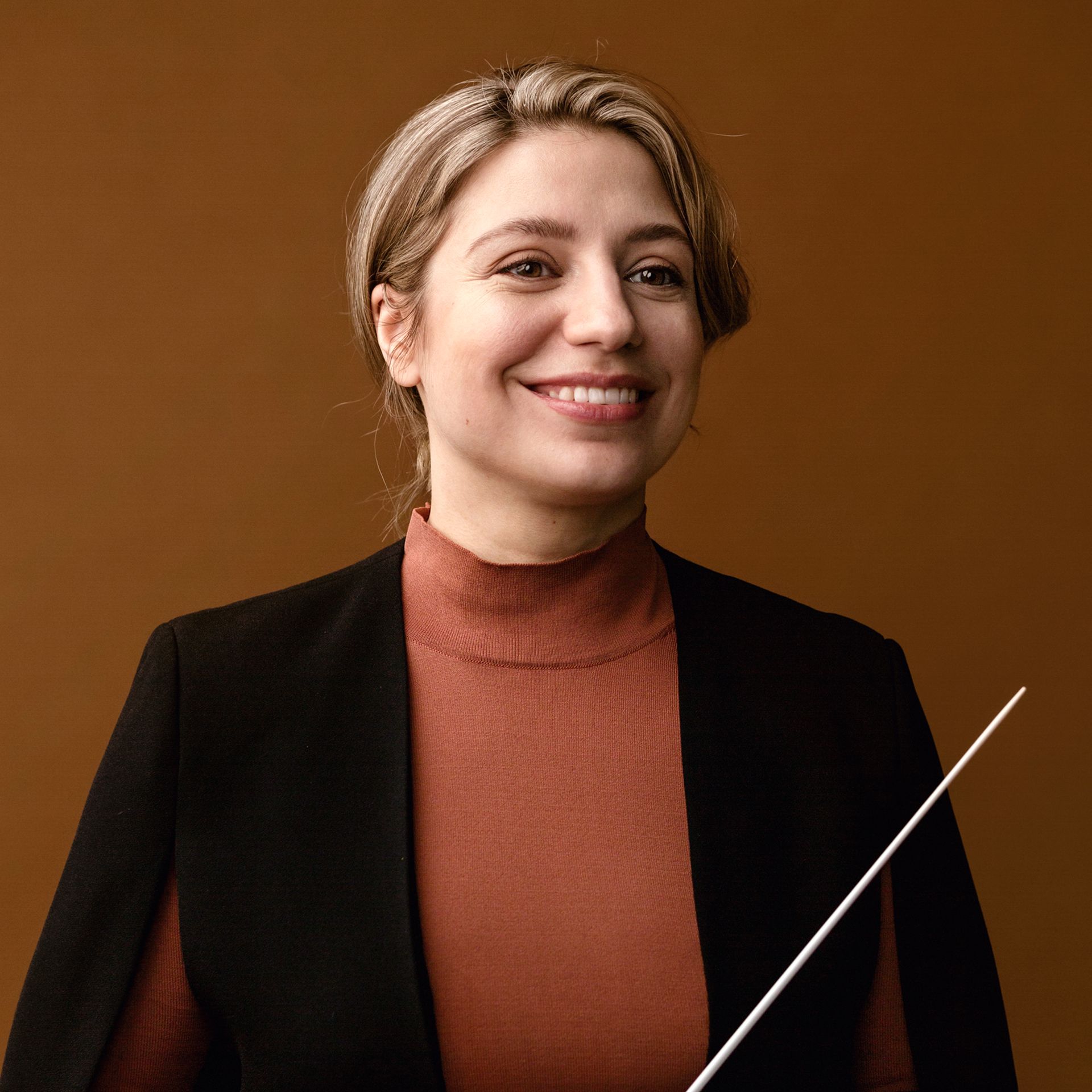
Photo: Sanna Lehto
Photo: Sanna Lehto
Finnish conductor Dalia Stasevska studied violin and composition at the Tampere Conservatory and violin, viola and conducting at the Sibelius Academy in Helsinki. Her conducting teachers included Jorma Panula and Leif Segerstam.
Principal Guest Conductor of the BBC Symphony Orchestra since 2019, she made her BBC Proms debut that year and conducted the Last Night of the Proms in 2020 as well as the First Night this year. This autumn she became Chief Conductor of the Lahti Symphony Orchestra.
Highlights of the current season include debuts with the New York Philharmonic and the Baltimore and Seattle Symphony orchestras. She also returns to the Oslo Philharmonic and Royal Stockholm Philharmonic orchestras, as well as to Finnish National Opera for a double bill of Poulenc’s La voix humaine and songs by Kurt Weill with Karita Mattila. Other recent engagements include performances with the Orchestre National de France, Detroit and Montreal Symphony orchestras, Swedish Radio Symphony and Seoul Philharmonic Orchestra.
In the opera house she has conducted Madam Butterfly and Lucia di Lammermoor for Norwegian Opera, as well as Don Giovanni for the Royal Swedish Opera, Eugene Onegin for Opéra de Toulon, The Cunning Little Vixen for Finnish National Opera and Sebastian Fagerlund’s Höstsonaten (‘Autumn Sonata’) at the 2018 Baltic Sea Festival in Stockholm, featuring Anne Sofie von Otter.
In 2018 Dalia Stasevska had the honour of conducting the Royal Stockholm Philharmonic at the Nobel Prize Ceremony in Stockholm. Last year she was awarded the Royal Philharmonic Society’s Conductor Award.
Davóne Tines bass-baritone/narrator
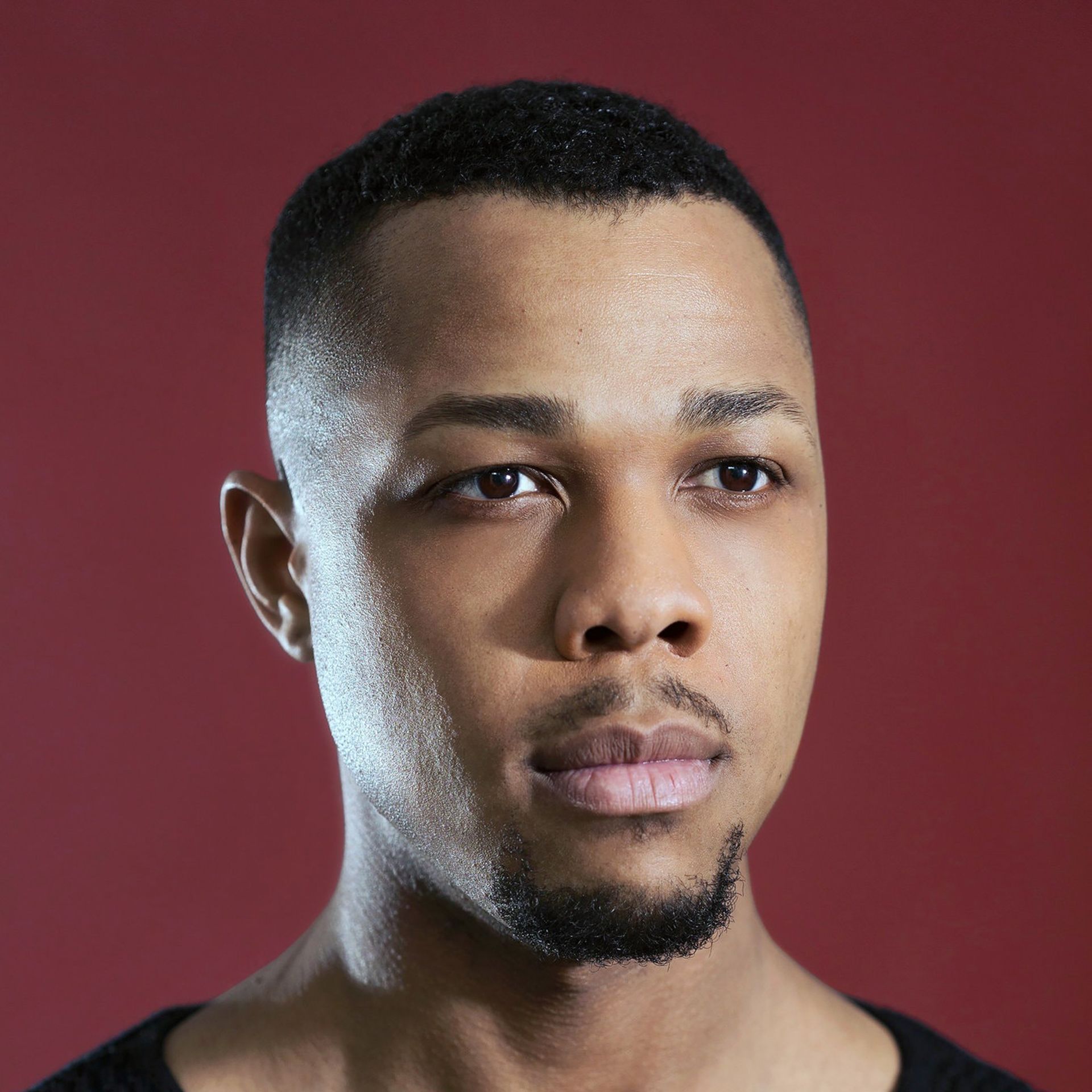
Photo: Bowie Verschuuren
Photo: Bowie Verschuuren
Davóne Tines has established himself as a groundbreaking artist whose work not only spans a diverse repertoire but also explores the social issues of today. As a Black, gay performer at the intersection of many histories, cultures and aesthetics, his work blends opera, art song, contemporary classical, spirituals, gospel and songs of protest.
He is Artist-in-Residence at Michigan Opera Theatre – an appointment that culminates in his performance in the title-role of Anthony Davis’s X: The Life and Times of Malcolm X later this season – and is the Philharmonia Baroque Orchestra & Chorale’s first-ever Creative Partner.
He gave the premiere of his Concerto No. 1: SERMON in a streamed concert last year with the Philadelphia Orchestra. This follows his Recital No. 1: MASS, in which the Mass is woven through with music from Western European and African American traditions, which he has performed at the Ravinia Festival, in Washington DC and in Houston, as well as in London at the Milton Court Concert Hall.
He is a member of AMOC (American Modern Opera Company) and co-creator of The Black Clown, a music-theatre piece commissioned and premiered by the American Repertory Theater and presented at New York’s Lincoln Center.
His concert appearances include Beethoven’s Symphony No. 9 with the San Francisco Symphony and Kaija Saariaho’s True Fire with the Orchestre National de France.
Davóne Tines is a winner of the 2020 Sphinx Medal of Excellence, recognising talented Black and Latinx classical musicians, and the recipient of a 2018 Emerging Artists Award from Lincoln Center. He is a graduate of the Juilliard School in New York and Harvard University, where he also serves as a guest lecturer.
BBC Symphony Orchestra
The BBC Symphony Orchestra has been at the heart of British musical life since it was founded in 1930. It plays a central role in the BBC Proms at the Royal Albert Hall, performing at the First and Last Night each year in addition to regular appearances throughout the Proms season with the world’s leading conductors and soloists.
The BBC SO performs an annual season of concerts at the Barbican in London, where it is Associate Orchestra. Its commitment to contemporary music is demonstrated by a range of premieres each season, as well as Total Immersion days devoted to specific composers or themes. Highlights this autumn include the season-opening concert conducted by Sakari Oramo including music by Brahms and Ruth Gipps; a concert conducted by Principal Guest Conductor Dalia Stasevska featuring the devised work Concerto No.1: SERMON by Davóne Tines, combining music and poetry in a unique examination of racial injustice; children’s author Jacqueline Wilson reading from her bestselling books in a family concert; the world premiere of Up for Grabs by composer and Arsenal fanatic Mark-Anthony Turnage; and the BBC Symphony Chorus’s highly anticipated return to the Barbican stage in December.
The vast majority of performances are broadcast on BBC Radio 3 and a number of studio recordings each season are free to attend. These often feature up-and-coming new talent, including members of BBC Radio 3’s New Generation Artists scheme. All broadcasts are available for 30 days on BBC Sounds and the BBC SO can also be seen on BBC TV and BBC iPlayer and heard on the BBC’s online archive, Experience Classical.
The BBC Symphony Orchestra and Chorus – alongside the BBC Concert Orchestra, BBC Singers and BBC Proms – also offer enjoyable and innovative education and community activities and take a leading role in the BBC Ten Pieces and BBC Young Composer programmes.
Chief Conductor
Sakari Oramo
Günter Wand
Conducting Chair
Semyon Bychkov
Principal Guest
Conductor Designate
Dalia Stasevska
Conductor Laureate
Sir Andrew Davis
First Violins
Stephen Bryant leader
Cellerina Park
Jeremy Martin
Jenny King
Celia Waterhouse
Colin Huber
Shirley Turner
Molly Cockburn
Zanete Uskane
Thea Spiers
Elizabeth Partridge
William Hillman
Amy Cardigan
Kalliopi Mitropoulou
Second Violins
Heather Hohmann
Dawn Beazley
Daniel Meyer
Vanessa Hughes
Danny Fajardo
Tammy Se
Caroline Cooper
Victoria Hodgson
Lucica Trita
Maya Bickel
Non Peters
Ingrid Button
Violas
Norbert Blume
Philip Hall
Joshua Hayward
Nikos Zarb
Audrey Henning
Natalie Taylor
Michael Leaver
Carolyn Scott
Peter Mallinson
Matthias Wiesner
Cellos
Tamsy Kaner
Graham Bradshaw
Mark Sheridan
Clare Hinton
Sarah Hedley-Miller
Michael Atkinson
Augusta Harris
Morwenna Del Mar
Double Basses
Nicholas Bayley
Richard Alsop
Michael Clarke
Beverley Jones
Elen Pan
Alice Kent
Flutes
Daniel Pailthorpe
Tomoka Mukai
Piccolo
Kathleen Stevenson
Oboes
Alison Teale
Imogen Smith
Cor Anglais
Sarah-Jayne Porsmorguer
Clarinets
Richard Hosford
Harry Penny
Bass Clarinet
Thomas Lessels
Bassoons
Nina Ashton
Lorna West
Contrabassoon
Steven Magee
Horns
Nicholas Korth
Mark Wood
Michael Murray
Daniel Curzon
James Pillai
Trumpets
Philip Cobb
Joseph Atkins
Trombones
Helen Vollam
Dan Jenkins
Bass Trombone
Robert O’Neill
Tuba
Jim Anderson
Timpani
Luke Taylor
Percussion
David Hockings
Alex Neal
Fiona Ritchie
Drum Kit
Matt French
Harp
Louise Martin
Piano/Celesta
Philip Moore
The list of players was correct at the time of publication