
Impressions & Meditations
Thursday 5/12/24, 7.30pm
BBC Hoddinott Hall, Cardiff


Gabriella Smith
Tumblebird Contrails12’
Simon Wills
Nora Barnacle Assumes Command – ballet concertante for orchestra and solo trombone world premiere c35’
INTERVAL: 20 minutes
Charles Ives
Symphony No. 1 32’
Geoffrey Patersonconductor (Smith & Ives)
Simon Willsconductor (Wills)
Donal Bannister trombone


This concert is being broadcast live by BBC Radio 3 in Radio 3 in Concert; it will be available for 30 days after broadcast via BBC Sounds, where you can also find podcasts and music mixes.
Introduction

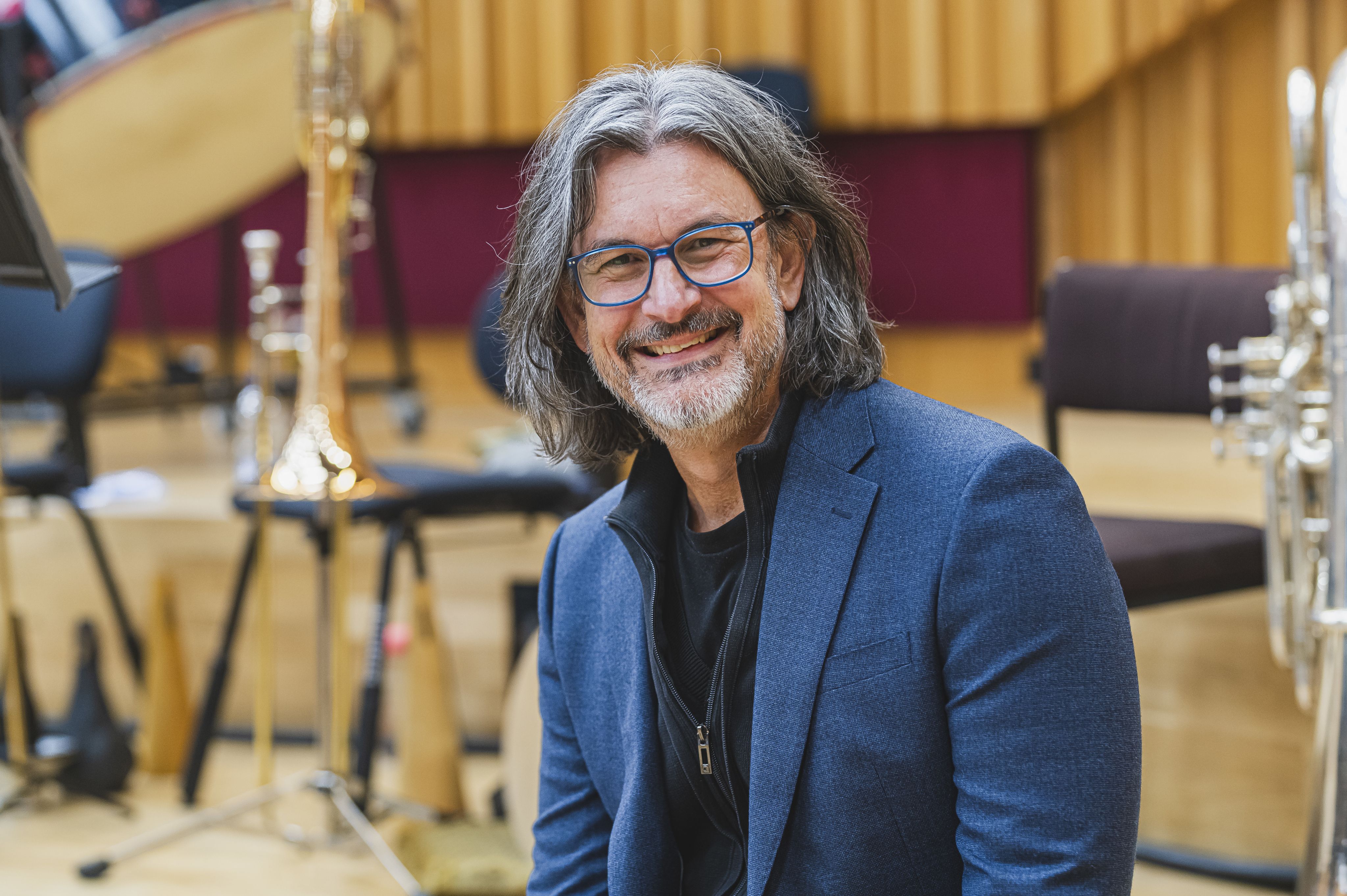
Photo: Kirsten McTernan
Photo: Kirsten McTernan
Welcome to tonight’s concert, for which we welcome onto the podium two conductors: Geoffrey Patterson for pieces by Gabriella Smith and Charles Ives and Simon Wills, who conducts the world premiere of his own Nora Barnacle Assumes Command.
The intriguingly titled Tumblebird Contrails byGabriella Smith is her dazzling response to a trip to the dramatic Point Reyes on the Californian coast, where she found herself overwhelmed by the sounds and sights greeting her.
BBC NOW’s own principal trombone steps into the spotlight as soloist in Wills’s Nora Barnacle Assumes Command. While its links with James Joyce are clear (Nora Barnacle being his wife’s name), the composer describes the resulting piece as less a concerto and more ‘an abstract ballet in 11 scenes without a break’.
We end with Ives’s First Symphony; it was written during his years as a student at Yale, where he took lessons with the influential, if conservative, figure of Horatio Parker. Yet, despite seeming to conform, there are glimpses in the piece of the mature Ives, not least his idiosyncratic way with traditional themes and his liking for piling one melody upon another to entirely refreshing effect.
Enjoy!
Matthew Wood
Head of Artistic Planning and Production
Please respect your fellow audience members and those listening at home. Turn off all mobile phones and electronic devices during the performance. Photography and recording are not permitted.
Gabriella Smith(born 1991)
Tumblebird Contrails (2014)

Geoffrey Patersonconductor
Tumblebird Contrails is inspired by a single moment I experienced while backpacking in Point Reyes. Here, sitting on the sand at the edge of the ocean, I found myself listening to the hallucinatory sounds of the Pacific (the keening gulls, pounding surf, rush of approaching waves, sizzle of sand and sea foam in receding tides), the constant ebb and flow of pitch to pitchless, tune to texture, grooving to free-flowing, watching a pair of ravens playing in the wind, rolling, swooping, diving, soaring – imagining the ecstasy of wind in the wings – jet trails painting never-ending streaks across the sky. The title, Tumblebird Contrails, is a Kerouac-inspired, nonsense phrase I invented to evoke the sound and feeling of the piece.
Programme note © Gabriella Smith
Simon Wills(born 1957)
Nora Barnacle Assumes Command – ballet concertante for orchestra and solo trombone (2022)
world premiere
Donal Bannistertrombone
Simon Willsconductor
James Joyce was footloose and mercurial. His wife Nora Barnacle was a quieter character, though photographs of her suggest a certain coquettishness. She complained that he wasted money and drank too much; though she was proud of him, she thought his writings obscure and lacking sense. The title of this piece describes how those opposites play out in the music; it is no different from a more familiar label such as prelude and fugue. There are many shifts of mood: melancholy, hallucinatory and occasionally plain daft. Between them, or spread over them like a blanket, is something calmer – the dignified character of Nora. She assumes command in the end because calm is generally stronger than noise.
Composing for dance is my first love and I imagined the work as an abstract ballet in 11 scenes without a break. It contains no references to events in Jim and Nora’s lives or to his writings – apart from the Irish melody Oft in the Stilly Night. In a heartbreaking scene in A Portrait of the Artist as a Young Man the hero’s poverty-stricken family sing it as night falls. Nora Barnacle opens with it and thereafter I used it as a sort of musical woodpile from which I would extract planks or twigs as I worked. Occasionally one of them sprouted into something recognisable, but mostly the melody is concealed, like DNA binding things together. The soloist has too many rests for this to be a concerto in the normal sense and his relationship with the orchestra is constantly changing. At times it’s a conventional solo with accompaniment but at others the trombone behaves like a cantankerous old man disrupting things from the sidelines – or sulks and does nothing at all.
I composed the piece in Paris during July and the early part of August 2022. As usual, I worked with an old-fashioned dip pen, progressing from a page of drawings to slivers of music and finally to a score. The inky sketches resisted housetraining more than is usual; it seemed as though they knew exactly how they wanted the finished piece to be. When a work is wilful in that way, a wise composer lets it win, however strange the result may turn out to be – and so I did.
Programme note © Simon Wills
INTERVAL: 20 minutes
Charles Ives(1874–1954)
Symphony No. 1(1898–1902)
1 Allegro
2 Adagio molto (sostenuto)
3 Scherzo: Vivace
4 Allegro molto
Geoffrey Patersonconductor
For anyone more familiar with the freewheeling, radical experimentalism that Charles Ives conjured in his later music – Three Places in New England, for example, or the enigmatic The Unanswered Question – the rarely performed First Symphony that the younger Ives completed in 1902 might come as something of a shock. It’s a work that’s rooted in traditional European models and styles, so much so that it almost explicitly quotes several earlier composers.
That’s not to say that Ives only developed his radical musical ideas late in life. Even as a boy, young Charles took inspiration from his father George Ives, a multi-instrumentalist, music teacher and bandleader who himself had a strong predilection for musical experimentation. George was fascinated by the complex cacophony of multiple marching bands playing simultaneously, or collisions between conflicting keys heard concurrently, or even the supposedly ‘out-of-tune’ notes that lay in the cracks of a piano keyboard – all ideas that Charles would also explore.
Just a few weeks after Charles entered Yale University in 1894, however, his father died. It was a devastating blow to the young man, but he found – perhaps – an alternative father figure in renowned composer and educator Horatio Parker, who had studied with Josef Rheinberger in Munich, and who was fastidious, exacting and narrow in his demands for a late-Romantic, most definitely Germanic style of music from his students.
Ives consulted Parker closely during the First Symphony’s gestation, submitting its second and fourth movements as his final-year thesis in 1898, and completing the work with the third movement in 1902. And while later in life, he sometimes dismissed the piece as little more than a homework assignment, Ives would secretly admit that he rather liked it. There’s no denying its powerful personality, certainly, nor the youthful Ives’s deeply idiosyncratic and thoroughly distinctive way of handling his material, as though the radical freedoms he’d learnt from his father were still surging beneath the surface of Parker’s strict stipulations.
A wistful, Schubertian melody for clarinet (sketched just after his father’s death) opens the substantial first movement, though the theme’s unusual harmonic sidesteps betray Ives’s more forward-thinking ideas. A dashing, outdoor melody later takes over in the strings, and Ives kicks off his developments of both ideas with a remarkable, Impressionistic passage of perpetually rising harmonies, before the opening themes return to lead the movement to its joyful closing perorations.
While the cor anglais’s hymn-like melody that launches the second movement might sound dangerously similar to the slow movement of Dvořák’s ‘New World’ Symphony, the music also foreshadows the poignant sentimentality of a lot of the slower music that Ives would later create. His third-movement Scherzo builds up a canon from a nimble, devilish theme layered on versions of itself, while his romping, march-like finale ultimately welcomes back themes from across the Symphony in a gloriously rich pile-up of melodies.
Programme note © David Kettle
Help Us Improve Our Online Programmes.
Please take this 5-minute survey and let us know what you think of these notes.
Programme Survey
You may also like:
La voix humaine
Thursday 30/01/25, 7.30pm
BBC Hoddinott Hall, Cardiff
Ravel Ma mère l’Oye
Poulenc La voix humaine
Jaime Martín conductor
Danielle de Niese soprano
THEATRICAL | VIVID | BREATHTAKING
Principal Guest Conductor Jaime Martín leads us in a programme of French gems, starting with a celebration of the 150th anniversary of Ravel’s birth. His luscious, magical, enchanting and playful score to the ballet Ma mère l’Oye is based on characters from classic fairy tales, from Sleeping Beauty and Little Ugly to Tom Thumb and Beauty and the Beast.
After the interval, opera star Danielle de Niese makes her debut with BBC NOW as Elle in a semi-staged performance of Poulenc’s powerful one-act opera La voix humaine. During a phone call from her lover, grief and denial lead to outrage and despair as he calls off their relationship – the timeless theme of unrequited love playing out before our very eyes.
Shostakovich 6 with Ryan Bancroft
Friday 14/2/25, 7.30pm
BBC Hoddinott Hall, Cardiff
Saturday 15/2/25, 7.30pm
Brangwyn Hall, Swansea
Gavin Higgins A Monstrous Little Suite world premiere
Weinberg Trumpet Concerto
Shostakovich Symphony No. 6
Ryan Bancroft conductor
Håkan Hardenberger trumpet
EFFERVESCENT | MULTIFARIOUS | EXHILARATING
Principal Conductor Ryan Bancroft takes to the podium to conduct the world premiere of Composer-in-Association, Gavin Higgins’s A Monstrous Little Suite from his opera The Monstrous Child, before Håkan Hardenberger makes a much anticipated return to BBC NOW for one of the finest concertos of its kind, Weinberg’s playful, suspenseful and witty Trumpet Concerto. It ranges from shadows of darkness to a hobbling waltz, ingeniously quoting from some of the most popular music in existence, from Bizet’s Carmen to Stravinsky’s Petrushka, via Mendelssohn’s much-loved Wedding March to Mahler’s Fifth.
Pensive drama contrasts with outright giddiness in Shostakovich’s Sixth Symphony, demonstrating kaleidoscopic variation at its most telling. A long, yearningly sombre and stunningly beautiful slow opening movement gives way to two breathtaking scherzos that gallop through the orchestra in a fizzing, almost raucous musical circus.
Biographies
Geoffrey Patersonconductor

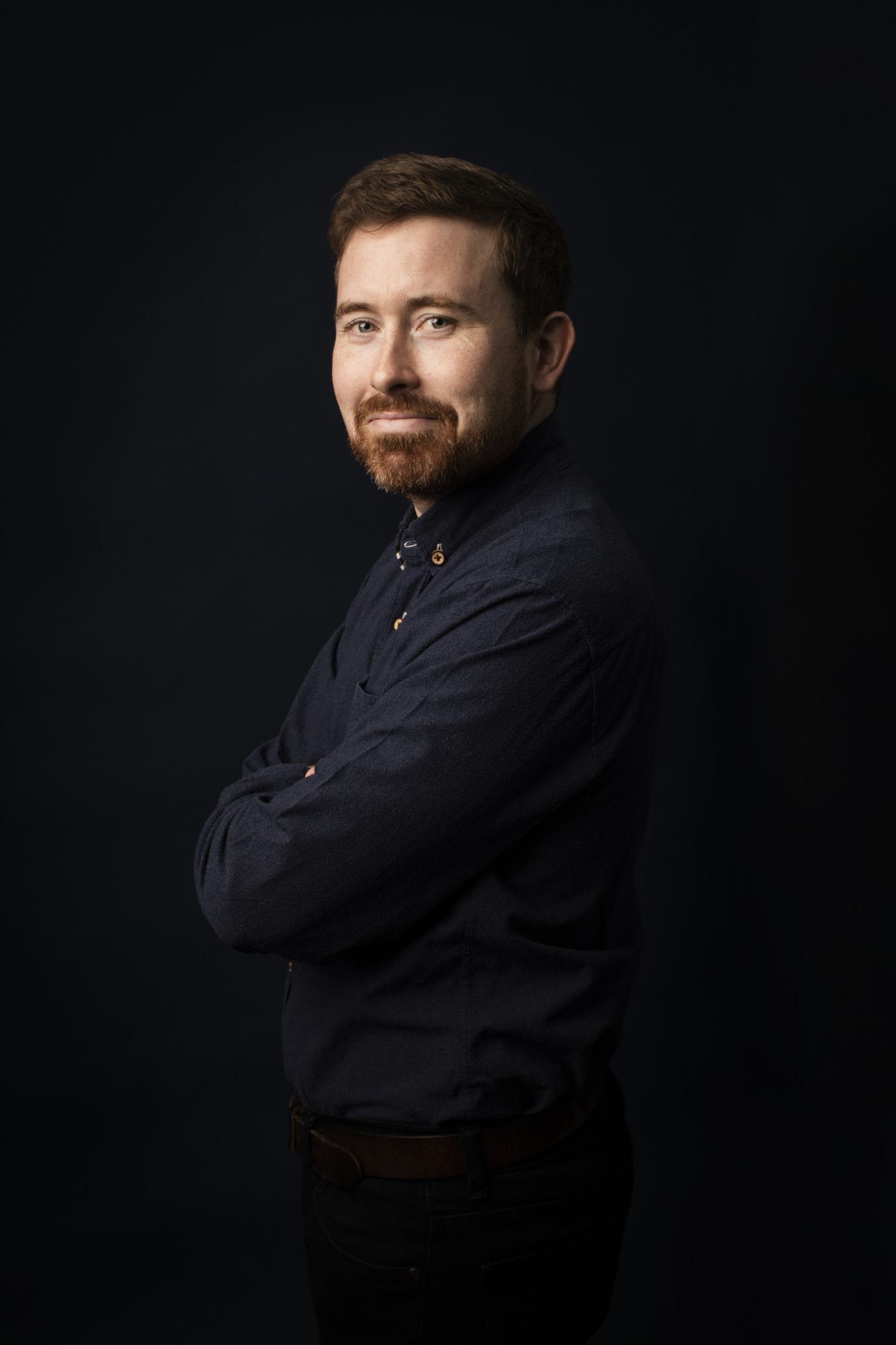
Benjamin Ealovega
Benjamin Ealovega
British conductor Geoffrey Paterson is admired for his impressive grasp of detail, responsiveness to musicians and his ability to shape and make music from the most complex scores with natural authority.
In the past few months he has conducted the Aarhus, Danish National and Hamburg Symphony orchestras – all of whom have invited him back for this season – and the Nagoya Philharmonic (reinvited for 2025). Here in the UK, last season he appeared with the Royal Liverpool Philharmonic, London Mozart Players and took on Wagner’s Ring (in De Vlieger’s orchestral arrangement) with the Brighton Philharmonic, as well as returning to the BBC Scottish Symphony for filmed studio sessions.
This season he conducts the Warsaw Philharmonic at the Warsaw Contemporary Music Festival, returns to his regular collaborators, the London Sinfonietta (Hannah Kendall premiere), Nash Ensemble (Strauss and Wagner) and to the Birmingham Contemporary Music Group (Birtwistle, Anderson). He continues his close collaboration with Norwegian jazz saxophonist Marius Neset, with whom he has performed many times, including at the BBC Proms and Bergen Festival and for Musikkollegium Winterthur; they pair up again for the Northern Lights Festival 2025 with the Arctic Philharmonic.
Opera has always formed a large part of his activities; recent productions have included Britten’s A Midsummer Night’s Dream in Frankfurt, Philip Glass’s Orphée at English National Opera, Willem Jeth’s Ritratto at Dutch National Opera and Albert Herring at the Royal Academy of Music. He has also conducted at the Bayerische Staatsoper (Menotti’s The Consul and ballets by Max Richter and Saariaho), Royal Danish Opera (Die Fledermaus, Porgy and Bess and Prokofiev’s Cinderella), Opera North (La bohème), Glyndebourne Tour (Die Entführung aus dem Serail) and Music Theatre Wales (Dusapin’s Passion). This autumn he conducts two contemporary ballets at the Royal Opera House, Covent Garden.
Geoffrey Paterson studied at Cambridge University, where he also took composition lessons with Alexander Goehr, followed by studies at the Royal Conservatoire of Scotland. Having won both First Prize and the Audience Prize at the 2009 Leeds Conductors Competition, he went on to participate in the Lucerne Festival conducting masterclasses with Pierre Boulez. During his time on the Royal Opera House’s Young Artist Programme he assisted conductors including Sir Antonio Pappano, Sir Mark Elder, Andris Nelsons and Daniele Gatti in an extensive repertoire. For two seasons he worked in Bayreuth as musical assistant to Kirill Petrenko for Der Ring des Nibelungen.
Simon Willsconductor


Chris Stock
Chris Stock
Simon Wills began his career in the orchestra of the Teatro Massimo in Palermo. After some years playing with Welsh National Opera, he joined the London Symphony Orchestra and was simultaneously principal trombone of the Chamber Orchestra of Europe, a post he held for 14 years.
He is a widely performed composer, mostly outside the UK. Stage works include A Day Close to Summer, written for the Baden Baden Festspielhaus, The Secret Agent, an opera written for the Feldkirch Festival in Austria and The Stolen Smells, an opera buffa which he conducted in Lucerne in 2012. It was subsequently produced by Norddeutsche Rundfunk at the Kampnagel in Hamburg under Thomas Hengelbrock. Du Bist Da, Du Bist Fort, commissioned by the Düsseldorfer Schauspielhaus won the Junge Ohren prize for music theatre in 2013 and later that year, the NDR Elbphilharmonie Orchester opened its season with his Wodehouse-inspired orchestral overture Empress of Blandings; the BBC Symphony Orchestra later recorded the work for Radio 3. In 2014 he became the first British composer since 1959 to receive a Cuban premiere, when he conducted his tone-poem Bolondrón in Havana with the Orquestra del Liceu and in 2015 the Munich Philharmonic toured and broadcast his Dante symphony, Malebolge. His Caribbean-inspired tone poem The Island, commissioned and premiered by the Tonhalle Orchestra in Zurich recently received its first UK performance, given by the Ulster Orchestra; it was later broadcast on Radio 3 by the BBC Scottish Symphony Orchestra. 1816, Das Jahre öhne Sommer an experimental theatre commission from the Schumannfest in Düsseldorf, opened in May 2016 and a month later Anita Berber, Göttin der Nacht, his narrative ballet for large orchestra, was produced by Thüringer Staatsballet with choreography by Jiri and Otto Bubenicek. Nora Barnacle Assumes Command is his second premiere this year: in May he conducted his toccata for large ensemble, One is Down, in Fort Worth, Texas. Works in progress include a sequence of Rilke settings for double choir, a secular Requiem and his Fourth Symphony.
He frequently directs his own works and has appeared as guest conductor with the Lucerne Symphony Orchestra, Cyprus State Orchestra, Turan Alem Symphony Orchestra in Kazakhstan, Liceu orchestra in Havana and Stockholm Wind Orchestra. As part of the celebrations for the Commonwealth Heads of Government Meeting in Kampala in 2007 he conducted what is believed to have been the Ugandan premiere of Mozart’s Requiem at Namirembe Cathedral. This is his conducting debut with BBCNOW.
Donal Bannistertrombone

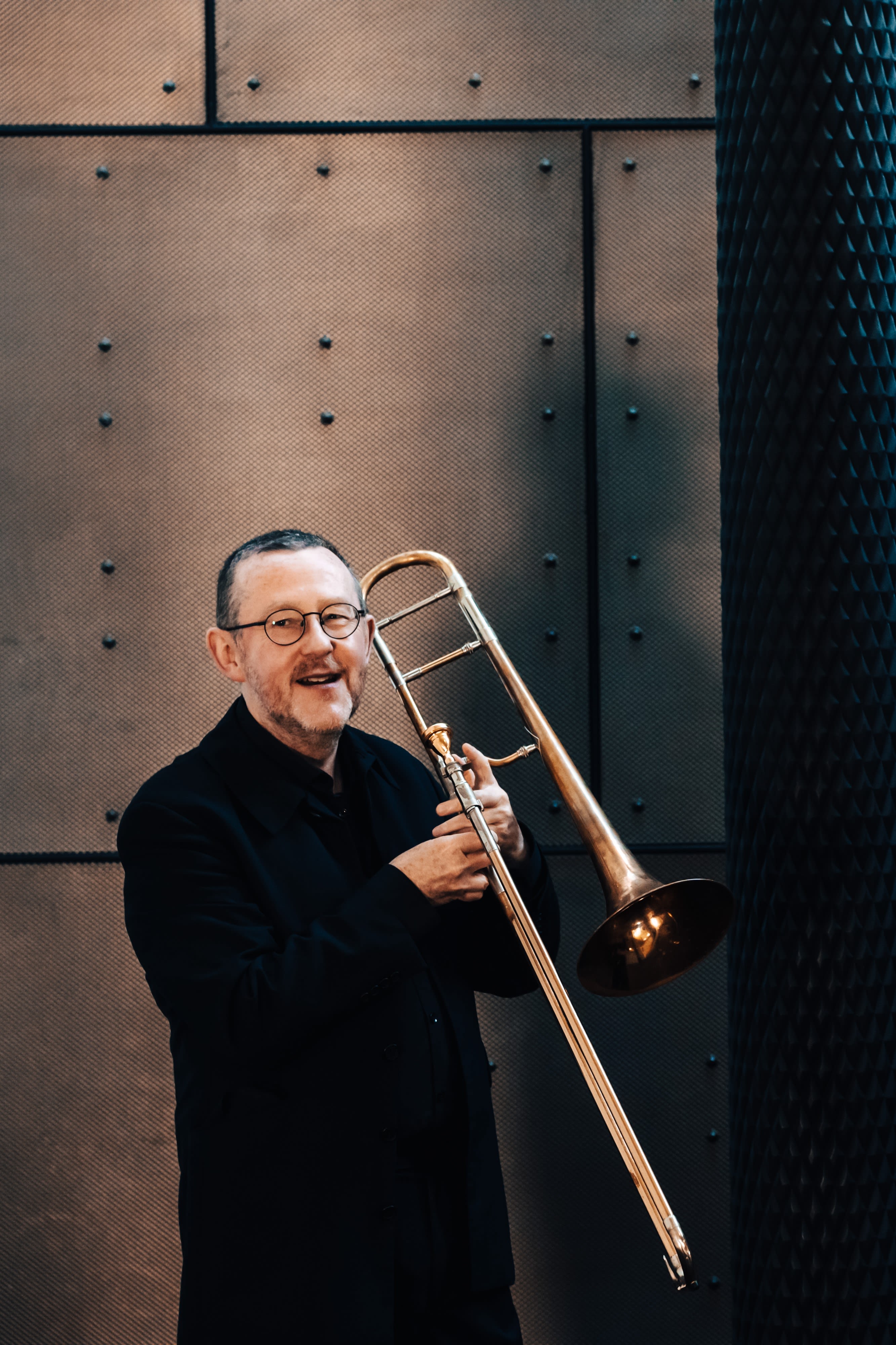
James Fear
James Fear
Donal Bannister is Principal Trombone with the BBC National Orchestra of Wales, a position he has held since 2007. Previously he was a member of the Bournemouth Symphony Orchestra.
Born in Dublin to a musical family, he studied at Trinity College Dublin, where he was a scholar, and New York’s Eastman School of Music, where he was a Fulbright scholar. While in New York, he developed a particular interest in the music of Haydn, focusing on the music of the late 1760s and early 1770s, a period of daring experiment in the composer’s career.
His musical activities are wide-ranging: he is a regular guest with many other British orchestras, teaches at the Royal Welsh College of Music & Drama, is a published composer and arranger for brass, has presented many pre-concert talks and lectures and conducts community orchestras. In his work with BBC NOW he is keen to create a bridge between the modern orchestral world and that of period instruments by using a wide variety of trombones appropriate to the varied repertoire of the orchestra.
During the Covid lockdowns he developed a new and outstandingly successful partnership with Molly the singing Saluki dog, becoming an immediate global online sensation. Unfortunately, Molly is too self-effacing to be with us tonight, though she has taken part in, and offered invaluable advice during many of the practice sessions for Nora Barnacle Assumes Command. Following intense discussions, its composer Simon Wills chose not take on any of Molly’s suggested amendments.
BBC National Orchestra of Wales
For over 90 years, the BBC National Orchestra of Wales, the only professional symphony orchestra in Wales, has played an integral part in the cultural landscape of the country, occupying a distinctive role as both a broadcast and national orchestra, and serving as an ambassador of Welsh culture, regularly performing music created in Wales and championing Welsh composers and artists.
Part of BBC Cymru Wales and supported by the Arts Council of Wales, BBC NOW performs a busy schedule of concerts and broadcasts, working with acclaimed conductors and soloists from across the world, including its Principal Conductor, the award-winning Ryan Bancroft.
The orchestra is committed to working in partnership with community groups and charities, taking music out of the concert hall and into settings such as schools and hospitals to enable others to experience and be empowered by music. It undertakes workshops, concerts and side-by-side performances to inspire and encourage the next generation of performers, composers and arts leaders, and welcomes thousands of young people and community members annually through its outreach and education projects.
BBC NOW performs annually at the BBC Proms and biennially at the BBC Cardiff Singer of the World competition, and its concerts can be heard regularly across the BBC – on Radio 3, Radio Wales and Radio Cymru. On screen, music performed by BBC NOW can be heard widely across the BBC and other global channels, including the soundtrack and theme tune for Doctor Who, Planet Earth III, Prehistoric Planet, The Pact and Children in Need.
Based at BBC Hoddinott Hall, Cardiff Bay, BBC NOW utilises a state-of-the-art recording studio with a camera system for livestreams and TV broadcasts to bring BBC NOW’s music to a broader audience across Wales and the world. For more information about BBC NOW please visit bbc.co.uk/now
Patron
HM King Charles III KG KT PC GCB
Principal Conductor
Ryan Bancroft
PrincipalGuest Conductor
Jaime Martín
Conductor Laureate
Tadaaki Otaka CBE
Composer-in-Association
Gavin Higgins
First Violins
Lesley Hatfield leader
Nick Whiting associate leader
Martin Gwilym-Jones sub-leader
Gwenllian Hâf MacDonald
Terry Porteus
Suzanne Casey
Anna Cleworth
Žanete Uškāne
Ruth Heney
Carmel Barber
Emilie Godden
Alejandro Trigo
Kerry Gordon-Smith
Amy Fletcher
Second Violins
Anna Smith *
Will Hillman
Sheila Smith
Joseph Williams
Roussanka Karatchivieva
Lydia Caines
Beverley Wescott
Ilze Abola
Katherine Miller
Vickie Ringguth
Michael Topping
Gary George-Veale
Violas
Rebecca Jones *
Alex Thorndike #
Tetsuumi Nagata
Peter Taylor
Lowri Taffinder
Robert Gibbons
Lydia Abell
Anna Growns
Laura Sinnerton
Daire Roberts
Cellos
Alice Neary *
Heeyeon Cho
Jessica Feaver
Sandy Bartai
Alistair Howes
Carolyn Hewitt
Keith Hewitt
Rachel Ford
Double Basses
David Stark *
Alex Jones #
Christopher Wescott
Richard Gibbons
Ketan Curtis
Ruohua Li
Flutes
Matthew Featherstone *
John Hall †
Lindsey Ellis
Piccolo
Lindsey Ellis †
Oboes
Steve Hudson *
Catriona Lockhart
Max Spiers
Cor anglais
Max Spiers
Clarinets
Nicholas Carpenter *
Bethany Crouch
Lenny Sayers
Bass Clarinet
Lenny Sayers †
Bassoons
Jarosław Augustiniak *
Thaïs Bordes
David Buckland
Contrabassoon
David Buckland †
Horns
Tim Thorpe *
Meilyr Hughes
Neil Shewan †
John Davy
Tom Taffinder
Trumpets
Philippe Schartz *
Robert Samuel
Corey Morris †
Trombones
Dafydd Thomas †
Tom Scalfe
Bass Trombone
Darren Smith †
Tuba
Daniel Trodden †
Timpani
Steve Barnard *
Percussion
Phil Hughes
Phil Girling
Andrea Porter
Harp
Bethan Semmens
* Section Principal
† Principal
‡ Guest Principal
# Assistant String Principal
The list of players was correct at the time of publication
Director Lisa Tregale
Orchestra Manager Liz Williams
Assistant Orchestra Manager Nick Olsen **
Orchestra Personnel ManagerKevin Myers
Business Coordinator Georgia Dandy
Orchestra Administrator Eleanor Hall +
Head of Artistic Planning and ProductionMatthew Wood
Artists and Projects Manager Victoria Massocchi **
Orchestra Librarian Naomi Roberts
Producer Mike Sims
Broadcast Assistantvacancy
Head of Marketing and Audiences Sassy Hicks
Marketing Coordinator Amy Campbell-Nichols +
Digital Producer Yusef Bastawy **
Social Media Coordinator Harriet Baugh
Education Producers Beatrice Carey, Rachel Naylor maternity cover
Audio Supervisors Simon Smith, Andrew Smillie
Production Business Manager Lisa Blofeld
Stage and Technical Manager Steven Brown +
Assistant Stage and Technical Manager Josh Mead +
+ Green Team member
** Diversity & Inclusion Forum