Season Opening Concert with Ryan Bancroft
Thursday 30 September 2021, 7.30pm

Gavin Higgins
Rough Voices 12’
Ludwig van Beethoven
Piano Concerto No. 4 34’
INTERVAL: 20 minutes
Jean Sibelius
Symphony No. 2 43’
Eric Lu piano
Nicola Heywood Thomas presenter
BBC National Orchestra of Wales
Ryan Bancroft conductor


The concert is being recorded by BBC Radio 3 for broadcast in ‘Radio 3 in Concert’ on 5 October. It will be available to stream or download for 30 days after broadcast via BBC Sounds, where you can also find podcasts and music mixes. Visit bbc.co.uk/now for more information on future performances.
Tonight’s programme
A very warm welcome to tonight’s concert, the first of our season, in which BBC National Orchestra of Wales is joined by its Principal Conductor Ryan Bancroft for the first time here at St David’s Hall in Cardiff.
There’s a typically adventurous programme on offer, beginning with Gavin Higgins’s recent piece Rough Voices. It was commissioned for last year’s Proms and is a dramatic and sometimes violent reaction to the Covid pandemic, taking inspiration from poet Tony Walsh.
It’s more vital than ever that we nurture outstanding musicians of the younger generation, and the BBC has long done that through its New Generation Artists scheme. Tonight American pianist Eric Lu, already a major name though still in his early twenties, performs Beethoven’s most seraphic concerto, the Fourth.
We end with Sibelius’s Second Symphony, a work that combines the warmth of Italy, where he began work on it, with a confidence showing that here was a composer ready to take the genre out of the Romantic era and into the 20th century.
Thank you for joining us.
Lisa Tregale
Director
Please respect your fellow audience members and those listening at home. Turn off all mobile phones and electronic devices during the performance. Photography and recording are not permitted.
Gavin Higgins (born 1983)
Rough Voices (2020)


Rough Voices was a commission for the 2020 BBC Proms, where it was performed by BBC National Orchestra of Wales (but at Hoddinott Hall rather than London’s Royal Albert Hall, owing to the pandemic). As with other composers who wrote new works for that Proms season, I was asked to respond in some way to the Covid-19 pandemic.
I thought long and hard about the impact of the crisis and kept returning to the thought of how those living in poverty have been disproportionately affected – as has also been the case with issues such as mental health, loneliness, education, housing and redundancy. This made me angry.
As I was writing the piece, I came across the poem ‘Tough’ by Tony Walsh (aka Longfella, born 1965) – a battle cry for the working class – and his words resonated with the music I was composing:
They don’t like it when we make it despite all their ifs and cuts
They don’t like it when we take it as our right to shake things up
They don’t like it when rough voices start demanding better choices
But it’s tough, we’ve had enough and we are coming
Being from a working-class background myself, I know how life-changing music can be. I also know that, as we come out of the pandemic, readdressing questions of diversity and class within the classical-music world will become even harder. We must continue to support and promote working-class talent or we will needlessly lose a generation of brilliant musicians. As such, Rough Voices is a rallying call for the underclasses.
The piece starts with a scream – of anger and frustration – that seems to interrupt a continuous and immanent chorale played on strings. The interruptions move into an insistent, incessant procession that drives relentlessly onwards.
The ‘scream’ returns at the climax of the work, now in a righteously indignant tone, before the chorale reappears, changed somewhat with echoes of the rhythmic pulse that has dominated much of the piece.
Programme note © Gavin Higgins
Ludwig van Beethoven (1770–1827)
Piano Concerto No. 4 in G major, Op. 58 (1805–6)
1 Allegro moderato
2 Andante con moto –
3 Rondo: Vivace
Eric Lu piano
For a while, the piano concerto provided Beethoven with the ideal vehicle for the expression of his egalitarian worldview. As a composer, he forced the genre into the extended dimensions of his all-embracing creative vision. He saw a new, sociological significance in the pitting of a single instrument against a large orchestral ensemble – presenting himself as the individual (the soloist) who could inspire and influence the masses (the orchestra).
By the time he came to write his Fourth Piano Concerto in 1805–6, his hearing was in terminal decline. The composer was wise enough to foresee his impending inability to play concertos with orchestras in public, and the Fourth would be the last in which he imagined himself on the piano stool while writing. That’s where he was seated for the premiere of the piece at an epic concert on 22 December 1808 in Vienna’s Theater an der Wien.
If we view this concerto as Beethoven’s final statement as a performing composer-pianist, then it offers a striking picture of his mindset at the time. Never before had he (or anyone else, for that matter) woven soloist and orchestra together with the degree of nuance achieved here. This is done without whipping up a confrontational frenzy; rather, he presents the soloist as the bringer of stillness and peace to a world of underlying ferment. This work is treasured not for its heroism or revolutionary ideas, but for the poise and humanity of its musical ideas.
The concerto’s quiet opening gambit on piano alone would have constituted an act of unprecedented boldness to contemporary audiences. Those initial piano chords are followed by a pianissimo response from the orchestra in a completely unrelated key. Both the improvisatory feel of this opening exchange and the use of keys that would have felt – even subconsciously – disorientating to audiences of the time appear to cast a spell over the entire work.
The idea of contrast takes further root in the concerto’s central Andante con moto. This movement has long been associated with the legend of Orpheus. As that character attempted to tame wild beasts with his lyre, so Beethoven’s piano responds to gruff gestures from unison strings with shapely, conciliatory (and now harmonised) melodies of its own. The movement is one sustained process of transformation in which the soloist gradually gains influence over the orchestra.
In the finale, which follows without a break, Beethoven introduces the trumpets and timpani as the concerto hauls itself into yet another unrelated key. This is a movement with a constantly shifting palette of relatively introspective moods. But its turning point comes at the huge ‘triple trill’, after which the music plunges into a headlong dash to the home-key finish – wholly countering the understatement that has gone before.
Programme note © Andrew Mellor
Andrew Mellor is a journalist and critic based in Copenhagen, where he writes for national and international publications. His book ‘The Northern Silence – Journeys in Nordic Music and Culture’ will be published next year (Yale UP).
INTERVAL: 20 minutes
Jean Sibelius (1865–1957)
Symphony No. 2 in D major, Op. 43 (1901–2, rev. 1903)
1 Allegretto
2 Tempo andante, ma rubato
3 Vivacissimo – Lento e soave –
4 Finale: Allegro moderato
When things got bad for Sibelius in Finland, the composer would often make for Italy – with or without his family. In 1901, this time with his family in tow, Sibelius escaped the Finnish winter in Rapallo, a small town on the west coast of Italy not far from Genoa.
Sibelius borrowed a room surrounded by ‘magnolia, cypresses, vine, palm trees and a manifold variety of flowers’. In this Mediterranean setting he was reminded of the legend of Don Juan, and began to sketch a symphonic poem on the subject of the legendary philanderer.
Despite his idyllic surroundings, Sibelius was in crisis. His daughter Ruth was recovering from a dangerous illness, while Finland’s journey towards freedom had suffered yet another blow. The Russians had begun the process of incorporating the Finnish army into their own, crippling Finland’s autonomy.
Back home in May 1901, Sibelius resumed work on the piece he’d conceived amid the flowers of Rapallo – now a symphony without a narrative, but still cast in the bright key of D major.
By the following spring, the symphony was finished. Sibelius conducted four performances of the work in Helsinki, giving the premiere on 8 March. His colleague Robert Kajanus concluded that the work was an ode to Finnish nationalism – a stirring hymn to bolster the widespread programme of passive resistance. According to Sibelius, though, Kajanus was way off the mark. The composer’s annotations reveal rather more personal struggles. The second theme of the second movement was apparently inspired by Ruth’s recovery. The more subdued, lamenting theme of the final movement commemorated Elli Järnefelt, Sibelius’s sister-in-law who had recently committed suicide.
In more abstract terms, the piece consolidates techniques that were fast becoming Sibelius hallmarks: his use of looping and layering patterns in the strings, his fondness for stepwise melodies and the overall coherence of his themes, which relate naturally to one another as if they were tributaries of the same river. We hear that in the opening movement, which is controlled entirely by the three adjacent pitches heard right at the start.
The residue of the Don Juan project is felt amid the conflicts of the second movement. Sibelius pits a theme he called ‘death’ (first heard on bassoons playing an octave apart) against one he called ‘Christus’ (the Ruth theme, which emerges from jagged strings).
The third movement is a stormy dance that works its way back to the three adjacent notes that opened the piece.
From here, the symphony slips into its final movement with the mustering of a heroic tune dressed first in cautious harmonies and then in brilliant, triumphant ones. The tune, again born of those three adjacent notes, lightens the dark shadows of the troubling Elli Järnefelt theme to suggest the blossoming of new life.
Programme note © Andrew Mellor
Biographies
Ryan Bancroft conductor


Photo: Benjamin Ealovega
Photo: Benjamin Ealovega
Ryan Bancroft grew up in Los Angeles and first came to international attention in April 2018, when he won both First Prize and Audience Prize at the prestigious Malko Competition for Young Conductors in Copenhagen. In September 2019 it was announced that he had been appointed Principal Conductor of the BBC National Orchestra of Wales. This role began in the 2020–21 season. Following his first visit to work with the Tapiola Sinfonietta he was invited to become its Artist-in-Association from this season.
He has made debuts with leading international orchestras, including the Atlanta, BBC, Cincinnati, City of Birmingham, Danish National, RAI National, Swedish Radio and Toronto Symphony orchestras, the Rotterdam and Royal Stockholm Philharmonic orchestras and Norwegian National Opera Orchestra. Forthcoming debuts include concerts with the Baltimore, Gothenburg and Iceland Symphony orchestras.
He has a passion for contemporary music and has performed with Amsterdam’s Nieuw Ensemble, assisted Pierre Boulez in a performance of his Sur Incises in Los Angeles, premiered works by Sofia Gubaidulina, Cage, Tenney and Anne LeBaron, and has worked closely with improvisers such as Wadada Leo Smith and Charlie Haden.This season he makes his debut with Ensemble Intercontemporain.
He studied at the California Institute of the Arts, Royal Conservatoire of Scotland and in the Netherlands.
Eric Lu piano
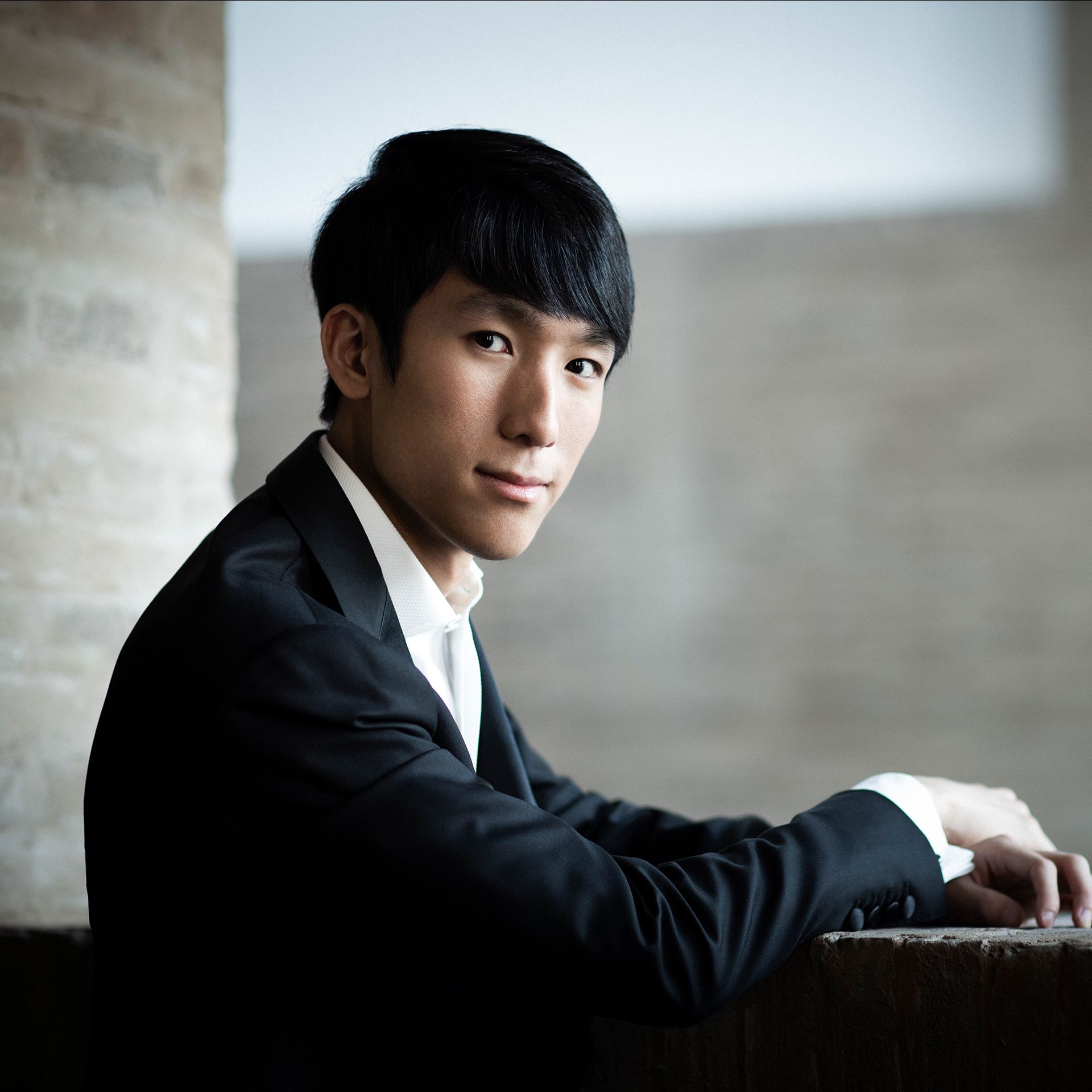
Photo: Benjamin Ealovega
Photo: Benjamin Ealovega
Eric Lu won First Prize at the Leeds International Piano Competition in 2018. He made his BBC Proms debut the following summer and is currently a member of the BBC Radio 3 New Generation Artists scheme and has an exclusive recording contract.
Highlights of this season include concerts with the Oslo and St Petersburg Philharmonic orchestras, Barcelona, BBC and Finnish Radio Symphony orchestras and Tapiola Sinfonietta, as well as recitals at the Wigmore Hall, Leipzig Gewandhaus and Cologne Philharmonie.
The past two seasons have seen him perform with the Detroit and Seattle Symphony orchestras, BBC, Royal Liverpool and Royal Stockholm Philharmonic orchestras, the Hallé, Swedish Chamber Orchestra and Orchestre National de Lille. He has worked with conductors such as Mirga Gražinytė-Tyla, Vasily Petrenko, Edward Gardner, Sir Mark Elder, Tomáš Hanus, Alexander Bloch, Thomas Dausgaard, Martin Fröst and Long Yu.
His most recent solo album, of Chopin and Schumann, was released to critical acclaim last year.
He was born in Massachusetts in 1997 and first came to international attention as a prizewinner at the 2015 Chopin International Competition aged 17. He is a graduate of the Curtis Institute of Music, where he studied with Robert McDonald and Jonathan Biss. He is also a pupil of Dang Thai Son.
BBC National Orchestra of Wales
For over 90 years, BBC National Orchestra of Wales has played an integral part in the cultural landscape of Wales, occupying a distinctive role as both broadcast and national symphony orchestra. Part of BBC Wales and supported by the Arts Council of Wales, it performs a busy schedule of live concerts throughout Wales, the rest of the UK and the world. The orchestra is an ambassador of Welsh music and champions contemporary composers and musicians.
The orchestra performs annually at the BBC Proms and biennially at the BBC Cardiff Singer of the World competition, and its concerts can be heard regularly across the BBC: on Radio 3, Radio Wales and Radio Cymru.
BBC NOW works closely with schools and music organisations throughout Wales and regularly undertakes workshops, side-by-side performances and young composer initiatives to inspire and encourage the next generation of performers, composers and arts leaders.
During the recent lockdowns, BBC NOW has continued to record and film behind closed doors at BBC Hoddinott Hall and has produced videos, soundtracks and weekly digital concerts that have been seen by 14 million people globally, including an extremely popular video of the Doctor Who soundtrack! Plans for the orchestra include live-streamed concerts and events, tours to different communities throughout Wales and education and community development schemes to include everyone in music-making. To find out more visit bbc.co.uk/bbcnow
Patron
HRH The Prince of Wales KG KT PC GCB
Principal Conductor
Ryan Bancroft
Conductor Laureate
Tadaaki Otaka CBE
Composer-in-Association
Gavin Higgins
Composer Affiliate
Sarah Lianne Lewis
First Violins
Lesley HatfieldLeader
Nick Whiting Associate Leader
Martin Gwilym-Jones †
Gwenllian Hâf MacDonald
Terry Porteus
Suzanne Casey
Emilie Godden
Kerry Gordon-Smith
Carmel Barber
Robert Bird
Anna Cleworth
Second Violins
Anna Smith *
Jane Sinclair #
Sheila Smith
Sellena Leony
Katherine Miller
Beverley Wescott
Vickie Ringguth
Michael Topping
Barbara Zdziarska
Violas
Rebecca Jones *
Alex Thorndike #
Tetsuumi Nagata
Peter Taylor
Laura Sinnerton
Catherine Palmer
James Drummond
Robert Gibbons
Cellos
Alice Neary *
Keith Hewitt #
Jessica Feaver
Sandy Bartai
Carolyn Hewitt
Rachel Ford
Double Basses
David Stark *
Ben Burnley
Christopher Wescott
Richard Gibbons
Flutes
Matthew Featherstone *
John Halll
Oboe
Steve Hudson *
Oboe/Cor anglais
Sarah-Jayne Porsmoguer †
Clarinet
Nick Carpenter
Clarinet/Bass Clarinet
Lenny Sayers †
Bassoon
Jarosław Augustyniak *
Bassoon/Contrabassoon
David Buckland †
Horns
Tim Thorpe *
Meilyr Hughes
Neil Shewan †
William Haskins
John Davy
Trumpets
Philippe Schartz *
Corey Morris
Andy Everton †
Trombones
Donal Bannister*
Simon Wills
Bass Trombone
Darren Smith †
Tuba
Daniel Trodden †
Timpani
Steve Barnard *
Percussion
Mark Walker
Harp
Valerie Aldrich-Smith †
Piano
Catherine Roe Williams
* Section Principal
† Principal
‡ Guest Principal
# Assistant Principal
The list of players was correct at the time of publication