
Viennese Whirl
Saturday 20 April, 7.30pm
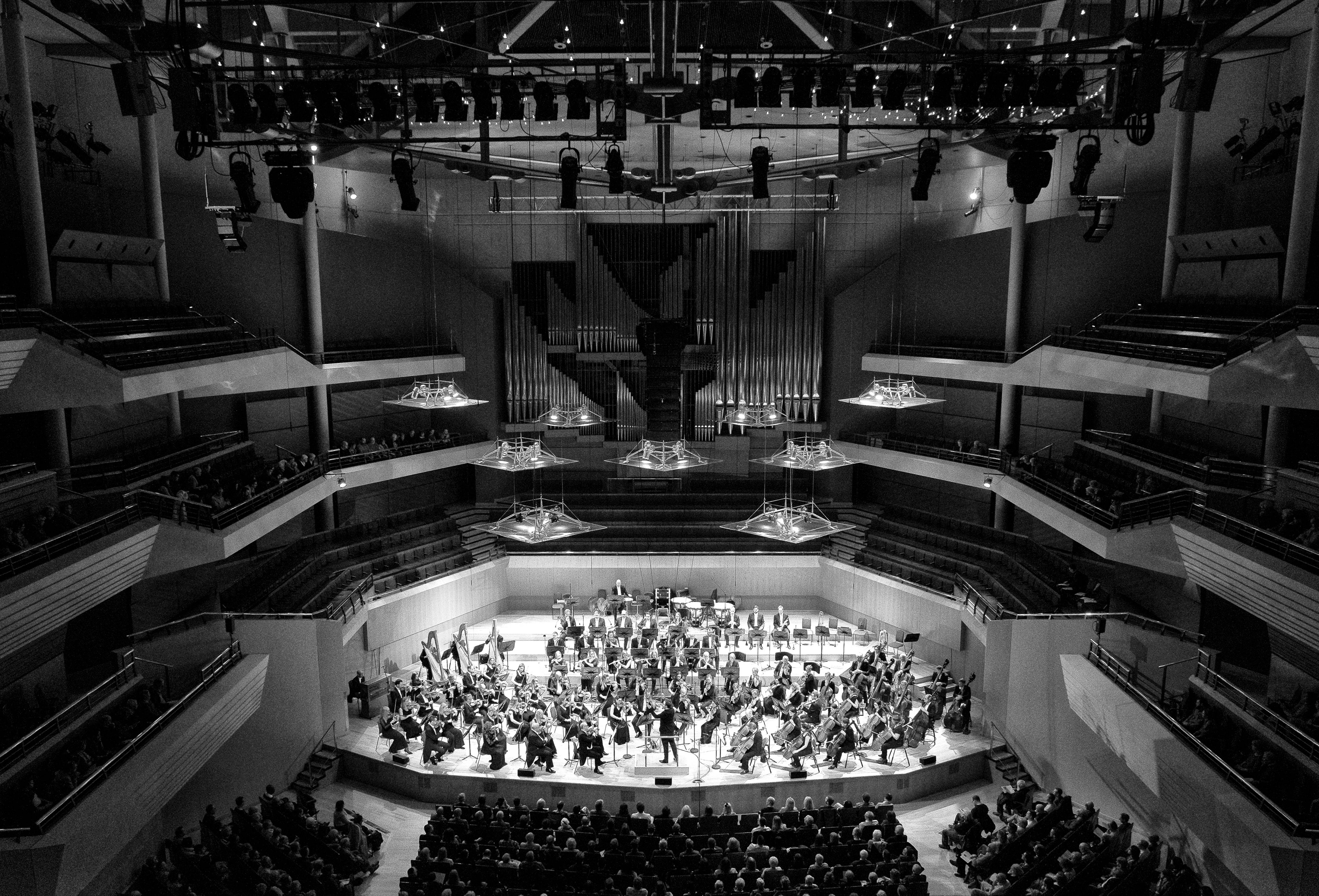
The Bridgewater Hall, Manchester


Welcome to tonight’s performance
With a heritage as rich as a Sachertorte, tonight’s concert gorges on the finest musical ingredients of Austria’s capital. Beethoven’s symphonies are cornerstones of the orchestral world, and the Seventh is a feast of rhythm and dance – expect more barnstorming than boleros. A hundred years on, the music of Berg stirred from the melting pot of 1900s Vienna. His Violin Concerto is by turns angelic and angst-ridden, one of the most innovative pieces ever written for the instrument. ‘Waltz King’ Johann Strauss II provides the icing on the cake with his Emperor Waltz and, with a bonus trip down the River Danube, our dance through Vienna is complete.
Our relationship with BBC Radio 3
As the BBC’s flagship orchestra for the North, almost all of the BBC Philharmonic’s concerts are recorded for broadcast on Radio 3. Tonight you will see a range of microphones on the stage and suspended above the orchestra. We have a Producer, Assistant Producer and Programme Manager at the orchestra who produce our broadcasts.
We seek to bring a diverse and risk-taking range of repertoire to our audiences, including our concert-goers here in Manchester, as well as the two million listeners who tune in to BBC Radio 3.
Please do not take flash photographs during the performance as this is very distracting to the artists. Audio and video recording is strictly prohibited.
To ensure that everyone can enjoy the concert, please either turn off your phone and any other electronic devices before it begins or ensure that they are turned to silent.

Johann Strauss II
Emperor Waltz 11’
Alban Berg
Violin Concerto 25’
INTERVAL: 20 MINUTES
Johann Strauss II
The Blue Danube 9’
Ludwig van Beethoven
Symphony No. 7 in A major 36’
Josef Špaček violin
BBC Philharmonic
Anja Bihlmaier conductor


Tonight’s concert is being recorded by BBC Radio 3 for broadcast in Radio 3 in Concert on Wednesday 5 June at 7.30pm. It will be available for 30 days after broadcast via BBC Sounds, where you can also find podcasts and music mixes.
Help us Improve Our Online Programmes.
Please take this 5-minute survey and let us know what you think of these notes.
Programme Survey
Johann Strauss II(1825–1899)
Emperor Waltz, Op. 437 (1889)

Few states understood soft power better than the Austro-Hungarian monarchy, and at the peak of Johann Strauss II’s global fame his music was practically an extension of Habsburg diplomacy. In August 1889 Emperor Franz Joseph of Austria travelled to Berlin to affirm Austria’s friendship with the new German Emperor Wilhelm II: the two empires, they proclaimed, were ‘hand in hand’. Weeks later, Strauss and his orchestra followed up with a residency at Berlin’s newly-opened Königsbau ballroom and a brand-new waltz, initially entitled Hand in Hand but later published as Kaiser-Walzer (‘Emperor Waltz’).
This is Strauss at the peak of his artistic ambition: a sweeping, truly majestic sequence of waltzes, introduced by a brisk but dignified march and rounded off by a sunset coda that evokes, as poignantly as anything by Mahler, a very Viennese awareness that all good things must come to an end. Pragmatic as ever, Strauss left the title Kaiser-Walzer deliberately vague – meaning that the new waltz would be equally saleable to patriotic subjects of both emperors. But lest anyone doubt his personal loyalties, the first edition carried a picture of the crown of Austria. ‘Franz Joseph can reign only as long as the Waltz King lives,’ joked the Viennese coffee-house wits.
Johann Strauss II
As the son of Vienna’s – and Europe’s – most celebrated dance-band leader, there was never much doubt about the career that the teenage Johann Strauss II would follow. But young Johann (‘Schani’ to friends and family) swiftly eclipsed his estranged father, and over a six-decade career as composer and bandleader he elevated popular music to the level of high art, playing to vast audiences across Europe and the USA and earning the nickname ‘the Waltz King’.
Strauss’s artistic roots lay in Vienna’s wine gardens and cafés, and his music is unambiguously about pleasure. But to confine him to Viennese Evenings is to overlook the sophistication and range of his greatest works. Admired without reservation by both Brahms and Wagner, Strauss returned the compliment, and his finest waltzes resemble miniature tone-poems. He brought an inimitable fantasy and panache to polkas, galops, marches and quadrilles, and of his 16 operettas, two in particular – Die Fledermaus (‘The Bat’, 1874) and Der Zigeunerbaron (‘The Gypsy Baron’, 1885) – set the template for Viennese operetta for a generation: near-perfect comic masterpieces, bubbling over with melody, warmth and unquenchable joie de vivre. Fresh, tuneful and enduringly popular, the music of Johann Strauss II came to embody the spirit of a city, and then of an entire civilisation.
Programme note and profile © Richard Bratby
Richard Bratby writes on music for The Spectator, Gramophone and The Critic. His book Refiner’s Fire: The Academy of Ancient Music and the Historical Performance Revolution was published last year.
Alban Berg (1885–1935)
Violin Concerto (1935)
Part 1
1 Andante – 2
Allegretto
Part 2
3 Allegro –
4 Adagio
Josef Špaček violin
The 1935 Violin Concerto was the final piece that Alban Berg completed, and it indeed serves as something of a requiem – for the composer himself, and for the daughter of close friends.
Manon Gropius was the first-born of Alma Mahler-Werfel (née Schindler) and her second husband, Bauhaus founder and architect Walter Gropius. Manon was an aspiring actress but died suddenly of polio in April 1935 at the age of just 18. Berg knew the family well and was devastated by her death. He’d been commissioned by US violinist Louis Krasner to write a violin concerto and was determined that the new piece should serve as a memorial for Manon, eventually dedicating it ‘to the memory of an angel’.
Krasner’s initial idea was for a heartfelt work using pioneering serial methods – in which a piece’s music is derived from a single, egalitarian ordering of the 12 notes of the chromatic scale (all the black and white notes on a keyboard) – that would genuinely capture an audience’s imagination. Berg’s conception of a concerto of high emotion and deep tragedy, and one conveyed through the strict stipulations of serialism, seemed like the ideal response to Krasner’s demands. And what Berg produced has every right to stake its claim as the most expressive, immediately accessible piece of serial music in the repertoire.
Berg achieved his remarkable expressiveness by loosening some of the rigours of serialism to admit some old-fashioned consonant tonality. His ordering of notes (or ‘row’, in serialist jargon) is actually a succession of familiar major chords, plus a final four notes that correspond precisely with the opening of one of Bach’s most austere, despairing chorales, ‘Es ist genug’ (‘It is enough’). Indeed, Berg quotes Bach explicitly in the concerto’s second movement, first in the violin’s solo line, then using four clarinets to do a passable impression of a rural church organ.
From the start, Berg conceived his concerto as an instrumental requiem for Manon, with its four movements – divided into two parts – depicting her birth, her short life, her death and finally her transfiguration as she soars heavenward via Berg’s ever-ascending row. Even more tragically, however, the Violin Concerto would also serve as Berg’s own requiem. While he was composing the work at his summer retreat on the Wörthersee in Austria, he was stung by a wasp on his back and – in the days before antibiotics – suffered months of painful infection before finally succumbing to septicaemia in the early hours of Christmas Eve 1935.
Programme note © David Kettle
David Kettle is an Edinburgh-based writer and editor who contributes regularly to The Scotsman, The Daily Telegraph, The List and The Strad.
Alban Berg
Berg had written many songs before he came to the attention of Arnold Schoenberg – the father of the Second Viennese School and pioneer of serialism. Berg’s early works under Schoenberg’s watchful eye – the Op. 1 Piano Sonata and the Seven Early Songs, completed in his early twenties – already pointed to a post-Romantic musical language, and an intense, sensitive character. After his atonal String Quartet (1910) he moved to larger forces in the Altenberg Lieder (1912), which caused a riot at its premiere. Following the war he won an international reputation with his first opera Wozzeck, while his Chamber Concerto, written for Schoenberg’s 50th birthday, incorporated serial techniques and hidden ciphers referring to the Second Viennese School, Schoenberg–Berg–Webern alliance. Berg would continue his use of serialism in the Lyric Suite (1925–6) for string quartet, the opera Lulu (completed after his death and first performed in its entirety as recently as 1979), and in the Violin Concerto (1935), but often not as rigorously as Schoenberg and Webern.
Profile by Edward Bhesania © BBC
Edward Bhesania is Editorial Manager, BBC Proms Publications.
INTERVAL: 20 minutes
Johann Strauss II
The Blue Danube, Op. 314 (1867)
‘Alas! Not by me,’ scribbled Brahms over the opening notes of Johann Strauss’s waltz An der schönen blauen Donau (‘On the Beautiful Blue Danube’). Piano arrangements sold well over a million copies worldwide. And yet The Blue Danube (as it’s more generally known in English) had almost flopped. After Austria’s disastrous war with Prussia in 1866, few Viennese felt like dancing. When the Wiener Männergesangsverein – a Viennese male voice choir – asked Strauss to write something for its February 1867 ball, he did his best to lift the mood. The new waltz was originally intended to be sung by the men of the choir; the choral parts included the words ‘Viennese, cheer up! Why not?’.
Relaunched as a purely instrumental work at the April 1867 Exposition Universelle in Paris, The Blue Danube would become the most famous of all Viennese waltzes. ‘Each waltz is a little love story,’ wrote the critic Eduard Hanslick, shortly after Strauss’s death, and none more than this. With a shimmer of violins and three simple rising notes on the horn, Strauss conjures a breathless sense of anticipation and an atmosphere of pure poetry. The rhythm slowly starts to spin, the great procession of dance melodies flows past, and then – before the final flourish – Strauss pauses one last time, amid sunset colours, to reflect on happiness past.
Programme note © Richard Bratby
Ludwig van Beethoven (1770–1827)
Symphony No. 7 in A major, Op. 92 (1811–12)
1 Poco sostenuto – Vivace
2 Allegretto
3 Presto – Assai meno presto – Presto
4 Allegro con brio
Wagner was only partly right when he called Beethoven’s Seventh ‘the apotheosis of the dance’. It’s even more fundamental than that. Rhythm really is it: the Seventh thrills with Beethoven’s obsessive focus on what he can make from just a few rhythmic cells, which he turns into structural building blocks with maniacal relentlessness.
But the Seventh does even more than that. This isn’t a piece about revolutionary ideas or heroes, it’s not a spiritual journey from darkness to light, it’s not about humanity’s relationship with nature, and it’s not about a composer showing how he can break through the conventions of previous generations. He’d done all of that – and more – in his previous six symphonies. He addresses the Seventh, not to our brains, but to our bodies. It is a sensory overload that pummels and pounds its way into all of the frequency-receiving parts of our anatomy: not only our ears, but our stomachs, our loins, our limbs, our feet, all of the parts of us that are made to move with and be moved by music.
Rhythm is inescapably the point of the main part of the first movement, whose dotted-rhythm Morse code is drummed out in nearly every bar, just as it’s drilled into our listening consciousness; rhythm is the catalyst for the ever-intensifying machine for mourning of the second movement; the third-movement scherzo is a vertiginous symphonic catapult, a challenge for us to keep up with the pace; and the finale puts a folk tune on rhythmic steroids, creating a churning centripetal force that sucks in the limits of the musical universe along with all of us listening and everyone playing.
The Seventh is the symphony as pure visceral experience, a piece that explodes fiercely and violently out of the bounds of the concert hall and into all the vibrating, resonating places of our bodies. It is not merely a dance, but an earthy apotheosis of symphonic grooving!
Programme note © Tom Service
Tom Service presents The Listening Service and other programmes for BBC Radio 3, and has also presented on BBC TV. A regular writer for The Guardian since 1999, he is also the author of the books Music as Alchemy and Thomas Adès: Full of Noises.
Ludwig van Beethoven
In his early twenties Beethoven left his native Bonn for Vienna, where he became established in fashionable circles as a composer, piano virtuoso and improviser. Largely following the Classical models of Haydn and Mozart in his ‘early’ period, he recognised signs of his impending deafness as early as 1796. In 1802 he confessed his suffering and alienation, as well as a creative resolve, in his Heiligenstadt Testament. His middle period was characterised by a broadening of form and an extension of harmony to suit his proto-Romantic expression, spawning the Symphonies Nos. 2 to 8, notable piano sonatas, several string quartets and his only opera, Fidelio. From 1812 to 1818 he produced little music, but his last years saw the mould-breaking ‘Choral’ Symphony and an exploration of increasing profundity in the more intimate mediums of the string quartet and piano sonata.
Profile by Edward Bhesania © BBC
Biographies
Anja Bihlmaier conductor
German-born conductor Anja Bihlmaier studied at the Freiburg Hochschule für Musik with Scott Sandmeier and at the Mozarteum University Salzburg, where she held a scholarship, with Dennis Russell Davies and Jorge Rotter. She is Chief Conductor of the Residentie Orkest, The Hague, and has held positions at the Hanover State Opera, Kassel State Theatre and Chemnitz Theatre.
A passionate opera conductor, recently she conducted Gounod’s Faust at Trondheim Opera, Britten’s A Midsummer Night’s Dream at Malmö Opera and Mozart’s The Magic Flute at the Vienna Volksoper. Last year she conducted Wagner’s The Flying Dutchman in Tampere and Verdi’s La traviata for Norwegian National Opera.
Recent concert engagements include performances with the BBC, City of Birmingham, Danish National, Finnish Radio, Swedish Radio and SWR Symphony orchestras and Royal Stockholm Philharmonic Orchestra. Last year, with the BBC Philharmonic, she made her first BBC Proms appearance.
This season’s highlights include debuts with the Bergen and London Philharmonic orchestras, Frankfurt Radio, Melbourne and Sydney Symphony orchestras, Deutsche Kammerphilharmonie Bremen, Hamburg Staatsorchester, Orchestre National du Capitole de Toulouse and Royal Scottish National Orchestra. She also returns to the Salzburg Camerata in her debut at Mozart Week.
Josef Špaček violin
Czech violinist Josef Špaček studied with Itzhak Perlman at the Juilliard School in New York, Ida Kavafian and Jaime Laredo at the Curtis Institute of Music in Philadelphia, and Jaroslav Foltýn at the Prague Conservatory. He was Laureate of the International Queen Elisabeth Competition in Brussels and won top prizes at the Michael Hill and Carl Nielsen International Violin competitions and the Young Concert Artists International Auditions in New York.
He has served as Concertmaster of the Czech Philharmonic – the youngest in its history. In 2016 the orchestra named him Associate Artist and at the end of the 2019/20 season he left to devote himself exclusively to his solo career.
He appears with orchestras including the Bamberg, Berlin Radio, Shanghai and Tokyo Metropolitan Symphony orchestras, Czech, Helsinki, Japan, Luxembourg, Netherlands, Rotterdam and Strasbourg Philharmonic orchestras, Academy of St Martin in the Fields, Berlin Konzerthaus Orchestra, Orchestre de Paris, Scottish Chamber Orchestra and Zurich Tonhalle Orchestra. Also a chamber musician and recitalist, he is a regular guest at festivals and in concert halls throughout Europe.
His recordings include the concertos by Dvořák and Janáček; works for violin and piano by Smetana, Janáček and Prokofiev; works for violin solo and violin and piano by H. W. Ernst; and Eugène Ysaÿe’s complete violin sonatas.
BBC Philharmonic
The BBC Philharmonic is reimagining the orchestral experience for a new generation – challenging perceptions, championing innovation and taking a rich variety of music to the widest range of audiences.
Alongside a flagship series of concerts at Manchester’s Bridgewater Hall, the orchestra broadcasts concerts on BBC Radio 3 and BBC Sounds from venues across the North of England, annually at the BBC Proms and from its international tours. The orchestra also records regularly for the Chandos label and has a catalogue of over 300 discs and digital downloads.
Championing new music, the orchestra has recently given world and UK premieres of works by Anna Appleby, Gerald Barry, Erland Cooper, Tom Coult, Sebastian Fagerlund, Emily Howard, Robert Laidlow, James Lee III, Grace-Evangeline Mason, David Matthews, Outi Tarkiainen and Anna Thorvaldsdottir, with the scope of the orchestra’s output extending far beyond standard repertoire.
The BBC Philharmonic’s Chief Conductor is John Storgårds, with whom the orchestra has enjoyed a long association. French conductor Ludovic Morlot is its Associate Artist, while Anna Clyne, one of the most in-demand composers of the day, is its Composer in Association.
Last May the orchestra performed at the 2023 Eurovision Song Contest, both at a free concert with previous Ukrainian winner Jamala and in the final itself with Italian artist Mahmood, for a rendition of John Lennon’s ‘Imagine’ during the Liverpool Songbook medley.
The orchestra continues to deliver a programme of engagement with children and young people. At the end of last year it released Musical Storyland, a major new 10-part series featuring the BBC Philharmonic musicians, which brings famous stories from around the world to life using the power of music. This was the first time an orchestra has been commissioned to make a series of films for UK network television.
Through all its activities, the BBC Philharmonic is bringing life-changing musical experiences to audiences across Greater Manchester, the North of England, the UK and around the world.
Chief Conductor
John Storgårds
Associate Artist
Ludovic Morlot
Composer in Association
Anna Clyne
First Violins
Zoe Beyers Leader
Midori Sugiyama Assistant Leader
Thomas Bangbala Sub Leader
Kevin Flynn †
Austeja Juskaite-Igl
Ian Watson
Anna Banaszkiewicz-Maher
Martin Clark
Julian Gregory
Karen Mainwaring
Catherine Mandelbaum
Anya Muston
Robert Wild
Ian Flower
Sarah White
Second Violins
Lisa Obert*
Glen Perry**
Lily Whitehurst †
Gemma Bass
William Chadwick
Helen Evans
Simon Gilks
Sophie Szabo
Christina Knox
Melody Prophet
Matthew Watson
Anna O’Brien
Natalie Purton
Violas
Steven Burnard*
Sarah Greene †
Bernadette Anguige
Kathryn Anstey
Matthew Compton
Rachel Janes
Ruth Montgomery
Nicholas Howson
Roisin Ni Dhuill
Fiona Dunkley
Amy Hark
Carolyn Tregaskis
Cellos
Peter Dixon*
Maria Zachariadou**
Steven Callow †
Jessica Schaefer
Rebecca Aldersea
Melissa Edwards
Elinor Gow
Miriam Skinner
Elise Wild
Peggy Nolan
Double Basses
Ronan Dunne*
Alice Durrant †
James Goode
Andrew Vickers
Genna Spinks
Mhairi Simpson
Richard English
Flutes
Alex Jakeman*
Victoria Daniel †
Piccolo
Jennifer Hutchinson
Oboes
James Hulme ‡
Matthew Jones
Cor anglais
David Benfield
Clarinets
Fraser Langton
Jillian Allan
Lewis Banks
Alto Saxophone
Lewis Banks
Bass Clarinet
Elliot Gresty
Bassoons
Roberto Giaccaglia*
Angharad Thomas
Contrabassoon
Bill Anderson
Horns
Rebecca Levis ¥
Phillip Stoker
Tom Kane
Jonathan Barrett
Lindsey Stoker
Trumpets
Tom Fountain*
Gary Farr †
Emily Mitchell
Trombones
Richard Brown*
Gary MacPhee
Bass Trombone
Russell Taylor
Tuba
Christopher Evans
Timpani
Paul Turner*
Percussion
Paul Patrick*
Geraint Daniel
Tim Williams ¥
John Melbourne
Harp
Clifford Lantaff*
* Principal
† Sub Principal
‡ Assistant Principal
§ Guest Principal
¥ Associate Principal
The list of players was correct at the time of publication
Orchestra Director Adam Szabo
Team Assistant Diane Asprey
Senior Producer Mike George
Assistant Producer Kathy Jones
Programme Manager Stephen Rinker
Orchestra Manager Tom Baxter
Assistant Orchestra Manager Stefanie Farr
Orchestra Personnel Manager Helena Nolan
Orchestra Assistant Maria Villa
Audience Development Manager Beth Wells
Marketing Executive Emma Naylor
Marketing Assistant Kate Highmore
Learning and Digital Manager Jennifer Redmond
Learning Projects Co-ordinator Youlanda Daly
Librarians Edward Russell, Emily Pedersen
Senior Stage Manager Thomas Hilton
Transport Manager Will Southerton
Keep up to date with the BBC Philharmonic
Listen to our BBC Radio 3 broadcasts via the BBC Sounds app. Visit our website and follow us on Twitter, Facebook and Instagram and sign up to the newsletter
To help us improve our online concert programmes, please take this 5-minute survey
Produced by BBC Proms Publications