
Sir Stephen Hough plays Brahms
Thursday 3/10/24, 7.30pm
Brangwyn Hall, Swansea


Johannes Brahms
Piano Concerto No. 144’
INTERVAL: 20 minutes
Johannes Brahms, orch. Arnold Schoenberg
Piano Quartet No. 143’
Ryan Bancroftconductor
Sir Stephen Hough piano


The concert is being recorded by BBC Radio 3 for future broadcast in Radio 3 in Concert; it will be available for 30 days after broadcast via BBC Sounds, where you can also find podcasts and music mixes.
Introduction

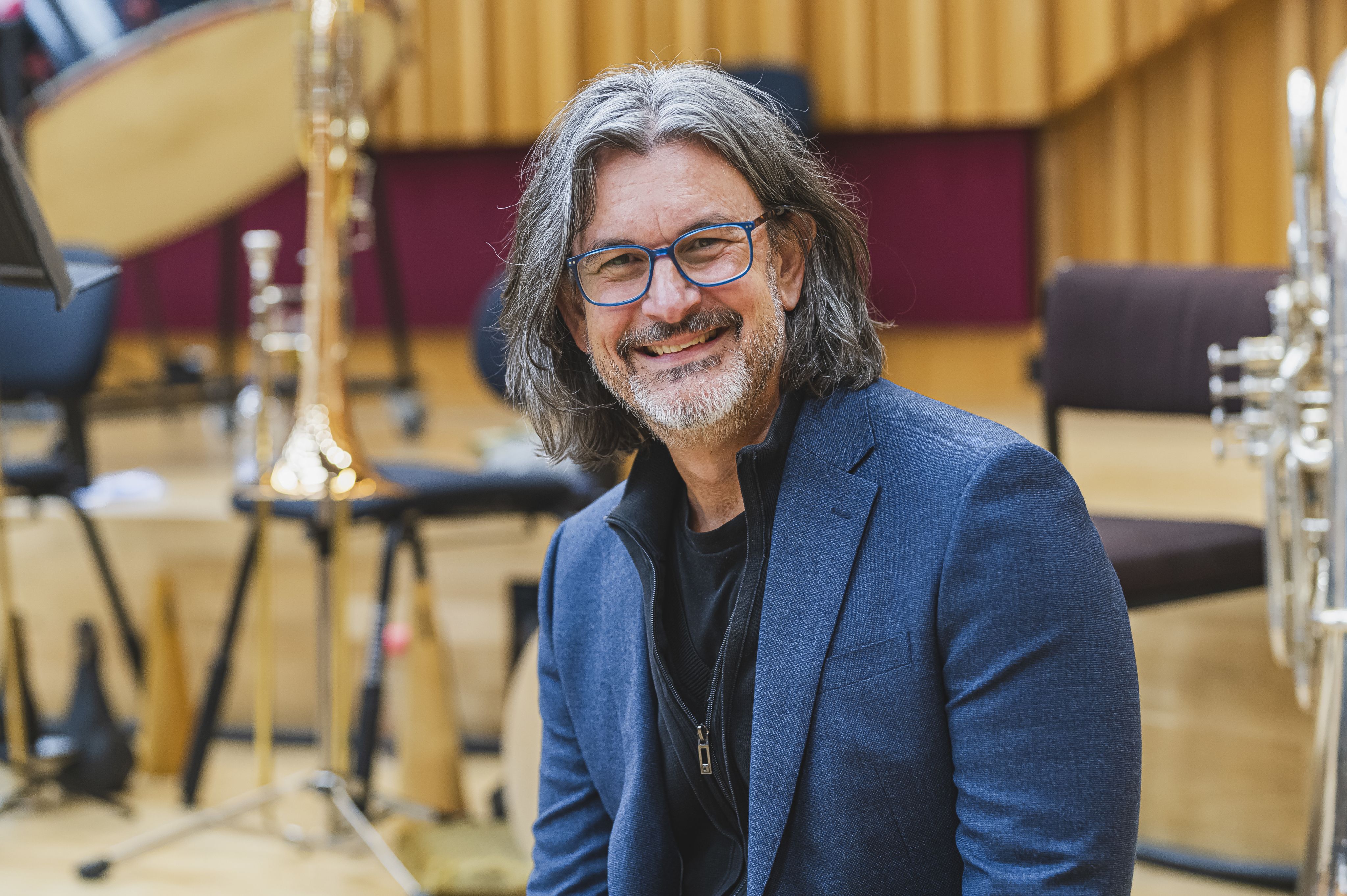
Photo: Kirsten McTernan
Photo: Kirsten McTernan
Welcome to tonight’s concert, the first of the new season given by our Principal Conductor Ryan Bancroft. The evening is a celebration of Brahms in two highly contrasting works.
The First Piano Concerto, over which the composer laboured long and hard for several years, is an extraordinary achievement, especially when you realise he was only in his mid-twenties when he finished it. It’s a piece that takes the lofty heights of the Beethovenian concerto and melds it with a symphonic ambition to create a Romantic concerto that seems entirely new. It’s a world away from the surface brilliance of many concertos of the time: though its difficulties are prodigious, they’re always at the service of the music. Performing it tonight we’re delighted to welcome Sir Stephen Hough.
At around the same time as this mighty concerto, Brahms was also working on his First Piano Quartet, a piece that puts all four musicians through their paces, particularly in the driving, dancing finale. This evening we hear it in the very distinct sound-world conjured by Arnold Schoenberg (whose 150th birthday we’re celebrating this year) in his arrangement for orchestra. His aim, as he explained to a friend, was to rework the textures so that everything became audible – which he achieved magnificently in an orchestration that brings Brahms very much into the 20th century.
Enjoy!
Matthew Wood
Head of Artistic Planning and Production
Please respect your fellow audience members and those listening at home. Turn off all mobile phones and electronic devices during the performance. Photography and recording are not permitted.
Johannes Brahms(1833–97)
Piano Concerto No. 1 in D minor, Op. 15 (1854–8)

1 Maestoso
2 Adagio
3 Rondo: Allegro non troppo
Sir Stephen Houghpiano
Johannes Brahms was still only 25 when he completed his mammoth Piano Concerto No. 1 in 1858. The work had preoccupied him for five years, undergoing several transformations including incarnations as a two-piano sonata and a symphony before finding its final form as a concerto for his own instrument. He was the soloist for the first performance in Hanover the following year.
The concerto emerged from a formative phase. In his early twenties, Brahms gained a circle of musical friends, chief among whom was the Hungarian violinist Joseph Joachim. Although Joachim eventually gave up composing, at that stage he was more experienced than Brahms. In their extensive, lively correspondence, they discussed many musical details of the concerto.
Joachim was not the only exciting new influence. In 1853, shortly after they met, Brahms also visited Robert and Clara Schumann. He was swiftly assimilated into their cultivated circle of musicians, artists and writers in Düsseldorf. The excitement of those years emerges from Brahms’s effervescent, playful letters. He wrote to Joachim: ‘I do not comprehend my former life.’
His friend Julius Otto Grimm described this youthful Brahms as ‘chock-full of crazy notions’. Brahms painted his apartment with grotesque frescoes, took furiously energetic country walks and was perennially cash-strapped, not least because he lavished his meagre funds on books.
But Brahms also recognised that he had to sharpen his compositional tools. In 1854 he decided to hone his craft, declining to publish any music for several years. Joachim was his companion in this project of self-education, known in German as Bildung.
Tragedy struck in 1856 with the death of Robert Schumann, a devastating loss for the young composer that resonated in his music for many years. Clara Schumann, however, remained a lifelong friend and support. During the D minor Concerto’s gestation, she praised the ‘greatness of conception and the tenderness of [the] melodies in the first movement’. Shortly afterwards, she noted joyously in her diary: ‘Johannes has finished his concerto – we have played it several times on two pianos.’
It was by far his most ambitious work to date. Brahms pushed the boundaries by writing a symphony for piano and orchestra, the two forces pitted against each other in a titanic battle. The overall scale of the concerto is vast, especially the first movement, with its dramatic, storm-tossed opening. The second movement, an Adagio, provides a tranquil interlude before the demonic third movement drives the music to its thrilling close.
For decades the public rejected the concerto. Its second performance in Leipzig was downright disastrous, to Brahms’s despair, evoking loud hisses! Only during the 20th century did the work become a repertoire standard. Today, with its unique fusion of physical stamina and expressive breadth, we can appreciate the sheer originality of Brahms’s conception.
Programme note © Natasha Loges
INTERVAL: 20 minutes
Johannes Brahms, orch. Arnold Schoenberg(1874–1951)
Piano Quartet No. 1 in G minor, Op. 25(1856–61, orch. 1937)
1 Allegro
2 Intermezzo: Allegro ma non troppo – Trio: Animato – Intermezzo
3 Andante con moto
4 Rondo alla Zingarese: Presto
In May 1937, four years after settling in the USA, Schoenberg started working on an orchestration of Brahms’s First Piano Quartet. He gave his reasons for doing so in a letter to the critic Alfred Finkelstein:
‘1 I like this piece. 2 It is very seldom played. 3 It is always very badly played, because the better the pianist, the louder he plays and you hear nothing from the strings. I wanted once to hear everything, and this I achieved.’
Fortunately for us, Brahms’s First Piano Quartet is much better known, and clearly better played, than when Schoenberg heard it. But there’s another good reason for performing this arrangement than simply wanting to hear all the notes. In this arrangement by Schoenberg it is a remarkable coming-together of two great minds, creating something that sounds more like a very personal homage to Brahms than simply an adaptation for the large concert hall.
When Schoenberg started work on it, he wanted to be as faithful as possible to a composer he revered, and from whom he had learnt a great deal. So he started with an orchestra of the same standard mid-19th century proportions that Brahms would have used, and strove to create as authentic a sound as possible. But with time Schoenberg found this increasingly difficult, and before long the orchestra had grown significantly larger, including instruments the older master would almost certainly have considered beyond the pale: cor anglais, E flat (‘piccolo’) and bass clarinets, and in the finale a large percussion section featuring xylophone and tubular bells.
The result is that the orchestration gets more Schoenbergian as it proceeds – not just in sound, but in character too. For him, a Jew writing in exile from Nazi-occupied Central Europe, and from the Vienna he grew up in and half-loved, half-hated, there may have been an element of reconnection here – realignment with what was best in his old home city at a time when it was heading terrifyingly towards the worst. The element of personal tragedy in Brahms’s First Piano Quartet duly acquires a modern edge, while the wild minor-key exultation of the ‘Gypsy’ finale takes on a truly Schoenbergian note of defiance – not least near the end, when a downward cascading scale, originally on the piano, is taken up by a distinctly Jewish Klezmer-sounding clarinet. There’s an element of dark triumph here, but that triumph is at least as much Schoenberg’s as Brahms’s.
Programme note © Stephen Johnson
Help Us Improve Our Online Programmes.
Please take this 5-minute survey and let us know what you think of these notes.
Programme Survey
You may also like:
Romantic Rhapsodies
Thursday 7/11/24, 7.30pm
Brangwyn Hall, Swansea
Mendelssohn Violin Concerto in E minor
Bruckner Symphony No. 4, ‘Romantic’
Jaime Martín conductor
Ellinor D’Melon violin
SPECTACULAR | COLOURFUL | RHAPSODIC
Written for his dear friend Ferdinand David, Mendelssohn’s E minor Violin Concerto is the perfect blend of charm and elegance. Brimming with lyricism and structural inventiveness, it is little wonder that this concerto has firmly established itself as one of the most best loved of all concertos. To perform it we’re delighted to welcome rising star and multi-award-winner Ellinor D’Melon.
In celebration of Bruckner’s 200th-birthday year, his Fourth Symphony takes centre stage in the second half of this concert, conducted by our Principal Guest Conductor, Jaime Martín. Spectacular horn solos soar against shimmering strings, funeral marches interweave with German chorales and the Scherzo is full of hunting-horn calls, before leaning into a more gentle Trio reminiscent of Haydn or Beethoven in this colourful symphony.
Elegant Romantics
Thursday 3/4/25, 7.30pm
BBC Hoddinott Hall, Cardiff
Friday 4/4/25, 7.30pm
Theatr Brycheiniog, Brecon
Fanny Mendelssohn Overture
Elgar Cello Concerto
Brahms Symphony No. 4
Simone Menezes conductor
Bryan Cheng cello
ROMANTIC | ELEGANT | ICONIC
Fanny Mendelssohn’s elegantly romantic Overture sets the mood for the classical favourites that follow. Rhapsodic melodies accented by pizzicato allusions lead the way to virtuosity and British bravado in Elgar’s much-loved Cello Concerto, although his post-First World War melancholy is never far from the surface, with assertive yet austere themes, a jaunty energy offset by meditative qualities. As soloist we welcome BBC NOW debutant, the multi-award-winning cellist Bryan Cheng.
A work of tremendous power and passion, Brahms’s last – and arguably his greatest – symphony, his fourth, exudes beauty, grandeur and emotion, and we’re delighted to welcome highly acclaimed Italo-Brazilian conductor, Simone Menezes, to the podium in her debut with BBC NOW.
Biographies
Ryan Bancroftconductor

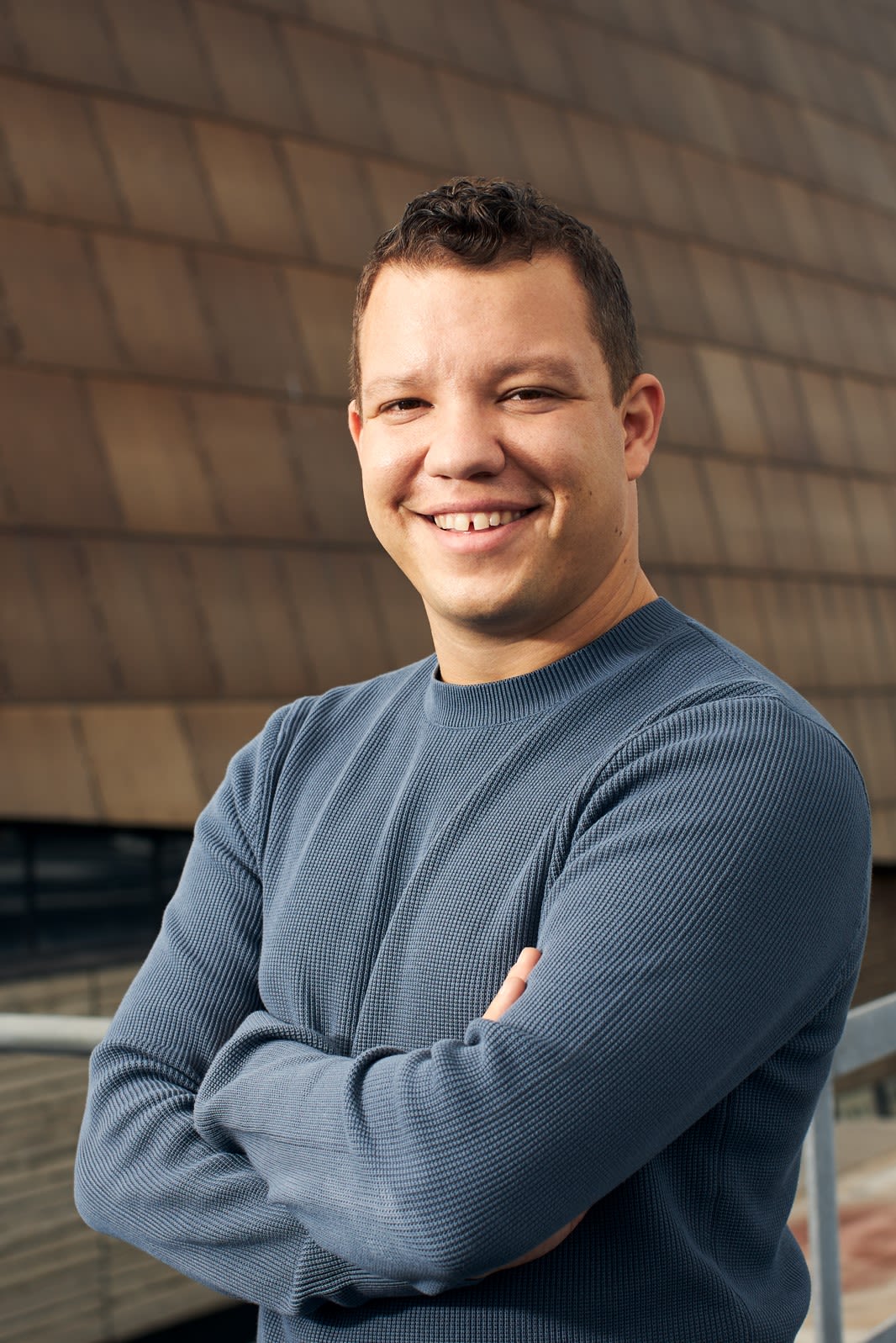
Benjamin Ealovega
Benjamin Ealovega
Ryan Bancroft grew up in Los Angeles and first came to international attention in April 2018, when he won both First Prize and Audience Prize at the prestigious Malko Competition for Young Conductors in Copenhagen. Since September 2021 he has been Principal Conductor of BBC National Orchestra of Wales. Following his first visit to work with the Tapiola Sinfonietta, he was invited to become its Artist-in-Association from the 2021/22 season. In September 2023 he became Chief Conductor of the Royal Stockholm Philharmonic Orchestra.
After beginning his tenure as Chief Conductor in Stockholm with the orchestra’s first performance of Sven-David Sandström’s The High Mass, his second season includes performances of Mahler and Bruckner symphonies, alongside world premieres by Chrichan Larson and Zacharias Wolfe, and collaborations with renowned soloists including Leif Ove Andsnes, Maxim Vengerov and Víkingur Ólafsson.
This season he makes debuts with the Boston and Finnish Radio Symphony orchestras, Deutsches Symphonie-Orchester Berlin at the Berlin Philharmonie and the WDR Symphonieorchester in Cologne.
He has a passion for contemporary music and has performed with Amsterdam’s Nieuw Ensemble, assisted Pierre Boulez in a performance of his Sur incises in Los Angeles, premiered works by Sofia Gubaidulina, John Cage, James Tenney and Anne LeBaron, and has worked closely with improvisers such as Wadada Leo Smith and Charlie Haden.
He studied at the California Institute of the Arts, Royal Conservatoire of Scotland and in the Netherlands.
Sir Stephen Houghpiano

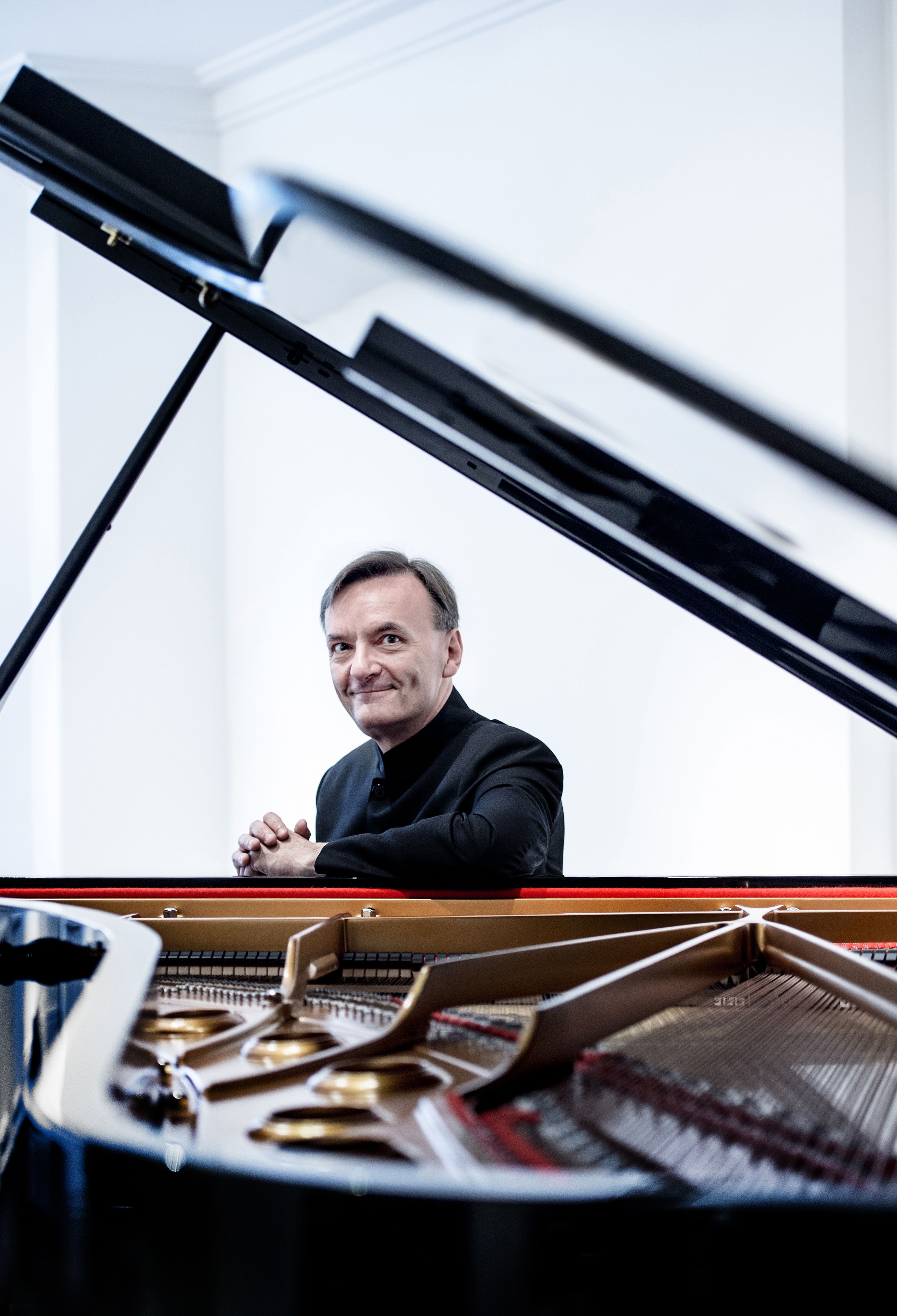
Sim Canetty-Clarke
Sim Canetty-Clarke
Named by The Economist as one of Twenty Living Polymaths, Sir Stephen Hough combines a distinguished career of a concert pianist with those of a composer and writer. In recognition of his contribution to cultural life, he became the first classical performer to be given a MacArthur Fellowship, and was awarded a knighthood in the Queen’s Birthday Honours 2022.
In a career spanning over 40 years, he has played regularly with most of the world’s leading orchestras and has been a regular guest of international recital series and festivals.
He appeared as both performer and composer at the 2024 Last Night of the Proms. Over the next 12 months he gives over 80 concerts on four continents, opening the Philharmonia Orchestra’s season at the Royal Festival Hall, performing a solo recital at the Barbican Centre and giving the world premiere of his Willa Cather-inspired Piano Quintet at Lincoln Center’s David Geffen Hall. Following the 2023 world premiere of his own Piano Concerto (‘The World of Yesterday’), named after Stefan Zweig’s memoir, he brings the work to the Adelaide, Bournemouth, Oregon, Singapore and Vermont Symphony orchestras.
His discography of 70 recordings has garnered awards including the Diapasond’Or de l’Année, several Grammy nominations, and eight Gramophone Awards, including Record of the Year and the Gold Disc.
Sir Stephen Hough’s output of songs, choral and instrumental works has been commissioned by Musée du Louvre, National Gallery of London, Westminster Abbey, Westminster Cathedral, Wigmore Hall, the Genesis Foundation, Gilmore International Keyboard Festival, the Walter W. Naumburg Foundation, BBC Sounds and the Berlin Philharmonic Wind Quintet.
As an author, his most recent book is the memoir Enough: Scenes from Childhood, published in 2023. He is an Honorary Bencher of the Middle Temple, an Honorary Member of the Royal Philharmonic Society, an Honorary Fellow of Cambridge University’s Girton College, the International Chair of Piano Studies and a Companion of the Royal Northern College of Music, and is on the faculty of the Juilliard School in New York.
BBC National Orchestra of Wales
For over 90 years, the BBC National Orchestra of Wales, the only professional symphony orchestra in Wales, has played an integral part in the cultural landscape of the country, occupying a distinctive role as both a broadcast and national orchestra, and serving as an ambassador of Welsh culture, regularly performing music created in Wales and championing Welsh composers and artists.
Part of BBC Cymru Wales and supported by the Arts Council of Wales, BBC NOW performs a busy schedule of concerts and broadcasts, working with acclaimed conductors and soloists from across the world, including its Principal Conductor, the award-winning Ryan Bancroft.
The orchestra is committed to working in partnership with community groups and charities, taking music out of the concert hall and into settings such as schools and hospitals to enable others to experience and be empowered by music. It undertakes workshops, concerts and side-by-side performances to inspire and encourage the next generation of performers, composers and arts leaders, and welcomes thousands of young people and community members annually through its outreach and education projects.
BBC NOW performs annually at the BBC Proms and biennially at the BBC Cardiff Singer of the World competition, and its concerts can be heard regularly across the BBC – on Radio 3, Radio Wales and Radio Cymru. On screen, music performed by BBC NOW can be heard widely across the BBC and other global channels, including the soundtrack and theme tune for Doctor Who, Planet Earth III, Prehistoric Planet, The Pact and Children in Need.
Based at BBC Hoddinott Hall, Cardiff Bay, BBC NOW utilises a state-of-the-art recording studio with a camera system for livestreams and TV broadcasts to bring BBC NOW’s music to a broader audience across Wales and the world. For more information about BBC NOW please visit bbc.co.uk/now
Patron
HM King Charles III KG KT PC GCB
Principal Conductor
Ryan Bancroft
PrincipalGuest Conductor
Jaime Martín
Conductor Laureate
Tadaaki Otaka CBE
Composer-in-Association
Gavin Higgins
First Violins
Lesley Hatfield leader
Nick Whiting associate leader
Shana Douglas
Gwenllian Hâf MacDonald
Terry Porteus
Suzanne Casey
Carmel Barber
Kerry Gordon-Smith
Emilie Godden
Anna Cleworth
Ruth Heney
Žanete Uškāne
Alejandro Trigo
Paul Mann
Second Violins
Anna Smith *
Amy Jones
Ros Butler
Sheila Smith
Vickie Ringguth
Joseph Williams
Michael Topping
Katherine Miller
Beverley Wescott
Roussanka Karatchivieva
Lydia Caines
Jane Sinclair
Violas
Yukiko Ogura ‡
Alex Thorndike #
Tetsuumi Nagata
Peter Taylor
Robert Gibbons
Anna Growns
Lowri Taffinder
Laura Sinnerton
Lydia Abell
Catherine Palmer
Cellos
Joely Koos ‡
Martin Johnson
Raphael Lang
Sandy Bartai
Carolyn Hewitt
Alistair Howes
Rachel Ford
Keith Hewitt
Double Basses
David Stark *
Alex Jones #
Christopher Wescott
Richard Gibbons
Gabriel Rodrigues
Emma Prince
Flutes
Matthew Featherstone *
John Hall †
Lindsey Ellis
Piccolos
Lindsey Ellis †
John Hall
Oboes
Steve Hudson *
Henrietta Cooke
Amy McKean †
Cor anglais
Amy McKean †
Clarinets
Nicholas Carpenter *
Lenny Sayers
E flat Clarinet
Will White
Bass Clarinet
Lenny Sayers †
Bassoons
Jarosław Augustiniak *
James Fisher
David Buckland
Contrabassoon
David Buckland †
Horns
Tim Thorpe *
Meilyr Hughes
Neil Shewan †
Joel Ashford
John Davy
Trumpets
Philippe Schartz *
Robert Samuel
Corey Morris †
Trombones
Donal Bannister *
Dafydd Thomas
Bass Trombone
Darren Smith †
Tuba
Daniel Trodden †
Timpani
Steve Barnard *
Percussion
Phil Hughes
Rhydian Griffiths
Max Ireland
Richard Cartlidge
* Section Principal
† Principal
‡ Guest Principal
# Assistant String Principal
The list of players was correct at the time of publication
Director Lisa Tregale
Orchestra Manager Liz Williams
Assistant Orchestra Manager Nick Olsen **
Orchestra Personnel ManagerKevin Myers
Business Coordinator Georgia Dandy
Orchestra Administrator Eleanor Hall +
Head of Artistic Planning and ProductionMatthew Wood
Artists and Projects Manager Victoria Massocchi **
Orchestra Librarian Naomi Roberts
Producer Mike Sims
Broadcast Assistantvacancy
Head of Marketing and Audiences Sassy Hicks
Marketing Coordinator Amy Campbell-Nichols +
Digital Producer Yusef Bastawy **
Social Media Coordinator Harriet Baugh
Education Producers Beatrice Carey, Rachel Naylor maternity cover
Audio Supervisors Simon Smith, Andrew Smillie
Production Business Manager Lisa Blofeld
Stage and Technical Manager Steven Brown +
Assistant Stage and Technical Manager Josh Mead +
+ Green Team member
** Diversity & Inclusion Forum