Songs of Destiny
Friday 20/6/25, 7.30pm
BBC Hoddinott Hall, Cardiff


Johannes Brahms Serenade No. 2 29’
INTERVAL: 20 minutes
Johannes Brahms Schicksalslied 18’
Igor Stravinsky Symphony of Psalms 21’
Ryan Bancroft conductor
BBC National Chorus of Wales
BBC Hoddinott Hall is certified by EcoAudio and we’re proud to be supporting the BBC in becoming a more sustainable organisation. For more information on the BBC’s net-zero transition plan and sustainability strategy please visit https://www.bbc.co.uk/aboutthebbc/documents/bbc-net-zero-transition-plan-2024.pdf




This concert is being recorded by BBC Radio 3 for future broadcast in Radio 3 in Concert; it will be available for 30 days after broadcast via BBC Sounds, where you can also find podcasts and music mixes.
Introduction
Welcome to tonight’s concert, the last in our main season, in which our Principal Conductor Ryan Bancroft returns for a programme that contrasts a Romantic great and a 20th-century master.
We begin with Brahms, and his Second Serenade. For years he had felt the long shadow cast by Beethoven and his supreme symphonic achievements. So, rather than competing with his own symphony, he experimented with the serenade form. The substantial Second overflows with Brahms’s characteristic good humour and easy melodiousness.
The BBC National Chorus of Wales joins the orchestra on stage for the second half. From around a decade later than the Serenade comes Brahms’s Schicksalslied, setting the poetry of Friedrich Hölderlin in a work that fully reflects its changeability of mood.
We end with Stravinsky’s Symphony of Psalms, one of his supreme examples of neo-Classicism. In it, he conjures a sense of otherness not simply through the three contrasting psalm texts, but in an orchestra shorn of its violins, violas and clarinets.
Enjoy – and I look forward to seeing you next season!
Lisa Tregale
Director
Please respect your fellow audience members and those listening at home: mobile phones may be kept on but on silent and with the brightness turned down; other electronic devices should be switched off during the performance. Photography and recording are not permitted.
Johannes Brahms (1833–1897)
Serenade No. 2, Op. 16 (1859)

1 Allegro moderato
2 Scherzo: Vivace
3 Adagio non troppo
4 Quasi menuetto – Trio
5 Rondo: Allegro
In a sense, it was Beethoven’s fault. By the time the young Johannes Brahms was beginning his musical career, there was a growing sense that a successor was needed to take up Beethoven’s symphonic mantle: and for better or worse, Brahms’s mentor Robert Schumann felt that the young Hamburg-born composer was the man for the job. In late 1853, Schumann publicly predicted Brahms’s glorious successes to come. Flattered and terrified in equal measure, Brahms spent the next 23 years attempting to write a symphony he deemed good enough to fit the bill. It was a protracted, painful process. But it generated some fascinating and unusual works along the way.
In 1857, the year after Schumann’s death, Brahms began one of several attempts at a symphonic project. Within a year, he had diverted his energies into producing not a Romantic symphony, but a Classical-style serenade. This neatly side-stepped Beethoven altogether, hopping backwards into a world of short, graceful movements and dances. He completed a second such work in November 1859. Whereas the First Serenade was described as being ‘für grosses Orchester’, this Second Serenade was deliberately scored for chamber forces only – just winds and strings.
Brahms conducted a private performance of it in February 1860 in Hamburg, where it was reviewed approvingly by the local papers. The Hamburger Nachrichten noted the sleek textures of the ensemble and the cheerful Rondo as a particular highlight. The Serenade is in five movements: a series of three pillars (the outer movements and the central Adagio) are each quite substantial, with a much shorter Scherzo and ‘Quasi menuetto’ in between. It is an easy-going work full of sunshine and singing lines for winds and strings alike. But Brahms’s love of Beethovenian drama peeps through here and there, particularly in the mournful unwinding of the Adagio with its unexpected and sometimes rather angular harmonies. The shorter movements are all plucked bass-lines and swinging rhythms, while the happy finale acts as counterbalance to the lyrical but structurally ambitious opening Allegro moderato.
Alas, the positive reception of the Serenade in Hamburg was not to be replicated at subsequent performances. When the piece was performed shortly afterwards in Hanover, the conductor received a vicious letter writing it off as ‘a monstrosity, a caricature, a freak… It is inexcusable that such filth should have been offered to a public thirsting for good music’!
Programme note © Katy Hamilton
INTERVAL: 20 minutes
Johannes Brahms
Schicksalslied, Op. 54 (1868–71)
BBC National Chorus of Wales
Brahms began his Schicksalslied (‘Song of Destiny’) in 1868, soon after completing his German Requiem, but although it is much smaller in scale (well under 20 minutes), it took almost as long to finish: the score wasn’t completed until 1871, three years later.
Part of the problem, for Brahms, resided in the form of the text, verses from the novel Hyperion by the mentally fragile, at times exquisitely visionary poet Friedrich Hölderlin (1770–1843). Many of the German Romantics of Hölderlin’s generation used images from Ancient Greece to evoke a sublime creative freedom, felt to be sadly lacking in their all-too-real contemporary existence. But Hölderlin seems to have felt this divine-human separation with special intensity. Brahms was clearly impressed by this, but the demands of balanced musical form, so important to a ‘Classical-Romantic’ such as Brahms, inclined him away from Hölderlin’s dramatic sequence: two stanzas of ‘tranquil clarity’ followed by a sudden, devastating plunge into a bleak ‘uncertainty’. Brahms’s instincts inclined him towards a more balanced structure, with some kind of final reference to the opening section. But surely bringing back the opening words, even in condensed form, would weaken the power of Hölderlin’s ending?
It was the conductor Hermann Levi (who later gave the first performance of Schicksalslied) who offered an answer: have the orchestra alone bring back the prelude to the first section. The chorus remains silent, so that the last words we hear are Hölderlin’s ‘ins Ungewisse hinab’ – ‘down into uncertainty’, but the orchestra has more to tell us. The result is a work which, while remaining movingly true to Hölderlin’s vision, achieves its effects within a musically satisfying form of its own. The gorgeous orchestral prelude delivers a subtly mixed message: nobly arching woodwinds and muted strings evoke the tranquillity of the Elysian Fields, but underneath, quietly tolling timpani, sounding an unmistakably funereal rhythm, remind us of mortality. After the chorus has sung of ‘radiant divine zephyrs’ and ‘blissful eyes’ that ‘gaze in eternal clarity’, two eerily hushed discords on winds and timpani are followed by a plunge into a surging minor-key Allegro for Hölderlin’s comfortless final verse. Eventually fury yields to quiet desolation, then the tempo drops to Adagio and the original orchestral prelude returns, but in a different key from the opening, with the addition of liquid slow string figures and solemn trombones. Brahms hardly ever used this kind of ‘progressive tonality’, and nowhere else on this scale. It is a masterstroke, enhancing the sense of distance from the original vision. The blissful existence of the Olympian gods has been glimpsed, but ultimately, alas, it is not for us.
Programme note © Stephen Johnson
Text
Schicksalslied
Ihr wandelt droben im Licht
Auf weichem Boden, selige Genien!
Glänzende Götterlüfte
Rühren euch leicht,
Wie die Finger der Künstlerin
Heilige Saiten.
Schicksallos, wie der schlafende
Säugling, athmen die Himmlischen;
Keusch bewahrt
In bescheidener Knospe,
Blühet ewig
Ihnen der Geist,
Und die seligen Augen
Blicken in stiller
Ewiger Klarheit.
Doch uns ist gegeben,
Auf keiner Stätte zu ruhn,
Es schwinden, es fallen
Die leidenden Menschen
Blindlings von einer
Stunde zur andern,
Wie Wasser von Klippe
Zu Klippe geworfen,
Jahr lang ins Ungewisse hinab.
Friedrich Hölderlin (1770–1843)
Translation
You wander up there in the light
on soft ground, blessed spirits!
Radiant divine zephyrs
stir you gently,
like the hand of an artist
caressing sacred strings.
Untouched by destiny, like sleeping
infants, breathe the immortals;
chastely preserved
within the humble bud,
their spirit blooms
for ever,
and their blissful eyes
gaze in tranquil
eternal clarity.
But we are granted
no resting place.
Suffering mankind
dwindles and stumbles
blindly from
hour to hour
like water, hurled
from cliff to cliff
down through the years into uncertainty.
Translation © Gery Bramall
Igor Stravinsky (1882–1971)
Symphony of Psalms(1930)
1 Exaudi orationem meam, Domine –
2 Expectans expectavi Dominum –
3 Alleluia. Laudate Dominum in sanctis eius
BBC National Chorus of Wales
The Symphony of Psalms was written during the most productive years of what is often referred to as Stravinsky’s neo-Classical period – although the term is a loose one here, as the composer pilfered from such a wide range of antiquated styles and forms, and found so many inventive ways to transform them. Indeed, the string of works from Oedipus rex (1927) to Perséphone (1933) – via Apollo and the Violin Concerto – features an extraordinary range of compositional approaches. The Symphony of Psalms comes in the middle of this sequence and is perhaps the most stylistically enigmatic.
Stravinsky’s constantly shifting idiom was sometimes met with confusion during this period, with critics accusing him of relying too much on musical masks and disguises. But there’s no doubting the sincerity of this work: an attempt to declare his faith as something personal and inspiring. While his earlier pieces for the Ballets Russes had been closer to pageantry, in which Russian tropes were exaggerated for the Parisian audience, the Symphony of Psalms dates from more than 15 years into his time as a cosmopolitan exile in France, and is a more heartfelt, serious assertion of his Russian Orthodox heritage. It may not be the festive piece Serge Koussevitzky hoped for when he commissioned it (to celebrate the Boston Symphony Orchestra’s 50th anniversary), but it has a life-affirming grandeur simmering just below the surface.
The orchestration removes clarinets, violins and violas, and at times creates a haunting, hollow sound. Elsewhere, Stravinsky makes percussive use of two orchestral pianos, energising the passages where the vocal lines sound like ritualistic chant.
While psalm settings are often exercises in direct, obvious word-painting, Stravinsky avoids such clichés, refraining in the third movement from depicting the instruments mentioned in Psalm 150. Here it becomes clear that, for this composer, praise and worship are in fact very calm and reflective states. Towards the end of the second movement, Psalm 40 proclaims that the Lord ‘hath put a new song in my mouth’, but this is sung while a most archaic device, a stunning double fugue, is unfolding. The first movement is the most reminiscent of Stravinsky’s ‘Russian phase’, with its syncopations and obsessive repetitions of just one or two notes.
Like the earlier Symphonies of Wind Instruments (1920), it is a monumental work rather than a symphony in the traditional sense – a huge framing device for the sounds made by the singing of the psalms.
Programme note © Tom Owen
Text
Symphony of Psalms
Exaudi orationem meam, Domine
Exaudi orationem meam, Domine, et deprecationem meam:
Auribus percipe lacrymas meas.
Ne sileas, quoniam advena ego sum apud te,
Et peregrinus, sicut omnes patres mei.
Remitte mihi, ut refrigerer
Priusquam abeam, et amplius non ero.
Psalm 39: vv. 12–13
Expectans expectavi Dominum
Expectans expectavi Dominum,
Et intendit mihi et exaudivit preces meas;
Et eduxit me de lacu miseriae, et de luto faecis.
Et statuit supra petram pedes meos;
Et direxit gressus meos.
Et immisit in os meum canticum novum,
Carmen Deo nostro.
Videbunt multi et timebunt;
Et sperabunt in Domino.
Psalm 40: vv. 1–3
Alleluia. Laudate Dominum in sanctis eius
Alleluia. Laudate Dominum in sanctis eius:
Laudate eum in firmamento virtutis eius.
Laudate eum in virtutibus eius:
Laudate eum secundum multitudinem magnitudinis eius.
Laudate eum in sono tubae:
laudate eum in psalterio et cithara.
Laudate eum in tympano et choro:
Laudate eum in chordis et organo.
Laudate eum in cymbalis benesonantibus:
Laudate eum in cymbalis iubilationis:
Omnis spiritus laudet Dominum.
Psalm 150
Translation
Hear my prayer, O Lord, and give ear unto my cry;
hold not thy peace at my tears.
For I am a stranger with thee,
and a sojourner, as all my fathers were.
O spare me, that I may recover strength,
before I go hence, and be no more.
I waited patiently for the Lord:
and he inclined unto me, and heard my cry.
He brought me up also out of an horrible pit, out of the miry clay,
and set my feet upon a rock,
and established my goings.
And he hath put a new song in my mouth,
even praise unto our God:
and many shall see it, and fear,
and shall trust in the Lord.
Hallelujah. Praise God in his sanctuary:
praise him in the firmament of His power.
Praise him for his mighty acts:
praise him according to his excellent greatness.
Praise him with the sound of the trumpet:
praise him with the psaltery and the harp.
Praise him with the timbrel and dance:
praise him with stringed instruments and organs.
Praise him upon the loud cymbals:
praise him upon the high sounding cymbals.
Let everything that hath breath praise the Lord.
Help Us Improve Our Online Programmes.
Please take this 5-minute survey and let us know what you think of these notes.
Programme Survey
Tonight we launch our 2025/26 Season, so make sure to pick up a copy of our new season brochure.
If you enjoyed tonight’s concert you may enjoy the following concerts featuring the chorus:
Gloria
Saturday 7/2/26, 3.00pm
Brangwyn Hall, Swansea
Sunday 8/2/26, 3.00pm
BBC Hoddinott Hall, Cardiff
BSL Interpretation
Górecki Three Pieces in Old Style
Poulenc Gloria
Dvořák Symphony No. 8
Michał Nesterowiczconductor
Sophie Bevansoprano
BBC National Chorus of Wales
DRAMATIC | STRIKING | CHARACTERFUL
Old meets new in Górecki’s Three Pieces in Old Style. Inspired by papers on old Polish music and heavily influenced by modal music combined with folk, these string pieces encapsulate the sonorous charms of Górecki’s style.
From the energetic forward drive and rhythmic fervour of the opening movements to the serenity and elegance of the ‘Domine Deus’, Poulenc’s playful and theatrical Gloria is not only an expression of his deeply held faith, but also showcases his unique musical style. Dvořák’s firecracker Eighth Symphony is bursting with catchy tunes and high energy. To conduct, we’re delighted to welcome globally renowned Polish conductor Michał Nesterowicz as he makes his debut with BBC NOW.
Brahms Requiem
Thursday 26/3/26, 7.30pm
Brangwyn Hall, Swansea
Mozart Symphony No. 40
Brahms Ein deutsches Requiem
Thomas Zehetmair conductor
Elizabeth Watts soprano
Andrew Foster-Williams baritone
BBC National Chorus of Wales
UNMISTAKABLE | UPLIFTING | BREATHTAKING
Mozart’s penultimate symphony, which brings the power of opera to the concert platform, is a passionate masterclass in tension and release. The darkly intense opening movement gives way to a lighter, more lyrical Andante, and light and shade abound as a terse Minuet leads to a colourful Trio before the anguished, turbulent finale brings this masterpiece to a close.
Brahms’s lyrically uplifting Requiem, a deeply personal piece, stands as one of the world’s greatest choral works. Written following the death of his mother and marking a turning-point in his career, this non-liturgical but sacred Requiem stands in clear contrast to other well-known examples based on the Latin Mass, such as those of Verdi and Mozart. A powerful serenity is shot through with hope and spirituality, one that resonates with audiences as strongly today as when it was written.
Biographies
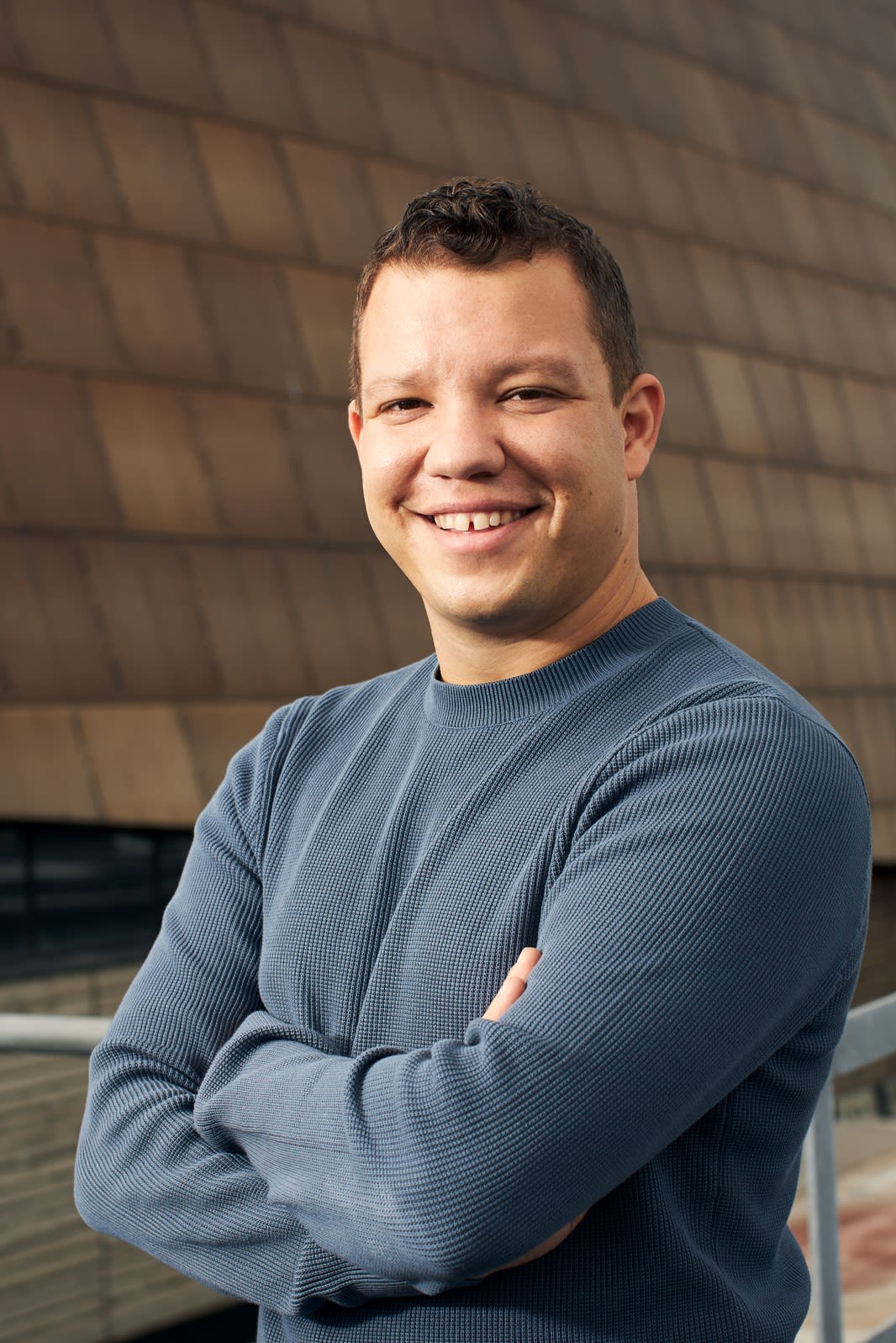
Ryan Bancroftconductor

Benjamin Ealovega
Benjamin Ealovega
Ryan Bancroft grew up in Los Angeles and first came to international attention in April 2018, when he won both First Prize and Audience Prize at the prestigious Malko Competition for Young Conductors in Copenhagen. Since September 2021 he has been Principal Conductor of BBC National Orchestra of Wales. Following his first visit to work with the Tapiola Sinfonietta, he was invited to become its Artist-in-Association from the 2021/22 season. In September 2023 he became Chief Conductor of the Royal Stockholm Philharmonic Orchestra.
After beginning his tenure as Chief Conductor in Stockholm with the orchestra’s first performance of Sven-David Sandström’s The High Mass, his second season includes performances of Mahler and Bruckner symphonies, alongside world premieres by Chrichan Larson and Zacharias Wolfe, and collaborations with renowned soloists including Leif Ove Andsnes, Maxim Vengerov and Víkingur Ólafsson.
This season he has made debuts with the Boston and Finnish Radio Symphony orchestras, Deutsches Symphonie-Orchester Berlin at the Berlin Philharmonie and the WDR Symphonieorchester in Cologne.
He has a passion for contemporary music and has performed with Amsterdam’s Nieuw Ensemble, assisted Pierre Boulez in a performance of his Sur incises in Los Angeles, premiered works by Sofia Gubaidulina, John Cage, James Tenney and Anne LeBaron, and has worked closely with improvisers such as Wadada Leo Smith and Charlie Haden.
He studied at the California Institute of the Arts, Royal Conservatoire of Scotland and in the Netherlands.
BBC National Orchestra of Wales
For over 90 years, the BBC National Orchestra of Wales, the only professional symphony orchestra in Wales, has played an integral part in the cultural landscape of the country, occupying a distinctive role as both a broadcast and national orchestra, and serving as an ambassador of Welsh culture, regularly performing music created in Wales and championing Welsh composers and artists.
Part of BBC Cymru Wales and supported by the Arts Council of Wales, BBC NOW performs a busy schedule of concerts and broadcasts, working with acclaimed conductors and soloists from across the world, including its Principal Conductor, the award-winning Ryan Bancroft.
The orchestra is committed to working in partnership with community groups and charities, taking music out of the concert hall and into settings such as schools and hospitals to enable others to experience and be empowered by music. It undertakes workshops, concerts and side-by-side performances to inspire and encourage the next generation of performers, composers and arts leaders, and welcomes thousands of young people and community members annually through its outreach and education projects.
BBC NOW performs annually at the BBC Proms and biennially at the BBC Cardiff Singer of the World competition, and its concerts can be heard regularly across the BBC – on Radio 3, Radio Wales and Radio Cymru. On screen, music performed by BBC NOW can be heard widely across the BBC and other global channels, including the soundtrack and theme tune for Doctor Who, Planet Earth III, Prehistoric Planet, The Pact and Children in Need.
Based at BBC Hoddinott Hall, Cardiff Bay, BBC NOW utilises a state-of-the-art recording studio with a camera system for livestreams and TV broadcasts to bring BBC NOW’s music to a broader audience across Wales and the world. For more information about BBC NOW please visit bbc.co.uk/now
BBC National Chorus of Wales
Made up of over 120 singers, BBC National Chorus of Wales is one of the leading mixed symphony choruses in the UK and, while preserving its amateur status, works to the highest professional standards under its Artistic Director, Adrian Partington. Comprising a mix of amateur singers alongside students from the Royal Welsh College of Music & Drama and Cardiff University, the chorus, based at BBC Hoddinott Hall in Cardiff Bay, works regularly alongside BBC National Orchestra of Wales, as well as giving concerts in its own right.
Recent highlights include performances of Poulenc’s Stabat mater and the world premiere of Alexander Campkin’s Sound of Stardust alongside BBC Cardiff Singer of the World Audience Prize winner Julieth Lozano Rolong and choral conductor Sofi Jeannin, Shostakovich’s 13th Symphony under the baton of Principal Conductor Ryan Bancroft and Karl Jenkins’s Dewi Sant in his 80th birthday year. It also makes annual appearances at the BBC Proms, with recent performances including Verdi’s Requiem and John Adams’s Harmonium with Ryan Bancroft and Vaughan Williams’s A Sea Symphony with Andrew Manze.
This season sees the chorus perform Handel’s Messiah with early-music specialist John Butt, give two performances of Beethoven’s monumental Missa solemnis at Llandaff Cathedral and in Swansea with Andrew Manze, and its annual carol concert and tonight’s performance of Brahms with Ryan Bancroft.
The chorus is committed to promoting Welsh and contemporary music, and gave the second-ever performance of Grace Williams’s Missa Cambrensis, 45 years after its premiere, a recording of which was released earlier this year. It has also premiered works by many composers, including a special performance of Kate Whitley’s Speak Out, a setting of the words of Malala Yousafzai’s 2013 UN speech.
The chorus can be heard on BBC Radio 3, BBC Radio Wales and BBC Radio Cymru, and recently featured in Paul Mealor’s soundtrack for BBC Wales’s Wonders of the Celtic Deep.
Patron
HM King Charles III KG KT PC GCB
Principal Conductor
Ryan Bancroft
PrincipalGuest Conductor
Jaime Martín
Conductor Laureate
Tadaaki Otaka CBE
Composer-in-Association
Gavin Higgins
First Violins
Nick Whiting associate leader
Martin Gwilym-Jones sub-leader
Gwenllian Hâf MacDonald
Terry Porteus
Kerry Gordon-Smith
Anna Cleworth
Žanete Uškāne
Juan Gonzalez
Carmel Barber
Alejandro Trigo
Ruth Heney
Emilie Godden
Amy Fletcher
Second Violins
Anna Smith *
Lydia Caines
Beverley Wescott
Katherine Miller
Vickie Ringguth
Elizabeth Whittam
Gary George-Veale
Violas
Rebecca Jones *
Alex Thorndike #
Tetsuumi Nagata
Peter Taylor
Anna Growns
Laura Sinnerton
Robert Gibbons
Catherine Palmer
Lowri Taffinder
Lydia Abell
Cellos
Thomas Isaac ‡
Raphael Lang
Sandy Bartai
Keith Hewitt
Alistair Howes
Carolyn Hewitt
Kathryn Graham
Tabitha Selley
Double Basses
David Stark *
Christopher Wescott
Emma Prince
Mike Chaffin
Callum Duggan
Clare Larkman
Flutes
John Hall †
Liz May
Carys Gittins
Lindsey Ellis
Piccolo
Oboes
Alec Harmon
Flic Cowell
Richard Lines-Davies
Cor anglais
Amy McKean
Clarinets
Lenny Sayers
Bassoons
Bruce Parris
Jo Shewan
Contrabassoon
David Buckland †
Horns
Tim Thorpe *
Meilyr Hughes
Eleanor Blakeney
Tom Taffinder
John Davy
Trumpets
Robert Samuel
Corey Morris †
Rob Johnston
William Morley
Trombones
Bass Trombone
Tuba
Richard Evans
Timpani
Steve Barnard *
Percussion
Harp
Elen Hydref
Pianos
Catherine Roe Williams
Chris Williams
* Section Principal
The list of players was correct at the time of publication
Director Lisa Tregale
+ Green Team member
BBC National Chorus of Wales
Artistic Director Adrian Partington
Accompanist Chris Williams
Vocal Coach Gail Pearson
Soprano 1
Asia Bonuccelli
Amelia Brown
Eleanor Cantrill
Eve Carey
Iustina Chirila
Charlotte Crane
Katelyn Da Costa
Rebekah Edwards
Ella Edwards Beavington
Bethan M. Evans
Rebecca Gilling
Sally Glanfield
Sarah Jane Griffiths
Darcie Hamilton
Kylie Hansen
Claire Hardy
Rebecca Jolliffe
Vanessa John-Hall
Lucie Jones
Rachael Leary
Katherine Meredith
Leora Molnar
Bethan Nicholas-Thomas
Joanna Osborn
Angharad Phillips
Elizabeth Phillips
Zoha Sohail
Ellen Steward
Helen Thomas
Hannah Willman
Qin Yan
Soprano 2
Megan Allen
Kate Bidwell
Angie Contestabile
Denise Cooke
Isabel D'Avanzo
Esme Daniell-Greenhalgh
Cerys Herbert-Stott
Pippa Johnson
Margaret Lake
Carolyn Lee
Amelia Mack
Lucy Paterson
Kensey Petschow
Samar Small
Melanie Taylor
Caroline Thomas
Florence Waddington
Hannah Williams
Katherine Woolley
Alto 1
Catherine Bradfield
Alison Davies
Catherine Duffy
Anna Eldred
Rachel Farebrother
Kathrin Hammer
Naomi Hitchings
Rhian-Carys Jones
Lisa May
Sara Peacock
Lily Pearson
Bethany Piper
Avery Rabbitt
Kate Reynolds
Amy Roberts
Zozi Sookanadenchetty
Cerys Thomas
Vicki Westwell
Jessica Williams
Alto 2
Jennie Beard
Darcy Cole
Heledd Evans
Yvonne Higginbottom
Cerian Rolls
Sian Schutz
Julie Wilcox
Sarah Willmott
Tenor 1
Oli Bourne
Meilyr Dafydd
Keith Davies
Roland George
Philip Holtam
Tom Lazell
Andrew Lunn
Andrew Morris
Brendan Roberts
Carwyn Whomsley
Nicholas Willmott
Tenor 2
Rhys Archer
Tony Breese
Orin Daniel
Jonathan Dobie
Michael Ennis
Peter Holmes
Rory McIvre
Owen Parsons
Sam Proll
Richard Shearman
Thomas Wilde
Michael Willmott
Bass 1
Noah Boneham-Hill
Leo Collins
Peter Cooke
David Davies
John Davies
Claurindo Diakiesse
James Downs
Jack Irwin
Emyr Wynne Jones
John Rhys Liddington
Lucas Maunder
Neil Schofield
Miles Smith
Alun Williams
Daniel Williams
Bass 2
Jeffrey Davies
Samuel Davies
Oliver Hodgson
Stuart Hogg
Luke Monkhouse
Gareth Nixon
Mike Osborn
David Rodgers
The list of singers was correct at the time of publication.