
Bach's St John Passion
Friday 29 March, 2.00pm
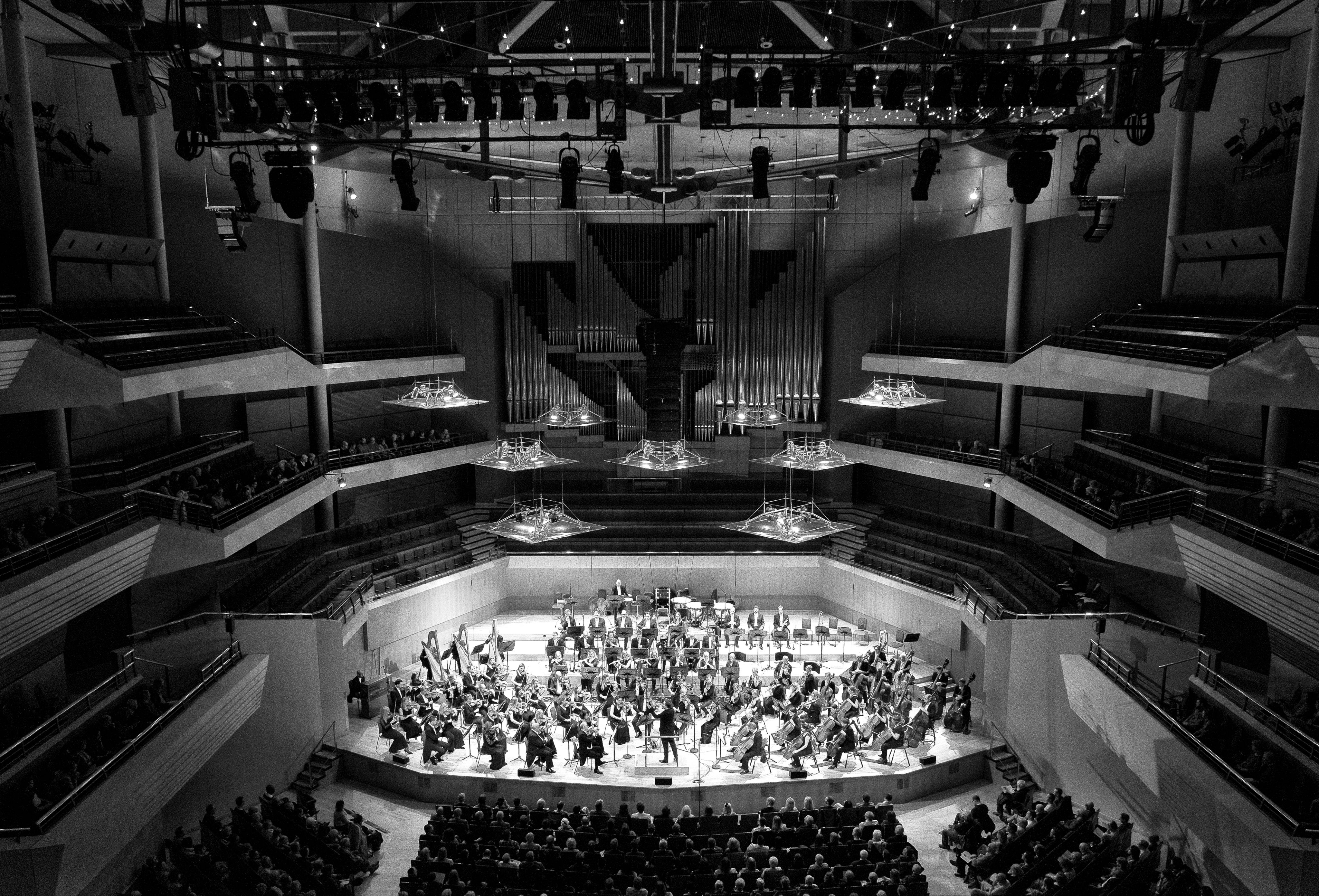
The Bridgewater Hall, Manchester


Welcome to tonight’s performance
Bach’s St John Passion is an extraordinary act of worship, the first of his two surviving Passion settings. Through the eyes of John the Apostle, we relive the story of the arrest, trial and crucifixion of Christ. We hear the witness accounts of Jesus, Peter and Pontius Pilate, as well as the judgement of the baying crowd, all within an intensely dramatic orchestral setting.
Our relationship with BBC Radio 3
As the BBC’s flagship orchestra for the North, almost all of the BBC Philharmonic’s concerts are recorded for broadcast on Radio 3. Today you will see a range of microphones on the stage and suspended above the orchestra. We have a Producer, Assistant Producer and Programme Manager at the orchestra who produce our broadcasts.
We seek to bring a diverse and risk-taking range of repertoire to our audiences, including our concert-goers here in Manchester, as well as the two million listeners who tune in to BBC Radio 3.
Please do not take flash photographs during the performance as this is very distracting to the artists. Audio and video recording is strictly prohibited.
To ensure that everyone can enjoy the concert, please either turn off your phone and any other electronic devices before it begins or ensure that they are turned to silent.

Johann Sebastian Bach
St John Passion (1724 version) 115’
There will be one interval of 20 minutes between Parts 1 & 2
Benjamin Hulett Evangelist
Roderick Williams Jesus
Hilary Cronin soprano
Jess Dandy contralto
Laurence Kilsby tenor
Benjamin Bevan bass/Pilate
Emily Callow Servant*
Sam Horan Servant*
David Hoult Peter*
Manchester Chamber Choir
BBC Philharmonic
Nicholas Kraemer conductor
* members of Manchester Chamber Choir


This concert is being broadcast live by BBC Radio 3. It will be available for 30 days after broadcast via BBC Sounds, where you can also find podcasts and music mixes.
Scan the QR code to find the BBC Philharmonic’s latest broadcasts.
Help us Improve Our Online Programmes.
Please take this 5-minute survey and let us know what you think of these notes.
Programme Survey
Johann Sebastian Bach(1685–1750)
St John Passion(1724 version)

A PDF version of the sung texts in this programme can be viewed here
When Bach arrived in Leipzig in 1723, he took on responsibility for teaching music to the 50 pupils of the Thomasschule as well as overseeing the music in Leipzig’s four largest churches. Composition for the regular Sunday services and the preparation of the choir for these occasions absorbed most of Bach’s energies, but he was also required to produce new music for the annual Passion service on Good Friday – one of the most important occasions in the liturgical calendar. Although sung Passions had been performed elsewhere in Europe for centuries, in Leipzig they were a new innovation, having been introduced to the city just a few years earlier by Bach’s predecessor, Johann Kuhnau. As his first year at Leipzig drew to a close, Bach celebrated with the unveiling of the St John Passion – his first major undertaking in his new role and the first of at least three Passion settings he would compose during his time there (although sadly only two survive).
Known affectionately as ‘the little Passion’, as distinct from the larger St Matthew Passion that followed in 1727, the St John is a more urgent and dramatic work than the more contemplative St Matthew, placing greater emphasis on conveying the tension and humanity of the Passion story. This is echoed in the work’s structure: while the St Matthew Passion is a sprawling work that lasts more than three hours, the St John clocks in at just under two. But even this would have surprised Bach’s congregation, who had never heard anything so substantial in the church before. It would also have sounded far more operatic and ornate than the music they were accustomed to hearing as part of the traditional service. Take the opening chorus, with its dissonant woodwind and undulating strings, which has all the hallmarks of an overture or curtain-raiser, setting a sombre and despondent mood for the Evangelist’s first entry. Elsewhere, Bach uses ornamentation more familiar from operatic arias to add an expressive intensity to the text.
But Bach’s real triumph is his deft interweaving of the original Gospel (for the recitatives) and more modern poetry (for the arias and chorales). Without challenging the Gospel’s message, Bach creates regular moments for reflection – interpolating the arias and chorales between the narration and inviting the congregation to meditate upon what they have just heard. When Jesus is crucified, for example, Bach takes a moment to step outside the Gospel text to deliver a truly human message: an alto soloist sings the aria ‘Es ist vollbracht’ (‘It is accomplished’), one of the most poignant moments in the work and one that paints Christ as a glorious figure, even in death. But, when Jesus faces trial at the start of Part 2 (Bach’s congregation would have endured an hour-long sermon between the two parts), Bach reverts to John’s original Gospel, affording this scene the same extensive treatment that it is given in the biblical text.
Schumann called the St John Passion ‘much bolder, more powerful, more poetic than the one from Matthew’s Gospel’, and its message is ultimately more uplifting. It is a work of hope and promise that looks forward to the prospect of a glorious resurrection, in spite of the suffering and sorrow of the Good Friday story.
Programme note © Jo Kirkbride
Jo Kirkbride is a freelance writer on classical music and CEO of IMPACT Scotland, overseeing the building and running of the Dunard Centre, the first concert hall to be built in Edinburgh for more than a century. She is the former Chief Executive of the Dunedin Consort.
Johann Sebastian Bach
Bach was a chorister then violinist before taking his first organist post at Arnstadt while still a teenager. It was in Weimar, as court organist from 1708, that he wrote many of his great organ works, as well as organ transcriptions of concertos by Vivaldi. In 1717 he became Kapellmeister at Cöthen, where he wrote the Brandenburg Concertos, the four Orchestral Suites and the violin concertos, and married his second wife, Anna Magdalena, with whom he had 13 children. Bach’s heavy duties in his final job, as Kantor of the Thomasschule in Leipzig from 1723 until his death, involved writing a new cantata each week for some years, as well as teaching Latin and music, choir-training and directing the music for church services. In later years he drew his art together in such major works as the Mass in B minor, The Art of Fugue, the Musical Offering and the Goldberg Variations. His densely contrapuntal idiom became unfashionable soon after his death until the early 19th century, when a revival of interest in his music began that has lasted to the present.
Profile by Edward Bhesania © BBC
Biographies
Nicholas Kraemer conductor
Having been at the forefront of the early music revolution, Nicholas Kraemer has established a reputation for directing period-informed performances with modern orchestras.
Currently Principal Guest Conductor of Music of the Baroque, Chicago, he has been Artistic Director of the Irish Chamber Orchestra, London Bach Orchestra and Bath Festival music programme, Permanent Guest Conductor of the Manchester Camerata, Principal Guest Conductor of the Kristiansand Symphony Orchestra and Musikkollegium Winterthur, and Associate Conductor of the BBC Scottish Symphony Orchestra. He has appeared worldwide with many period- and modern-instrument ensembles, while operatic engagements have taken him to Paris, Lisbon, Amsterdam, Geneva and Marseilles with repertoire ranging from Monteverdi to 20th-century works.
Nicholas Kraemer’s recordings include Vivaldi concertos with the City of London Sinfonia, Locatelli concerti grossi, Tartini violin concertos and concertos by Durante, Pergolesi and Leo with Elizabeth Wallfisch and the Raglan Baroque Players, Handel’s Rodelinda, Handel oratorio duets with Carolyn Sampson, Robin Blaze and the Orchestra of the Age of Enlightenment, and works by Thea Musgrave with the Scottish Chamber Orchestra. He has contributed to several feature films, most notably as Baroque Music Director for The Madness of King George.
Benjamin Bevan Bass/Pilate
Born into a family of musicians, Benjamin Bevan originally worked in the wine trade before studying voice at the Guildhall School of Music & Drama. He made his professional operatic debut with Scottish Opera and has since performed with leading opera companies and orchestras internationally.
His operatic highlights include Speaker (The Magic Flute) and Henry Cuffe (Gloriana) for the Royal Opera, Covent Garden, Lescaut (Boulevard Solitude) for Royal Danish Opera, Ferryman (Curlew River) for Opéra de Dijon, Roderick Usher (The Fall of the House of Usher), Lescaut, Dancaïre (Carmen) and White Rabbit (Alice’s Adventures in Wonderland) for Welsh National Opera, Lescaut (Manon), Marcello (La bohème), Riccardo (I puritani) and Fléville and Fouquier-Tinville (Andrea Chénier) for Scottish Opera, and Pontius Pilate (a staged production of Bach’s St John Passion) for Netherlands Reisopera. He has also sung at the Aix-en-Provence Festival and with Glyndebourne Festival Opera, English Touring Opera, Opéra de Lausanne and Opera Holland Park.
Recent engagements include his role debut as Stankar (Stiffelio) in Aachen, Betto (Gianni Schicchi) for Scottish Opera, Handel’s Messiah and Beethoven’s Ninth Symphony with Bach Collegium Japan and Starveling (A Midsummer Night’s Dream) in Genoa and Oman. Next season sees Benjamin Bevan’s return to Welsh National Opera.
Hilary Cronin soprano
Selected as a Rising Star of 2022 by BBC Music Magazine, Hilary Cronin won First Prize and the Audience Prize at the 2021 London International Handel Singing Competition. Since then she has sung Poppaea (Agrippina) with English Touring Opera and made debuts at the Halle Handel Festival in Francesca Cuzzoni: Handel’s Diva, at La Fenice, Venice, in Fauré’s Requiem, with the Freiburg Baroque Orchestra in Ode to Purcell and with the Scottish Chamber Orchestra in Mendelssohn’s incidental music for A Midsummer Night’s Dream.
Current engagements include Galatea (Acis and Galatea), Oriana (Amadigi), Handel’s Brockes Passion and Virtue/Damigella (The Coronation of Poppaea) with The English Concert, further Handel roles including Arianna (Arianna in Creta) with La Nuova Musica and Piacere (Il trionfo del Tempo e del Disinganno) at the Buxton Festival, Bach’s B minor Mass and Handel’s L’Allegro, il Penseroso ed il Moderato with the English Baroque Soloists, Bach cantatas with the London Handel Orchestra and Christmas Oratorio with the Oxford Bach Soloists, Barber’s Knoxville: Summer of 1915 with the Royal Orchestral Society, Handel’s Messiah with Britten Sinfonia, the Hallé and The Really Big Chorus, and Messiah and Haydn’s ‘Nelson’ Mass with The Sixteen. She will also sing the ‘Nelson’ Mass at the 2024 Newbury Festival.
Hilary Cronin’s recordings include Dido and Aeneas with La Nuova Musica under David Bates.
Jess Dandy contralto
Cumbrian-born Jess Dandy studied Modern and Medieval Languages at Trinity College, Cambridge, and the École Normale Supérieure de Lyon, and is an alumna and Fellow of the Guildhall School of Music & Drama.
She has appeared in concert with the leading UK and European orchestras and period-instrument ensembles, collaborating with conductors such as Harry Bicket, John Butt, William Christie, Laurence Cummings, Sir John Eliot Gardiner, Stephen Layton, Gemma New, Trevor Pinnock and Osmo Vänskä, and sings regularly in recital at London’s Wigmore Hall and the Oxford Lieder Festival.
Engagements this season include Elgar’s Sea Pictures with the Tokyo Symphony Orchestra, Mozart’s Requiem with the Tampere Philharmonic, Handel’s Messiah with the Hallé, Royal Northern Sinfonia, Glyndebourne Sinfonia and Il Gardellino, Julia Perry’s Stabat mater with the BBC Philharmonic and Mordecai (a concert performance of Handel’s Esther) at the London Handel Festival. Other recent highlights include concerts at the BBC Proms with the Academy of Ancient Music and Dunedin Consort, and the world premieres of Alissa Firsova’s A Spell of Creation with the BBC Philharmonic and Josephine Stephenson’s opera All Seas at Opéra Grand Avignon.
Jess Dandy was shortlisted for a 2021 Royal Philharmonic Society Award in the Young Artist category.
Benjamin Hulett Evangelist
Tenor Benjamin Hulett was a choral scholar at New College, Oxford, and studied with David Pollard at the Guildhall School of Music & Drama. He was a member of the Hamburg State Opera from 2005 to 2009.
He has made debuts at major opera houses throughout Europe and has performed in the UK with the Royal Opera, Covent Garden, Glyndebourne Festival Opera, Opera North, Opera Holland Park, Garsington Opera and Welsh National Opera and in Jonathan Miller’s staging of Bach’s St Matthew Passion at the National Theatre.
Last summer he sang Kudrjaš (Katya Kabanova) at the Salzburg Festival and appeared at the BBC Proms in Mozart’s C minor Mass with the Dunedin Consort. Subsequent engagements include Rev. Horace Adams (Peter Grimes) at La Scala, Milan, Jonathan (Handel’s Saul) at the Royal Danish Theatre, his return to Grange Park Opera as Kudrjaš, Bruckner’s F minor Mass with the Antwerp Symphony Orchestra and Collegium Vocale Gent under Philippe Herreweghe, Mathan (Handel’s Athalia) at the Halle Handel Festival and Messiah both on a UK tour with Glyndebourne Festival and with the Warsaw Philharmonic Orchestra under Matthew Halls.
Benjamin Hulett’s wide range of recordings includes Bach’s St John Passion with the Bach Camerata under David Temple and he has received a number of awards and nominations.
Laurence Kilsby tenor
Laurence Kilsby was a chorister with the Tewkesbury Abbey Schola Cantorum and won BBC Radio 2’s Young Chorister of the Year in 2009, before studying at the Royal College of Music in London and the Curtis Institute in Philadelphia. Last season he was a member of the studio of the Paris Opéra. An inaugural Lies Askonas Fellow, he won the 2018 Kathleen Ferrier Society Bursary for Young Singers, the 2022 Wigmore Hall/Bollinger International Song Competition and the 2022 Cesti Competition at the Innsbruck Festival of Ancient Music.
Highlights of the current season include his debuts with the Opéra-Comique in Paris, Opéra de Dijon and Cologne Opera and his return to the Aix-en-Provence Festival. Concert engagements include Bach’s St Matthew Passion with the Netherlands Chamber Orchestra under Ivor Bolton and the Vienna Symphony Orchestra under Matthew Halls, Handel’s Messiah with the Royal Northern Sinfonia under Peter Whelan, Britten Sinfonia under Sofi Jeannin and the Orchestra of the Opéra Royal de Versailles under Gaétan Jarry, and a European tour of Mozart’s Requiem with Ensemble Pygmalion under Raphaël Pichon.
Laurence Kilsby appears as treble soloist on a number of recordings including Handel’s L’Allegro, il Penseroso ed il Moderato with the Gabrieli Consort under Paul McCreesh, which was nominated for a Grammy Award.
Roderick Williams Jesus
Baritone Roderick Williams performs a broad repertoire ranging from Baroque to contemporary music in the opera house, on the concert platform and in recital worldwide.
He enjoys relationships with all the major UK opera houses and has sung in world premieres by Michael van der Aa, Sally Beamish, Alexander Knaifel, David Sawer and Robert Saxton. Recent and future engagements include the Traveller (Death in Venice) for Welsh National Opera, the title-role in Eugene Onegin for Garsington Opera, Papageno (The Magic Flute) for the Royal Opera, Covent Garden, Sharpless (Madam Butterfly) for English National Opera and van der Aa’s Upload with Cologne Opera, the Bregenz Festival and Netherlands Opera.
He sings regularly with the major UK orchestras and appears with orchestras and ensembles worldwide. His festival appearances include the BBC Proms (including the Last Night in 2014) and the Aldeburgh, Bath, Cheltenham, Edinburgh and Melbourne festivals.
As a composer he has had works premiered at the Wigmore and Barbican halls, the Purcell Room and live on national radio. Since last season he has held the position of Composer in Association with the BBC Singers.
Roderick Williams was appointed OBE in 2017. He composed a new work for and sang at the King’s Coronation in May 2023.
BBC Philharmonic
The BBC Philharmonic is reimagining the orchestral experience for a new generation – challenging perceptions, championing innovation and taking a rich variety of music to the widest range of audiences.
Alongside a flagship series of concerts at Manchester’s Bridgewater Hall, the orchestra broadcasts concerts on BBC Radio 3 and BBC Sounds from venues across the North of England, annually at the BBC Proms and from its international tours. The orchestra also records regularly for the Chandos label and has a catalogue of over 300 discs and digital downloads.
Championing new music, the orchestra has recently given world and UK premieres of works by Anna Appleby, Gerald Barry, Erland Cooper, Tom Coult, Sebastian Fagerlund, Emily Howard, Robert Laidlow, James Lee III, Grace‑Evangeline Mason, David Matthews, Outi Tarkiainen and Anna Thorvaldsdottir, with the scope of the orchestra’s output extending far beyond standard repertoire.
The BBC Philharmonic’s Chief Conductor is John Storgårds, with whom the orchestra has enjoyed a long association. French conductor Ludovic Morlot is its Associate Artist, while Anna Clyne, one of the most in-demand composers of the day, is its Composer in Association.
Last May the orchestra performed at the 2023 Eurovision Song Contest, both at a free concert with previous Ukrainian winner Jamala and in the final itself with Italian artist Mahmood, for a rendition of John Lennon’s ‘Imagine’ during the Liverpool Songbook medley.
The orchestra continues to deliver a programme of engagement with children and young people. At the end of last year it released Musical Storyland, a major new 10-part series featuring the BBC Philharmonic musicians, which brings famous stories from around the world to life using the power of music. This was the first time an orchestra has been commissioned to make a series of films for UK network television.
Through all its activities, the BBC Philharmonic is bringing life-changing musical experiences to audiences across Greater Manchester, the North of England, the UK and around the world.
Chief Conductor
John Storgårds
Associate Artist
Ludovic Morlot
Composer in Association
Anna Clyne
First Violins
Zoe Beyers Leader
Midori Sugiyama Assistant Leader
Thomas Bangbala Sub Leader
Anna Banaszkiewicz-Maher
Karen Mainwaring
Anya Muston
Second Violins
Lisa Obert*
Glen Perry †
Simon Gilks
Christina Knox
Alyson Zuntz
Alex Webber-Garcia
Violas
Steven Burnard*
Rachel Stott
Matthew Compton
Rosalyn Cabot
Violas d’amore
Steven Burnard*
Rachel Stott
Cellos
Peter Dixon*
Steven Callow ‡
Jessica Schaefer
Viola da gamba
Lucine Musaelian
Double Basses
Ronan Dunne*
Alice Durrant ‡
Flutes
Alex Jakeman*
Victoria Daniel ‡
Oboes/Oboes d’amore
Jennifer Galloway*
Kenny Sturgeon
Cor Anglais
Gillian Callow
Bassoon
Roberto Giaccaglia*
Chamber Organ
Darius Battiwalla
Theorbo
Toby Carr
* Principal
† Assistant Principal
‡ Sub Principal
The list of players was correct at the time of publication
Orchestra Director Adam Szabo
Team Assistant Diane Asprey
Senior Producer Mike George
Assistant Producer Kathy Jones
Programme Manager Stephen Rinker
Orchestra Manager Tom Baxter
Assistant Orchestra Manager Stefanie Farr
Orchestra Personnel Manager Helena Nolan
Orchestra Assistant Maria Villa
Audience Development Manager Beth Wells
Marketing Executive Emma Naylor
Marketing Assistant Kate Highmore
Learning and Digital Manager Jennifer Redmond
Learning Projects Co-ordinator Youlanda Daly
Librarians Edward Russell, Emily Pedersen
Senior Stage Manager Thomas Hilton
Transport Manager Will Southerton
Manchester Chamber Choir
Manchester Chamber Choir was founded in 2003 by a group of friends with a shared passion for singing interesting and varied music. The choir still holds that same passion for quality music-making and hosts its own concert seasons in and around Manchester. It also regularly works alongside the BBC Philharmonic and has supported performers including Hans Zimmer, Jarvis Cocker, Andrea Bocelli and the Pet Shop Boys. Some of its performances of world premieres include James MacMillan’s Credo at the 2012 BBC Proms and Mark Simpson’s oratorio The Immortal at the 2015 Manchester International Festival.
The choir works with a range of conductors including Neil Ferris, Robert Hollingworth, Philip Rushforth, Paul Spicer, Ewa Strusińska and Suzzie Vango, who bring their individual passions and knowledge to each programme. It has a long history of performing Bach with the BBC Philharmonic, mostly under Juanjo Mena but also, on Good Friday 2017, in a live broadcast performance of the St Matthew Passion with Nicholas Kraemer.
Other highlights in recent years include a 2017 tour to Xi’an, China, where the choir gave a televised performance of Beethoven’s Ninth Symphony with the Xi’an Symphony Orchestra, a concert in Manchester Cathedral in 2018 conducted by its then Principal Conductor, Jonny Lo, celebrating both Leonard Bernstein’s centenary and the cathedral’s new organ, and a collaboration with the BBC Philharmonic in 2020 commemorating the 250th anniversary of Beethoven’s birth. The choir returned to singing following the pandemic in autumn 2021 with a full season under its new Principal Conductor, Vicente Chavarría, and has resumed regular concerts at The Bridgewater Hall for the Manchester Mid‑day Concerts Society.
Manchester Chamber Choir will conclude the current season with a concert on 25 May at Bolton Parish Church with repertoire including Parry’s Songs of Farewell, Bairstow’s Blessed City, Heavenly Salem and Finzi’s Lo, the Full Final Sacrifice.
Principal Conductor
Vicente Chavarría
Sopranos
Heather Barlow
Katy Boulton
Emily Callow*
Claire Campbell Smith
Jackie Cuthbert
Darryl Dumigan
Eleanor Hobbs
Suzanne Hodge
Clare Jackson
Emma Judge
Lyndsey Key
Philippa Neal
Becca Stanton
Claire Valentine
Anna Wright
Anne Wynne
Altos
Laurie Bailey
Sarah Battye
Lydia Carr
Kirsten Flores
Ben Gittins
Bekki Gocher
Sarah Johnston
Debbie Heaton
Nina Mowforth
Laura Pask
Rachel Shatliff
Debbi Steele
Alison Syner
Georgina Williamson
Rachel Yates
Tenors
Howard Barlow
Martin Barry
Simon Davies
Ben Dunsmore
Sam Horan*
Dan Hunt
Joseph Martin
Paul Massey
Paul Mummery
Chris Paterson
Tom Salmon
Basses
Paul Chillingworth
Graham Curtis
Joe Derry
Mark Ellul
Peter Evans
Stuart Fielding
Tom Henderson
David Hoult*
Paul Roberts
Ian Stephens
Peter Syrus
Roger Williams
Dmitry Yumashev
* Soloist
The list of singers was correct at the time of going to press
Keep up to date with the BBC Philharmonic
Listen to our BBC Radio 3 broadcasts via the BBC Sounds app. Visit our website and follow us on Twitter, Facebook and Instagram and sign up to the newsletter
To help us improve our online concert programmes, please take this 5-minute survey
Produced by BBC Proms Publications