
Scheherazade
Saturday 11/11/23, 7.30pm
BBC Hoddinott Hall, Cardiff


Paul Dukas
The Sorcerer’s Apprentice 12’
Edvard Grieg
Piano Concerto 30’
INTERVAL: 20 minutes
Nikolay Rimsky-Korsakov
Scheherazade 42’
Lionel Bringuierconductor
Zee Zee piano


This concert is being recorded by BBC Radio 3 for future broadcast inAfternoon Concert and being filmed by BBC Four for Inside Classical.
Introduction
A warm welcome to tonight’s concert, in which BBC National Orchestra of Wales is joined by conductor Lionel Bringuier for a programme of three highly contrasting Romantic masterpieces.
To begin, Dukas’s brilliantly evocative tone-poem The Sorcerer’s Apprentice, a tale of the dangers of magic in the hands of the inexperienced, and one made famous when Walt Disney used it in his film Fantasia.
Zee Zee joins the orchestra for Grieg’s ever-popular Piano Concerto, with its heady mix of gorgeous melodies, virtuosity and colours from the folk music of the composer’s native Norway.
There’s colour aplenty in Rimsky-Korsakov’s Scheherazade, too, in which he spins tales from TheThousand and One Nights into music of alluring enchantment.
Enjoy!
Please respect your fellow audience members and those listening at home. Turn off all mobile phones and electronic devices during the performance. Photography and recording are not permitted.
Paul Dukas (1865–1935)
The Sorcerer’s Apprentice(1897)

By far the best-known of Dukas’s small handful of works, the orchestral tone-poem L’apprenti sorcier (‘The Sorcerer’s Apprentice’) was composed in 1897 and is subtitled ‘Symphonic scherzo after a ballad by Goethe’. Goethe’s 14-verse ballad Der Zauberlehrling was written exactly 100 years before Dukas’s piece. Liszt was the originator of the tone-poem – a single-movement orchestral work inspired by something non-musical – and by the late 19th-century the genre was at the peak of its popularity.
This work’s popularity, though, is down to Walt Disney using it in his 1940 film Fantasia, bringing Dukas’s music to a whole new audience.
The story behind the work features a sorcerer who leaves his apprentice with chores to do in his workshop. This apprentice casts a spell on a broom, wanting it to clean up for him, but chaos ensues because the apprentice doesn’t know how to stop the broom. In desperation, he chops it in half, but it continues sloshing water around at twice the speed. Eventually the sorcerer returns and breaks the spell. The moral is that only a master should attempt to invoke powerful spirits.
There is always much debate about the extent to which instrumental music can closely follow events in a text, and the essential differences between a verbal and non-verbal medium mean there are no easy answers. Dukas makes a connection to Goethe’s poem through symbolism: the trumpets represent the magic spell and the bassoon represents the broom (together with the bass clarinet when the broom is broken in two). Music can most easily represent the doubling of speed when the two halves of the broom run amok. At the end of the piece, four chords act as punctuation and perhaps represent the apprentice being chastised by his master.
Programme note © Caroline Potter
Edvard Grieg(1843–1907)
Piano Concerto in A minor, Op. 16 (1868, rev. 1907)
1 Allegro molto moderato
2 Adagio –
3 Allegro moderato molto e marcato – Quasi presto – Andante maestoso
Zee Zee piano
‘Keep going. You’ve got what it takes – don’t let them intimidate you!’ It’s the kind of reaction young composers dream of. The international star virtuoso pianist and composer Franz Liszt had just read through the newly completed Piano Concerto by the 25-year-old Norwegian composer Edvard Grieg, his enthusiasm visibly growing as he played. Then, at the end of the finale, where the movement’s lyrical ‘big tune’ returns in triumph (with just one note tellingly altered), Liszt had leapt up from the keyboard, thrown his arms wide and exclaimed, ‘G, G, not G sharp! Splendid!’
Although Grieg did take Liszt’s advice and ‘keep going’, the path he took led him in a rather different direction. It seems that soon after that formative meeting with Liszt, Grieg decided that his real talent was for creating miniatures rather than grand symphonic works. Some critics, prompted by this – and possibly irritated by the Piano Concerto’s seemingly indestructible popularity – have suggested that in the end it doesn’t quite work: that some of the development is a bit formulaic, that the finale in particular sounds like a collection of short pieces stuck together, that the first movement is all too obviously modelled on that of Schumann’s Piano Concerto (also in A minor).
But Liszt wasn’t wrong. Grieg may have had Schumann’s dramatic opening gesture in mind when he began this work, but he transformed it into one of the most majestic beginnings in the concerto repertoire: a crescendo roll on timpani, a shout for the full orchestra, then a series of downward-cascading figures for the piano. After this the movement contrasts two main themes with great skill: the first is introduced quietly by winds, answered by strings, the second is a warm singing melody first heard on cellos.
After its magical, hushed orchestral opening, the song-like Adagio is dominated by the piano, poetically decorating and embellishing the orchestral ideas until it seizes the main melody in triumph at the climax. The finale follows without a break. At first we have a sequence of vigorous folk-dance tunes, then comes the concerto’s big tune, introduced in a slower tempo by a solo flute. Grieg builds up the excitement impressively in the faster coda, up to the point where the flute tune returns in full orchestral splendour, with that tiny but thrilling alteration that so excited Liszt. Not only is it a fine dramatic stroke in its own right, it rounds off the concerto magnificently, as though the whole work had been building to this moment of radiant affirmation.
Programme note © Stephen Johnson
INTERVAL: 20 minutes
Nikolay Rimsky-Korsakov (1844–1908)
Scheherazade – symphonic suite, Op. 35 (1888)

1 The Sea and Sinbad’s Ship
2 The Tale of the Kalendar Prince
3 The Young Prince and the Young Princess
4 The Festival of Baghdad – The Sea – Shipwreck – Conclusion
Rimsky-Korsakov was 17 years old when he first met the composer Mily Balakirev. Although contemplating a career in the navy, Rimsky-Korsakov had been composing while at cadet school; now, under Balakirev’s influence, he became determined to devote himself to music. He went on to be a member of the nationalist group of Russian composers led by Balakirev, known as the Mighty Handful, along with Alexander Borodin, Modest Mussorgsky and César Cui.
When Borodin died in 1887, leaving his opera Prince Igor unfinished, Rimsky-Korsakov took on the task of completing it. The Eastern-leaning flavour of his friend’s music inspired him to create something similar – and the idea of Scheherazade could not have been better chosen.
In its preface Rimsky-Korsakov told the story:
The Sultan Shahriar, convinced of the duplicity and infidelity of all women, vowed to slay each of his wives after the first night. The Sultana Scheherazade, however, saved her life by … recounting to the Sultan a succession of tales over a period of one thousand and one nights. Overcome by curiosity, the monarch postponed his wife’s execution from day to day, and ended by renouncing his sanguinary resolution altogether.
Rimsky-Korsakov was eager to achieve a balance between programmatic relevance and purely musical bedazzlement – and accomplished this with great aplomb. ‘Developing the musical material quite freely,’ he wrote in his autobiography, ‘I had in view the creation of an orchestral suite in four movements, closely knit by the community of its themes and motifs, yet presenting, as it were, a kaleidoscope of fairy-tale images and designs of Oriental character.’
The complete work – a symphony in all but name – begins by evoking, with a hefty unison, the cruel sultan. Scheherazade responds, poised and seductive: the violin solo represents her voice, returning to link the four sections into one span. Rimsky-Korsakov saw the movements’ titles simply as a stimulus; rather than illustrating precise narrative episodes he is offering a fantastical score to entice and enchant each listener.
The first movement, with the palpable swell of the sea, is headed ‘The Sea and Sinbad’s Ship’. Next, ‘The Tale of the Kalendar Prince’ is a dramatic scherzo, full of tension and adventure. The love scene of ‘The Young Prince and the Young Princess’ presents a tender intermezzo; and finally Sinbad’s ship is wrecked in an apocalyptic seascape, its climax recalling music from the first movement. As for Scheherazade, a high, sustained note from the solo violin shows that she is alive and safe.
Programme note © Jessica Duchen
Help Us Improve Our Online Programmes.
Please take this 5-minute survey and let us know what you think of these notes.
Programme Survey
You may also like:
Playing Picasso
Friday 8/12/23, 7.30pm
BBC Hoddinott Hall, Cardiff
Stravinsky Pulcinella
Satie Parade
Stravinsky Ragtime
Falla The Three-Cornered Hat – Suite No. 2
Ryan Bancroftconductor
Katharine Dain soprano
Jorge Navarro Colorado tenor
Michel de Souzabaritone
COLOURFUL | IMPASSIONED | ENLIGHTENING
Pablo Picasso is one of the most influential artists of the 20th century, famed, not least, for co-founding the Cubist movement; surprisingly less known is his close involvement in the costume designs for many ground-breaking ballets. His creative union with ballet impresario Serge Diaghilev was one of the most potent collaborations of the 20th century, not only altering the nature of ballet, but for Picasso opening up a whole new world of artistic exploration.
Fifty years after Picasso’s death we celebrate his legacy in a concert of music from the ballets he designed. These range from Stravinsky’s Pulcinella, in which traditional stories are ‘entirely transformed into striking modernist masterpieces, reimagining the ballet as a site for clashing avant-garde styles, shapes and forms’ through Picasso’s sets and costume designs, to Satie’s angular, confrontational and avant-garde Parade and Falla’s Three-Cornered Hat, telling a Spanish love story set within the Andalusian mountains.
Jurassic Park in Concert
Wednesday 13/12/23, 7.30pm
Venue to be confirmed
Thursday 14/12/23, 7.30pm
Brangwyn Hall, Swansea
Benjamin Popeconductor
MULTIGENERATIONAL | NOSTALGIC | THRILLING
Who can forget the earth-quaking, thunderous plod of a T rex, or the terrifying sounds of a velociraptor? Join BBC NOW this December for Jurassic Park live in concert.
Follow the story of Dr Alan Grant and Ellie Sattler as they battle for survival on Isla Nublar when the theme park’s newly revived dinosaurs escape their enclosures and seek to rule the earth once more. Featuring stunning visual imagery and ground-breaking special effects, this action-packed adventure may not be your typical Christmas concert, but with BBC National Orchestra of Wales performing John Williams’s epic score live to film, it is a more than fitting way to celebrate the 30th anniversary of the iconic film!
Folk Fusions – Japan Meets Eastern Europe
Saturday 24/2/24, 7.30pm
BBC Hoddinott Hall, Cardiff
Takemitsu Three Film Scores
Kikuko Kanai Okinawa Fantasy Suite UK premiere
Liszt Piano Concerto No. 2
Dvořák The Wood Dove
Nodoka Okisawa conductor
Iyad Sughayer piano
STRIKING | REVERENTIAL | INSPIRATIONAL
In a programme inspired by folk music, we’re delighted to welcome Japanese conductor Nodoka Okisawa to the podium. Jazz and blues-style writing meets funeral music and an unusually melancholic yet cheerful waltz in Three Film Scores by herfellow Japanese musician Tōru Takemitsu. Kikuko Kanai developed her own unique compositional voice, being one of the first Japanese women to compose Western classical music, while retaining her Okinawan musical heritage. She transcribed many Japanese folk songs, some of which found use as the basis for her own works, including her Okinawa Fantasy Suite.
Franz Liszt also found inspiration in his Hungarian heritage, often drawing on it in his own music. He was of course renowned as a consummate concert pianist, so it’s no wonder his piano concertos are among his most performed works today. With heady Romanticism, transformative melodies and fiery cadenzas, his Second Concerto is brought to life by award-winning Jordanian-Palestinian pianist Iyad Sughayer. Native Czech grittiness, fanciful programmatic titling and a love of Karel Erben’s folk ballads shine through Dvořák’s The Wood Dove, with its evocative orchestrations colouring its many melodies, in which light contrasts with shade, grief with love, chorales with dances – simply put, symphonic storytelling at its best.
Biographies
Lionel Bringuierconductor

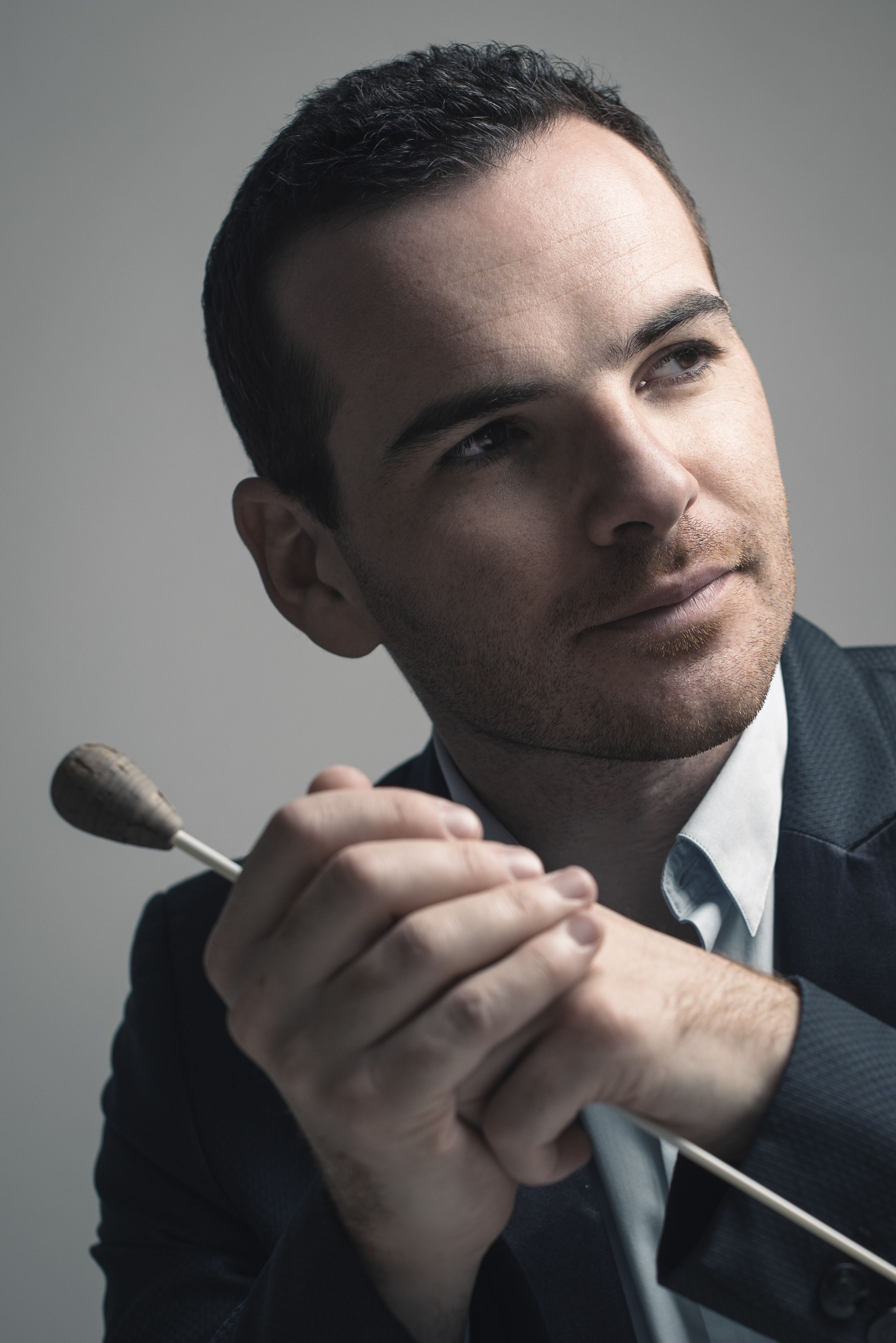
Simon Pauly
Simon Pauly
Lionel Bringuier has conducted symphony and chamber orchestras and at opera houses across the globe.
This season he continues in his position as Associate Artist of the Philharmonic Orchestra in his hometown of Nice. This appointment gives him the opportunity to curate a series of programmes which he will also conduct, and to invite close musical partners, who this season include Khatia Buniatishvili, Philippe Bianconi, Daniel Müller-Schott, Renaud Capuçon and Alexandre Tharaud. He has been Music Director of the Zurich Tonhalle Orchestra (2014–18), as well as holding previous posts at the Orquesta Sinfónica de Castilla y León in Valladolid, Orchestre de Bretagne and Ensemble Orchestral de Paris.
Other highlights this season include concerts with the Dresden and Royal Liège Philharmonic orchestras, Metz National Orchestra, Antwerp, Polish National and San Diego Symphony orchestras, the Colburn School Orchestra and Paris Conservatoire Orchestra.
Over the past decade he has built up strong relationships with the Houston Symphony Orchestra and the Aspen Festival. He has also worked extensively in Asia, regularly conducting the Tokyo Symphony Orchestra, as well as working with the Seoul and Malaysian Philharmonic orchestras. In 2019 he returned to Australia, conducting the Sydney and West Australian Symphony orchestras.
He regularly collaborates with Yuja Wang, with whom he has recorded the Ravel G major Piano Concerto. Other recordings include Chopin with Nelson Freire and Saint-Saëns with Renaud and Gautier Capuçon. He works closely with other leading instrumentalists, including Lisa Batiashvili, Anne-Sophie Mutter, Yefim Bronfman, Emanuel Ax, Leif Ove Andsnes and Janine Jansen.
He comes from a family of musicians and studied cello and conducting at the Paris Conservatoire, winning the International Besançon Competition for Young Conductors a year after graduating. In 2020 he served on the jury of La Maestra, the first international conducting competition for women, and he continues to work with local schools in Nice to introduce children to classical music and orchestral experiences.
Lionel Bringuier was named a Chevalier de l’Ordre National du Mérite by the French government and has been awarded the Médaille d’or à l’unanimité avec les félicitations du jury à l’Académie Prince Rainier III de Monaco and the Médaille d’or from the City of Nice.
Zee Zeepiano


Sunhao Zhou
Sunhao Zhou
Zee Zee began her musical training in Berlin at the age of five, subsequently studying with Dan Zhaoyi at the Shenzhen Arts School, Nelita True at the Eastman School of Music, Yoheved Kaplinsky and Robert McDonald at the Juilliard School and Leon Fleisher at the Peabody Institute. Her competition successes include China’s first International Piano Concerto Competition and the Gina Bachauer, Krainev and Queen Elisabeth competitions.
This season’s highlights include concerts with the Borusan Istanbul, China, Oxford and Szczecin Philharmonic orchestras, Armenian State, Shanghai and Tucson Symphony orchestras and Ulster Orchestra, as well as appearing at Wigmore Hall, Amsterdam Concertgebouw and the Macao, Prague Spring, Parnu, Minnesota Beethoven and InClassica Dubai festivals.
Highlights of recent seasons include the season-opening concert of the Estonian National Symphony Orchestra under Neeme Järvi; a UK tour with Paavo Järvi; concerts with the Philharmonia Orchestra at the Royal Festival Hall and the Hong Kong Philharmonic under Christoph Koncz, Paavo Järvi and Yu Long; piano concerto cycles of Beethoven and Saint-Saëns with the Shanghai Symphony Orchestra; and recitals at the Aspen, Brevard Summer and Lucerne festivals and at Casa da Música in Porto, Esplanade in Singapore and Premiere Performance Hong Kong, among others.
She regularly works with today’s leading conductors, including Marin Alsop, Jonathan Bloxham, Lionel Bringuier, Charles Dutoit, Alondra de la Parra, Domingo Hindoyan, Paavo Järvi, Neeme Järvi, Christoph Koncz, Michał Nesterowicz, Jun Märkl, Julian Rachlin, Yan Pascal Tortelier, Roberto Trevino and Xian Zhang.
She is a founding member of the Z.E.N. Trio, alongside violinist Esther Yoo and cellist Narek Hakhnazaryan, with whom she has recorded Brahms, Dvořák, Shostakovich, Babadjanian and Rachmaninov.
Zee Zee is the founder and the artistic director of the Z+ international music festival, which brings together international chamber musicians and takes place annually in Shanghai.
She released a disc of Liszt and Ravel concertos with Paavo Järvi and the Philharmonia Orchestra in 2019, following it last year with Journey, a solo album featuring works by Wagner, Schoenberg and Liszt.
BBC National Orchestra of Wales
For over 90 years, BBC National Orchestra of Wales has played an integral part in the cultural landscape of Wales, occupying a distinctive role as both broadcast and national symphony orchestra. Part of BBC Wales and supported by the Arts Council of Wales, it has a busy schedule of live concerts throughout Wales, the rest of the UK and the world.
The orchestra is an ambassador of Welsh music and champions contemporary composers and musicians; its concerts can be heard regularly across the BBC – on Radio 3, Radio Wales and Radio Cymru.
BBC NOW works closely with schools and music organisations throughout Wales and regularly undertakes workshops, side-by-side performances and young composer initiatives to inspire and encourage the next generation of performers, composers and arts leaders.
The orchestra is based at BBC Hoddinott Hall in Cardiff Bay, where its purpose-built studio not only provides the perfect concert space, but also acts as a broadcast centre from where its live-streamed concerts and pre-recorded content are presented as part of its popular Digital Concert Series.
For further information please visit the BBC National Orchestra and Chorus of Wales's website: bbc.co.uk/now
Patron
HM King Charles III KG KT PC GCB
Principal Conductor
Ryan Bancroft
Conductor Laureate
Tadaaki Otaka CBE
Composer-in-Association
Gavin Higgins
Composer Affiliate
Sarah Lianne Lewis
First Violins
Lesley Hatfield leader
Martin Gwilym-Jones sub-leader
Fiona McCapra
Terry Porteus
Anna Cleworth
Ruth Heney
Carmel Barber
Nadine Nigl
Juan Gonzalez
Rebecca Totterdell
Peter Povey
Emma Menzies
Amy Fletcher
Gary George-Veale
SecondViolins
Anna Smith *
Sheila Smith
Katherine Miller
Beverley Wescott
Ilze Abola
Vickie Ringguth
Lydia Caines
Joseph Williams
Roussanka Karatchivieva
Michael Topping
Sall-Wyn Ryan
Catherine Fox
Violas
Matt Maguire ‡
Alex Thorndike #
Tetsuumi Nagata
Peter Taylor
Robert Gibbons
Catherine Palmer
Laura Sinnerton
Liam Brolly
Ania Leadbeater
Lucy Theo
Cellos
Alice Neary *
Raphael Lang
Sandy Bartai
Alistair Howes
Carolyn Hewitt
Rachel Ford
Keith Hewitt
Katy Cox
DoubleBasses
David Stark *
Alexander Jones #
Richard Gibbons
Alex Verster
Hiu Man Phoebe Cheng
Imogen Fernando
Flutes
Matthew Featherstone *
John Hall †
Lindsey Ellis
Piccolos
Lindsey Ellis †
John Hall
Oboes
Steve Hudson *
Amy McKean †
Sarah-Jayne Porsmoguer
Cor anglais
Sarah-Jayne Porsmoguer †
Clarinets
Nick Carpenter ‡
Hannah Morgan
Lenny Sayers
Bass Clarinet
Lenny Sayers †
Bassoons
Jarosław Augustiniak *
Jo Shewan
Alanna Pennar-McFarlane
David Buckland
Contrabassoon
David Buckland †
Horns
Tim Thorpe *
Meilyr Hughes
Neil Shewan †
Tom Findlay
Tom Taffinder
Trumpets
Philippe Schartz *
Robert Samuel
Lewis West
Cornets
Lewis West
Sam Lewis
Trombones
Donal Bannister *
Miri Wallich
Bass Trombone
Darren Smith †
Tuba
Daniel Trodden †
Timpani
Matt Hardy
Percussion
Phil Hughes *
Andrea Porter
Rhydian Griffiths
Max Ireland
Sarah Mason
Harp
Valerie Aldrich-Smith †
* Section Principal
† Principal
‡ Guest Principal
# Assistant String Principal
The list of players was correct at the time of publication
Director Lisa Tregale
Orchestra Manager Vicky James
Assistant Orchestra Manager Nick Olsen
Orchestra Coordinator, Operations Kevin Myers
Business Coordinator Caryl Evans
Orchestra Administrator Eleanor Hall
Head of Artistic Production Matthew Wood
Artists and Projects Manager Eleanor Phillips
Orchestra Librarian Katie Axelsen (paternity cover)
Producer Mike Sims
Broadcast Assistant Kate Marsden
Head of Marketing and Audiences Sassy Hicks
Marketing Coordinator Amy Campbell +
Digital Producer Yusef Bastawy
Social Media Coordinator Harriet Baugh
Education Producers Beatrice Carey, Rhonwen Jones **
Audio Supervisors Simon Smith, Andrew Smillie
Production Business Manager Lisa Blofeld
Stage and Technical Manager Steven Brown +
Assistant Stage and Technical Manager Josh Mead
BBC Wales Apprentices Analese Thomas-Strachan, Jordan Woodley
+ Green Team member
** Diversity & Inclusion Forum