Sibelius
Shostakovich
Mendelssohn
Saturday 25 September, 7.30pm
The Bridgewater Hall, Manchester

Welcome to tonight’s performance
Our first Bridgewater Hall concert in 18 months brings together adventurous soloist Jakob Kullberg and Chief Guest Conductor John Storgårds for Shostakovich’s epic First Cello Concerto. Also tonight, Sibelius’s evergreen Pelléas et Mélisande suite and the first in our two-part exploration of Mendelssohn’s symphonies – tonight, the dazzling Italian.
Our relationship with BBC Radio 3
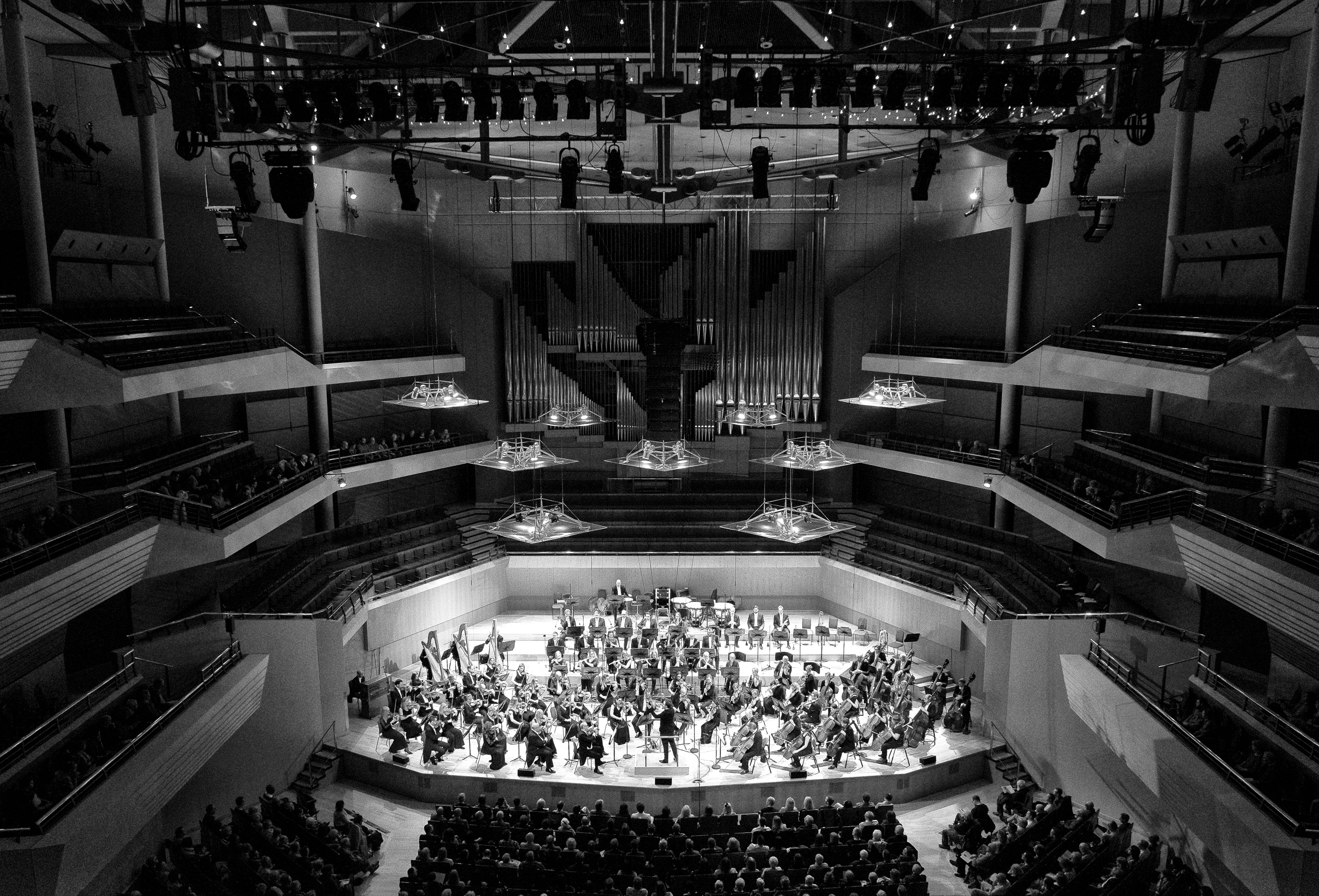
As the BBC’s flagship orchestra for the North, almost all of the BBC Philharmonic’s concerts are recorded for broadcast on Radio 3. Tonight you will see a range of microphones on the stage and suspended above the orchestra. We have a Producer, Assistant Producer and Programme Manager at the orchestra who produce our broadcasts.
We seek to bring a diverse and risk-taking range of repertoire to our audiences, including our concert-goers here in Manchester, as well as the two million listeners who tune in to BBC Radio 3.
Please do not take flash photographs during the performance as this is very distracting to the artists. Audio and video recording is strictly prohibited.
To ensure that everyone can enjoy the concert, please either turn off your phone and any other electronic devices before it begins or ensure that they are turned to silent.

Jean Sibelius
Pelléas et Mélisande – suite 28’
Dmitry Shostakovich
Cello Concerto No. 1 in E flat major 27’
INTERVAL: 20 minutes
Felix Mendelssohn
Symphony No. 4 in A major, ‘Italian’ 30’
Jakob Kullberg cello
John Storgårds conductor
BBC Philharmonic


Tonight’s concert is being recorded by BBC Radio 3 for broadcast in Radio 3 in Concert on Friday 8 October at 7.30pm. It will be available for 30 days after broadcast via BBC Sounds, where you can also find podcasts and music mixes.
Jean Sibelius (1865–1957)
Pelléas et Mélisande – suite, Op. 46 (1905)

1 At the Castle Gate
2 Mélisande
3 At the Seashore
4 A Spring in the Park
5 The Three Blind Sisters
6 Pastorale
7 Mélisande at the Spinning Wheel
8 Entr’acte
9 The Death of Mélisande
Maurice Maeterlinck’s tragic Symbolist play Pelléas et Mélisande is rarely seen in theatres today, but it cast a peculiarly long shadow over composers at the turn of the 20th century. Gabriel Fauré scored the first London production in 1898, four years before Claude Debussy completed the final version of his landmark opera and Arnold Schoenberg started work on his symphonic poem. Jean Sibelius got in on the act soon after, writing music for a Helsinki production and then reworking it into this nine-part concert suite.
After the grand swells of the opening, which has found a 64-years-and-counting afterlife as the theme to BBC TV’s The Sky at Night, we meet the woman at the centre of the play’s love triangle: married to one man but soon to fall in love with his brother. The doomed lovers meet by the sea (to a decidedly ominous soundtrack) and in the park (to a jaunty waltz), before Mélisande’s hopes of happiness start to fade – and then, in ‘Mélisande at the Spinning Wheel’, appear to come crashing down entirely. The oddly perky ‘Entr’acte’ (originally the prelude to the play’s penultimate act) feels shipped in from another piece entirely, before Sibelius brings things to a suitably yearning yet tragic conclusion. No happy endings here
Jean Sibelius
It’s an overstatement to suggest that Jean Sibelius shaped a nation, but he certainly provided its soundtrack: no composer’s music is as deeply rooted in his mother country as Sibelius’s is in his native Finland. Born in 1865 and christened Johan – ‘Jean’ was a student affectation borrowed from an uncle – Sibelius turned to composition only after realising he wouldn’t fulfil his childhood dream of becoming a violinist – but he quickly found fame in his mid-20s with Kullervo, one of numerous works he wrote in evocative homage to his homeland. Best known today for his seven symphonies and dozen-plus symphonic poems, most of the latter inspired by Finland and its mythology, Sibelius lived a long life but worked a comparatively short career, writing little during what amounted to a 30-year retirement.
Dmitry Shostakovich (1906–75)
Cello Concerto No. 1 in E flat major, Op. 107 (1959)
1 Allegretto
2 Moderato –
3 Cadenza –
4 Allegro con moto
Jakob Kullberg cello
The Second World War was raging when Mstislav Rostropovich, a 16-year-old prodigy from Baku, began his studies in 1943 at the Moscow Conservatory in cello, composition and in orchestration, the latter with Dmitry Shostakovich, who was two decades his senior and a controversial figure in Soviet Russia. The pair’s pupil–teacher relationship blossomed into a friendship born of mutual admiration: ‘He was the most important man in my life after my father,’ said the cellist. And it was Rostropovich, by then a world-class virtuoso, for whom Shostakovich wrote the first of his two cello concertos in 1959.
It’s a relentless work, and fearsomely difficult to boot. The soloist is exposed from the opening bars, a variation on the four-note motif (D–E flat–C–B natural; or D–Es–C–H in German notation, for ‘D. Schostakowitsch’) that the composer used as his musical signature in numerous works, and further riffs on this motif give the first movement its structure. The elegant, elegiac second movement is the heads to its tails – but it’s followed, almost rudely, by an electric shock of a solo cadenza. Three-quarters done, the concerto feels full of loose ends, but Shostakovich seamlessly ties them up in a cascading final movement that ends as abruptly as the piece began.
Dmitry Shostakovich
One of the 20th century’s greatest composers, Dmitry Shostakovich is also among its most fascinating and elusive musical figures. Raised to adulthood in Revolutionary Russia, he spent much of his life under fearsome scrutiny from a Soviet leadership who alternately praised his patriotism and damned his insolence – unable to quite determine whether he was with them or against them. Even today, opinion is split as to whether Shostakovich was a Communist lackey or a dissident democrat – and the breadth of his astonishing output, from dazzling ballets and fizzing jazz suites to intense symphonies and introspective string quartets, offers clues but no concrete confirmation. Nearly 50 years after his death, Shostakovich’s music is more popular than ever, but the man himself remains tantalisingly out of reach.
INTERVAL: 20 minutes
Felix Mendelssohn (1809–47)
Symphony No. 4 in A major, Op. 90 ‘Italian’ (1833)
1 Allegro vivace
2 Andante con moto
3 Con moto moderato
4 Saltarello: Presto
Unaffected by the poor health that ultimately sent him to an early grave, the young Felix Mendelssohn seized every chance to travel – and, as if sending home postcards to family and friends, he used what he saw to inform what he wrote. His ramblings through Britain as a 20-year-old star musician inspired the ‘Scottish’ Symphony (No. 3), among other works; and an extended Italian trip the next year led to what the composer described as ‘the most cheerful thing I have composed so far’, premiered – before the ‘Scottish’, despite the numbering – when Mendelssohn was just 24. Although he wasn’t happy with the work, revising it incessantly and even forbidding its publication, it’s now among his most popular pieces.
For much of the ‘Italian’ Symphony’s 30-minute duration, there’s nothing recognisably Italian about it. Mendelssohn appears less interested in representing the country than in sharing the feelings it inspired in him – as with the opening, a joyous blast of southern sunshine. Apparently inspired by a religious procession in Naples or Rome (you’d never tell), the stately second movement is followed by a classically Mozartian minuet and trio – before Mendelssohn at last cracks open the Italian fizz with a conclusion that transports folk dance rhythms from the village square to the concert platform.
Felix Mendelssohn
Born to a prominent Jewish family in Hamburg in 1809, Felix Mendelssohn was among the most prodigiously talented musicians of his age: a performer by 9, a capable composer just three years later. He was later described by contemporary Robert Schumann as ‘the Mozart of the 19th century’, and it’s fair to say that his music looks back to Mozart’s Classicism (and to the music of Bach, whom Mendelssohn idolised) more than it looks forwards to the turbulent innovations of Wagner and other Romantic-era composers who followed in his wake. His vast catalogue, which includes a beloved Violin Concerto, five soaring symphonies and dozens of songs, was cut tragically short when he succumbed to ill health in 1847 at the age of just 38.
Notes and profiles © Will Fulford-Jones
Will Fulford-Jones is a writer and editor who works widely across music and the arts.
BBC Philharmonic
The BBC Philharmonic is reimagining the orchestral experience for a new generation – challenging perceptions, championing innovation and taking a rich variety of music to the widest range of audiences.
The orchestra usually performs around 100 concerts every year, the vast majority broadcast on BBC Radio 3. Along with around 35 free concerts a year at its MediaCityUK studio in Salford and a series of concerts at Manchester’s Bridgewater Hall, the orchestra performs across the North of England, at the BBC Proms and internationally, and records regularly for the Chandos label.
The BBC Philharmonic’s Chief Conductor is Omer Meir Wellber. Described by The Times’s Richard Morrison as ‘arguably the most inspired musical appointment the BBC has made for years’, Israeli-born Wellber burst into his new role at the 2019 BBC Proms and has quickly built an international reputation as one of the most exciting young conductors working today. The orchestra also has strong ongoing relationships with its Chief Guest Conductor, John Storgårds, and Associate Artist Ludovic Morlot. In May the orchestra announced young British composer and rising star Tom Coult as its Composer in Association.
The scope of the orchestra’s programme extends far beyond standard repertoire. Over the past few years it has collaborated with artists as varied as Clean Bandit, Jarvis Cocker and The Wombats; played previously unheard music by writer-composer Anthony Burgess in a unique dramatisation of A Clockwork Orange; joined forces with chart-toppers The 1975 at Blackpool’s Tower Ballroom; premiered The Arsonists by composer Alan Edward Williams and poet Ian McMillan, the first opera ever written to be sung entirely in a Northern English dialect; and broadcast on all seven BBC national radio networks, from BBC Radio 1 to BBC Radio 6 Music and the BBC Asian Network. Last year the orchestra also entered the UK Top 40 singles chart with ‘Four Notes: Paul’s Tune’.
The BBC Philharmonic is pioneering new ways for audiences to engage with music and places learning and education at the heart of its mission. Outside of the concert hall, it is passionate about taking music off the page and into the ears, hearts and lives of listeners of all ages and musical backgrounds – whether in award-winning interactive performances, schools’ concerts, Higher Education work with the Royal Northern College of Music or the creation of teacher resources for the BBC’s acclaimed Ten Pieces project. Through all its activities, the BBC Philharmonic is bringing life-changing musical experiences to audiences across Greater Manchester, the North of England, the UK and around the world.
First Violins
Yuri Torchinsky Leader
Midori Sugiyama AssistantLeader
Thomas Bangbala SubLeader
Alison Fletcher *
Kevin Flynn †
Austeja Juskaityte
Anya Muston
Clare Dixon
Karen Mainwaring
Toby Tramaseur
Julian Gregory
Mansell Morgan
Second Violins
Lisa Obert *
Raja Halder
Rachel Porteous
Lucy Flynn
Sophie Szabo
Claire Sledd
Rebecca Mathews
Matthew Watson
Natalie Purton
Oliver Morris
Violas
Steven Burnard *
Bernadette Anguige †
Alexandra Fletcher
Kathryn Anstey
Ruth Montgomery
Rachel Janes
Fiona Dunkley
Nicholas Howson
Cellos
Peter Dixon *
Marina Vidal Valle
Miriam Skinner
Elise Wild
Rebecca Aldersea
Melissa Edwards
Double Basses
Ronan Dunne *
Mark Jenkins
Miriam Shaftoe
Andrew Vickers
Daniel Whibley
Flutes
Victoria Daniel †
Claire Duggan
Piccolo
Jennifer Hutchinson
Oboes
Jennifer Galloway *
Kenny Sturgeon
Cor Anglais
Gillian Callow
Clarinets
John Bradbury *
Fraser Langton
Bassoons
Roberto Giaccaglia *
Bill Anderson
Shing To Mak
Contrabassoon
Bill Anderson
Horns
Ben Hulme *
Rebecca Hill ¥
Phillip Stoker
Tom Kane
Jonathan Barrett
Trumpets
Richard Blake ‡
Gary Farr †
Timpani
Paul Turner *
Percussion
Paul Patrick *
Keyboard
Ian Buckle
* Principal
† Sub Principal
‡ Guest Principal
¥ Associate Principal
The list of players was correct at the time of publication
Keep up to date with the
BBC Philharmonic
Listen to our BBC Radio 3 broadcasts via the BBC Sounds app. Visit our website and follow us on Twitter, Facebook and Instagram and sign up to the newsletter
Produced by BBC Proms Publications