
Firsova, Elgar and Mahler
Saturday 14 May, 7.30pm
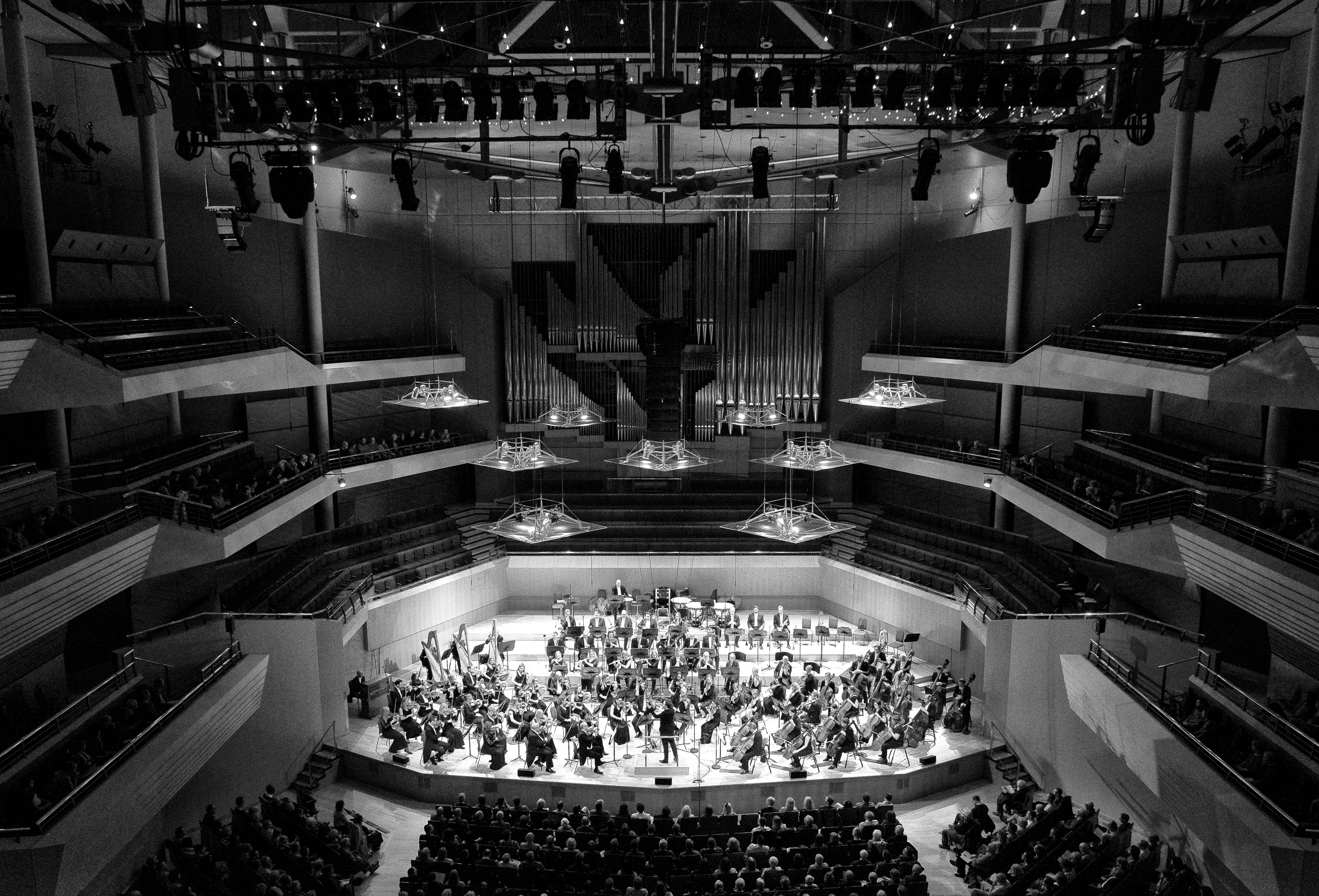
The Bridgewater Hall, Manchester


Welcome to tonight’s performance
Gustav Mahler’s First Symphony makes for a breathtaking calling card – completed (in its first version) when the composer was just 27 and rich in allusions to the natural world, it absolutely fizzes with ideas and imagination. It’s the focal point of New Zealander Gemma New’s first Bridgewater Hall concert with the BBC Philharmonic – which also includes Alissa Firsova’s potent evocation of the stormy affair between Mahler’s widow Alma and painter Oskar Kokoschka, and Elgar’s luscious song-cycle Sea Pictures, sung tonight by rising-star contralto Jess Dandy.
Our relationship with BBC Radio 3
As the BBC’s flagship orchestra for the North, almost all of the BBC Philharmonic’s concerts are recorded for broadcast on Radio 3. Tonight you will see a range of microphones on the stage and suspended above the orchestra. We have a Producer, Assistant Producer and Programme Manager at the orchestra who produce our broadcasts.
We seek to bring a diverse and risk-taking range of repertoire to our audiences, including our concert-goers here in Manchester, as well as the two million listeners who tune in to BBC Radio 3.
Please do not take flash photographs during the performance as this is very distracting to the artists. Audio and video recording is strictly prohibited.
To ensure that everyone can enjoy the concert, please either turn off your phone and any other electronic devices before it begins or ensure that they are turned to silent.

Alissa Firsova
Die Windsbraut 11’
Edward Elgar
Sea Pictures 22’
INTERVAL: 20 MINUTES
Gustav Mahler
Symphony No. 1 in D major 50’
Jess Dandy contralto
Gemma New conductor
BBC Philharmonic


Tonight’s concert is being recorded by BBC Radio 3 for broadcast in ‘Radio 3 in Concert’ on Tuesday 10 June at 7.30pm. It will be available to stream or download for 30 days after broadcast via BBC Sounds, where you can also find podcasts and music mixes.
Help us Improve Our Online Programmes.
Please take this 5-minute survey and let us know what you think of these notes.
Programme Survey
Alissa Firsova (born 1986)
Die Windsbraut, Op. 38 (2017)


Though she was a gifted composer and pianist in her own right, Alma Mahler-Werfel (née Schindler) is remembered as a muse for many great figures of her time, including her husbands Gustav Mahler, Walter Gropius and Franz Werfel. Even her composition teacher Alexander Zemlinsky was under her spell (though Gustav eventually prevented Alma from continuing lessons with him, possibly out of jealousy). Another heart conquered was that of Oskar Kokoschka, an Austrian artist with whom Alma had a brief, turbulent relationship and a love-letter exchange which lasted right up until her death. Among the hundreds of his artworks inspired by Alma was Die Windsbraut (‘The Bride of the Wind’). Kokoschka considered this painting to be the ultimate proof of his love. My orchestral work Die Windsbraut is a depiction of this painting and the tempestuous and passionate love that Alma and Kokoschka shared.
Kokoschka first met Alma at a dinner party just under a year after Mahler’s death. He told his friend, the photographer Brassaï: ‘How beautiful she was, and how seductive she looked beneath her mourning veil! She enchanted me! … After dinner, she took me by the arm and drew me into an adjoining room, where she sat down and played the Liebestod [from Wagner’s Tristan and Isolde] on the piano for me … After that evening, we were inseparable.’ Clearly this was a potent memory for Kokoschka, whose intial title for Die Windsbraut was Tristan und Isolde.
In one of his last letters, Kokoschka expressed his wish for their love to be depicted by a poet ‘with a sixth sense for language, its structure, its rhythm and its intonation – one that knows the whole range of our emotions from tenderness to the most lascivious sensuality … so that we can tell the world what we two did with each other and against each other, and can pass on the living meaning of our love to those that come after us.’
I found it fascinating to take up this challenge through music. At the opening of my Die Windsbraut, I tried to imitate the rustle of the wind, howling up into a tumultuous storm, at which point the violins begin the passionate main theme, full of big leaps to signify the restless and exasperated feelings, while the winds and brass play the part of the dramatic whirlwind of the waves. The main theme is then played by the violas and cellos, before crashing into a ‘crazed’, trill-filled orchestral tutti representing a triumphant union of Kokoschka’s and Alma’s love, with tremolos in the strings and the horns fanfaring the main theme in unison.
Then we enter the eye of the storm where, in the painting, Alma and Oskar are peacefully lying together. The trombone solo, supported by a brass chorale, opens Oskar’s ‘love’ theme (the second subject), answered by Alma in the strings, after which they sail through a jungle as the theme develops in various wind solos, and a paradisal garden full of flutes and celesta. Various other ethereal orchestral colours attempt to capture what Oskar called the ‘Bengali moonlight’ in his painting. Meanwhile duets in the trumpets, horns and clarinets, the return of the main theme in the first violins, mystical, bell-like sounds and a duet between the solo first violin and harp bring us back to the opening material.
Then eerie trills build up back into another stormy outbust, only this time the ‘love’ theme is played by the strings and brass, while the winds play the main theme, reaching the culmination of the piece before settling down into a reminiscent coda, as the two lovers look back at all they had lived through.
Programme note © Alissa Firsova
Alissa Firsova
To juggle two careers at the highest level would be daunting for even the most accomplished of musicians, but Alissa Firsova appears to have found a way to combine three careers at once. She is equal parts composer, conductor and pianist, the daughter of two eminent Russian composers (Dmitri Smirnov and Elena Firsova) who was a somewhat reluctant musician until she won the BBC Proms/Guardian Young Composer of the Year competition in 2011. ‘It gave me a boost, and in a way it gave me no choice because I felt I had to live up to the name,’ she says.
A glut of prestigious commissions soon flowed her way, and in 2010 she became one of the youngest composers ever to have been commissioned by the BBC Proms (for Bach Allegro). Since then she has appeared at the Proms three more times – once as a composer (Bergen’s Bonfire in 2015) and twice as a pianist.
She counts the late Mstislav Rostropovich among her mentors and credits him with her decision to pursue a multi-faceted career like her idols Rachmaninov, Liszt and Mahler. But her music somehow deftly eludes their influences. It is poetic, evocative and heartfelt, richly orchestrated and at times irresistibly idealistic – the result of a lifetime spent steeped in music.
Profile © Jo KirkbrideJo Kirkbride is Chief Executive of the Edinburgh-based Dunedin Consort and a freelance writer on classical music. She studied Beethoven’s slow movements for her PhD and writes regularly for the London Symphony Orchestra, London Philharmonic Orchestra, London Sinfonietta and Snape Proms.
Edward Elgar (1857–1934)
Sea Pictures, Op. 37 (1897/99)


1 Sea Slumber-Song
2 In Haven (Capri)
3 Sabbath Morning at Sea
4 Where Corals Lie
5 The Swimmer
Jess Dandy contralto
A PDF version of the sung texts, can be viewed here
Nestled between two of Elgar’s greatest public successes – the ‘Enigma’ Variations (1899) and The Dream of Gerontius (1900) – is his only song-cycle, Sea Pictures. Commissioned by the Norfolk and Norwich Festival to write a vocal piece, Elgar chose five poems, each by a different author, all loosely linked by their references to the sea, and composed a cycle for contralto and orchestra, which he himself conducted at the Festival in 1899. Elgar’s soloist at the Norwish premiere was the celebrated contralto Dame Clara Butt (dressed as a mermaid, no less), and the pair gave another sold-out chamber performance in London just days later. ‘The cycle went marvellously well,’ Elgar wrote in a letter to his friend August Jaeger. ‘We were recalled four times – I think – after that I got disgusted and lost count. She sang really well.’
The public loved it, but the critics could not agree, blaming Elgar’s choice of texts for its shortcomings. The poems – by Roden Noel, Alice Elgar (Elgar’s wife), Elizabeth Barrett Browning, Richard Garnett and Adam Lindsay Gordon – appear to have been selected from an anthology of poetry about the sea and, rather than looking to create a cyclical narrative, it seems Elgar simply wanted to create a series of evocative snapshots. But the critic for the Manchester Courier complained that the poems, ‘having no special connection with one another, could not in any way tell a story, or even present us with a series of mood pictures evolved one from the other’. The Daily Telegraph criticised the cycle for not
being sufficiently evocative of the sea, wishing for ‘one verse, if no more, eloquent of the ocean when its waves dance in the sunshine’.
And yet Elgar’s score, while not impressionistic in the same way as Debussy’s La mer would prove just a few years later, ripples with watery evocations. The upper strings bob back and forth, the harp glistens in the sunlight, the cellos and basses tug us downwards and surge forwards. In the final song, we hear the crack of the timpani and Elgar unleashes the full might of the orchestra as the sea swells with ‘short, sharp, violent lights’. Contrary to the critics’ condemnation, Sea Pictures could hardly be more aptly named: a series of ‘mood pictures’ of the sea, in all its strength, grandeur, beauty and tranquillity.
Programme note © Jo Kirkbride
INTERVAL: 20 minutes
Gustav Mahler (1860–1911)
Symphony No. 1 in D major (1884–8, rev. 1893–8)


1Langsam. Schleppend [Slow. Dragging] – Immer sehr gemächlich [Always at a very leisurely pace]
2Kräftig bewegt, doch nicht zu schnell [With strong movement, but not too fast] – Trio: Recht gemächlich [Quite leisurely] – Tempo primo
3Feierlich und gemessen, ohne zu schleppen [Solemn and measured, without dragging] – Sehr einfach und schlicht wie eine Volksweise [Very simple, like a folk melody]
4Stürmisch bewegt [Stormy] – Sehr gesangvoll [Very melodious]
No other work in Mahler’s catalogue has quite the same complicated history as his First Symphony. It exists in at least four different versions and was originally presented as a symphonic poem in two parts, comprising five movements rather than four. The symphony originally had no title, later Mahler called it the ‘Titan’ and gave the work a descriptive programme, but later still he changed his mind again and retracted both title and programme, calling them ‘anti-artistic’ and ‘anti-musical’. It was a long and tortuous process to get to the symphony as we know it today, and it has had its fair share of negative reviews along the way. ‘The new symphony is the kind of music which for me is not music,’ Eduard Hanslick wrote. Another critic called it a ‘parody of a symphony’. Mahler was baffled. ‘It is the most spontaneous and daringly composed of my works,’ he wrote. ‘Naively, I imagined that it would have immediate appeal … How great was my surprise and disappointment when it turned out quite differently.’
Much of the public’s consternation – and the critical accusations of parody – seem to stem from Mahler’s appropriation of pre-existing material (some of it his own, some belonging to others). The symphony is built around a raft of musical quotations and allusions, the most prominent among them being references to his song-cycle Lieder eines fahrenden Gesellen (‘Songs of a Wayfarer’), which he had completed just a few years earlier. Indeed, the main theme of the first movement is borrowed from the second song of the cycle, ‘Ging heut’ Morgen über’s Feld’, an expression of pure joy and delight at the wonders of nature. Later, in the slow third movement, Mahler references the last song of the cycle, ‘Die zwei blauen Augen’, in which the Wayfarer’s cares appear to evaporate as he allows himself to be calmed by nature. It was to be Mahler’s first gesture towards incorporating the voice within the symphony – a trope which, like his fixation upon nature and our position within it, would dominate his other symphonies in the years to come.
But these self-referential quotations also jostle with glimpses of Wagner’s Parsifal, Liszt’s ‘Dante’ Symphony, and even the traditional folk song ‘Bruder Jakob’ (perhaps better known as ‘Frère Jacques’), which appears in the slow movement, transmuted (somewhat disconcertingly) into a funereal minor key. It is, in many ways, a baffling assortment of themes and ideas, as ‘spontaneous and daring’ as Mahler himself knew it to be. But in his discarded programmatic outline, Mahler also gives us a hint of what he was trying to capture, which is nothing less than all of life itself: ‘The hero is exposed to the most fearful combats and to all the sorrows of the world … Only when he has triumphed over death, and when all the glorious memories of youth have returned with themes from the first movement, does he get the upper hand.’
Programme note © Jo Kirkbride
Gustav Mahler
More than any composer since Beethoven, Mahler radically altered the course of symphonic form, broadening its scale and instrumentation, imbuing it with vast emotional range and incorporating autobiographical references. Born in Bohemia, he went to study in Vienna, aged 15, before developing a conducting career in a succession of opera theatres. In 1897 he became Kapellmeister at the Vienna Court Opera, converting from Judaism to Catholicism in order to do so. The demands of his conducting commitments left only the summers for composing, when he would retreat to the mountains and lakes. He was heavily drawn to the folk-like poetry collection Des Knaben Wunderborn (‘The Youth’s Magic Horn’, 1808), writing over 20 ‘Wunderhorn’ songs and incorporating its texts into his Symphonies Nos. 2–4. Five of his siblings died in infancy, as did his own elder daughter – lending further poignancy to his Kindertotenlieder (‘Songs on the Death of Children’, 1901–4). He worked in New York at the Metropolitan Opera and Philharmonic Orchestra, but fell victim to heart disease: he died before completing his 10th numbered symphony, soon after the bitter discovery of his wife Alma’s affair with the architect Walter Gropius.
Profile by Edward Bhesania © BBC
Biographies
Gemma New conductor
New Zealand-born conductor Gemma New is Music Director of the Hamilton Philharmonic Orchestra and Principal Guest Conductor of the Dallas Symphony Orchestra. A former Dudamel Conducting Fellow with the Los Angeles Philharmonic, she served previously as Associate Conductor of the New Jersey Symphony and was a 2018 Conducting Fellow at the Tanglewood Music Center in Boston. She holds a Master of Music degree in Orchestral Conducting from the Peabody Institute in Baltimore, where she studied with Gustav Meier and Markand Thakar. She graduated with honours from the University of Canterbury in New Zealand with a Bachelor of Music in Violin Performance.
Last season she led the New York Philharmonic’s 29th Annual Memorial Day Concert at St John the Divine in a free performance live-streamed to the public. She also made debuts at the Hollywood Bowl with the Los Angeles Philharmonic and at the Aspen and Grand Teton Music festivals. In Australasia she debuted with the Sydney Symphony Orchestra and led the New Zealand Symphony Orchestra’s Winter Festival.
Highlights of the 2021–22 season include subscription appearances with the Atlanta, Baltimore, Kansas City, Montreal and St Louis Symphony orchestras, Minnesota Orchestra and National Symphony Orchestra, Washington DC, as well as debuts with the BBC Philharmonic, Hallé, Netherlands Philharmonic Orchestra, Orchestre National d’Île-de-France, WDR Symphony Orchestra Cologne and Los Angeles Opera for the West Coast premiere of Kevin Puts’s The Brightness of Light with Renée Fleming and Rod Gilfry.
Gemma New recently completed a four-year position as Resident Conductor of the St Louis Symphony Orchestra. In her final season with the orchestra, she led the season-opening concerts and conducted a concert broadcast live with Chris Thile on the nationally syndicated variety show Live From Here.
She is the recipient of the 2021 Sir George Solti Conducting Award.
Jess Dandy contralto
Cumbrian contralto Jess Dandy was shortlisted for a Royal Philharmonic Society Award in the category of Young Artist. Last year she was the contralto soloist at the First Night of the Proms, singing Vaughan Williams’s Serenade to Music and a new commission by Sir James MacMillan. Other recent highlights include a series of BBC Radio 3 broadcasts which included her Wigmore Hall debut, and a solo recital with Malcolm Martineau at Perth Concert Hall. She also appeared at the Wigmore Hall in a Vivaldi and Ariosti programme with La Serenissima.
She has appeared on the concert platform with the Academy of Ancient Music, BBC National Orchestra and Chorus of Wales, BBC Symphony Orchestra, Dunedin Consort, English Concert, Florilegium, Orchestre Révolutionnaire et Romantique and Les Arts Florissants, collaborating with conductors including Sir John Eliot Gardiner, Harry Bicket, Trevor Pinnock, John Butt, William Christie, Kristian Bezuidenhout and Stephen Layton.
Highlights of the 2021–22 season include Bradamante in Vivaldi’s Orlando furioso at the Teatro Real Madrid and the Seine Musicale Paris; Handel’s Messiah with the Hallé, Britten Sinfonia and Royal Liverpool Philharmonic Orchestra; and appearances with the BBC National Orchestra of Wales, Academy of Ancient Music and Kitchener-Waterloo Symphony, as well as a return to the Wigmore Hall for both a new commission by Huw Watkins and a solo evening recital.
BBC Philharmonic
The BBC Philharmonic is reimagining the orchestral experience for a new generation – challenging perceptions, championing innovation and taking a rich variety of music to the widest range of audiences.
The orchestra usually performs around 100 concerts every year, the vast majority of which are broadcast on BBC Radio 3. Along with around 35 free concerts a year at its MediaCityUK studio in Salford and a series of concerts at Manchester’s Bridgewater Hall, the orchestra performs across the North of England, at the BBC Proms and internationally, and records regularly for the Chandos label.
The BBC Philharmonic’s Chief Conductor is Omer Meir Wellber. Described by The Times’s Richard Morrison as ‘arguably the most inspired musical appointment the BBC has made for years’, Israeli-born Wellber burst into his new role at the 2019 BBC Proms and has quickly built an international reputation as one of the most exciting young conductors working today. The orchestra also maintains strong relationships with its Chief Guest Conductor John Storgårds and Associate Artist Ludovic Morlot. In May last year the orchestra announced young British composer and rising star Tom Coult as its Composer in Association.
The scope of the orchestra’s programme extends far beyond standard repertoire. Over the past few years it has collaborated with artists as varied as Clean Bandit, Jarvis Cocker and The Wombats; played previously unheard music by writer-composer Anthony Burgess in a unique dramatisation of A Clockwork Orange; joined forces with chart-toppers The 1975 at Blackpool’s Tower Ballroom; premiered The Arsonists by composer Alan Edward Williams and poet Ian McMillan, the first opera ever written to be sung entirely in a Northern English dialect; and broadcast on all seven BBC national radio networks, from BBC Radio 1 to BBC Radio 6 Music and the BBC Asian Network. Last year the orchestra also entered the UK Top 40 singles chart with ‘Four Notes: Paul’s Tune’.
The BBC Philharmonic is pioneering new ways for audiences to engage with music and places learning and education at the heart of its mission. Outside of the concert hall, it is passionate about taking music off the page and into the ears, hearts and lives of listeners of all ages and musical backgrounds – whether in award-winning interactive performances, schools’ concerts, Higher Education work with the Royal Northern College of Music or the creation of teacher resources for the BBC’s acclaimed Ten Pieces project. Through all its activities, the BBC Philharmonic is bringing life-changing musical experiences to audiences across Greater Manchester, the North of England, the UK and the rest of the world.
First Violins
Yuri Torchinsky Leader
Midori Sugiyama Assistant Leader
Thomas Bangbala Sub-Leader
Kevin Flynn †
Anna Banaszkiewicz-Maher
Martin Clark
Julian Gregory
Karen Mainwaring
Anya Muston
Robert Wild
Toby Tramaseur
Mansell Morgan
Ian Flower
Sarah White
Alison Williams
Second Violins
Lisa Obert *
Glen Perry ‡
Lily Whitehurst
Rachel Porteous
Helen Evans
Lucy Flynn
Sophie Szabo
Christina Knox
Rebecca Mathews
Claire Sledd
Matthew Watson
Jack Greed
Natalie Purton
Oliver Morris
Violas
Kimi Makino ‡
Bernadette Anguige †
Kathryn Anstey
Matthew Compton
Ruth Montgomery
Nicholas Howson
Rachel Janes
Fiona Dunkley
Amy Hark
Michael Dale
Rosamund Hawkins
Aimee Johnson
Cellos
Peter Dixon *
Steven Callow †
Jessica Schaefer
Rebecca Aldersea
Melissa Edwards
Elinor Gow
Miriam Skinner
Elise Wild
Amy Jolly
Mandy Turner
Double Basses
Ronan Dunne *
Alice Durrant †
Miriam Shaftoe
Andrew Vickers
Peter Willmott
Mhairi Simpson
Emma Prince
Ben du Toit
Flutes
Victoria Daniel †
Claire Duggan
Sally Minter
Piccolo
Jennifer Hutchinson
Oboes
Jennifer Galloway *
Matthew Jones
Helen Clinton
Cor Anglais
Gillian Callow
Clarinets
Nick Carpenter §
Fraser Langton
Matthew Dunn
Bass Clarinet
Jillian Allan
Bassoons
Roberto Giaccaglia *
Ben Hudson
Contrabassoon
Bill Anderson
Horns
Ben Hulme *
Rebecca Hill ¥
Phillip Stoker
Tom Kane
Jonathan Barrett
Jenny Cox
Alexei Watkins
Diana Sheach
Trumpets
Richard Blake §
Gary Farr
Katie Smith
Tim Barber
Ben Jarvis
Stephen Murphy
Trombones
Richard Brown *
Gary MacPhee
Christopher Jones
Bass Trombone
Russell Taylor
Tuba
Christopher Evans
Timpani
Paul Turner *
Oliver Patrick
Percussion
Paul Patrick *
Geraint Daniel
Oliver Patrick
Sophie Hastings
Ben Gray
Mark Norman
Harp
Clifford Lantaff *
Organ
Darius Battiwalla
Celeste
Paul Janes
* Principal
† Sub Principal
‡ Assistant Principal
§ Guest Principal
¥ Associate Principal
The list of players was correct at the time of publication
Keep up to date with the
BBC Philharmonic
Listen to our BBC Radio 3 broadcasts via the BBC Sounds app. Visit our website and follow us on Twitter, Facebook and Instagram and sign up to the newsletter
To help us improve our online concert programmes, please take this 5-minute survey
Produced by BBC Proms Publications


