
Re:Sound – Voices of Our Cities
Sunday 26 March 2023, 7.30pm


Leonard Bernstein
Three Dance Episodes from ‘On the Town’ 11’
Aaron Copland
Music for a Great City – Night Thoughts 7’
Errollyn Wallen
Mighty River 15’
INTERVAL: 20 minutes
Streetwise Opera
Re:Sound c.40’
Streetwise Opera
The Sixteen
BBC Concert Orchestra
Keith Lockhart conductor
Martin Handley presenter


This concert is being recorded by BBC Radio 3 for broadcast in ‘Radio 3 in Concert’ next Wednesday at 7.30pm. It will be available for 30 days after broadcast via BBC Sounds, where you can also find podcasts and music mixes.
Re:Sound is made up of nine micro-operas that explore London, Nottingham and Manchester from the point of view of people who have experienced homelessness. At workshops run by Streetwise Opera, participants come up with ideas, storylines and lyrics that peer beneath the surface of the city. They collaborate with composers, choreographers and animators to transform their inspiration into bold new musical works. Members of Streetwise Opera are joined on stage by singers from renowned choral ensemble The Sixteen and the BBC Concert Orchestra.
Streetwise Opera is an opera company that empowers people recovering from homelessness to share their creativity and talent with audiences.Re:Soundamplifies the voices of people who have been homeless as it explores how our cities can become spaces of tolerance, dialogue and inclusion.
The evening opens with Bernstein’s boisterous ode to Times Square, from his musical On the Town, which follows three sailors on a brief leave in New York. The musical’s familiar New York theme crops up in this symphonic panorama.
A darker side to city life is revealed in Aaron Copland’s Music for a Great City, based on his score for the controversial 1961 film Something Wild, which tells the story of a young New Yorker brutally raped and then imprisoned by the man who saves her from committing suicide.
Errollyn Wallen’s Mighty River winds its way through the first half of the concert, a profound meditation on the history of the slave trade which links the movement of water with the human instinct to be free.
Leonard Bernstein (1918–90)
Three Dance Episodes from ‘On the Town’ (1945)

1 The Great Lover Displays Himself
2 Lonely Town: Pas de deux
3 Times Square: 1944
During his lifetime Bernstein collaborated on three ballets and two musicals with the choreographer Jerome Robbins. It was their first work together, the hit ballet Fancy Free (1944), that launched their theatrical careers and spawned the much-loved wartime musical On the Town, written the same year. Featuring three sailors on 24-hour shore leave in New York City, the show is remarkable for the sheer amount of dance it features – eight ballet numbers in all. This was not simply the result of its balletic beginnings; it reflects Bernstein and Robbins’s extraordinary ability to tell stories through dance and music alone. Indeed, their next musical, the landmark West Side Story (1957), is in the same vein; and revealingly, when it came to crafting works fit for the concert hall from these shows, it was to dance that Bernstein turned: Three Dance Episodes from ‘On the Town’ (1945), premiered by Bernstein and the San Francisco Symphony on 3 February 1946, was matched 15 years later by the Symphonic Dances from ‘West Side Story’ (1960).
The Three Dance Episodes make a suitably contrasting trio, capturing the spirit of the show and Bernstein’s evocative symphonic score. ‘The Great Lover Displays Himself’ spotlights the music accompanying the dream sequence of the sensitive and romantic sailor Gabey who, while napping on the subway, is transformed into a dashing and confident lover dancing for his fantasy woman, ‘Miss Turnstiles’. Built around a handful of recurring motifs, it is a playful and at times brash episode imbued with Bernstein’s typical rhythmic elan. The central episode, ‘Lonely Town: Pas de deux’ looks to the bluesy ballad ‘Lonely Town’ for its source material. Musically tender but melancholic in feel, this episode accompanies a disturbing late-night scene witnessed by Gabey: a teenage girl is wooed and then rejected by an older sailor in Central Park. It is in the final ‘Times Square: 1944’ that Bernstein really lets his hair down. Launched in swinging style with an E flat clarinet solo, we are immersed in the bright lights of Times Square for an evening out with the sailors and their new-found gals. Bernstein’s love of jazz, penchant for unexpected offbeats and ability to switch between disparate musical styles with panache sees us dart from arcade to dance hall as he brings the episode to a raucous close.
Programme note © Sophie Redfern
Sophie Redfern lectures in music at King’s College London. She is a specialist in American music and dance and is the author of Bernstein and Robbins: The Early Ballets.
Aaron Copland (1900-90)
Music for a Great City (1961, arr. 1964) – Night Thoughts
It was for the 1961 psychological thriller Something Wild that Aaron Copland wrote his eighth and final film score. Directed by Jack Garfein, the claustrophobic exploration of a teenage girl’s trauma against the backdrop of a grittily shot and sordid New York City was, for Copland, ‘extraordinarily vivid’. In response he composed a compelling and often dissonant score capturing the noise of the metropolis and the tense troubling interior atmosphere of the tale that unfolds.
From this came Music for a Great City (1964), a concert suite commissioned for the London Symphony Orchestra’s 60th anniversary and premiered at the Royal Festival Hall with the composer conducting on 26 May 1964. About half the film’s original music is used across its four contrasting movements and ‘Night Thoughts’, the second, stands as the work’s slow and reflective nocturnal elegy. Drawing on music of lonely resignation for the lead character, Mary Ann, long lines in the strings and woodwind meander and meet, never quite settling, never quite at ease.
Programme note © Sophie Redfern
Errollyn Wallen (born 1958)
Mighty River (2007)
Composing for the orchestra is my favourite challenge and this commission from the Rector and PCC of Holy Trinity Clapham Common and the Rev. John Wates, to mark the bicentenary of the Abolition of the Slave Trade, is an especially important one for me. It is an innate human instinct to be free, just as it is for the river to rush headlong to the sea. That is the concept for this work, which makes reference to the hymn ‘Amazing Grace’ and the spirituals ‘Deep River’ and ‘Go Down Moses’. It is as if the perpetual motion of the music, like water, like time, through its sheer momentum, comes across the cries and echoes of human hearts and voices, singing out of suffering, repentance, humility and hope. Each new piece I write is like an adventure, and in composing Mighty River I reaffirmed my belief that history is a living thing of which we are all part. It has been a joy to have got to know John and Carol Wates (Carol is a distant relative of William Wilberforce) and to have discussed with them the creation and intentions of this work. Mighty River is in a single movement and I dedicate it to my great-great-great-great-great-great grandmother. I will never know her but I praise her for her courage and toughness. Because of her I thrive.
Programme note © Errollyn Wallen
INTERVAL: 20 minutes
Streetwise Opera
Re:Sound
Re:Sound is a year-long festival that encourages artists and audiences to rediscover the cities they live in, through the eyes – and voices – of people who’ve been homeless.
Over the past 12 months, people with lived experience of homelessness in London, Nottingham and Manchester have collaborated with each other and with composers, choreographers and animators to create nine micro-operas – short musical stories of their cities, told through a fusion of animation, movement and live voices.
Every word and note you hear, each choreographic gesture and flicker of animation have been inspired, formed and forged through these collaborations.
Three of these pieces have been co-created by participants in our regular weekly sessions in each city: at the Southbank Centre, Nottingham Playhouse and Manchester’s Whitworth Art Gallery. The remaining six micro-operas have been co-written by participants in frontline homelessness settings: The Magpie Project and The Renewal Programme (London), Emmanuel House and Double Impact (Nottingham), and Women’s Direct Access Centre and Cornerstone Day Centre (Manchester).
The festival reaches its climax this week with performances by each group at the Bridgewater Hall, Nottingham Playhouse and Southbank Centre’s Blue Room, prior to today’s performance at the Queen Elizabeth Hall that brings together participants from across the country.
Every micro-opera offers a new perspective of our cities through a lens too often ignored – brilliantly imaginative stories of passion, strength, humour and solidarity. These bold new works serve as a reminder that the human spirit can soar to unimaginable heights if only given an opportunity.
Introduction © Martin Constantine, Artistic Director, Streetwise Opera
The Re:Sound micro-operas
Hustle Bustle
Co-created by composer Ben See and participants in Streetwise Opera’s weekly workshops at the Southbank Centre; orchestrated by Liam Taylor-West.
As the double-decker navigates the London traffic, some passengers bury their faces in the freesheets, others speak loudly on the phone, others try to grab a little shut-eye, and yet others seem hypnotised by their mobiles. It’s been a dull and uneventful journey – but, as the vehicle comes to a loud and abrupt stop, they are all shaken back into reality.
The shouting and the sight of the placards make their hearts sink. They are surrounded by environmental activists staging a protest, and they quickly realise that the bus is not going anywhere! The commuters shout at the protesters, demanding they get out of their way. The activists accuse them of standing by selfishly while the world burns. Anger boils on both sides, and the shouting and fist-waving seem about to escalate.
Amidst the commotion, a baby starts to cry – loudly, so loudly that it quietens down all the shouting. Anger turns to surprise, which turns to embarrassment, which turns to compassion. Commuters and protesters join in a lullaby to calm the child, as they discover that they have a lot more in common than they thought.
Standing by the Thames
Co-created by composer Electra Perivolaris and mums and toddlers from The Magpie Project in East London.
This micro-opera centres on two women, both of whom have recently migrated to Britain under the most difficult of circumstances.
As they stand on a bridge over the Thames, they notice each other on opposite sides of the river. They form an immediate connection, reflecting together on their current situation, the way that the flowing waters connect them back to other parts of their lives, and then bringing them back into the present, imagining a hopeful future centred around togetherness and community.
Composer Electra Perivolaris dedicates this micro-opera ‘to the wonderful women who have contributed so much to the compositional process, as well as to Jane, Hannah and all the team at The Magpie Project for the invaluable work they do on a daily basis and for making such a warm and creative environment.’
No Ordinary City
Co-created by composer Kemal Yusuf and residents of The Renewal Programme in Newham.
Andy, a foreign art student in London, has left behind the violence and insecurity of his home country. His friends are in England, and so is his future. Or so he thinks, until he receives a letter from the Home Office.
This young man, who has had the courage to begin rebuilding his life in a new country, now faces the fear and the uncertainty of once again being uprooted and set adrift.
Andy and his friends attempt to convince the Government to let him stay in Britain, and, as he faces off against a bureaucracy and a system that make him feel dehumanised and unwelcome, he desperately tries to prove his worth.
This micro-opera explores how fragile and vulnerable life can be for someone who has been stripped of their sense of belonging.
We’re Nor ’Avin’ It!
Co-created by composer Alison Willis and participants in Streetwise Opera’s weekly workshops at the Nottingham Playhouse.
It’s the early 1800s and Britain is in the middle of the Industrial Revolution. Textiles produced in the UK are gaining an international market, and producers are eager to increase their capacity. They introduce the wide framework, which allows them to hire fewer and less-experienced knitters. Qualified workers are going hungry because of the machines.
This micro-opera explores the rebellion led by ‘Ned Ludd’, a Robin Hood-like imaginary persona who was created to mobilise knitters. Under the cover of darkness, the Luddites would break into textile workshops and smash the frameworks. They were persecuted and threatened with hanging, but they inspired workers to fight for their rights. That spirit of rebellion and social justice lives on across Nottingham today.
Everything Happens at the Clock
Co-created by composer Tim Lole and service users at Emmanuel House Support Centre in Nottingham; orchestrated by Liam Taylor-West.
Faces, places and names change constantly across Nottingham. As the masses of students settle in every year, the city is constantly reinventing itself. However, one thing does not change: the clock tower at Victoria has been standing since 1900, as a reference, a meeting point and the backdrop for many stories.
Today, we meet under the clock to grab a bite or meet up with our mates. Back in 1966, just before Nottingham Victoria railway station was razed and only the clock tower remained, the place was buzzing with the excitement of those arriving into the city to build new lives, or those who were venturing out to explore the country.
As we sing about the old times, we discover that the clock, more than a way of keeping time, has always been about keeping hope alive.
Museum of Nottingham Life
Co-created by composer Elizabeth Kelly and service users at Double Impact support centre in Nottingham.
In a future where humans have become extinct, a robot explores the city, trying to rediscover its past. As it enters the Museum of Nottingham Life, it encounters all sorts of treasures from happier times – from fish and chips and green mushy peas, to music, football, poetry and industry.
It is led into a room where the brains of Nottingham’s most notable residents have been preserved, from the poet Lord Byron and the chemist Jesse Boot, to fashion designer Paul Smith and cellist Sheku Kanneh-Mason. The robot is about to discover something that will allow it to reconnect with its own humanity.
City of Bee-ting Hearts
Co-created by composer Emily Levy and residents of homelessness hostel Women’s Direct Access Centre in Manchester.
The Manchester worker bee has been an emblem for the city for over 150 years. The bee symbolises Mancunians’ hard work ethic, the city being a hive of activity and the sense of unity among its residents.
This micro-opera introduces us to several characters who run into the bee at decisive moments of their lives.
Shannon, who has not long been in the city, finally feels welcome when the bee rests on her arm, as she decides she will make Manchester her home. Dopey is inspired by the bee’s patience and determination, and he decides to give himself a chance to be better. And Tom, inspired by the fact that bees will not sting unless they’re threatened, gains a more positive understanding of his own fears and worries.
Manchester Rain
Co-created by composer Michael Betteridge and clients of Cornerstone Day Centre in Manchester.
This piece explores how a moment of kindness can be a catalyst for change.
In this work, three characters encounter Manchester’s infamous rain, with each one having a very different relationship to the city’s weather.
Dr Rose Autumn, a shy and solitary individual, is clinging to an heirloom umbrella, which, despite the rain pouring harder, she does not want to use in order to preserve her dead mother’s memory.
A business person is frustrated by how the weather ruins his expensive suits, but also how it makes everyone in the city so miserable; all he wants is to make a connection and exchange a smile with passers-by.
A brolly seller is, of course, revelling in the weather: rain equals cold, hard cash.
As rain turns to thunder and lightning, we witness a moment in which Rose’s umbrella is about to become a lightning rod, surely killing her. Will someone step in and save her?
The Spirit of Manchester
Co-created by composer Nicolas Lewis and participants in Streetwise Opera’s weekly workshops at the Whitworth Art Gallery in Manchester; orchestrated by Jennifer Whyte.
The people of Manchester have a proud history of standing together against injustice and oppression. From the Peterloo Massacre to the Manchester Arena bombing, Mancunians have shown that they always find the resilience, courage and solidarity to get back on their feet and demand justice.
This micro-opera introduces us to Aquabella, a spirit that emerges from Piccadilly Fountains to remind Manchester’s citizens of the values that lie at the heart of the city.
The piece follows Florence, an activist heading out to a protest. As she walks among the crowd, a man bumps into her and does not apologise. His name is Ernie, and he is a businessman. They get into an argument that highlights the inequality between people who live in the same city.
Aquabella promptly reminds them that Manchester is built upon the values of respect and tolerance.
Biographies
Keith Lockhardt conductor

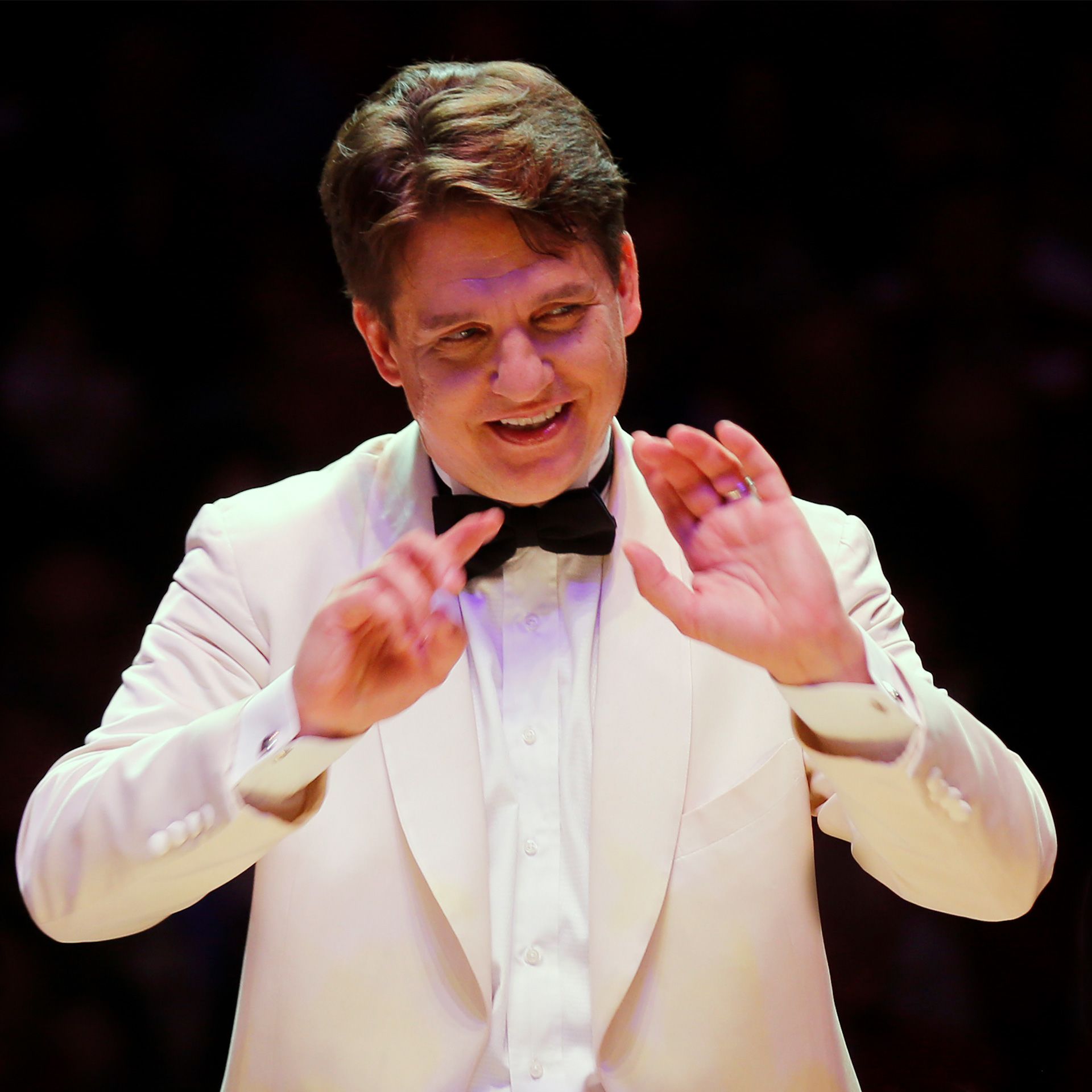
Photo: Winslow Townson
Photo: Winslow Townson
Keith Lockhart is Conductor of the Boston Pops and Artistic Director of the Brevard Music Center in North Carolina.
He is now in his 27th season with the Boston Pops, a tenure that includes nearly 2,000 performances, 45 national tours to more than 150 cities and four international tours. He and the Pops have made 80 television shows and participated in high-profile sporting events. The annual 4 July Boston Pops Fireworks Spectacular draws a live audience of over half a million with millions more who watch on television or live webcast.
From 2010 to 2018 he was Principal Conductor of the BBC Concert Orchestra. Highlights of his tenure include critically acclaimed North American tours, conducting annual performances at the BBC Proms, and celebrating the orchestra’s 60th year in 2012. In June of that same year he conducted the orchestra during Queen Elizabeth II’s gala Diamond Jubilee Concert, which was broadcast around the world.
In October 2007 he succeeded David Effron as Artistic Director of the Brevard Music Center Summer Institute and Festival. This has established itself as one of the nation’s leading summer institutes for gifted young musicians, preparing them to perform great musical works at a high artistic level.
He was previously Music Director of the Utah Symphony and Cincinnati Chamber orchestras and Associate Conductor of the Cincinnati Symphony and the Cincinnati Pops orchestras.
He was born in Poughkeepsie, New York, and began his piano studies at the age of seven; he holds degrees from Furman University and Carnegie Mellon University, as well as honorary doctorates from the Boston Conservatory, Boston University, Northeastern University, Furman University and Carnegie Mellon University, among others.
BBC Concert Orchestra
The mission of the BBC Concert Orchestra is to bring inspiring musical experiences to everyone, everywhere, with the ensemble’s versatility as the key. The orchestra can be heard on BBC Radio 2’s Sunday Night Is Music Night and for BBC Radio 3 it explores a wide selection of music, ranging from classical to contemporary. It has performed on many soundtracks, including Blue Planet and Serengeti for BBC One, and last February it worked with over 20 artists, including Michael Ball and Simply Red, for BBC Radio 2’s Piano Room Month with BBC iPlayer and BBC Sounds.
The orchestra appears annually at the BBC Proms and it is an Associate Orchestra at London’s Southbank Centre. It takes a leading role in Create Yarmouth, engaging and inspiring young people and adults in the Great Yarmouth area with activities including concerts, pop-up performances and learning projects. It is also involved in BBC Ten Pieces, the BBC Young Composer competition and the BBC Open Music programme
First Violins
Charles Mutter
Rebecca Turner
Peter Bussereau
Chereene Price
Lucy Hartley
Cormac Browne
Rustom Pomeroy
Tim Birchall
Amanda Britton
Charlotte Reid
Second Violins
Marcus Broome
Sarah Freestone
Daniel Mullin
Barbara
Dziewiecka-Data
Lucy Jeal
Sheila Law
Ikuko Sunamura
Julian Trafford
Violas
Timothy Welch
Nigel Goodwin
Helen Knief
Judit Kelemen
Adrian Smith
Elisa Bergersen
Cellos
Benjamin Hughes
Matthew Lee
Josephine Abbott
Ben Rogerson
Jacqueline Phillips
Katy Whittle
Double Basses
Dominic Worsley
Andrew Wood
Stacey-Ann Miller
James Goode
Flutes
Ileana Ruhemann
Clare Jefferis
Joanna Marsh
Piccolo
Joanna Marsh
Oboes
Rebecca Wood
Victoria Walpole
Cor Anglais
Victoria Walpole
Clarinets
Derek Hannigan
Nigel Ellis
Sarah Thurlow
Alto Saxophone
Nigel Ellis
Bass Clarinet
Sarah Thurlow
Bassoons
Arek Adamczyk
Jane Gaskell
Horns
Andrew Littlemore
Tom Rumsby
Mark Johnson
Richard Stroud
Trumpets
Catherine Moore
David McCallum
John Blackshaw
Trombones
Matthew Lewis
Mike Lloyd
David Stewart
Timpani
Barnaby Archer
Percussion
Alasdair Malloy
Stephen Whibley
Harp
Anne Denholm
Piano
Ben Dawson
Kit
Matt French
The list of players was correct at the time of publication
Streetwise Opera
Streetwise Opera is an opera company that enables people who’ve experienced homelessness to find inspiration and empowerment while they rebuild their lives and identities. We support participants to develop as creative people and, as we amplify their voices, change how society views homelessness.
We engage world-class artists, both established and emerging, to co-create bold new work and reimagine traditional repertoire. We create opera that is for everyone and, by bringing together diverse voices, change how society views opera.
We run a programme of singing and creative workshops in London, Manchester and Nottingham, which aims to inspire and empower people who are recovering from homelessness. As they engage with our work, Streetwise Opera performers improve their wellbeing and rebuild their social networks, and we have a robust evaluation system that helps us demonstrate the difference we make.
People who experience homelessness very often suffer from a diminished sense of self-worth and low expectations about what they can achieve and what they can expect from life. Streetwise Opera performers reinvent themselves as creators who make the world more beautiful and have the power to bring audiences to their feet. This gives them the confidence and inspiration to rebuild their lives.
Performers
London
Michael
Denise Allison
Natalie Allison
Pinky Bernard
Sarah Bisholo
Angela Campbell
Kieran Saikat Das Gupta
Tom Foames
Helen Georgy
Sylvia Hiscock
David Ighendo
Vicky James
Caroline Jones
Karen Jones
Julia Kwan
Phillippa Marlowe-Hunt
Yusaku Nagagawa
Yoko Nakahara
Margaret Nankya
Susan ‘Pickles’ Onion
Stuart Pearson
Maryanne Pereira
Stuart Picksley
Keif Powling
John Quan
Kim Rodway
Christine Rous
David Sanchez
Elma Twomey
Brian Ward
Kevin Woodwards
Manchester
Jayne
Keith
Maleeha Afzal
Michael Bennett
Sammy Braithwaite
Louise Brook
Chloe Buckley
Louise Darbyshire
Anita Ferguson
Darryl Flanagan
Richard Forrest
Steven Furlow
Daryl Gibson
Will Harris
Billie Haycraft
Phillip Jones
Georgina Kamperis
Steven Kelly
Stephen Lee
Andy Mercer
Sharrell Moore
Michael Owen
Zenlita Pinz
Jake Robertson
Terry Robinson
Steve Scallon
Liz Serjeant
John Shaw
Adele Taylor
Mark Ward
Martin Ware
Nottingham
Anna
Tesfahun Abay
Nicola Bartley
Jeremy Bartys
Lorraine Booth
Neil Brocklehurst
Kevin Delaney
Gary Douglas
Maria Finlay
Julie Ford
Jane Gadsby
Jessica Guest
Natalie Henriques
Amy Jardine
Anne Jennings
Simon Kemp
Yasmin Khan
Melody Marshall
John Merchant
Caroline Middleton
Catherine Nottingham
Demi Nottingham
Leon Nottingham
Paul Nottingham
Paul Palmer
Josef Pospisil
Barbara Richardson
Stevan Rowe
Lorraine Smith
Jim Stephenson
John Stewardson
Diana Sule
Vince Waring
Ruben Whitter
Kevin Wilkinson
Adam Zagorski
The list of performers was correct at the time of publication
The Sixteen
Whether performing a simple medieval hymn or expressing the complex musical and emotional language of a contemporary choral composition, The Sixteen does so with qualities common to all great ensembles. Tonal warmth, rhythmic precision and immaculate intonation are clearly essential to the mix. But it is the courage and intensity with which The Sixteen makes music that speak above all to so many people.
Celebrating its 40th anniversary in 2019, The Sixteen gave its first concert in 1979 under the direction of Founder and Conductor Harry Christophers. Their pioneering work since has made a profound impact on the performance of choral music and attracted a large new audience, not least as ‘The Voices of Classic FM’ and through BBC television’s Sacred Music series.
The voices and period-instrument players of The Sixteen are at home in over five centuries of music, a breadth reflected in their annual Choral Pilgrimage to Britain’s great cathedrals and sacred spaces, regular appearances at the world’s leading concert halls and award-winning recordings for The Sixteen’s CORO and other labels.
Recent highlights include the world premieres of Sir James MacMillan’s Stabat mater (at the Barbican in 2016 and live-streamed from the Sistine Chapel in 2018) and Fifth Symphony, ‘Le grand inconnu’ (2019 Edinburgh International Festival and Lincoln Center, New York), both commissioned for Harry Christophers and The Sixteen by the Genesis Foundation; an ongoing series of Handel oratorios; a debut tour of China; and a specially commissioned 2020 series of programmes presented by Sir Simon Russell Beale and entitled A Choral Odyssey.
Soprano
Hannah Cox
Alto
Kim Porter
Tenor
Matthew Mckinney
Bass
Stuart Young