
Elgar Cello Concerto
Thursday 10/11/22, 7.30pm (Aberystwyth Arts Centre)
Sunday 13/11/22, 3.00pm (Venue Cymru, Llandudno)


Béla Bartók
Hungarian Sketches (11’)
Edward Elgar
Cello Concerto (30’)
INTERVAL (20’)
Felix Mendelssohn
Symphony No. 3, ‘Scottish’ (40’)
Gergely Madaras Conductor
Santiago Cañón-Valencia Cello


This concert is being recorded by BBC Radio 3 for future broadcast in ‘Afternoon Concert’. It will be available to stream or download for 30 days via BBC Sounds, where you can also find podcasts and music mixes. Visit bbc.co.uk/now for more information on future performances.
Welcome

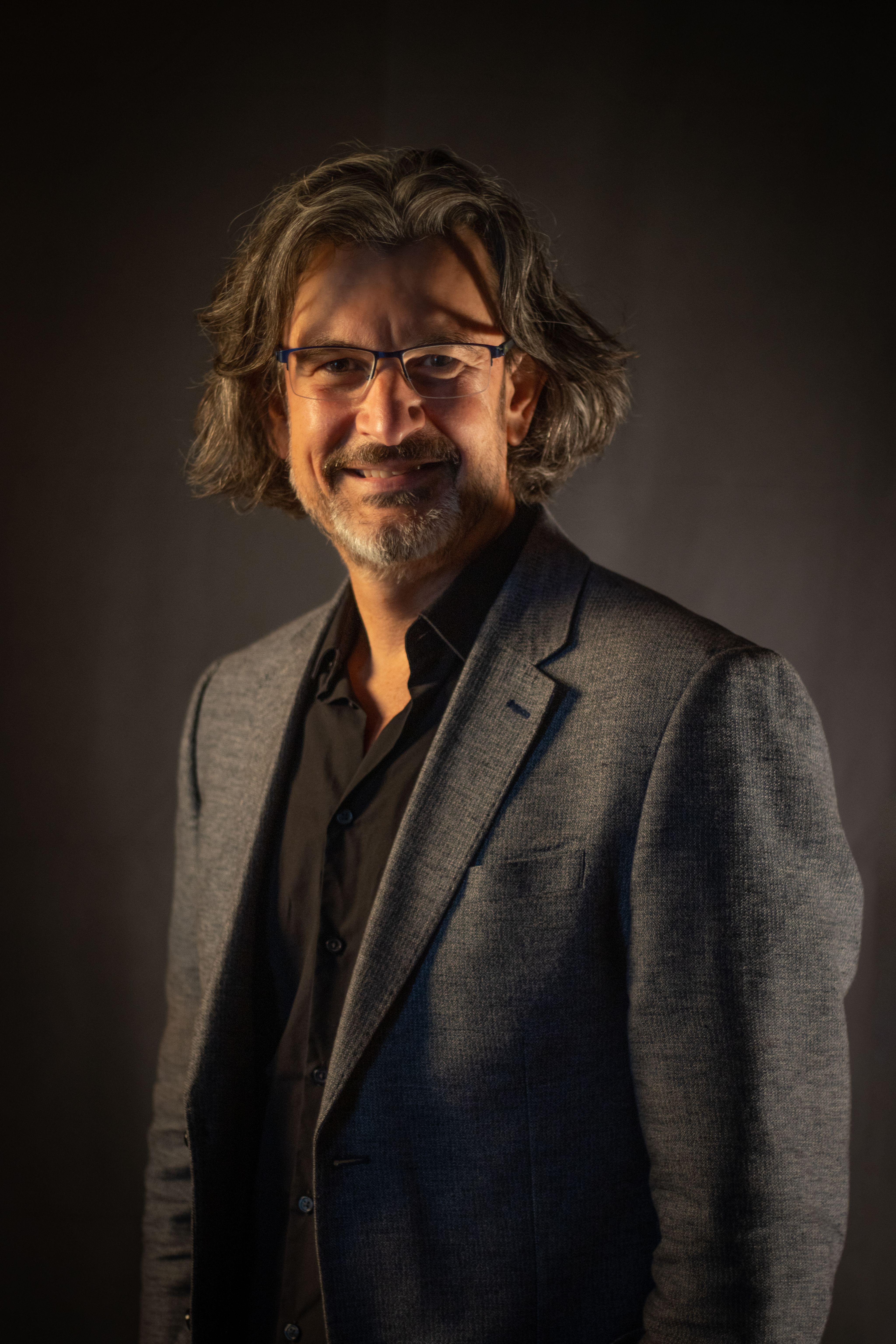
Welcome to today’s concert, part of our first tour back to North Wales in over two long years!
Mendelssohn’s ‘Scottish’ Symphony, which ends the programme, was inspired by a trip in 1829 which took the composer from the ruins of Edinburgh’s Holyrood Palace to the much wilder terrain of the Highlands and Islands.
Nearly 100 years later, at the end of the First World War, Elgar found a new sense of purpose after a period of creative impasse, and among the results was the great Cello Concerto, whose combination of nobility and introspection has made it irresistible to generations of players. Today’s soloist is the prodigiously gifted BBC New Generation Artist Santiago Cañón-Valencia.
We begin with a work that takes tonight’s conductor, Gergely Madaras, back to his roots: Bartok’s Hungarian Sketches. Enjoy!
Matthew Wood
Head of Artistic Production
Please respect your fellow audience members and those listening at home. Turn off all mobile phones and electronic devices during the performance. Photography and recording are not permitted.
Béla Bartók (1881–1945)
Hungarian Sketches (1931)

1 An Evening in the Village
2 Bear Dance
3 Melody
4 Slightly Tipsy
5 Swineherd’s Dance
Knowing that a composition date of 1931 places Bartók’s Hungarian Sketches in the midst of his most exploratory and adventurous period – the one that also produced the Third, Fourth and Fifth String Quartets, as well as the Music for Strings, Percussion and Celesta and the Second Piano Concerto – one can be forgiven for reacting with surprise at the pastoral delicacy, even naivety, of ‘An Evening in the Village’ that opens the suite. But the early 1930s was also a period when Bartók – who spent most of his life in dire financial straits – arranged and orchestrated a number of earlier works expressly in order to earn money.
The five movements of Hungarian Sketches (or Hungarian Pictures in some translations) are orchestrations of piano works Bartók composed some 20 years before. ‘An Evening’ and the humorously stomping ‘Bear Dance’ come from Ten Easy Pieces (1908); the pensive, enigmatically swelling ‘Melody’ is the second of the Four Dirges (1910); the self-explanatory ‘Slightly Tipsy’ is taken from the Three Burlesques (1908–11); and the wild and whirling ‘Swineherd’s Dance’ that concludes the set first appeared in For Children (1908–9). When the original piano pieces were written, Bartók was in the midst of a 12-year investigation into Hungarian and Romanian folk song undertaken with his friend and fellow composer Zoltán Kodály. Although only ‘Swineherd’s Dance’ directly quotes a traditional melody, all five movements of Hungarian Sketches contain allusions to the songs and musical styles that they discovered – from the alternation of conversational and tightly rhythmic articulation of ‘An Evening in the Village’ (two fundamental elements that Bartók brought together in one piece), the energetic rhythms of the ‘Bear Dance’ and ‘Swineherd’s Dance’ (and the hiccupping wobbles of ‘Slightly Tipsy’), to the Romanian mourning dirges of ‘Melody’ that provide Bartók with his favoured slow central movement.
Programme note © Tim Rutherford-Johnson
Further Listening: Budapest Festival Orchestra/Iván Fischer (Philips 4761799)
Further Reading: Béla Bartók David Cooper (Yale UP)
Edward Elgar (1857–1934)
Cello Concerto in E minor, Op. 85 (1918–19)

1 Adagio – Moderato –
2 Lento – Allegro molto
3 Adagio
4 Allegro – Moderato – Allegro, ma non troppo
Santiago Cañón-Valencia cello
‘I am lonely now & do not see music in the old way & cannot believe I shall complete any new work … Ambition I have none,’ wrote Elgar, little more than a year after completing his Cello Concerto in E minor. The concerto would become his last major work. With the exception of some small pieces of chamber music and a handful of transcriptions, Elgar wrote little of any consequence in the last 14 years of his life, though he began work on a whole array of new scores that were then abandoned, a piano concerto, a third symphony and an opera among them. His enthusiasm for composing had died along with his wife, Alice, who passed away just five months after the Cello Concerto was premiered.
Alice’s death had not come as a surprise. In the months leading up to it, Elgar described how she ‘seemed to be fading away before one’s very eyes’. But, as her health diminished, so Elgar’s musical persona became more introspective. Having written almost nothing during the war years, the years 1918–19 yielded four of the most beautiful – and distinctive – works of his career. His Violin Sonata, String Quartet and Cello Concerto (all in E minor) and Piano Quintet in A minor were marked by their newly contemplative style, which Alice declared ‘wonderful’. The critics admired the new Elgar, too, although the premiere of the Cello Concerto, given by the London Symphony Orchestra at Queen’s Hall in October 1919, was nearly a disaster. With too much rehearsal time apparently having been given over to the other works on the programme, a reviewer for The Observer wrote: ‘Never, in all probability, has so great an orchestra made so lamentable an exhibition of itself … The work itself is lovely stuff, very simple – that pregnant simplicity that has come upon Elgar’s music in the last couple of years – but with a profound wisdom and beauty underlying its simplicity.’
In contrast to his Violin Concerto of 1910, which is grand, impassioned and – in Elgar’s own words – ‘too emotional’, the Cello Concerto is solemn, reflective and altogether more wistful. This is not a virtuoso concerto in any traditional sense, though it is still the soloist who carries the weight of the narrative. Here, the cellist is part-performer and part-narrator, opening the work with a bold piece of recitative that begins as a cry of anguish before quickly fading into melancholy. The orchestra, too, is pared back, its gentle echoes and hushed accompaniment never eclipsing the soloist’s wandering lines. While there are flashes of grandeur and even of lightness, notably in the scurrying second movement and the march-like finale, these moments seem to pass all too quickly, either swept away by another idea or undercut by a note of sadness. This is Elgar in a deep and thoughtful mode, unburdening himself as though he were afloat on a sea of improvisation.
Programme note © Jo Kirbride
Further Listening: Sheku Kanneh-Mason; London Symphony Orchestra, Sir Simon Rattle (Decca 4850241)
Further Reading: Elgar: The Music Maker Diana McVeagh (Boydell Press)
INTERVAL: 20 minutes
Felix Mendelssohn (1809–47)
Symphony No. 3 in A minor, Op. 56, ‘Scottish’ (1829–42)

1 Andante con moto – Allegro un poco agitato – Assai animato – Andante –
2 Vivace non troppo –
3 Adagio –
4 Allegro vivacissimo – Allegro maestoso assai
Mendelssohn began sketching his ‘Scottish’ Symphony on the same 1829 trip that spawned The Hebrides overture, inspired this time by a ruined chapel at Edinburgh’s Holyrood Palace. ‘Everything around is broken and mouldering, and the bright sky shines in,’ wrote the composer in a letter home. ‘I believe I found today in that old chapel the beginning of my “Scotch” symphony.’ The end was a long time coming: Mendelssohn wrestled with the piece for a couple of years, shelved it in frustration for a decade and only finished it in 1842, making it – despite its official number – the fifth and final symphony he completed.
The work’s four movements are played without pause, and it doesn’t sound recognisably Scottish. Except, perhaps, for the rhythms of the melody that opens the fizzing second movement, the influence of traditional Scottish music is conspicuously absent: Mendelssohn, indeed, was uncharmed by the ‘so-called folk melodies’ of the British Isles (‘vulgar, out-of-tune trash’, he wrote of Welsh harp music). The third movement is archetypal Mendelssohn – stately and moving – but it’s the first and last movements that are the real meat of the piece. The first builds outwards from the melody Mendelssohn sketched at Holyrood; while the last, originally marked Allegro guerriero (‘Fast and warlike’), somehow finds its way from edgily nervous energy to rapturous triumph.
Programme note © Will Fulford-Jones
Further Listening: City of Birmingham Symphony Orchestra/Edward Gardner (Chandos CHSA5139)
Further Reading: Mendelssohn: A Life in Music
R. Larry Todd (OUP)
Biographies
Gergely Madaras conductor

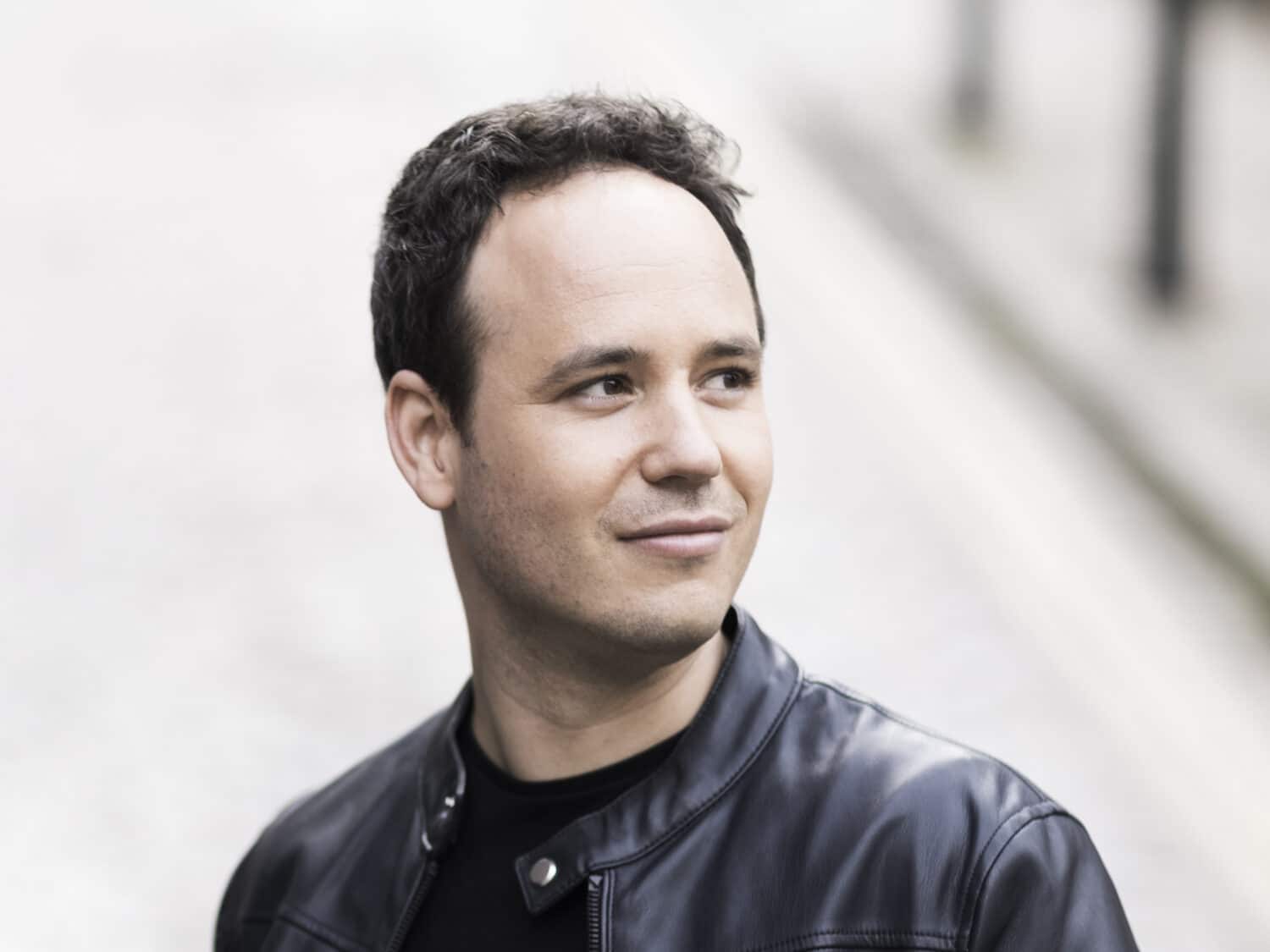
Gergely Madaras is Music Director of the Orchestre Philharmonique Royal de Liège. Together they perform across Belgium, as well as touring to the rest of Europe and to South America. They are currently celebrating the bicentenary of César Franck’s birth, performing his major operas, oratorios and symphonic works.
Other highlights this season include debuts with the London Philharmonic Orchestra, Orchestre Philharmonique de Radio France, Toulouse Capitole Orchestra, Orchestre National de Lille, Orchestre de Chambre de Paris, Orchestra della Svizzera Italiana and the Tokyo Metropolitan Symphony Orchestra. He returns to the Bamberg, Bournemouth and City of Birmingham Symphony orchestras and the Orchestra Sinfonica Nazionale della RAI.
Recent highlights include engagements with the Budapest Festival Orchestra, Zurich Tonhalle Orchestra, Netherlands Philharmonic Orchestra, Orchestre National de Lyon, Filarmonica della Scala, Maggio Musicale and the Scottish and Munich Chamber orchestras. He has also worked with the Academy of Ancient Music. Further afield, he has appeared with the Houston, Melbourne and Queensland Symphony orchestras.
In addition to conducting Classical and Romantic repertoire, he maintains a close relationship with contemporary music, collaborating with composers such as Sir George Benjamin, Péter Eötvös, György Kurtág and Pierre Boulez (for whom he was assistant conductor at the Lucerne Festival Academy 2011–13).
He was the inaugural Sir Charles Mackerras Fellow at the English National Opera. Since then he has conducted critically acclaimed productions at the Dutch National Opera, Grand Théâtre de Genève and Hungarian State Opera. This season he makes his debut at La Monnaie, conducting Shostakovich’s The Nose.
He was born in Budapest in 1984 and first began studying folk music (aged 5) with the last generation of authentic Hungarian gypsy and peasant musicians. He went on to study classical flute, violin and composition at the Liszt Academy in Budapest, as well as conducting at the University of Music and Performing Arts in Vienna.
Santiago Cañón-Valencia cello

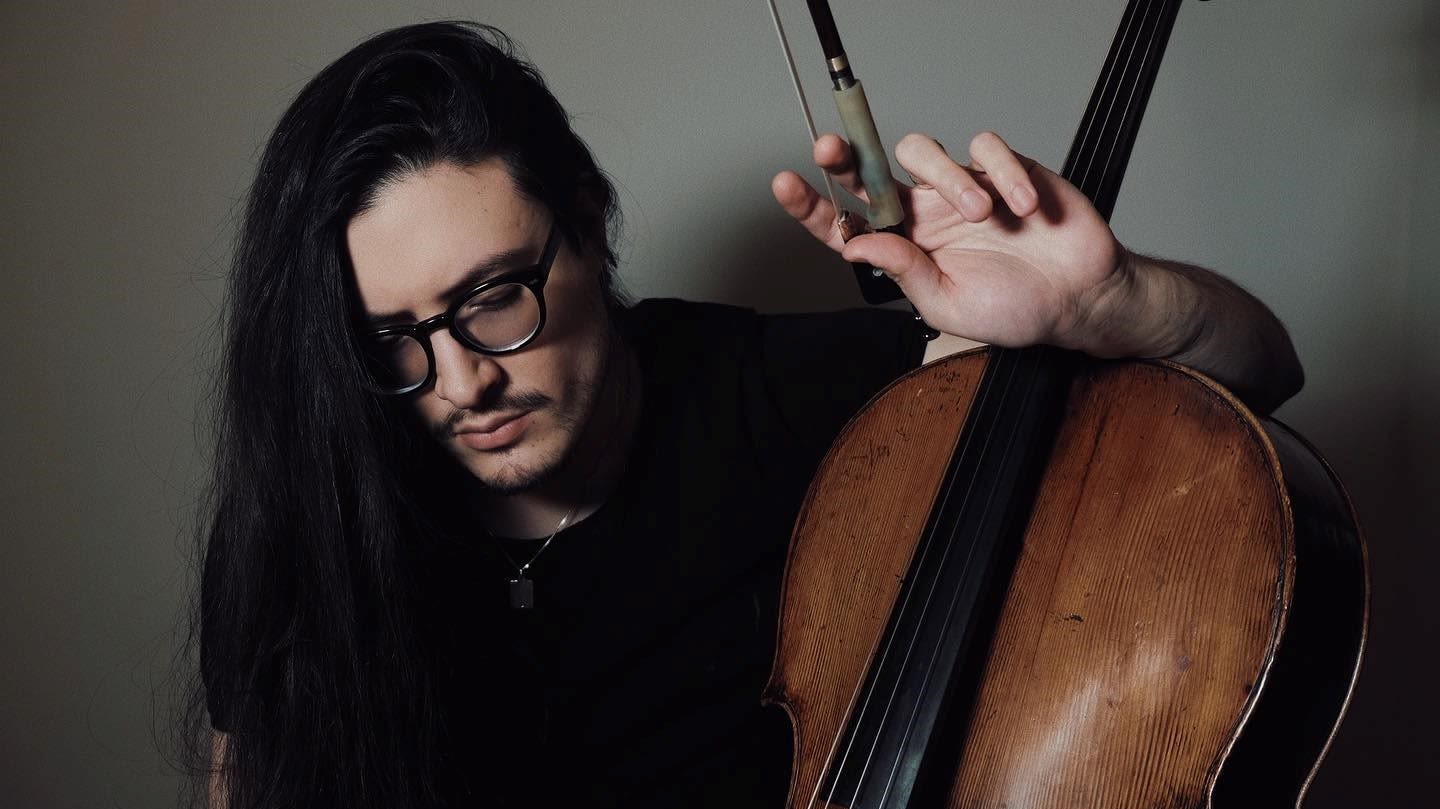
Santiago Cañón-Valencia has been praised as one of the most promising young cellists of his generation. Born in Bogotá in 1995, his major musical mentors have been Henryk Zarzycki in Colombia, James Tennant in New Zealand, Andres Diaz in the United States and Wolfgang Emanuel Schmidt at the Kronberg Academy for Young Soloists in Germany.
He has had many competition successes, including winning the Silver Medal and Audience Award at the 2019 Tchaikovsky Competition, and is currently a BBC Radio 3 New Generation Artist.
He made his orchestral debut as a soloist when he was 6 and since then has appeared with all the major orchestras in his native Colombia, while his international solo career has taken him around the world to perform with orchestras such as the Mariinsky Orchestra with Valery Gergiev, Frankfurt Radio Orchestra with Christoph Eschenbach, Brussels Philharmonic with Stéphane Denève, St Petersburg Philharmonic with Nikolai Alexeev, Hungarian Radio Symphony Orchestra with János Kovács, Moscow Soloists with Yuri Bashmet, Orpheus Chamber Orchestra and Antwerp Symphony with Muhai Tang, among others.
Recent highlights include concertos in Colombia and Japan, as well as debuts with the Polish National Radio, RTVE and SWR Symphony orchestras and Prague Philharmonia, and appearances at the Dresden, Casals and Moritzburg festivals.
He is committed to new music and has premiered concertos by Carlos Izcaray and Jorge Pinzón, as well as giving the Colombian premiere of Ginastera’s Cello Concerto No. 2.
His debut recording Solo, released in 2013, was warmly acclaimed and has been followed by Russian cello sonatas and Diable vert with pianist Katherine Austin. A new album is due for release later this year.
Since 2011 he has been the recipient of the Mayra and Edmundo Esquenazi Scholarship through the Salvi Foundation.
BBC National Orchestra of Wales
For over 90 years, BBC National Orchestra of Wales has played an integral part in the cultural landscape of Wales, occupying a distinctive role as both broadcast and national symphony orchestra. Part of BBC Wales and supported by the Arts Council of Wales, it has a busy schedule of live concerts throughout Wales and the rest of the UK. The orchestra is an ambassador of Welsh music and champions the works of contemporary composers.
It performs annually at the BBC Proms and biennially at the BBC Cardiff Singer of the World competition, and can be heard regularly across the BBC: on Radio 3, Radio Wales and Radio Cymru, as well as providing the soundtracks for some of your favourite television programmes.
Highlights of this season include the Elemental Explorations concerts in Brecon and Newport with Nil Venditti, Disney’s Fantasia in concert, Britten and Elgar with the orchestra’s much-loved Conductor Laureate Tadaaki Otaka, an all-new Gaming concert with gaming music legend Eímear Noone and a CoLaboratory concert with the sensational cellist Abel Selaocoe.
Alongside its busy schedule of live concerts, BBC NOW works closely with schools and music organisations throughout Wales, regularly delivering workshops, side-by-side performances and young composer initiatives to inspire and encourage the next generation of performers, composers and arts leaders and make music accessible to all. To find out more visit bbc.co.uk/bbcnow
Patron
HM King Charles III KG KT PC GCB
Principal Conductor
Ryan Bancroft
Conductor Laureate
Tadaaki Otaka CBE
Composer-in-Association
Gavin Higgins
Composer Affiliate
Sarah Lianne Lewis
First Violins
Lesley Hatfield Leader
Nick Whiting AssociateLeader
Martin Gwilym-Jones Sub-Leader
Gwenllian Hâf MacDonald
Terry Porteus
Suzanne Casey
Carmel Barber
Kerry Gordon-Smith
Ruth Heney
Zanete Uskane
Juan Gonzalez
Amy Fletcher
Second Violins
Anna Smith *
Vicki Hodgson
Beverley Wescott
Patrycja Mynarska
Ilze Abola
Vickie Ringguth
Katherine Miller
Michael Topping
Gary George-Veale
Cathy Fox
Violas
Rebecca Jones *
Tetsuumi Nagata
Peter Taylor
Robert Gibbons
Catherine Palmer
Dáire Roberts
James Flannery
Sharada Mack
Cellos
Alice Neary *
Raphael Lang
Sandy Bartai
Carolyn Hewitt
Rachel Ford
Kathryn Graham
Double Basses
David Stark *
Daniel Vassalo
Emma Prince
Hiu Man Phoebe Cheng
Flutes
Matthew Featherstone *
Jack Welch
Lindsey Ellis
Piccolo
Lindsey Ellis †
Oboes
Steve Hudson *
Amy McKean
Clarinets
Marie Lloyd ‡
Lenny Sayers
Bass Clarinet
Lenny Sayers †
Bassoons
Gareth Humphreys ‡
Jo Shewan
David Buckland
Contra-bassoon
David Buckland †
Horns
Tim Thorpe *
James Mildred
Neil Shewan †
William Haskins
John Davy
Trumpets
William Morley
Robert Samuel
Nina Tyrrell
Trombones
Paweł Cieślak
Huw Evans
Bass Trombone
Lloyd Pearce
Tuba
Richard Evans
Timpani
Steve Barnard *
Percussion
Chris Stock *
Phil Hughes
Harp
Valerie Aldrich-Smith †
Electronics
Catherine Roe Williams
* Section Principal
† Principal
‡ Guest Principal
# Assistant Principal
The list of players was correct at the time of publication
Director Lisa Tregale +
Orchestra Manager Zoe Poyser +
Assistant Orchestra Manager Vicky James **
Orchestra Administrator Nick Olsen
Orchestra Coordinator, Operations Kevin Myers
Business Coordinator Caryl Evans
Head of Artistic Production Matthew Wood
Artists and Projects Manager Eleanor Phillips
Orchestra Librarian Eugene Monteith **
Producer Mike Sims
Broadcast Assistant Jacob Perkins
Head of Marketing and Audiences Sassy Hicks
Marketing Coordinator Amy Campbell +
Digital Producer Yusef Bastawy
Social Media Coordinator Harriet Baugh
Education Producers Beatrice Carey, Rhonwen Jones **
Audio Supervisors Simon Smith, Andrew Smillie
Production Business Manager Lisa Blofeld
Stage and Technical Manager Steven Brown
Assistant Stage and Technical Manager Dave Rees
BBC Wales Apprentices
Josh Gill
Analese Thomas-Strachan
Jordan Woodley
+ Green Team member
** Diversity & Inclusion Forum