Price, Gershwin, Shostakovich
Saturday 11 June, 7.30pm
The Bridgewater Hall, Manchester

Welcome to tonight’s performance
Kerem Hasan takes up the baton for our final concert of the season. Join us as he guides us through the American Midwest with The Oak, a richly orchestrated, vibrant tone-poem by Florence Price. Then it’s over to the East Coast for a rhapsodic romp with pianist Xiayin Wang as she treads the line between silky and symphonic in George Gershwin’s F major concerto. Finally, we journey east to explore Shostakovich’s ever-complicated feelings towards life in the Soviet Union – displayed in this most complex and surely most poetic of symphonies, the 10th, chock-full of drama, lyricism and Shostakovich’s uniquely sardonic wit.
Our relationship with BBC Radio 3
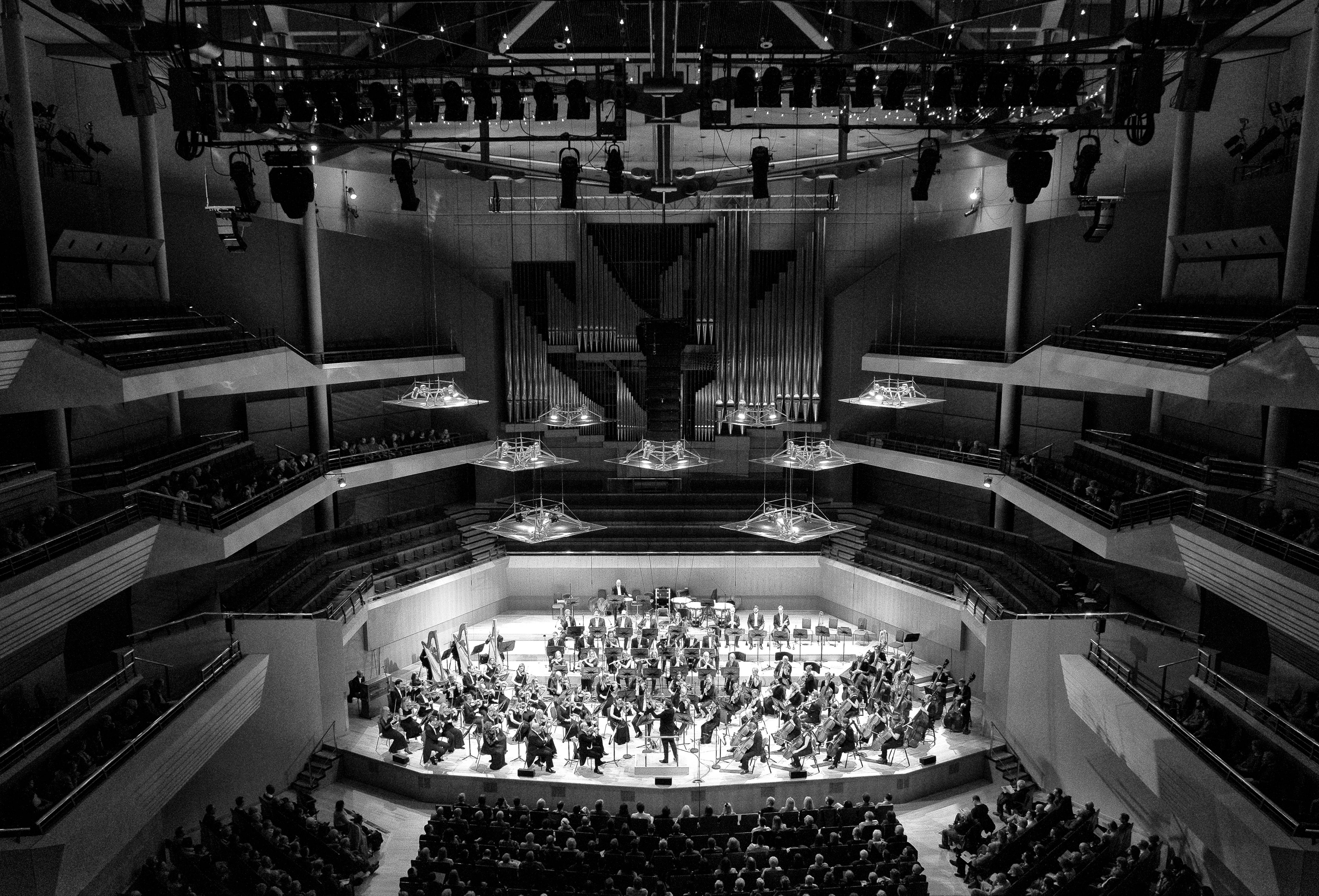
As the BBC’s flagship orchestra for the North, almost all of the BBC Philharmonic’s concerts are recorded for broadcast on Radio 3. Tonight you will see a range of microphones on the stage and suspended above the orchestra. We have a Producer, Assistant Producer and Programme Manager at the orchestra who produce our broadcasts.
We seek to bring a diverse and risk-taking range of repertoire to our audiences, including our concert-goers here in Manchester, as well as the two million listeners who tune in to BBC Radio 3.
Please do not take flash photographs during the performance as this is very distracting to the artists. Audio and video recording is strictly prohibited.
To ensure that everyone can enjoy the concert, please either turn off your phone and any other electronic devices before it begins or ensure that they are turned to silent.

Florence Price
The Oak 13’
George Gershwin
Concerto in F 31’
INTERVAL: 20 MINUTES
Dmitry Shostakovich
Symphony No. 10 in E minor 53’
Xiayin Wang piano
Kerem Hasan conductor
BBC Philharmonic


Tonight’s concert is being recorded by BBC Radio 3 for broadcast in ‘Radio 3 in Concert’ on Thursday 14 July at 7.30pm. It will be available to stream or download for 30 days after broadcast via BBC Sounds, where you can also find podcasts and music mixes.
Help us Improve Our Online Programmes.
Please take this 5-minute survey and let us know what you think of these notes.
Programme Survey
Florence Price(1887–1953)
The Oak (1943)

Florence Price composed The Oak in 1943. Its performances and reception during her lifetime are scantily documented. Posthumously, however, this tone-poem has enjoyed performances in the United States and now its second UK performance, with the BBC Philharmonic.
The Oak is a mature work within Price’s output. By now she had made her musical mark with her groundbreaking Symphony No. 1 (1932). Her Symphony No. 3 (1938–40) led Eleanor Roosevelt to remark that Price ‘has certainly made a contribution to our music’. By 1943 Price’s compositional voice had reached even greater expressive heights. If her earlier works were about proving her mastery of Western classical conventions, this later period demonstrated that she no longer had anything to prove but, indeed, much more to say.
Price begins The Oak with a sinister, slow-moving passage in the lower strings. A gradual textural build from the double basses to the violins evokes the impression of beholding an oak’s roots and slowly raising our heads to take in its dizzying heights. Towering and sinuous motifs recur throughout. The strings later offer lush backdrops to bucolic brass, melodic woodwind and rippling harp moments. Percussive passages and punctuations, however, ground the work in its ominous overtones. As a tree that beautified rural landscapes but was also the site of lynchings, the oak had a majesty and menace that Price – a Black woman born in the South – knew all too well.
Programme note © Samantha Ege
Samantha Ege is the Lord Crewe Junior Research Fellow in Music at Lincoln College, University of Oxford. She is the co-author of a forthcoming Florence Price biography with Douglas Shadle (OUP) and co-editor of the forthcoming Cambridge Companion to Florence B. Price with A. Kori Hill. As a concert pianist she has recorded and performed Price’s piano music extensively.
Florence Price
Florence Price was the first Black woman to gain widespread recognition as a composer. In a 1943 letter to the conductor Serge Koussevitzky, she said quite plainly, ‘To begin with I have two handicaps – those of sex and race.’ Both her race and her gender shaped Price’s life and career. Born in Little Rock, Arkansas, in 1887, she studied composition at the New England Conservatory of Music where, at the encouragement of her mother, she passed off as a Mexican woman in an attempt to avoid discrimination.
After her studies, Price returned to Arkansas in the 1920s, only to have to flee for Chicago in the wake of a wave of racial violence that wreaked havoc on local Black communities. In Chicago, Price spent the next decades building up an impressive output of symphonic and vocal music. Her art songs in particular won her much admiration, especially when the famous African American contralto Marian Anderson began singing them in the 1930s.
Price’s most well-known achievement is her Symphony No. 1 in E minor, premiered in 1933 by the Chicago Symphony Orchestra. It is in line with many of her works: written in a conservative, Romantic style. Price had the uncanny ability to combine Romantic language with African American folk music and spirituals, producing a style uniquely her own.
It is estimated that Price composed well over 300 works, although the majority remain unpublished. In 2009 much of Price’s music was discovered in an abandoned house in Arkansas. It is only now beginning to see the light of day.
Programme note © Kira Thurman
Kira Thurman is a cultural historian and musicologist at the University of Michigan. Her writings focus on the history of Black musicians in Europe and the USA. She is the author of Singing Like Germans: Black Musicians in the Land of Bach, Beethoven, and Brahms (Cornell University Press).
George Gershwin(1898–1937)
Concerto in F (1925)
1 Allegro
2 Adagio – Andante con moto
3 Allegro agitato
Xiayin Wang piano
When Gershwin was asked about his aims for the Concerto in F, which came hot on the heels of the enormous success of his Rhapsody in Blue in 1924, the composer responded: ‘Many persons had thought that the Rhapsody was only a happy accident. Well, I went out, for one thing, to show them there was plenty more where that came from.’ Commissioned for the New York Symphony by esteemed conductor Walter Damrosch, an avid supporter of new music, the concerto was to be Gershwin’s first major work for orchestra (the Rhapsody having been orchestrated by Ferde Grofé for solo piano and jazz band). Wary of his own inexperience as an orchestral composer, he organised a run-through – hiring 55 musicians at his own expense – in order to hear and refine it ahead of the premiere. But he was not the only one who was wary: critics questioned whether a light-music composer fluent in jazz had the requisite skills to write an extended concert work and greeted news that it contained popular dance music with suspicion.
Nevertheless, the premiere, on 3 December 1925, with Gershwin as soloist, was a much-anticipated event. According to one audience member, as the concerto reached its triumphant conclusion, the response in the hall was ‘thunderous’. The press verdict was more mixed: Gershwin had either written ‘about the most important new work that has been aired in this hamlet of ours in many somethings’ or had ‘neither the instinct nor technical equipment’ to compose in ‘symphonic dimensions’.
Despite the traditional title and movement outline, Gershwin originally planned to call this work ‘New York Concerto’ and, with this in mind, it is hard not to hear the bustle of the Jazz Age metropolis reverberating across a score that features wild contrasts and refuses to bind itself too rigidly to strict classical forms.
Gershwin described the first movement as ‘quick, pulsating, representing the young enthusiastic spirit of American life’. A declamatory percussion statement heralds the presentation of key musical ideas: a Charleston rhythm, a stylish dotted theme first heard on bassoon and a lilting syncopated second theme introduced on piano. Gershwin then toys with these ideas in episodes that – while being by turns humorous, grand, romantic, agitated and dramatic – are strikingly inventive and evocative.
The blues takes centre stage in the reflective slow movement, with a solo muted trumpet establishing what Gershwin referred to as the ‘poetic nocturnal’ mood. A brighter feeling emerges with the entry of the piano, but at the movement’s core is a typically big Gershwin melody in which the whole orchestra is able to flourish.
The concerto concludes with a hard-hitting romp in which themes from earlier battle with new ideas. In Gershwin’s vivid description, it is ‘an orgy of rhythms, starting violently and keeping to the same pace throughout’.
Programme note © Sophie Redfern
Sophie Redfern is a musicologist specialising in 20th-century American music and ballet. She is Honorary Research Fellow and Teaching Associate in Musicology and Musical Theatre at the University of Sheffield and the author of Bernstein and Robbins: The Early Ballets (Univ. of Rochester Press).
George Gershwin
Having left school at 15 to accompany a Tin Pan Alley song-plugger, Gershwin was set for a career in musicals. His first Broadway show La La Lucille opened in 1919 when he was still aged 20. The influence that the jazz idiom could have on the classical world became clear with the success of his Rhapsody in Blue in 1924, after which Gershwin turned more and more to so-called classical forms. His Concerto in F followed a year later and in 1928 came his brilliantly colourful tone-poem An American in Paris. Meanwhile he had struck up a partnership with his gifted lyricist brother Ira, resulting in a sequence of songs and shows. Not wanting to stifle Gershwin’s highly developed talents, both Ravel and Nadia Boulanger declined to give him lessons (Ravel famously commented that, given the amount the young American was earning, it was Gershwin who should be giving the lessons). Musicals and songs for films continued to flow, but Gershwin’s most ambitious and influential project was the ‘folk opera’ Porgy and Bess (1935). He died suddenly, before he was 40, of a brain tumour.
Profile by Edward Bhesania © BBC
INTERVAL: 20 minutes
Dmitry Shostakovich (1906–75)
Symphony No. 10 in
E minor, Op. 93 (1953)

1 Moderato
2 Allegro
3 Allegretto
4 Andante – Allegro
Dmitry Shostakovich wrote his 10th Symphony at one of the lowest points of his rollercoaster career. Elevated to national hero status after the triumph of the wartime ‘Leningrad’ Symphony (No. 7, 1941), and still feted after the much darker Eighth appeared two years later, he had then disgraced himself with his half-lightweight, half-darkly satirical Ninth Symphony in 1945 – not by any stretch the heroic choral Ninth the Soviet press had led everyone to expect. Its alleged failure was cited when Shostakovich was viciously denounced at the First Congress of the Union of Composers in 1948.
Shostakovich soon came to realise that, for the moment at least, ‘serious’ composition had to be for the desk drawer only. Listening to the 10th Symphony (1953), it isn’t hard to see why he thought it wise to hold the score back. For much of its length the symphony is sombre in character. Grief and rage well up unmistakably in the first movement’s powerful central climax and throughout the torrential second, while the third is full of the kind of tart, enigmatic humour which had recently earned him stinging rebuke.
But when the 10th Symphony was heard for the first time, nine months after the death of Stalin in March 1953, what struck many critics was how magnificently sustained it was as a musical argument. For all its brooding, sometimes harrowing intensity, the first movement is structured with skilful inevitability, poignant lyricism fused with intricate, almost Bachian counterpoint unparalleled in Shostakovich’s earlier symphonic works. Most of the time the orchestral palette is used sparingly, which means that highlighted sonorities stand out: solo clarinet intoning the first main theme after the dark strings-only introduction, low flute in the second theme and the unforgettable sound of two softly intertwining piccolos in the coda.
The volcanic but remarkably compact Allegro second movement is an outpouring of molten fury, but it’s also tremendously exciting – the thrill of cathartic release?
Then in the shadowy, dance-like Allegretto we hear two motifs of particular cryptic significance. The four-note motif introduced by high woodwind with percussion spells out the notes D-E flat-C-B – in German notation D-Ess-C-H, ie Shostakovich’s own initials (D. Sch.). The striking solo horn figure that interrupts the dance ingeniously spells out the name of one of Shostakovich’s students, Elmira Nazirova, with whom he was in love at that time – the feeling, apparently, was not reciprocated.
Initially the finale’s slow introduction brings us back to wintry introspection. Then suddenly a trailing flute figure is transformed into a perky Allegro dance, all high-kicking major-key energy, with D-S-C-H returning in massive unison at the climax. D-S-C-H persists towards the end (high horns, then pounding timpani), sounding through the manic dance music. Whether this represents triumph or something much darker and more equivocal is left to the listener to judge.
Programme note © Stephen Johnson
Stephen Johnson is the author of books on Bruckner, Wagner, Mahler and Shostakovich, and a regular contributor to BBC Music Magazine. For 14 years he was a presenter of BBC Radio 3’s Discovering Music. He now works both as a freelance writer and as a composer.
Dmitry Shostakovich
Dmitry Shostakovich has emerged as one of the 20th century’s greatest composers, but his standing is bound up with his biography, the oppression of the Stalin regime and the politics of the Cold War. He was a musical prodigy, and his graduation work, the First Symphony, soon won him international fame. At home he became the No. 1 composer, the most admired and best paid. Even so, he also suffered from harsh official censure, beginning in 1936 when his internationally acclaimed opera The Lady Macbeth of the Mtsensk District was withdrawn from Soviet stages following direct criticism from Stalin himself. His Seventh Symphony, written during the siege of Leningrad, became an international symbol of resistance to Nazism but prompted sneers from Western composers such as Stravinsky, who thought that art serving any kind of politics was distasteful. After Shostakovich’s death, his work was mined for messages of resistance to the regime, and such messages can indeed be found next to ciphers and hidden quotations relating to his private life. Shostakovich’s massive output, including the monumental cycles of 15 symphonies and 15 string quartets, thus remains a magnet for intense engagement – and not only for the reasons of its transcendent beauty and power.
Profile © Marina Frolova-Walker
Marina Frolova-Walker is Professor of Music History at the University of Cambridge and Fellow of Clare College, Cambridge. She is the author of Russian Music and Nationalism from Glinka to Stalin and Stalin’s Music Prize: Soviet Culture and Politics.
Biographies
Kerem Hasan conductor
London-born Kerem Hasan studied piano and conducting at the Royal Conservatoire of Scotland, later continuing his education at the Zurich University of the Arts with Johannes Schlaefli. He has been Chief Conductor of the Tyrolean Symphony Orchestra in Innsbruck since September 2019.
Operatic highlights of the 2021–22 season include Rossini’s The Italian Girl in Algiers and Mozart’s The Magic Flute at the Tyrolean State Theatre, Così fan tutte with the English National Opera and The Rake’s Progress with Glyndebourne Festival Opera. As well as concerts with the Tyrolean Symphony Orchestra, orchestral highlights include appearances with the Antwerp and ORF Vienna Radio Symphony orchestras, Borusan Istanbul and Royal Philharmonic orchestras, Orchestre National du Capitole de Toulouse, North Netherlands Orchestra and Tonkünstler Orchestra. He has also made debuts with the Bournemouth Symphony Orchestra and Galicia Symphony Orchestra, and later this month makes his US debut with the Detroit Symphony Orchestra, followed by concerts with the Minnesota Orchestra and at the Aspen Music Festival.
He is the 2017 winner of the Nestlé and Salzburg Festival Young Conductors Award, was a finalist in the Donatella Flick LSO Conducting Competition in London and was Assistant Conductor at the 2018 Aspen Music Festival.
Xiayin Wang piano
Xiayin Wang began playing the piano at the age of 5. In 1997 she moved to New York, where she studied at the Manhattan School of Music, before completing her studies at the Shanghai Conservatory. She now sits on the piano faculty at New York’s Mannes School of Music.
She has performed with the Baltimore, Houston, Pittsburgh and Rome Symphony orchestras, Israel and Vienna Chamber orchestras and Royal Scottish National Orchestra. She has appeared in recital at New York’s Carnegie Hall and Alice Tully Hall and Vienna’s Mozart-Saal, as well as in Chile, Costa Rica, France, Hungary, Italy, Mexico, Russia and her native China.
Recent and upcoming highlights include orchestral debuts with the Aiken, Pacific and Southwest Florida Symphony orchestras, Chicago Philharmonic, Minnesota Orchestra and Spanish National Orchestra; a UK tour with the National Youth Orchestra of Great Britain; solo recitals in North and South America; performances and a recording of Tchaikovsky and Khachaturian piano concertos with the Royal Scottish National Orchestra; chamber concerts in California with violinist Alexandra Soumm; and a return to New York City’s International Keyboard Institute & Festival.
Her discography includes recordings of Tchaikovsky and Scriabin piano concertos, Ginastera’s Piano Concertos Nos. 1 and 2 and Rachmaninov’s Piano Sonatas.
BBC Philharmonic
The BBC Philharmonic is reimagining the orchestral experience for a new generation – challenging perceptions, championing innovation and taking a rich variety of music to the widest range of audiences.
The orchestra usually performs around 100 concerts every year, the vast majority of which are broadcast on BBC Radio 3. Along with around 35 free concerts a year at its MediaCityUK studio in Salford and a series of concerts at Manchester’s Bridgewater Hall, the orchestra performs across the North of England, at the BBC Proms and internationally, and records regularly for the Chandos label.
The BBC Philharmonic’s Chief Conductor is Omer Meir Wellber. Described by The Times’s Richard Morrison as ‘arguably the most inspired musical appointment the BBC has made for years’, Israeli-born Wellber burst into his new role at the 2019 BBC Proms and has quickly built an international reputation as one of the most exciting young conductors working today. The orchestra also maintains strong relationships with its Chief Guest Conductor John Storgårds and Associate Artist Ludovic Morlot. In May last year the orchestra announced young British composer and rising star Tom Coult as its Composer in Association.
The scope of the orchestra’s programme extends far beyond standard repertoire. Over the past few years it has collaborated with artists as varied as Clean Bandit, Jarvis Cocker and The Wombats; played previously unheard music by writer-composer Anthony Burgess in a unique dramatisation of A Clockwork Orange; joined forces with chart-toppers The 1975 at Blackpool’s Tower Ballroom; premiered The Arsonists by composer Alan Edward Williams and poet Ian McMillan, the first opera ever written to be sung entirely in a Northern English dialect; and broadcast on all seven BBC national radio networks, from BBC Radio 1 to BBC Radio 6 Music and the BBC Asian Network. Last year the orchestra also entered the UK Top 40 singles chart with ‘Four Notes: Paul’s Tune’.
The BBC Philharmonic is pioneering new ways for audiences to engage with music and places learning and education at the heart of its mission. Outside of the concert hall, it is passionate about taking music off the page and into the ears, hearts and lives of listeners of all ages and musical backgrounds – whether in award-winning interactive performances, schools’ concerts, Higher Education work with the Royal Northern College of Music or the creation of teacher resources for the BBC’s acclaimed Ten Pieces project. Through all its activities, the BBC Philharmonic is bringing life-changing musical experiences to audiences across Greater Manchester, the North of England, the UK and the rest of the world.
Chief Conductor Omer Meir Wellber
Chief Guest Conductor John Storgårds
Associate Artist Ludovic Morlot
Composer in Association Tom Coult
First Violins
Yuri Torchinsky Leader
Thomas Bangbala Sub-Leader
Kevin Flynn †
Austeja Juskaite-Igl
Anna Banaszkiewicz-Maher
Martin Clark
Julian Gregory
Catherine Mandelbaum
Anya Muston
Robert Wild
Charlotte Dowding
Mansell Morgan
Paula Smart
Sarah White
Adam Riding
Alison Williams
Second Violins
Glen Perry ‡
Lily Whitehurst
Rachel Porteous
Helen Evans
Simon Gilks
Sophie Szabo
Christina Knox
Rebecca Mathews
Alyson Zuntz
Claire Sledd
Matthew Watson
Eve Kennedy
Steve Dinwoodie
Elizabeth Lister
Violas
Kimi Makino ‡
Bernadette Anguige †
Kathryn Anstey
Matthew Compton
Ruth Montgomery
Nicholas Howson
Rachel Janes
Roisin Ni Dhuill
Carolyn Tregaskis
Michael Dale
Harriet Mitchell
Rosamund Hawkins
Cellos
Peter Dixon *
Maria Zachariadou ‡
Steven Callow †
Jessica Schaefer
Rebecca Aldersea
Melissa Edwards
Elinor Gow
Miriam Skinner
Elise Wild
Mandy Turner
Double Basses
Ronan Dunne *
Alice Durrant †
James Goode
Andrew Vickers
Alex Jones
Lisa Featherston
Ayse Osman
Bryn Davies
Flutes
Alex Jakeman *
Victoria Daniel †
Piccolo
Jennifer Hutchinson
Oboes
Jennifer Galloway *
Kenny Sturgeon
Cor Anglais
Gillian Callow
Clarinets
John Bradbury *
Fraser Langton
Bass Clarinet
Giulio Piazzoli
Bassoons
Roberto Giaccaglia *
Georgina Powell
Margaret Cookhorn
Contrabassoon
Margaret Cookhorn
Horns
Ben Hulme *
Rebecca Hill ¥
Phillip Stoker
Tom Kane
Jonathan Barrett
Trumpets
Francisco Gaspar §
Tomas Lopez
Gary Farr †
Tim Barber
Holly Clark
Trombones
Richard Brown *
Richard Ward
Bass Trombone
Russell Taylor
Tuba
Christopher Evans
Timpani
Louise Goodwin §
Percussion
Paul Patrick *
Geraint Daniel
Mark Concar
Harry Percy
Oliver Pooley
Harp
Clifford Lantaff *
Celeste
James Keefe
* Principal
† Sub Principal
‡ Assistant Principal
§ Guest Principal
¥ Associate Principal
The list of players was correct at the time of publication
Keep up to date with the
BBC Philharmonic
Listen to our BBC Radio 3 broadcasts via the BBC Sounds app. Visit our website and follow us on Twitter, Facebook and Instagram and sign up to the newsletter
To help us improve our online concert programmes, please take this 5-minute survey
Produced by BBC Proms Publications