BBC Centenary concert – Hindemith, Schumann, Sadikova, Tippett
Saturday 12 February, 7.30pm
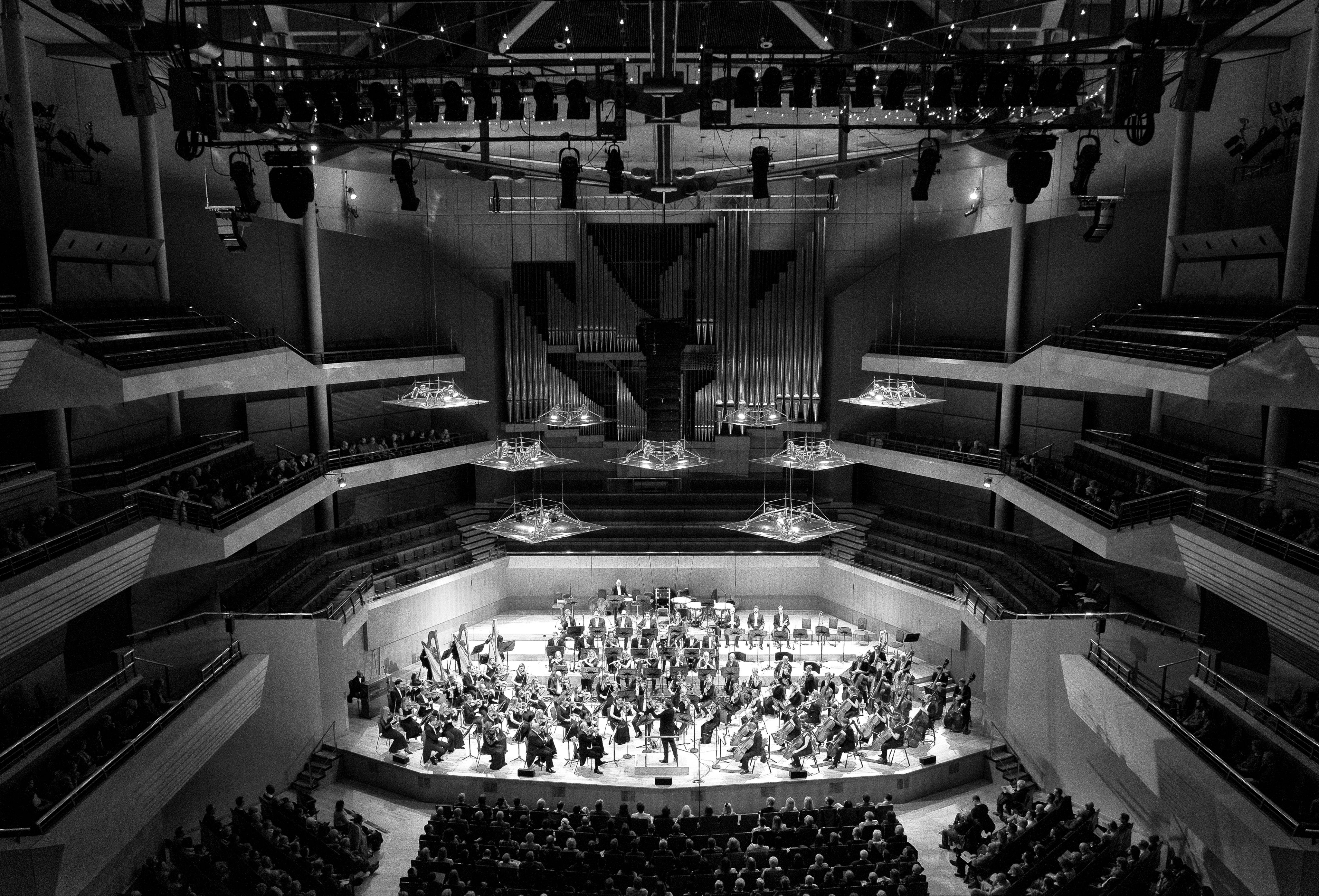
The Bridgewater Hall, Manchester


Welcome to tonight’s performance
Happy birthday to us! This year the BBC celebrates its centenary, and the BBC Philharmonic is coming to the party with a Saturday-night special – part of a weekend-long, UK-wide showcase of the BBC’s orchestras and choirs. Hindemith’s dizzily thrilling Kammermusik No. 1 dates from 1922, the year the BBC was founded, while the UK premiere of Aziza Sadikova’s Marionettes stands as testament to the BBC’s continued commitment to new music. Giulia Contaldo takes centre stage for the joyful Romanticism of Schumann’s Piano Concerto, before Chief Conductor Omer Meir Wellber transports us to mythical climes with Tippett’s sparkling ‘Ritual Dances’.
Our relationship with BBC Radio 3
As the BBC’s flagship orchestra for the North, almost all of the BBC Philharmonic’s concerts are recorded for broadcast on Radio 3. Tonight you will see a range of microphones on the stage and suspended above the orchestra. We have a Producer, Assistant Producer and Programme Manager at the orchestra who produce our broadcasts.
We seek to bring a diverse and risk-taking range of repertoire to our audiences, including our concert-goers here in Manchester, as well as the two million listeners who tune in to BBC Radio 3.
Please do not take flash photographs during the performance as this is very distracting to the artists. Audio and video recording is strictly prohibited.
To ensure that everyone can enjoy the concert, please either turn off your phone and any other electronic devices before it begins or ensure that they are turned to silent.

Paul Hindemith
Kammermusik No. 1 15’
Aziza Sadikova
Marionettes BBC commission: UK Premiere19’
INTERVAL: 20 minutes
Robert Schumann
Piano Concerto in A minor 31’
Michael Tippett
The Midsummer Marriage – Ritual Dances 24’
Giulia Contaldo piano
BBC Philharmonic
Omer Meir Wellber conductor/harpsichord


Tonight’s concert is being broadcast live on BBC Radio 3. It will be available for 30 days after broadcast via BBC Sounds, where you can also find podcasts and music mixes.
Help us Improve Our Online Programmes.
Please take this 5-minute survey and let us know what you think of these notes.
Programme Survey
Paul Hindemith (1895–1963)
Kammermusik No. 1 (1922)


1 Sehr schnell und wild [Very fast and wild]
2 Massig schnelle Halbe. Sehr streng im Rhythmus [Moderately fast. Very strict rhythm]
3 Quartett: Sehr langsam und mit Ausdruck [Quartet: Very slow and with expression]
4 Finale: 1921. Lebhaft [Lively]
Paul Hindemith began the First World War as a professional violinist in his native Frankfurt – but after his return from service in the trenches he turned more intently to composition, and the variety and volume of his output suggests a man in a hurry. Song-cycles, one-act operas, string quartets, piano works, ballets: all came cascading at speed as the 20-something composer sought to find and finesse his restless compositional voice in a Europe changing before his eyes.
Meaning ‘Chamber Music’, Hindemith’s seven-strong Kammermusiken series contains some of his most exhilarating early experiments – and none more so than No. 1, written for a never-seen-before line-up of 12 distinct parts: five strings, three winds, trumpet, piano (a ferociously difficult part), accordion and a grab-bag of percussion that includes xylophone, siren and what the score specifies as a ‘tin can filled with sand’.
The minute-long first movement is marked ‘Sehr schnell und wild’ (Very fast and wild), which about captures it; and, while the second movement takes down the tempo, it still courses with adrenaline. The pensive, quietly beautiful Quartet – flute, clarinet, bassoon and glockenspiel – stands out in such company, before abnormal service resumes with a Finale that hurtles headlong towards a suitably unexpected finish. Fasten your seatbelts.
Notes and profiles © Will Fulford-Jones
Will Fulford-Jones is a writer and editor who works widely across music and the arts.
Paul Hindemith
A gifted violinist from an early age, Hindemith studied violin and composition at Frankfurt’s Hoch Conservatory after serving in the German army, and while leader of the Frankfurt Opera Orchestra (1917–23) he produced three controversial one-act operas. Throughout the 1920s he was a prominent member of Europe’s modern-music scene, playing viola in the Amar Quartet, which he co-founded in 1921 to promote new music.
Alongside his often expressionistic, parodic scores of the 1920s he wrote much instrumental music for amateurs and children (‘Gebrauchsmusik’), believing in the importance of music’s role in everyday life. Hindemith’s opera Mathis der Maler (1933–5), based on the life of the painter Matthias Grünewald, was banned by the Nazi regime, and in 1938 he emigrated to Switzerland.
In 1940 he moved to the USA, becoming a visiting professor at Yale University, where he taught and founded the Yale Collegium Musicum as a workshop for the revival of early music. Though he took US citizenship in 1946, he returned to Europe in 1953 to a post at Zurich University. Despite his early experimentalism, Hindemith’s polyphonic skill represented a distinctly German trait that could be traced back to Bach.
Profile by Edward Bhesania © BBC
Edward Bhesania is Editorial Manager, BBC Proms Publications, and reviews for The Stage and The Strad. He has written for The Observer, Country Life, The Tablet and International Piano
Aziza Sadikova (born 1978)
Les marionettes (2015, rev. 2020)
BBC commission: UK premiere


Omer Meir Wellberharpsichord
Marionettes for harpsichord and orchestra was commissioned by the BBC and composed in 2020. A reflection on Joseph Haydn’s piece for puppet theatre, Philemon and Baucis, the work’s title, form (an ABA concertino), instrumentation and overall musical material (running semiquaver fragments, canonic and contrapuntal string writing and repetitive, bouncing spiccato patterns) take inspiration from Haydn’s Classical score.
I have also made an attempt to take the listener further back in history by implementing a musical reflection on my favourite composer, François Couperin. This can be heard in the improvisatory, Baroque style of the harpsichord writing, which features ‘notes inégales’ (rhythmically unequal pairings of notes).
I haven’t attempted to compose a typical modernist contemporary work with complex textures and techniques, but rather to broaden the tonal and harmonic spectrum of the given Classical music language, and allow myself free rein to enjoy the process. There are, however, moments where I depart from the Classical idiom and build multiple layers of tonal chords that result in orchestral clusters. These, at times, overtake the melodic lines. The effect is most noticeable when I introduce a quotation from Couperin’s famous piece for harpsichord Les baricades mistérieuses. Here, the melody appears as an ethereal echo of past music.
In this piece I have made an attempt to rediscover and reconnect with the music of the past. Of course, there has already been a neo-Classical movement. However, I believe we live in a different reality today, and can still enrich this music and refresh it for modern ears.
Notes and profiles © Aziza Sadikova
Aziza Sadikova
In the capital of Uzbekistan, Tashkent, where Aziza Sadikova was born and raised, there is a street, a music school and even a museum named after her grandfather. ‘The expectations were very high and frankly it was very hard work,’ she has said of her childhood. But Sadikova has more than proved her worth. Her music has been performed at Hamburg’s Elbphilharmonie and Leipzig’s Thomaskirche, by ensembles including the Hamburg State Philharmonic Orchestra, Britten Sinfonia and Peking State Opera.
Sadikova completed her studies at the Birmingham and Trinity Laban conservatoires but is now based in Berlin, where, she says, ‘the music scene is more diverse and vibrant’. This suits the inherent freedom of her musical style too, which has a restless and inquisitive energy about it.
Above all, Sadikova says, she is guided by her emotions. She harnesses her disparate ideas in graphic scores which often explore unconventional instrumental techniques, such as 2015’s Alles über Sally, a chamber opera for actor, soprano, ensemble, two typewriters and found objects. She combines the old with the new, as in 2010’s La Baroque for solo violin, and experiments with theatrical ideas, as in 2012’s Ein Brief, a piece of music theatre after Franz Kafka’s letters to Felice Bauer.
Pprofiles © Jo Kirkbride
Jo Kirkbride is Chief Executive of the Dunedin Consort and a freelancer writer on classical music. She studied Beethoven’s slow movements for her PhD and writes regularly for the London Symphony Orchestra, London Philharmonic Orchestra, London Sinfonietta and Snape Proms.
INTERVAL: 20 minutes
Robert Schumann (1810–56)
Piano Concerto in A minor, Op. 54 (1841–5)


1 Allegro affettuoso – Andante espressivo – Allegro
2 Intermezzo: Andantino grazioso –
3 Allegro vivace
Giulia Contaldopiano
Within the confines of his troubled and agonisingly short life, Robert Schumann’s only Piano Concerto was a long time coming. He began one as a teenager in 1827, sketched another in 1828, started a third in 1830 and made inroads into a fourth in 1839, but none made it past the drawing board.
Schumann made his fifth attempt during his ‘symphonic year’ of 1841 – when, after spending much of the previous decade writing for piano and most of 1840 writing songs, he turned to the orchestra. The going was tough. The concerto began as the single-movement Phantasie for piano and orchestra, first played by Schumann’s new wife Clara – eight months pregnant – at two private performances. But Schumann never found a publisher, and the work gathered dust until Clara implored him to make something of it.
Four years later Schumann revised the Phantasie, adding two further movements to create the Piano Concerto. Clara again gave the first performance, this time in Dresden – but once more in private, and the work ultimately went unheard by the public during the composer’s lifetime.
At the time, piano concertos tended towards the showy, with the soloist elevated far above the orchestra. Right from its beginnings as the Phantasie, Schumann’s concerto was different, as Clara was keenly aware: ‘the piano is most subtly interwoven with the orchestra … the pianist is not only soloist but orchestral musician as well.’ In an 1839 article, Schumann himself had described his hope that one day, ‘[a] genius … will show us in a newer and more brilliant way how orchestra and piano may be combined, how the soloist, dominant at the keyboard, may unfold the wealth of his instrument and his art, while the orchestra, no longer a mere spectator, may interweave its manifold facets into the scene.’ It took a while, but he eventually got there.
The work begins with a bang – but from the soloist’s near-instant restatement of the oboe’s liquid opening theme, piano and orchestra are working in union, not competition, constantly trading material to shepherd the music to a dazzling cadenza and then the first movement’s fiery conclusion.
The poised, balletic and altogether irresistible Intermezzo provides calm after the storm, but it’s over in a blink – and leads, hurriedly and unexpectedly, into the closing Allegro vivace, where a treacherously brilliant sea of cross-cutting rhythms and modulations carries both soloist and orchestra towards an expansive coda and conclusion.
Programme note © Will Fulford-Jones
Robert Schumann
After studying Law in Leipzig, Schumann intended to embark upon a career as a pianist until an injury to his right hand focused his energies on composition.
During the 1830s he wrote almost exclusively for the piano: largely character pieces, often literary-inspired, such as the Papillons (1830–31), Carnaval (1834–5), Kinderscenen (1838) and Faschingsschwank aus Wien (‘Carnival Scenes from Vienna’, 1839–40).
Schumann founded the influential journal Neue Zeitschrift für Musik in 1834 and around the same time fell in love with Clara Wieck, daughter of his piano teacher, Friedrich Wieck. The year of his marriage to Clara, 1840, saw a blossoming of song composition, including the cycles Liederkreis, Dichterliebe and Frauenliebe und -Leben. Encouraged by Clara to explore larger forms, all the four symphonies, the concertos for piano (1845) and cello (1850) and his opera Genoveva (1847–8) followed.
From the 1840s Schumann’s mental health fell into decline until, after an unsuccessful suicide attempt, he was admitted in 1854 to an asylum near Bonn, where he remained until his death.
Profile by Edward Bhesania © BBC
Michael Tippett (1905–98)
The Midsummer Marriage (1946–52) – Ritual Dances

1 Prelude
2 Transformation and Preparation for the First Dance
3 The First Dance: The Earth in Autumn
4 Transformation and Preparation for the Second Dance
5 The Second Dance: The Water in Winter
6 Transformation and Preparation for the Third Dance
7 The Third Dance: The Air in Spring
8 Preparation for the Fourth Dance
9 The Fourth Dance: Fire in Summer
Described by its composer as ‘a collective imaginative experience dealing with the interaction of two worlds, the natural and supernatural’, The Midsummer Marriage was six years in the writing but preoccupied Michael Tippett for 16 years, from its 1939 genesis to its 1955 premiere. Even by the standards of Tippett’s eventful life, this was a tempestuous period, which saw the composer make his name with the ambitious A Child of Our Time, spend two months in Wormwood Scrubs prison for avoiding military service, and work his way through a turbulent succession of gay relationships at a time when homosexuality remained illegal.
First performed at the Royal Opera House, Covent Garden, three weeks after Tippett’s 50th birthday, The Midsummer Marriage is effectively an English pastoral reimagining of Mozart’s The Magic Flute, thickened with symbolism, mysticism and allusion that left many contemporary audiences baffled. The ‘Ritual Dances’, though, had already seen the light of day, premiering as a stand-alone work two years earlier. In this context, untethered from the libretto (by Tippett) that some see as the opera’s chief weakness, the ‘Ritual Dances’ are much more than mere excerpts, and have become one of the composer’s most treasured concert works.
Connected by brief ‘transformation’ sections, the four dance rituals correspond to the seasons and connect to the elements, with the first three representing female animals hunting males (the symbolism is rich, to say the least). In the sprightly First Dance a hound fails to snare an escaping hare. In the darker Second an otter tracks a fish, which barely eludes her. And in the quicksilver Third a hawk hunts a bird, which breaks a wing and is left motionless as his pursuer descends for the kill. The final dance portrays the ecstatic union between the couple at the centre of the opera – soaring, gliding and then subsiding into blissful peace. ‘Part of the artist’s job is to renew our sense of the comely and the beautiful,’ wrote Tippett.
Programme note © Will Fulford-Jones
Michael Tippett
After studying at the Royal College of Music, Tippett moved to Oxted, Surrey, where he conducted a concert society and taught French to supplement his income.
In 1930 a performance of his principal works forced him to disown them, and he sought a period of further study – of counterpoint with R. O. Morris – which prepared the ground for his first mature works, the String Quartet No. 1 (1934–5, rev. 1943) and the Piano Sonata No. 1 (1936-8, rev. 1942).
Tippett’s moral and political convictions pervaded his life and music: he organised the South London Orchestra, drawn from unemployed musicians, and was imprisoned for two months in 1943 for refusing to serve the war effort. Meanwhile his oratorio A Child of Our Time (1939–41) was a public statement against persecution, prompted by the 1938 Kristallnacht attacks against Germany’s Jews.
He wrote six operas – also to his own texts – as well as five concertos, four piano sonatas, five string quartets and two major choral works connected with man’s relationship to time: The Vision of St Augustine (1963–5) and the vast, Bronowski-inspired The Mask of Time (1980–82).
Profile by Edward Bhesania © BBC
Biographies
Omer Meir Wellberconductor

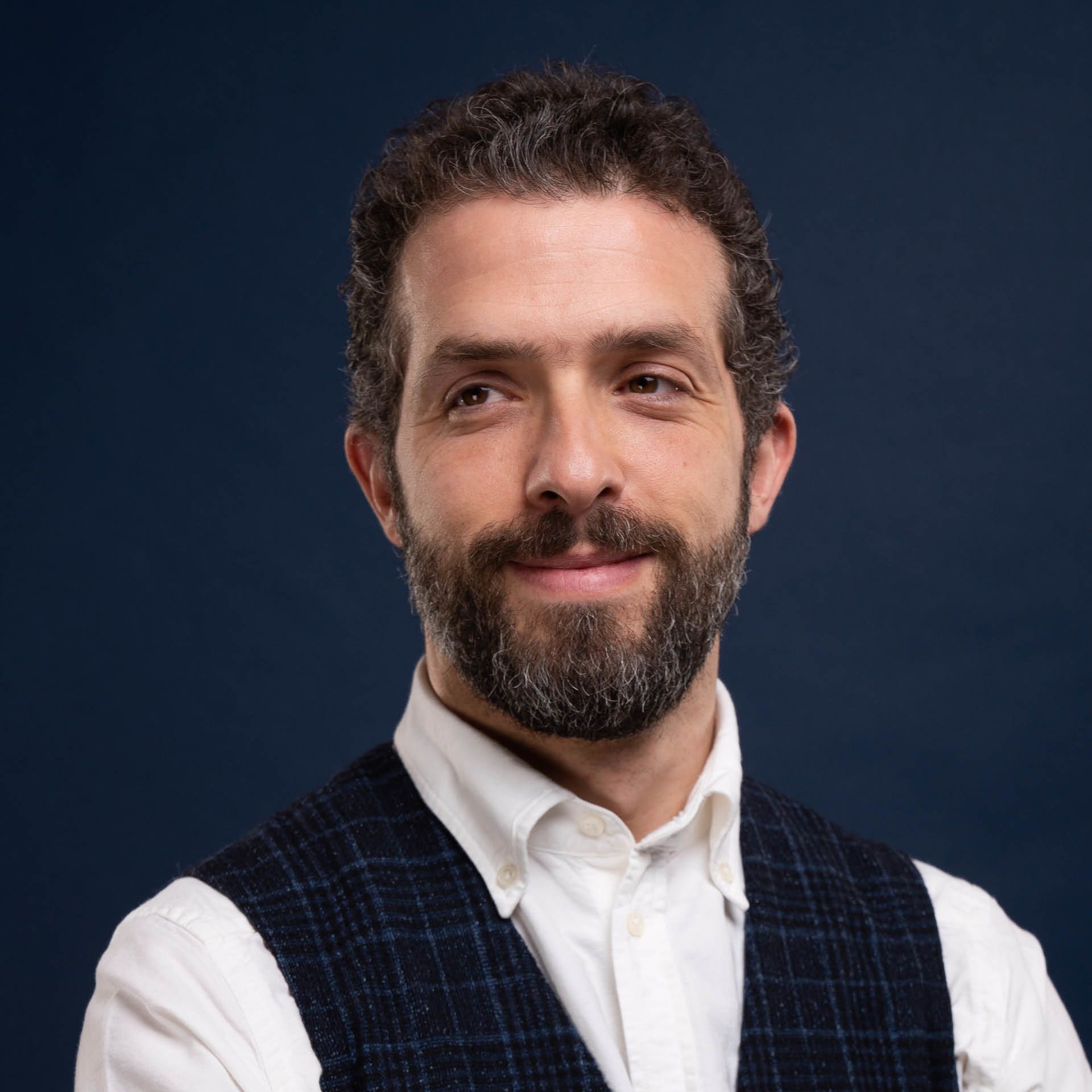
Photo: James Stack
Photo: James Stack
Born in Israel in 1981, Omer Meir Wellber began playing the accordion and piano at the age of 5. He went on to graduate from the Be’er Sheva Conservatory and to study Conducting and Composition at the Jerusalem Music Academy.
He is currently Chief Conductor of the BBC Philharmonic, Music Director of the Teatro Massimo, Palermo, Principal Guest Conductor of the Dresden Semperoper and Music Director of the Raanana Symphonette in Israel. From September this year he will be Music Director at the Vienna Volksoper.
He has worked with ensembles including the Israel and London Philharmonic orchestras, City of Birmingham and Swedish Radio Symphony orchestras, Deutsche Kammerphilharmonie Bremen, Deutsche Symphonie-Orchester Berlin, Leipzig Gewandhausorchester, NDR Elbphilharmonie Orchestra, Staatskapelle Dresden, Stuttgart Radio Symphony Orchestra and Tonhalle Orchestra Zurich.
A strong believer that music is a tool for social change, he champions a number of causes in his native Israel, including directing the Raanana Symphonette Orchestra, which tours music education projects to 70,000 children each year. He is also a Good Will Ambassador for Save a Child’s Heart, an Israeli-based non-profit organisation that provides critical cardiac medical support. In addition, he collaborates with various institutions through outreach programmes, fostering the next generation of conductors through educational lectures.
In 2019 Omer Meir Wellber made his literary debut with Die vier Ohnmachten des Chaim Birkner (‘The Four Times Chaim Birkner Fainted’). He has also co-authored Die Angst, das Risiko und die Liebe: Momente mit Mozart (‘Fear, Risk and Love: Moments with Mozart’), published in Germany in 2017.
Giulia Contaldo piano
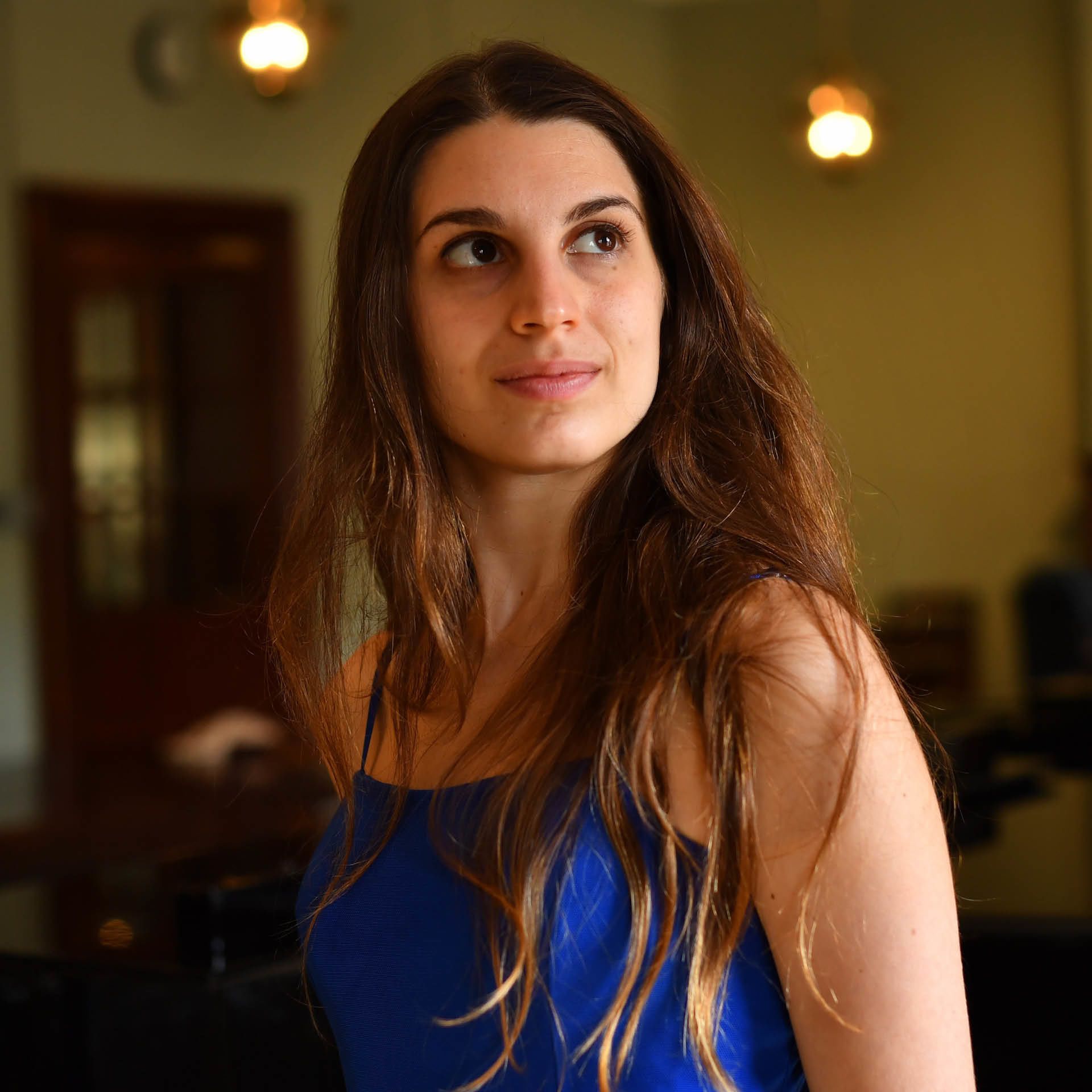
Born in Florence, Italy, Giulia studied piano with Giovanna Prestia at Florence’s Luigi Cherubini Conservatory, graduating with an honourable mention. From 2012 she was a student of Jin Ju at the Imola International Piano Academy and she later graduated in Piano Chamber Music from the University for Music and Performing Arts, Vienna. Since 2019 Giulia has studied with Graham Scott and Dina Parakhina at Manchester’s Royal Northern College of Music on the International Artist Postgraduate Diploma Programme.
She was awarded both the Audience Prize and Third Prize at the 2021 James Mottram International Piano Competition, performing Beethoven’s Fourth Piano Concerto with the Royal Liverpool Philharmonic Orchestra under Joshua Weilerstein. Recent highlights include the Gold Medal Competition and Concerto Competition awards at the RNCM last June, performing with the Manchester Camerata, as well as her Wigmore Hall debut.
She has appeared in competitions, performances and festivals throughout Austria, France, Germany, Italy, Portugal, Switzerland, the USA and the UK, including the Leeds International Piano Competition, Boston University Tanglewood Institute, Moritzburg Festival, Accademia Musicale Chigiana and Spoleto’s Festival dei Due Mondi, among others.
A chamber music advocate, Giulia Contaldo has collaborated with world renowned musicians including violist Bruno Giuranna and cellist Mario Brunello.
She has been kindly supported by the Helen Mackaness Award, Talent Unlimited and the Keyboard Charitable Trust.
BBC Philharmonic
The BBC Philharmonic is reimagining
the orchestral experience for a new generation – challenging perceptions, championing innovation and taking a rich variety of music to the widest range of audiences.
The orchestra usually performs around 100 concerts every year, the vast majority broadcast on BBC Radio 3. Along with around 35 free concerts a year at its MediaCityUK studio in Salford and a series of concerts at Manchester’s Bridgewater Hall, the orchestra performs across the North of England, at the BBC Proms and internationally, and records regularly for the Chandos label.
The BBC Philharmonic’s Chief Conductor is Omer Meir Wellber. Described by The Times’s Richard Morrison as ‘arguably the most inspired musical appointment the BBC has made for years’, Israeli-born Wellber burst into his new role at the 2019 BBC Proms and has quickly built an international reputation as one of the most exciting young conductors working today. The orchestra also has strong ongoing relationships with its Chief Guest Conductor, John Storgårds, and Associate Artist Ludovic Morlot. Last May the orchestra announced young British composer and rising star Tom Coult as its Composer in Association.
The scope of the orchestra’s programme extends far beyond standard repertoire. Over the past few years it has collaborated with artists as varied as Clean Bandit, Jarvis Cocker and The Wombats; played previously unheard music by writer-composer Anthony Burgess in a unique dramatisation of A Clockwork Orange; joined forces with chart-toppers The 1975 at Blackpool’s Tower Ballroom; premiered The Arsonists by composer Alan Edward Williams and poet Ian McMillan, the first opera ever written to be sung entirely in a Northern English dialect; and broadcast on all seven BBC national radio networks, from BBC Radio 1 to BBC Radio 6 Music and the BBC Asian Network. Last year the orchestra also entered the UK Top 40 singles chart with ‘Four Notes: Paul’s Tune’.
The BBC Philharmonic is pioneering new ways for audiences to engage with music and places learning and education at the heart of its mission. Outside of the concert hall, it is passionate about taking music off the page and into the ears, hearts and lives of listeners of all ages and musical backgrounds – whether in award-winning interactive performances, schools’ concerts, Higher Education work with the Royal Northern College of Music or the creation of teacher resources for the BBC’s acclaimed Ten Pieces project. Through all its activities, the BBC Philharmonic is bringing life-changing musical experiences to audiences across Greater Manchester, the North of England, the UK and around the world.
First Violins
Zoe Beyers Leader
Midori Sugiyama Assistant Leader
Austeja Juskaityte
Martin Clark
Julian Gregory
Karen Mainwaring
Catherine Mandelbaum
Anya Muston
Robert Wild
Toby Tramaseur
Mansell Morgan
Sarah White
Alison Williams
Second Violins
Lisa Obert *
Rachel Porteous
Gemma Bass
Lucy Flynn
Sophie Szabo
Christina Knox
Rebecca Mathews
Claire Sledd
Matthew Watson
Charlotte Dowding
Oliver Morris
Hannah Padmore
Violas
Steven Burnard *
Kimi Makino ‡
Bernadette Anguige †
Kathryn Anstey
Matthew Compton
Ruth Montgomery
Rachel Janes
Fiona Dunkley
Amy Hark
Cheryl Law
Michael Dale
Cellos
Peter Dixon *
Maria Zachariadou ‡
Jessica Schaefer
Rebecca Aldersea
Melissa Edwards
Elinor Gow
Miriam Skinner
Marina Vidal Valle
Elise Wild
Double Basses
Ronan Dunne *
Alice Durrant †
Miriam Shaftoe
Mhairi Simpson
Lisa Featherston
Natasha Armstrong
Flutes
Victoria Daniel
Sally Minter
Piccolo
Jennifer Hutchinson
Oboes
Rainer Gibbons §
Kenny Sturgeon
Clarinets
John Bradbury *
Fraser Langton
Bassoons
Roberto Giaccaglia *
Corrine Crowley
Contrabassoon
Bill Anderson
Horns
Ben Hulme *
Rebecca Hill ¥
Phillip Stoker
Tom Kane
Jonathan Barrett
Jacob Bagby
Trumpets
Richard Cowen §
Gary Farr †
Tim Barber
Trombones
Richard Brown *
Christopher Jones
Bass Trombone
Russell Taylor
Tuba
Christopher Evans
Timpani
Paul Turner *
Percussion
Paul Patrick *
Geraint Daniel
Harp
Clifford Lantaff *
Keyboard
Ian Buckle
Accordion
Valerie Barr
* Principal
† Sub Principal
‡ Assistant Principal
§ Guest Principal
¥ Associate Principal
The list of players was correct at the time of publication
Director
Simon Webb
Orchestra Manager
Tom Baxter
Assistant Orchestra Manager
Stefanie Farr/Beth Wells
Orchestra Personnel Manager
Helena Nolan
Orchestra Administrator
Maria Villa
Senior Producer
Mike George
Programme Manager
Stephen Rinker
Assistant Producer
Katherine Jones
Marketing Manager
Amy Shaw
Marketing Executive
Jenny Whitham
Marketing Assistant
Kate Highmore
Manager, Learning and Digital
Jennifer Redmond/Beth Wells
Project Co-ordinator, Learning
Youlanda Daly/Róisín Ní Dhúill
Librarian
Edward Russell
Stage Manager
Thomas Hilton
Transport Manager
Will Southerton
Team Assistant
Diane Asprey
Keep up to date with the
BBC Philharmonic
Listen to our BBC Radio 3 broadcasts via the BBC Sounds app. Visit our website and follow us on Twitter, Facebook and Instagram and sign up to the newsletter
To help us improve our online concert programmes, please take this 5-minute survey
Produced by BBC Proms Publications