
Dvořák 8 with Ryan Bancroft
Thursday 30/11/23, 7.30pm
Aberystwyth Arts Centre
Friday 1/12/23, 7.30pm
Prichard-Jones Hall, Bangor


Hannah Kendall
TheSpark Catchers 10’
AlexanderGlazunov
Violin Concerto 21’
INTERVAL: 20 minutes
Antonín Dvořák
Symphony No. 8 34’
Ryan Bancroftconductor
Benjamin Beilman violin


The concert in Aberystwyth is being recorded by BBC Radio 3 for future broadcast inAfternoon Concert and being filmed by BBC Four for Inside Classical.
Introduction
We’re delighted to welcome onto the podium tonight BBC NOW’s Principal Conductor Ryan Bancroft for a programme ranging from the late 19th century to the present day.
To begin, Hannah Kendall’s tone-poem The Spark Catchers, a piece inspired by a poem by Lemn Sissay and one which packs a striking range of moods into its modest time span.
The Violin Concerto by Alexander Glazunov dates from the early years of the 20th century, but there’s no mistaking its headily Romantic tone. Glazunov’s own instrument was actually the piano, but you’d never know it from this concerto, which explores both the violin’s songfulness and its possibilities for virtuoso display. Tonight we welcome as soloist Benjamin Beilman, who is making his debut with BBC NOW.
The concert ends with one of Dvořák’s best-loved works: his Eighth Symphony. This is a work that exploits the composer’s natural melodiousness, its pervasive mood one of irrepressible joy.
Enjoy!
Please respect your fellow audience members and those listening at home. Turn off all mobile phones and electronic devices during the performance. Photography and recording are not permitted.
Hannah Kendall (born 1984)
The Spark Catchers(2017)

Lemn Sissay’s highly evocative poem The Spark Catchers is the inspiration behind this work. I was drawn to its wonderful dynamism, vibrancy and drive. I also liked the fact that Sissay was commissioned to write the poem for the London 2012 Olympics and that it is permanently etched into one of the electrical transformer points at the Olympic Park, a place where the whole world gathered to support and celebrate exceptional talent. Specific words and phrases from the text have established the structure of the work and informed the contrasting musical characteristics created within the piece’s main components.
The opening ‘Sparks and Strikes’ section immediately creates vigour and liveliness, with the piccolo and violins setting up a swelling rhythmic drive, interjected by strong strikes from the rest of the ensemble. This momentum continues into ‘The Molten Madness’, maintaining the initial kinetic energy, while also producing a darker and brooding atmosphere introduced in the bass lines. A broad and soaring melodic line in the horns and first violins overlays the material, moving into a majestic episode led by the full string section, accentuated by valiant calls in the woodwind, brass and percussion and culminating in a sudden pause. A lighter variation of the opening rhythmic material in the clarinets, harp and strings follows, creating a feeling of suspense. The texture builds up through a jazzy figure led by the brass, leading to powerful and surging interplay between the flutes, oboes and violins.
The lighter, clearer and crystalline ‘Beneath the Stars/In the Silver Sheen’ section follows. Quiet and still, it is distinguished by its gleaming delicacy through long interweaving lines, high pitch range and thin textures. An illuminating strike, underpinned by the glockenspiel and harp, signifies the climax of this section. Subsequently, the opening zest comes back again through dance-like material which culminates in ‘The Matchgirls’ March’ with its forceful and punchy chords. The Spark Catchers ends with a coda-like section, which carries over the power of the ‘March’ while also incorporating variations on musical motifs from ‘Sparks and Strikes’ and ‘The Molten Madness’, finally concluding on a sparkling flourish.
Programme note © Hannah Kendall
Alexander Glazunov (1865–1936)
Violin Concerto in A minor, Op. 82 (1904–5)
Moderato – Tranquillo – Tempo 1 – Cadenza – Allegro
Benjamin Beilman violin
Today, Alexander Glazunov isn’t generally considered one of the stellar names in Russian musical history. The symphonies and string quartets that form the core of his output are rarely heard, but the appealingly Tchaikovskian dances from his ballets The Seasons and Raymonda hold their place in the repertoire, and one big work has just about maintained its place in the concert hall: the Violin Concerto. One of the reasons this concerto remains popular is that it’s beautifully written for the violin: challenging certainly (occasionally ferociously so), but never written ‘against’ the instrument. This is the product of a man who understood the soul of the violin as well as its technical capabilities – all the more remarkable given that it wasn’t Glazunov’s first instrument. Composers of violin concertos have often consulted their intended soloists when they came to the cadenza, traditionally the most brilliant and exacting part of the work; but apparently Glazunov wrote it all himself, including those passages where the violin accompanies its own singing melodic lines – hard enough to play accurately, let alone expressively.
Glazunov composed the Violin Concerto in 1904–5 for the outstanding Hungarian virtuoso Leopold Auer, who was so impressed by it that he encouraged his 14-year-old pupil Mischa Elman to take it up. It was Elman’s playing of the concerto that established its reputation outside Russia. At his best, Glazunov had a gift for creating soulful, long-breathed melodies, and this piece has those in abundance. Its characteristic Russian rhapsodic expansiveness may have been influenced by the idyllic circumstances in which it was completed, amid the vast forests and lakes to the east of Glazunov’s native St Petersburg. But Glazunov preferred not to talk about inspiration, preferring to let the music speak for itself, which in this case it does beautifully and compellingly.
The form of the concerto is highly original: two halves of what seems to be a fairly traditional Moderato first movement frame a slower, more reflective Tranquillo section, in which the violin is joined by a bardic harp. After the return and reworking of the opening material (Tempo 1), the solo cadenza emerges seamlessly, finally gathering momentum and flowing on into the Allegro, led by a flavoursome dancing theme on two trumpets. But there’s no need to listen out for formal signposts. Glazunov’s Violin Concerto is probably best enjoyed as a single sustained outpouring of lyricism and brilliance, with the latter emphatically winning out in the dazzling final moments.
Programme note © Stephen Johnson
INTERVAL: 20 minutes
Antonín Dvořák (1841–1904)
Symphony No. 8 in G major, Op. 88 (1889)

1 Allegro con brio
2 Adagio
3 Allegretto grazioso
4 Allegro ma non troppo
Many composers struggle to find ideas; Dvořák’s problem was that he often had too many. ‘If only one could write them down straight away!’ he wrote to a friend. ‘Melodies simply pour out of me.’ This was in August 1889, when Dvořák was just finishing his gorgeous Piano Quartet, Op. 87. A week later he was jotting down ideas for a new symphony, the one we now know as ‘No. 8’, and less than a month later the piano score was complete.
Why was this a problem? Well, when it came to writing symphonies, the model established by Beethoven and Brahms dominated the scene in the late 19th century. Here, development of ideas was at least as important as the themes themselves: just think of how much musical mileage Beethoven extracts from the famous da-da-da-DA motif in his Fifth Symphony. In Dvořák’s own Seventh (1885), he had shown that he could knuckle down and, in Brahms’s words, ‘make a penny do the work of a shilling’. But, having achieved that – as another friend reported – he set out in No. 8 to create ‘a work different from his other symphonies, with individual thoughts worked out in a new way’. Not only is there a remarkable profusion of ideas in the Eighth Symphony’s first movement, they are all strongly flavoured and instantly memorable; there is development, but it’s the themes in their own right that charm us and thrill us when they return. Above all, the Eighth Symphony is the expression of joyous, overflowing heart. In an age when tragic or heroic symphonies represented a challenging ideal, Dvořák had done something else – created a symphony that really is profoundly happy.
That might not be quite the first impression: at the start cellos lead off with a solemn, chant-like theme in the minor key, but this is soon dispelled by a cheery birdcall on flute, and a crescendo builds to a resolutely major-key hymn theme on violas and cellos, which in turn yields to pure dancing joy. In essence this is the emotional template for the whole symphony. There may be passing shadows, but warmth and light invariably prevail.
The second movement echoes ‘In the Old Castle’, the third of Dvořák’s piano cycle Poetic Tone Pictures, Op. 85, composed that same year. You can imagine the visitor taking in the moods of the ancient fortress: grave one moment, sunlit the next, with fanfares suggesting memories of past strife recalled in happier, safer times.
Then comes the gorgeous Allegretto grazioso, half languid waltz, half sweetly melancholic folk dance, with a delightful surprise burst of rapid major-key dancing at the end.
Finally, an arresting trumpet fanfare introduces a hymn-like tune led by cellos, but this mock-seriousness is soon deflated by what follows. The end is pure, unbridled high spirits. Dvořák could certainly do tragedy, but it’s hard to find even a hint of it here.
Programme note © Stephen Johnson
Help Us Improve Our Online Programmes.
Please take this 5-minute survey and let us know what you think of these notes.
Programme Survey
You may also like:
Playing Picasso
LIVESTREAM
Friday 8/12/23, 7.30pm
BBC Hoddinott Hall, Cardiff
Stravinsky Pulcinella
Satie Parade
Stravinsky Ragtime
Falla The Three-Cornered Hat – Suite No. 2
Ryan Bancroftconductor
Katharine Dain soprano
Jorge Navarro Colorado tenor
Michel de Souzabaritone
COLOURFUL | IMPASSIONED | ENLIGHTENING
Pablo Picasso is one of the most influential artists of the 20th century, famed, not least, for co-founding the Cubist movement; surprisingly less known is his close involvement in the costume designs for many ground-breaking ballets. His creative union with ballet impresario Serge Diaghilev was one of the most potent collaborations of the 20th century, not only altering the nature of ballet, but for Picasso opening up a whole new world of artistic exploration.
Fifty years after Picasso’s death we celebrate his legacy in a concert of music from the ballets he designed. These range from Stravinsky’s Pulcinella, in which traditional stories are ‘entirely transformed into striking modernist masterpieces, reimagining the ballet as a site for clashing avant-garde styles, shapes and forms’ through Picasso’s sets and costume designs, to Satie’s angular, confrontational and avant-garde Parade and Falla’s Three-Cornered Hat, telling a Spanish love story set within the Andalusian mountains.
Jurassic Park in Concert
LIVESTREAM
Wednesday 13/12/23, 7.30pm
Utilita Arena Cardiff
Thursday 14/12/23, 7.30pm
Brangwyn Hall, Swansea
Benjamin Popeconductor
MULTIGENERATIONAL | NOSTALGIC | THRILLING
Who can forget the earth-quaking, thunderous plod of a T rex, or the terrifying sounds of a velociraptor? Join BBC NOW this December for Jurassic Park live in concert.
Follow the story of Dr Alan Grant and Ellie Sattler as they battle for survival on Isla Nublar when the theme park’s newly revived dinosaurs escape their enclosures and seek to rule the earth once more. Featuring stunning visual imagery and ground-breaking special effects, this action-packed adventure may not be your typical Christmas concert, but with BBC National Orchestra of Wales performing John Williams’s epic score live to film, it is a more than fitting way to celebrate the 30th anniversary of the iconic film!
Stardust and Souls
LIVESTREAM
Thursday 18/4/24, 7.30pm
BBC Hoddinott Hall, Cardiff
Alexander Campkin Sounds of Stardust world premiere
Dani Howard New Work : Percussion Concerto world premiere
Poulenc Stabat mater
Sofi Jeannin conductor
Dame Evelyn Glennie percussion
Julieth Lozano soprano
BBC National Chorus of Wales
ETHEREAL | ATMOSPHERIC | MYSTERIOUS
To conduct a concert featuring two world premieres and a gem of the choral repertoire, we’re delighted to welcome back the inimitable Sofi Jeannin alongside the BBC National Orchestra and Chorus of Wales, Dame Evelyn Glennie and BBC Cardiff Singer of the World Audience Prize winner Julieth Lozano Rolong for an evening of musical exploration and discovery.
First a world premiere from Alexander Campkin: his Sounds of Stardust. Dame Evelyn Glennie, percussionist extraordinaire, takes to the stage for the world premiere of Dani Howard’s new percussion concerto, before we celebrate Poulenc’s sacred vocal masterpiece. The Stabat mater was written in response to the death of his close friend, the artist Christian Bérard, and it embraces both light and dark – a true representation of the composer’s devout Catholicism, yet witty and effervescent personality.
Biographies
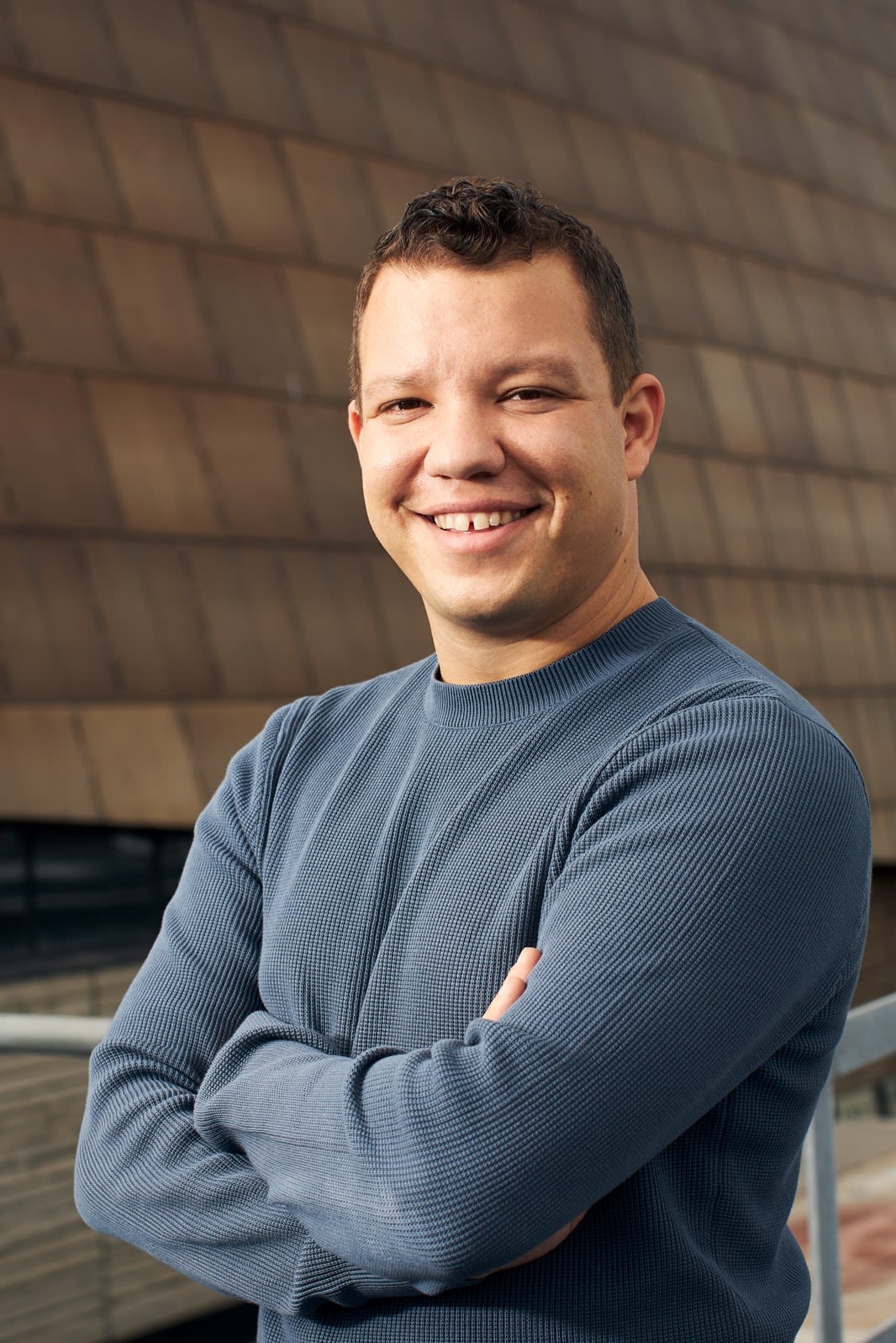
Ryan Bancroftconductor

Benjamin Ealovega
Benjamin Ealovega
Ryan Bancroft grew up in Los Angeles and first came to international attention in April 2018, when he won both First Prize and Audience Prize at the prestigious Malko Competition for Young Conductors in Copenhagen. Since September 2021 he has been Principal Conductor of BBC National Orchestra of Wales. Following his first visit to work with the Tapiola Sinfonietta, he was invited to become its Artist-in-Association from the 2021/22 season. In September he became Chief Conductor of the Royal Stockholm Philharmonic Orchestra.
His new role as Chief Conductor in Stockholm saw him open the season with the orchestra’s first performance of Sven-David Sandström’s The High Mass and highlights include premieres of pieces by Daniel Börtz and Anders Hillborg, and concerts with Emanuel Ax and Seong-Jin Cho.
This summer he made his Hollywood Bowl debut with the Los Angeles Philharmonic; this season he also makes debuts with the Cleveland Orchestra, San Francisco and Cincinnati Symphony orchestras, NDR Elbphilharmonie Orchestra, Orquesta Sinfónica Castilla y León and Netherlands Radio Philharmonic Orchestra, as well as returning to the Toronto Symphony Orchestra and Philharmonia Orchestra.
He has a passion for contemporary music and has performed with Amsterdam’s Nieuw Ensemble, assisted Pierre Boulez in a performance of his Sur incises in Los Angeles, premiered works by Sofia Gubaidulina, John Cage, James Tenney and Anne LeBaron, and has worked closely with improvisers such as Wadada Leo Smith and Charlie Haden.
He studied at the California Institute of the Arts, Royal Conservatoire of Scotland and in the Netherlands.
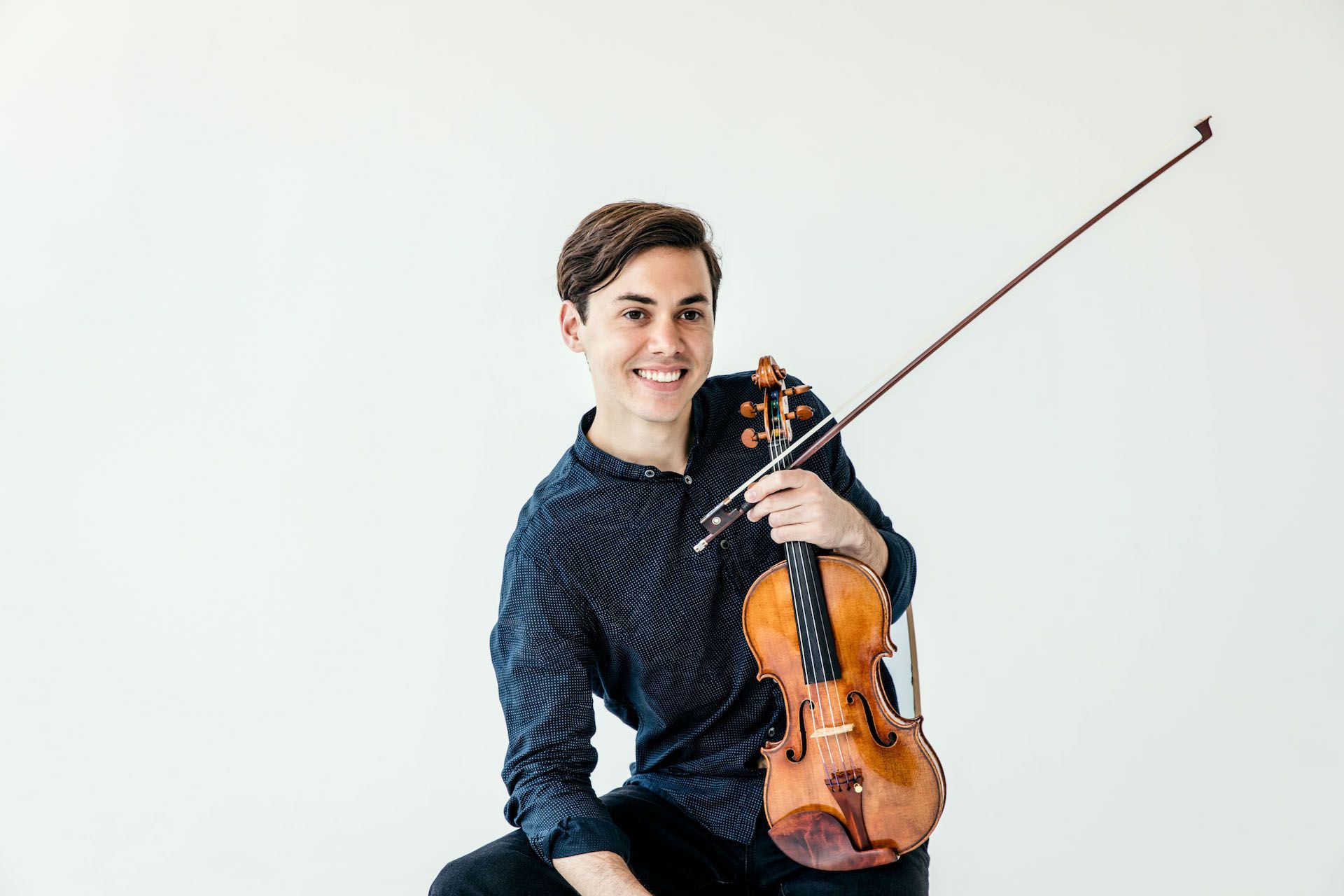
Benjamin Beilmanviolin

Sunhao Zhou
Sunhao Zhou
American Benjamin Beilman is one of the leading violinists of his generation.
In the US this season’s highlights include his debut with the St Louis Symphony Orchestra under Cristian Măcelaru and returns to the Minnesota Orchestra with Elim Chan, the Oregon Symphony Orchestra with David Danzmayr and the Pacific Symphony Orchestra, which he will play-direct. He also gives concerts with the SWR Symphonieorchester Stuttgart alongside Chan, the Deutsche Radio Philharmonie Saarbrücken, London Chamber Orchestra, Estonian National Symphony Orchestra and Opéra Orchestre National Montpellier Occitanie. He appears at the Grafenegg Festival, St Pölten Festspielhaus and Vienna Musikverein.
He has a particular passion for contemporary music, and composers such as Frederic Rzewski and Gabriella Smith have written pieces for him. He has also given multiple performances of Jennifer Higdon’s Violin Concerto, has premiered Chris Rogerson’s Violin Concerto No. 1 and recorded Thomas Larcher’s concerto.
As a recitalist and chamber musician he performs regularly at major halls across the world, including Carnegie Hall, Lincoln Center, Amsterdam Concertgebouw, Cologne Philharmonie, Berlin Philharmonie, Wigmore Hall, Louvre and Tokyo Bunka Kaikan; festival appearances include Verbier, Aix-en-Provence Easter, Robeco Summer Concerts (Amsterdam), Music@Menlo, Marlboro and Seattle Chamber Music. He also continues to perform with the Chamber Music Society of Lincoln Center.
Benjamin Beilman studied at the Curtis Institute of Music with Ida Kavafian and Pamela Frank, and at the Kronberg Academy with Christian Tetzlaff; his many prestigious accolades include a Borletti–Buitoni Trust Fellowship, an Avery Fisher Career Grant and a London Music Masters Award.
He performs with the ex-Balaković F. X. Tourte bow (c1820) and plays the ‘Ysaÿe’ Guarneri del Gesù from 1740, generously on loan from the Nippon Music Foundation.
BBC National Orchestra of Wales
For over 90 years, BBC National Orchestra of Wales has played an integral part in the cultural landscape of Wales, occupying a distinctive role as both broadcast and national symphony orchestra. Part of BBC Wales and supported by the Arts Council of Wales, it has a busy schedule of live concerts throughout Wales, the rest of the UK and the world.
The orchestra is an ambassador of Welsh music and champions contemporary composers and musicians; its concerts can be heard regularly across the BBC – on Radio 3, Radio Wales and Radio Cymru.
BBC NOW works closely with schools and music organisations throughout Wales and regularly undertakes workshops, side-by-side performances and young composer initiatives to inspire and encourage the next generation of performers, composers and arts leaders.
The orchestra is based at BBC Hoddinott Hall in Cardiff Bay, where its purpose-built studio not only provides the perfect concert space, but also acts as a broadcast centre from where its live-streamed concerts and pre-recorded content are presented as part of its popular Digital Concert Series.
For further information please visit the BBC National Orchestra and Chorus of Wales's website: bbc.co.uk/now
Patron
HM King Charles III KG KT PC GCB
Principal Conductor
Ryan Bancroft
Conductor Laureate
Tadaaki Otaka CBE
Composer-in-Association
Gavin Higgins
Composer Affiliate
Sarah Lianne Lewis
First Violins
Lesley Hatfield leader
Nick Whiting associate leader
Martin Gwilym-Jones sub-leader
Shana Douglas
Terry Porteus
Suzanne Casey
Carmel Barber
Laura Embrey
Anna Cleworth
Juan Gonzalez
Ruth Heney
Emilie Godden
SecondViolins
Anna Smith *
Ros Butler
Sheila Smith
Vickie Ringguth
Joseph Williams
Michael Topping
Katherine Miller
Beverley Wescott
Roussanka Karatchivieva
Lydia Caines
Ilze Abola
Violas
Francis Kefford ‡
Alex Thorndike #
Tetsuumi Nagata
Peter Taylor
Catherine Palmer
Lowri Thomas
Robert Gibbons
Jim Drummond
Cellos
Alice Neary *
Raphael Lang
Sandy Bartai
Rachel Ford
Alistair Howes
Carolyn Hewitt
Double Basses
David Stark *
Fabian Galeana
Christopher Wescott
Richard Gibbons
Flutes
Matthew Featherstone *
John Hall †
Lindsey Ellis
Piccolo
Lindsey Ellis †
Oboes
Steve Hudson *
Amy McKean †
Clarinets
Nick Carpenter ‡
Lenny Sayers
Bass Clarinet
Lenny Sayers †
Bassoons
Jarosław Augustiniak *
David Buckland
Horns
Tim Thorpe *
Meilyr Hughes
Neil Shewan †
Flora Bain
John Davy
Trumpets
Philippe Schartz *
Robert Samuel
Trombones
Donal Bannister *
Sakari Mäkimattila
Bass Trombone
Darren Smith †
Tuba
Daniel Trodden †
Timpani
Matt Hardy
Percussion
Phil Hughes *
Harry Lovell-Jones
Owen Williams
Harp
Valerie Aldrich-Smith †
* Section Principal
† Principal
‡ Guest Principal
# Assistant String Principal
The list of players was correct at the time of publication
Director Lisa Tregale
Orchestra Manager Vicky James
Assistant Orchestra Manager Nick Olsen
Orchestra Coordinator, Operations Kevin Myers
Business Coordinator Caryl Evans
Orchestra Administrator Eleanor Hall
Head of Artistic Production Matthew Wood
Artists and Projects Manager Eleanor Phillips
Orchestra Librarian Katie Axelsen (paternity cover)
Producer Mike Sims
Broadcast Assistant Kate Marsden
Head of Marketing and Audiences Sassy Hicks
Marketing Coordinator Amy Campbell +
Digital Producer Yusef Bastawy
Social Media Coordinator Harriet Baugh
Education Producers Beatrice Carey, Rhonwen Jones **
Audio Supervisors Simon Smith, Andrew Smillie
Production Business Manager Lisa Blofeld
Stage and Technical Manager Steven Brown +
Assistant Stage and Technical Manager Josh Mead
BBC Wales Apprentices Analese Thomas-Strachan, Jordan Woodley
+ Green Team member
** Diversity & Inclusion Forum


