
Horns & Horizons
Thursday 13/11/25, 7.30pm
Aberystwyth Arts Centre
Friday 14/11/25, 7.30pm
Prichard-Jones Hall, Bangor


Ida Moberg
Sunrise Suite 21’
Huw Watkins
Horn Concerto 20’
INTERVAL: 20 minutes
Wolfgang Amadeus Mozart
Horn Concerto No. 4 in E flat major 16’
Jean Sibelius
Symphony No. 5 in E flat major 30’
Ryan Bancroft conductor
Ben Goldscheider horn


The concert in Aberystwyth is being recorded by BBC Radio 3 for future broadcast in Classical Live; the concert in Bangor is being recorded for future broadcast in In Concert. They will be available for 30 days after broadcast via BBC Sounds, where you can also find podcasts and music mixes.
Introduction
Welcome to tonight’s concert, for which we’re delighted to welcome back Principal Conductor Ryan Bancroft for a programme celebrating Finland and the French horn.
Playing not one but two horn concertos is Ben Goldscheider, still in his twenties but already a superstar in the musical firmament. Huw Watkins wrote his concerto especially for him, inspired by both the virtuosity and the lyricism of his playing. Mozart’s beloved Fourth Horn Concerto has long been a favourite among musicians and audiences alike.
Sibelius’s Fifth Symphony has enjoyed a similar popularity and it bears no trace of the composer’s struggles when writing it. Within it, Sibelius delights in the beauty and epic qualities of the natural world around him. We begin in Finland, too, with the highly evocative Sunrise Suite by Ida Moberg, a figure who deserves to be far better known and who herself studied with Sibelius.
Enjoy!
Lisa Tregale
Director
Please respect your fellow audience members and those listening at home: mobile phones may be kept on but on silent and with the brightness turned down; other electronic devices should be switched off during the performance. Photography and recording are not permitted.
Ida Moberg (1859–1947)
Sunrise Suite(1908)

1 Sunrise
2 Preludium – Activity
3 Evening
4 Silence – Lullaby
Those lucky enough to gain entry to the Helsinki Music Institute in the 1910s would have been luckier still to find themselves in Ida Moberg’s class. Fresh from Dresden and the tutelage of Émile Jaques-Dalcroze – pioneer of the ‘eurhythmics’ method of music education – Moberg was introducing a new generation of Finnish musicians to potent new ideas that would influence and inspire them.
Moberg, sometimes referred to as Finland’s ‘first female symphonist’, was a brave, innovative and determined woman. Born in Helsinki, she studied piano and singing at the St Petersburg Conservatory before switching to composition after sustaining a vocal injury. After four years she returned to Helsinki where her teachers included Jean Sibelius, six years her junior.
Moberg had long been interested in the idea of music born of physical movement. That lay behind her move to Dresden in the 1910s where Jaques-Dalcroze was espousing his philosophy of imagining the human body as a well-tuned musical instrument. Moberg was also interested in theosophy – the idea of art as a portal to a transcendent spiritual realm – and fell under the aesthetic spell of the musical Symbolists and Impressionists, known for headily atmospheric orchestral pieces. For Moberg, every orchestral work – even her violin concerto – was categorised as a tone-poem.
If that assemblage of ‘isms’ and philosophies sounds baffling, Moberg’s suite titled in Swedish Soluppgång (‘Sunrise’) neatly outlines their effect on her music while also helping to explain that music’s effectiveness.
The work is ostensibly a description of a day in four movements: sunrise, activity, evening and stillness (the last of these uses a lullaby originally composed by Moberg for her opera on the life of Buddha, Asiens Ljus). In so doing, it also traces a spiritual awakening and perhaps the arc of a life, carrying a sure feeling of bodily movement right from the quivering undulations of its opening movement.
That movement, the ‘Sunrise’ of the title, unfurls itself into motion – perhaps a body stirring and waking; perhaps the sun breaking over the horizon. The sweeping radiance established here carries over into the rest of the piece. Moberg herself conducted the first performance of the work in Vyborg in 1908.
Programme note © Andrew Mellor
Huw Watkins (born 1976)
Horn Concerto (2023)
1 Allegro molto
2 Lento
3 Allegro
Ben Goldscheiderhorn
I first met Ben in 2020, when he was playing my fiendishly difficult Horn Trio with two friends. He asked if I’d write him a new piece: a lament, for horn and piano, which we recorded that summer. I was struck not only by his effortless virtuosity, but by the beauty and lyricism of his sound; so when the opportunity to write him a concerto arose, I jumped at the chance.
In the first movement, an athletic horn, full of octave leaps and extrovert activity, is urged on by a bustling, fast-moving orchestra. The second movement is much more reflective, the horn’s aching song introduced by a consoling oboe. The last movement begins quietly, with a sprightly clarinet setting up a lively dance in triple time. The horn enters, softly at first, but soon encouraging the whole orchestra to join in a riotous celebration.
Programme note © Huw Watkins
INTERVAL: 20 minutes
Wolfgang Amadeus Mozart (1756–91)
Horn Concerto No. 4 in E flat major, K495 (1786)
1 Allegro maestoso
2 Romance: Andante cantabile
3 Rondo: Allegro vivace
Ben Goldscheiderhorn
Mozart’s Horn Concerto No. 4 is one of the best-loved works in the solo horn repertoire, standing as a cornerstone among Classical wind concertos. It was composed in 1786 for Joseph Leutgeb, a virtuoso Viennese horn player and long-time friend of the Mozart family.
The year 1786 marked a creative high point for Mozart. At 30, he was enjoying the most stable period of his career in Vienna, in demand as a freelance composer and performer and rapidly gaining prominence at the court of the Austrian Emperor, Joseph II. Alongside this concerto, Mozart completed The Marriage of Figaro, three piano concertos (Nos. 23–25), the ‘Prague’Symphony and a wealth of chamber works.
By this time, Mozart had already composed two horn concertos for Leutgeb (Nos. 2 and 3). The fourth is the most celebrated of the set and was subtitled ‘A hunting horn concerto for Leutgeb’. It showcases the expressive range and technical brilliance of the natural horn – an instrument that lacked modern valves and relied on the player’s skill in hand-stopping to navigate chromatic passages.
The relationship between composer and soloist was both affectionate and mischievous, as is clear to see from the original manuscript, which is filled with jokes and quips in four different coloured inks. Littered throughout the score there are misleading instructions for the player, and teasing remarks such as ‘ox’, ‘fool’ and ‘that ass of a Leutgeb’.
The opening movement is a charming Allegro maestoso in E flat major, brimming with graceful melodies, wide registral leaps and technically demanding passagework. The slow second movement, a tender Romance, invites the soloist to explore the horn’s capacity for lyricism, with soaring melodic arches and a focus on beauty of tone. Finally, a lively Rondo brings the work to a joyful close in a playful musical chase, a lighthearted and witty movement which pays homage to the horn’s origins in the hunt.
Programme note © Branwen Thistlewood
Jean Sibelius (1865–1957)
Symphony No. 5 in E flat major, Op. 82(1914–15, rev. 1916, 1919)
1 Tempo molto moderato – Allegro moderato
2 Andante mosso, quasi allegretto
3 Allegro molto
Finnish composer Jean Sibelius was notoriously self-critical. He flipped from confidence one day to despair the next, and often revised his compositions extensively. Even by Sibelius’s standards, though, his work on the Fifth Symphony was extreme. He began writing it in 1914 but the piece was revised not once but twice. This was a time of tumultuous change for Sibelius, and the uncertainty of these years is reflected in the work’s extended compositional process.
Sibelius turned 50 in 1915 and he conducted the premiere of the symphony’s first version on his birthday. He was anxious about ageing, and his diary is littered with entries reflecting on how getting older might affect his creativity and his personal relationships. External circumstances were also a continuous source of concern. His Fourth Symphony had been coolly received, so Sibelius worried about his position as an international composer. The First World War cut him off from his European friends and colleagues, and then came the Finnish Civil War in 1918. The country had been a Russian Grand Duchy up until 1917, when it gained independence, prompting an internal power struggle that devastated the country, impacting hugely on Sibelius and his family.
No wonder that finishing a symphony in the midst of all this felt daunting. In its final form the Fifth Symphony is one of Sibelius’s most ambiguous and intriguing works. On some levels it is unrepentantly joyful. When faced with crisis, Sibelius turned to nature. The opening movement conjures a feeling of spring, and he based the swooping theme of the last movement on the sound of 16 swans that he saw flying overhead in April 1914. ‘Lord God, what beauty!’, he wrote: ‘The Fifth Symphony’s finale theme’. Sibelius directly connected the sight and sound of swans with the theme which he gives to the horns, capturing something of the birds’ movement in flight.
And yet this is only one aspect of the work. The dissonances that dominated the first version of the symphony linger into the final version, creeping into the first movement and creating threatening shadows that are never completely swept away.
The middle movement (Andante mosso) is a moment of pause, but it isn’t really a slow movement. It keeps up momentum, pushing on towards the symphony’s finale. When the end eventually does come, it is with six final chords punctuated by tense, cavernous shafts of silence. Sibelius gives us no easy answers in this symphony – perhaps that is one of the many reasons why it proves so enduringly popular today, over a century after it was first heard.
Programme note © Leah Broad
Help Us Improve Our Online Programmes.
Please take this 5-minute survey and let us know what you think of these notes.
Programme Survey
You may also like:
If you’ve enjoyed the concert today, bring friends and family and come along to this forthcoming concert. As an existing audience member, you can buy tickets for it for £7 using promotion code NOWYOU when buying online.
‘Grace’
Thursday 20/11/25, 7.30pm
BBC Hoddinott Hall, Cardiff
Grace Williams Ballads for Orchestra
Elizabeth Maconchy Serenata concertante
Anna Semple The Gates
Julia Wolfe Pretty
Stephanie Childressconductor
Geneva Lewis violin
INNOVATIVE | FRESH | PICTORIC
In our annual ‘Grace’ series exploring both the music of Grace Williams and modern women in music, this November we showcase works by living composers Anna Semple and Julia Wolfe, under the baton of Stephanie Childress.
Anna Semple’s The Gates was written for the Malcolm Street Orchestra and plays with the ideas of recall and memory, specifically the musical illustration of an image of a set of gates seen up close, then reimagined from afar but not remembered exactly. Julia Wolfe’s Pretty is inspired by the distortions and reverberations of rock and roll and is a raucous celebration of the connotations of what being ‘pretty’ means.
In a change to the previously advertised repertoire, BBC NOW will perform Elizabeth Maconchy’s Serenata concertante, with its contrast between lyrical, slower movements and more rhythmic, vigorous ones.
But first we turn to the series’ namesake, Grace Williams and her Ballads for Orchestra.
Book tickets for just £7 using promotion code NOWYOU https://www.bbc.co.uk/events/evr6gw
Biographies
Ryan Bancroft conductor

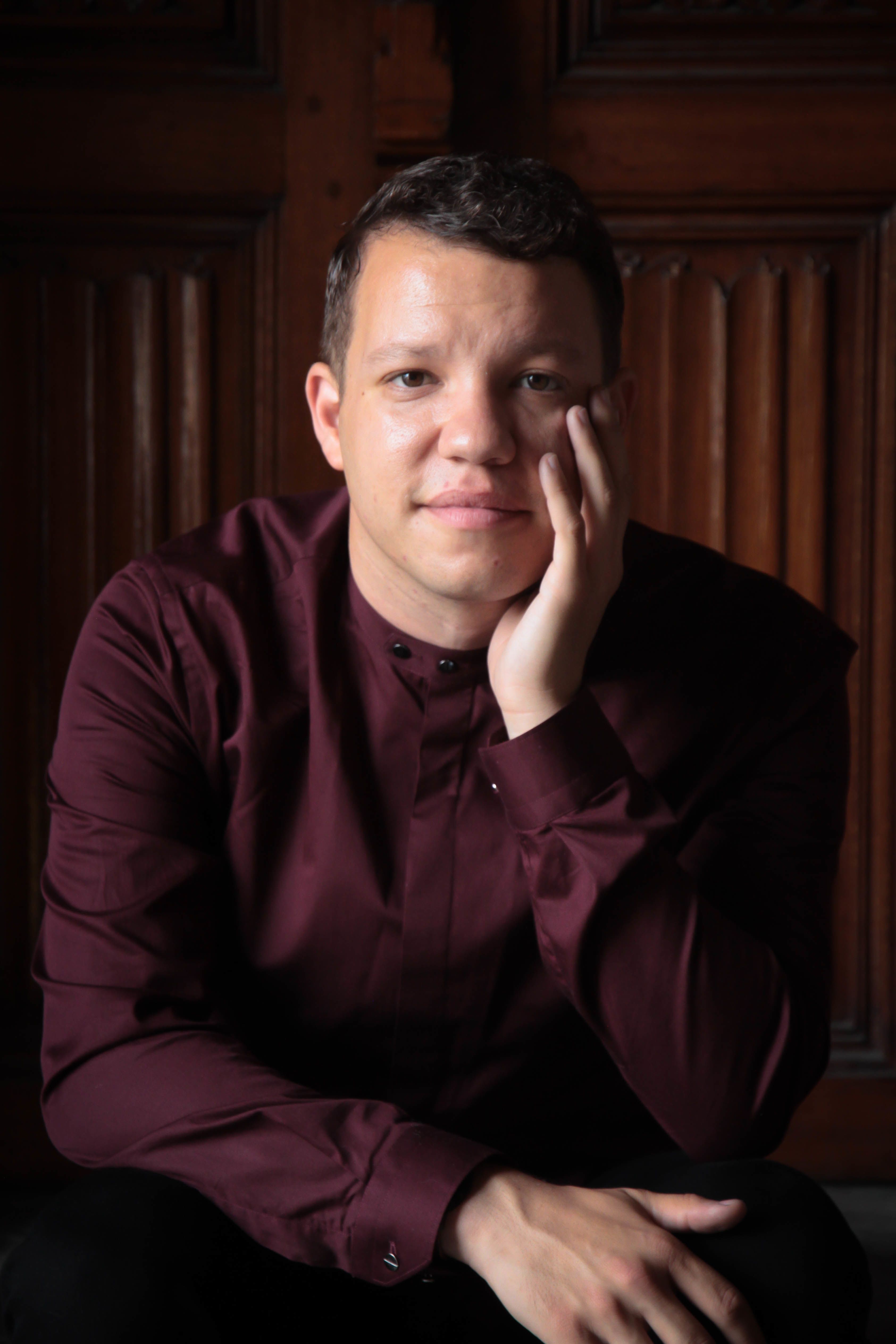
Ryan Bancroft grew up in Los Angeles and first came to international attention in 2018, when he won both First Prize and Audience Prize at the Malko Competition for Young Conductors in Copenhagen. Since September 2021 he has been Principal Conductor of BBC National Orchestra of Wales. He is also Artist-in-Association with the Tapiola Sinfonietta and, since September 2023, has been Chief Conductor of the Royal Stockholm Philharmonic Orchestra.
After beginning his tenure as Chief Conductor in Stockholm with the orchestra’s first performance of Sven-David Sandström’s The High Mass, his second season included performances of Mahler and Bruckner symphonies, alongside world premieres by Chrichan Larson and Zacharias Wolfe, and collaborations with renowned soloists including Leif Ove Andsnes, Maxim Vengerov and Víkingur Ólafsson.
This season he has made debuts with the Boston and Finnish Radio Symphony orchestras, Deutsches Symphonie-Orchester Berlin at the Berlin Philharmonie and the WDR Symphonieorchester in Cologne.
Ryan Bancroft has a passion for contemporary music and has performed with Amsterdam’s Nieuw Ensemble, assisted Pierre Boulez in a performance of his Sur incises in Los Angeles, premiered works by Sofia Gubaidulina, John Cage, James Tenney and Anne LeBaron, and has worked with improvisers such as Wadada Leo Smith and Charlie Haden. He studied at the California Institute of the Arts, Royal Conservatoire of Scotland and in the Netherlands.
Ben Goldscheiderhorn

Kaupo Kikkas
Kaupo Kikkas
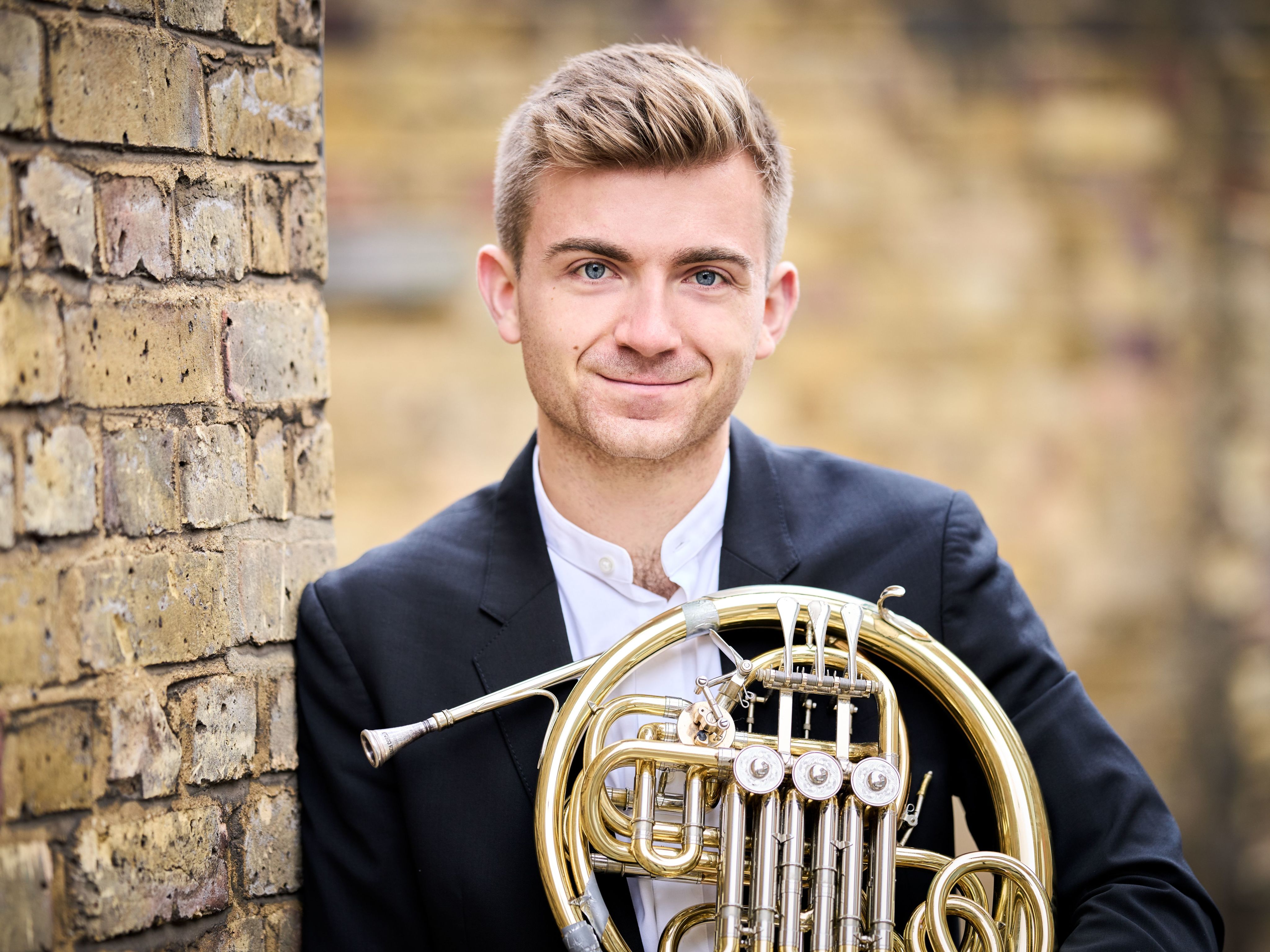
Ben Goldscheider has premiered over 50 new works for horn, spanning concertos, solo, chamber and cross-genre projects, including those incorporating live electronics and lighting.
This season he gives the world premieres of Sirens by Anna Clyne with the London Mozart Players and Laurence Osborn’s Horn Concerto with Manchester Camerata. He also makes his debut with Magdeburg Philharmonic and Christian Øland performing Gavin Higgins’s Horn Concerto.
Recent highlights include the world premiere of Brian Elias’s Horn Concerto with the BBC Symphony Orchestra at the Aldeburgh Festival, the Irish premiere of Higgins’s concerto with the Ulster Orchestra and performances with the Tokyo Philharmonic Orchestra and Aichi Chamber Orchestra.
He has given recitals at major concert halls across Europe, including the Amsterdam Concertgebouw, Hamburg Elbphilharmonie, Cologne Philharmonie, Vienna Musikverein, Berlin’s Pierre Boulez Saal, Southbank Centre, and Wigmore Hall.
He is also a committed chamber musician and has collaborated with leading artists, including Daniel Barenboim, Martha Argerich, Sergei Babayan, Kirill Gerstein, Denis Kozhukhin, Sunwook Kim, Clara Jumi-Kang and Allan Clayton, at festivals such as Verbier, Salzburg, Jerusalem, Intonations (Berlin) and Barenboim (Buenos Aires). In recital, he has worked with Michael Barenboim, Sir Stephen Hough, Tom Poster, Benjamin Baker, Giuseppe Guarrera and Richard Uttley, and is a member of the Kaleidoscope Chamber Collective. This year he was Artist-in-Residence at the Barnes Music Festival. Forthcoming highlights include a return to the US with Camerata Pacifica in Santa Barbara and a concert at the Boulez Saal with Alina Ibragimova and Dénes Várjon, as well as a programme of works for horn and electronics.
His recordings include Legacy: A Tribute to Dennis Brain, featuring newly commissioned works by Huw Watkins and Roxanna Panufnik and a solo concerto album with the Philharmonia Orchestra.
He is Principal Horn of the West–Eastern Divan Orchestra and a Principal Player of Camerata Pacifica. He is also a member of the Boulez Ensemble. He holds a professorship at the Royal Conservatory in Antwerp and serves as Artist-in-Association at the Royal Welsh College of Music & Drama.
Ben Goldscheider was born in London in 1997 and studied at the Royal College of Music Junior Department and in 2020 completed his studies with honours at the Barenboim-Said Academy in Berlin. He was a prize-winner at the 2019 YCAT International Auditions, a concerto finalist in the 2016 BBC Young Musician Competition, and was nominated by the Barbican as an ECHO Rising Star for the 2021/22 season.
BBC National Orchestra of Wales
For over 90 years, the BBC National Orchestra of Wales, the only professional symphony orchestra in Wales, has played an integral part in the cultural landscape of the country, occupying a distinctive role as both a broadcast and national orchestra, and serving as an ambassador of Welsh culture, regularly performing music created in Wales and championing Welsh composers and artists.
Part of BBC Cymru Wales and supported by the Arts Council of Wales, BBC NOW performs a busy schedule of concerts and broadcasts, working with acclaimed conductors and soloists from across the world, including its Principal Conductor, the award-winning Ryan Bancroft.
The orchestra is committed to working in partnership with community groups and charities, taking music out of the concert hall and into settings such as schools and hospitals to enable others to experience and be empowered by music. It undertakes workshops, concerts and side-by-side performances to inspire and encourage the next generation of performers, composers and arts leaders, and welcomes thousands of young people and community members annually through its outreach and education projects.
BBC NOW performs annually at the BBC Proms and biennially at the BBC Cardiff Singer of the World competition, and its concerts can be heard regularly across the BBC – on Radio 3, Radio Wales and Radio Cymru. On screen, music performed by BBC NOW can be heard widely across the BBC and other global channels, including the soundtrack and theme tune for Doctor Who, Planet Earth III, Prehistoric Planet, The Pact and Children in Need.
Based at BBC Hoddinott Hall, Cardiff Bay, BBC NOW utilises a state-of-the-art recording studio with a camera system for livestreams and TV broadcasts to bring BBC NOW’s music to a broader audience across Wales and the world. For more information about BBC NOW please visit bbc.co.uk/now
Patron
HM King Charles III KG KT PC GCB
Principal Conductor
Ryan Bancroft
PrincipalGuest Conductor
Jaime Martín
Conductor Laureate
Tadaaki Otaka CBE
Composer-in-Association
Gavin Higgins
First Violins
Terry Porteus
Suzanne Casey
Juan Gonzalez
Žanete Uškāne
Emilie Godden
Ruth Heney **
Carmel Barber
Alejandro Trigo
Anna Cleworth
Second Violins
Anna Smith *
Kirsty Lovie #
Ros Butler
Sheila Smith
Michael Topping
Katherine Miller
Lydia Caines **
Beverley Wescott
Vickie Ringguth
Roussanka Karatchivieva
Violas
Alex Thorndike #
Tetsuumi Nagata
Catherine Palmer
Anna Growns
Lydia Abell
Laura Sinnerton
Robert Gibbons
Cellos
Morwenna Del Mar ‡
Raphael Lang
Sandy Bartai
Keith Hewitt
Alistair Howes
Rachel Ford
Double Basses
David Stark *
Alexander Jones #
Emma Prince
Christopher Wescott
Oboes
Clarinets
Bassoons
Jarosław Augustyniak *
Rhiannon Carmichael
Horns
Meilyr Hughes
Edward Griffiths
Flora Bain
John Davy
Trumpets
Robert Samuel
Corey Morris †
Trombones
Bass Trombone
Timpani
* Section Principal
The list of players was correct at the time of publication
Director Lisa Tregale
+ Green Team member
Keep up to date with BBC National Orchestra of Wales
Listen to our BBC Radio 3 broadcasts via the BBC Sounds app. Visit our website and follow us on Facebook and Instagram
To help us improve our online concert programmes, please take this 5-minute survey
Produced by BBC Proms Publications