
A Little Night Music
Thursday 16/5/24, 7.30pm
BBC Hoddinott Hall, Cardiff


Stephen McNeff
The Celestial Stranger BBC co-commission: world premiere c20’
Gabriel Fauré
Pelléas et Mélisande – suite18’
INTERVAL: 20 minutes
Arnold Schoenberg
Verklärte Nacht (1943 version)30’
The advertised conductor Joana Carneiro has unfortunately had to withdraw from this concert. We’re very grateful to Jac van Steen for taking her place at short notice.
Jac van Steenconductor
Gavan Ring tenor


The concert is being recorded by BBC Radio 3 for future broadcast in Classical Liveand filmed for future release in the BBC National Orchestra of Wales Digital Concert Series. It will be available for 30 days after broadcast via BBC Sounds, where you can also find podcasts and music mixes.
Introduction

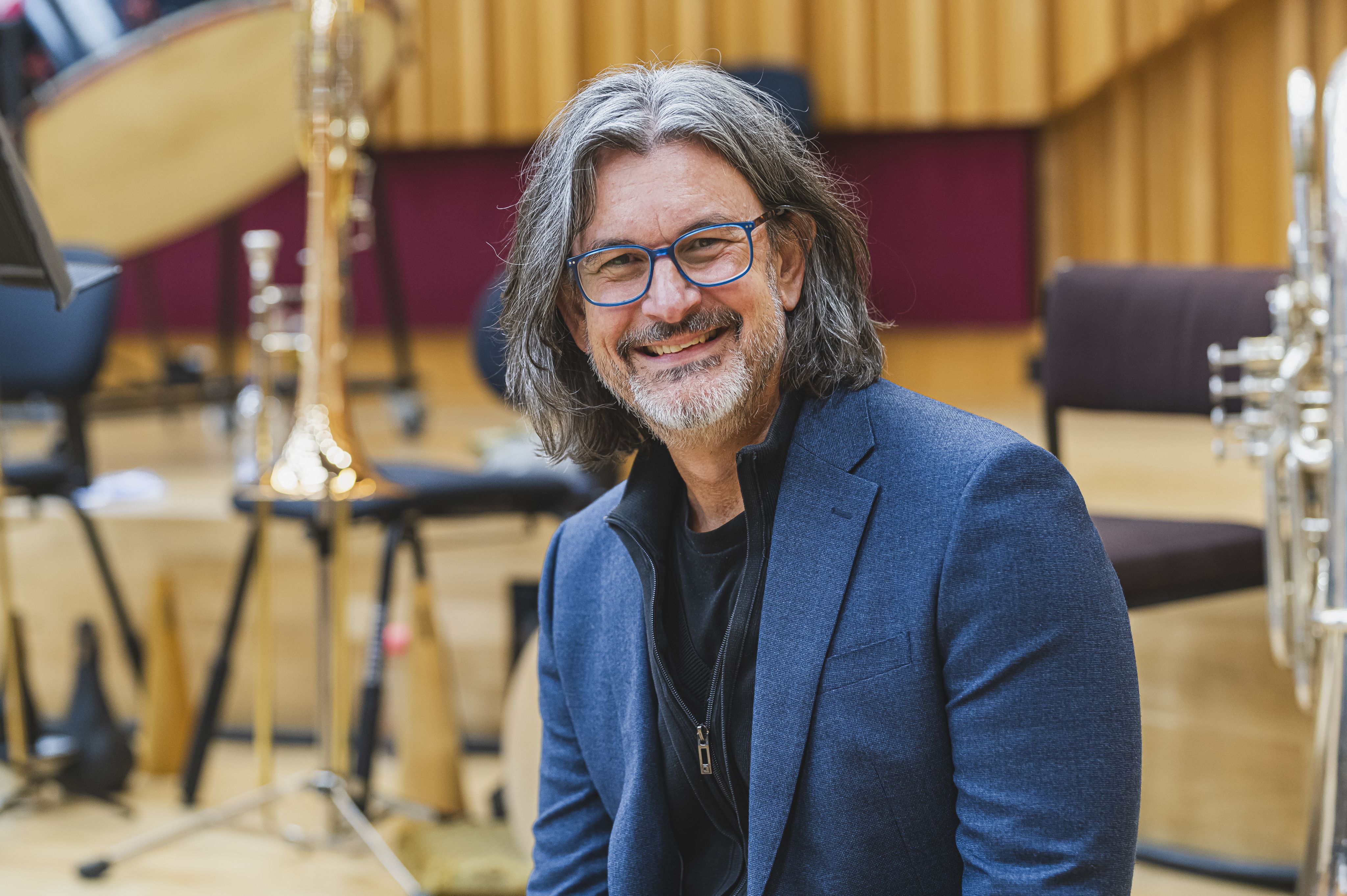
Photo: Kirsten McTernan
Photo: Kirsten McTernan
Welcome to tonight’s concert, for which we’re delighted to welcome back Jac van Steen, BBC NOW’s former Principal Guest Conductor.
The programme begins with a world premiere: Stephen McNeff’s The Celestial Stranger is a song-cycle evocatively combining texts by Dylan Thomas, Walt Whitman and the 17th-century mystic Thomas Traherne. To perform it we’re delighted to welcome tenor Gavan Ring.
There’s also a literary strand underpinning the remaining pieces tonight. The play Pelléas et Mélisande by the Symbolist writer Maurice Maeterlinck drew admiration from composers as varied as Debussy and Sibelius; Fauré also got in on the act when he wrote the incidental music for the play’s London premiere. From this he concocted a suite that puts the focus on its tragic heroine Mélisande, with music that is by turns lustrously beautiful and quietly sorrowing.
In 1899, just a year after Fauré’s suite, the young Schoenberg composed Verklärte Nacht, a heady string sextet inspired by an equally passionate poem by Richard Dehmel. The string-orchestra version we hear tonight ramps up the emotion still further, to wonderfully sensuous effect.
Enjoy!
Matthew Wood
Head of Artistic Planning and Production
Please respect your fellow audience members and those listening at home. Turn off all mobile phones and electronic devices during the performance. Photography and recording are not permitted.
Stephen McNeff (born 1951)
The Celestial Stranger(2023)
BBC co-commission: world premiere

1 The Celestial Stranger
2 On Leaping Over the Moon
3 As the Time Draws Nigh
4 The Hand that Signed the Paper
5 Farewell to Thee
Gavan Ring tenor
The Celestial Stranger was inspired by the 1997 rediscovery of texts by the 17th-century cleric and mystic Thomas Traherne in the library of Lambeth Palace in London. In these, Traherne imagines a person from another world discovering Earth and being enchanted by its beauty: ‘This little star so wide and so full of mysteries!’ In this cycle of songs our Stranger goes on to marvel at natural wonders and recounts how his (or her) brother imagines that, in jumping over a stream in the moonlight, he falls into a reverse world and ‘o’er-leaps the Moon’. Drawing on other poets such as Walt Whitman and Dylan Thomas, the cycle describes a broad narrative arc. In Whitman’s ‘As the Time Draws Nigh’ the Stranger is alerted to the dangers of the warlike industrialisation of society, while the prophetic fear of a totalitarian regime is expressed in Thomas’s ‘The Hand that Signed the Paper’. Understanding the imperfections of the world, our traveller takes their regretful leave in the fifth song – perhaps one day to return.
Programme note © Stephen McNeff
Text
1 The Celestial Stranger
Had a man been always in one of the stars,
Or confined to the body of the flaming sun,
Or surrounded with nothing but pure ether,
At vast and prodigious distances from the Earth,
Acquainted with nothing but the azure sky and the face of heaven,
Little could he dream of any treasures hidden in that azure veil afar off.
Should he let down on a sudden and see the sea,
And the effects of those influences he never dreamed of … Such strange kind of creatures,
Such mysteries and varieties,
Such never heard-of colours,
Such a new and lively green in the meadows,
Such odoriferous and fragrant flowers,
Such reviving and refreshing winds …
It would make him cry out:
This little star so wide and so full of mysteries!
So capacious and full of delight when we draw near!
All its treasures laugh and sing!
Who would have hoped for,
Who would have expected such enjoyments?
Verily, this star is a nest of angels!
Thomas Traherne (1636/7–74), adapted from the Lambeth Manuscript
2 On Leaping Over the Moon
I saw new Worlds beneath the Water lie,
New People; yea, another Sky
And sun, which seen by Day
Might things more clear display.
Just such another
Of late my Brother
Did in his Travel see, and saw by Night,
A much more strange and wondrous Sight:
As he went tripping o’er the King’s high-way,
A little pearly river lay
O’er which, without a wing
Or Oar, he dar’d to swim,
Swim through the air
On body fair;
He would not trust Icarian wings
Lest they should prove deceitful things;
For had he fall’n, it had been wondrous high,
Not from, but from above, the sky:
He might have dropt through that thin element
Into a fathomless descent;
Unto the nether sky
That did beneath him lie,
And there might tell
What wonders dwell
On earth above.
Yet doth he briskly run,
And bold the danger overcome;
Who, as he leapt, with joy related soon
How happy he o’er-leapt the Moon.
Thomas Traherne, adapted from the Burney Manuscript
3 As the Time Draws Nigh
I see men marching and countermarching by swift millions;
I see the frontiers and boundaries of the old aristocracies broken;
I see the landmarks of European kings removed;
I see this day the People beginning their landmarks; I see all others give way.
Never were such sharp questions ask’d as this day;
Never was average man, his soul, more energetic, more like a God;
Lo! how he urges and urges, leaving the masses no rest;
His daring foot is on land and sea everywhere – he colonises the Pacific, the archipelagoes;
With the steam-ship, the electric telegraph, the newspaper, I see, he interlinks all geography;
With these, the wholesale engines of war,
What whispers are these, O lands, running ahead of you, passing under the seas?
Are all nations communing? is there going to be but one heart to the globe?
The earth, restive, confronts a new era, perhaps a general divine war!
No-one knows what will happen next – such portents fill the days and nights;
Years prophetical! the space ahead as I walk, is full of phantoms.
Walt Whitman (1819–92), adapted from ‘Years of the Modern’
4 The Hand that Signed the Paper
The hand that signed the paper felled a city;
Five sovereign fingers taxed the breath,
Doubled the globe of dead and halved a country;
These five kings did a king to death.
The mighty hand leads to a sloping shoulder,
The fingers’ joints are cramped with chalk;
A goose’s quill has put an end to murder
That put an end to talk.
The hand that signed the treaty bred a fever,
And famine grew, and locusts came;
Great is the hand that holds dominion over
Man by a scribbled name.
The five kings count the dead but do not soften
The crusted wound nor stroke the brow;
A hand rules pity as a hand rules heaven;
Hands have no tears to flow.
Dylan Thomas (1914–53); from ‘The Poems of Dylan Thomas’ (© 1939) by New Directions Publishing Corp. Reprinted by permission of New Directions Publishing Corp.
5 Farewell to Thee
Farewell to thee, farewell to thee
Thou charming one who dwells in shaded bowers.
One fond embrace ere I depart
Until we meet again.
Proudly swept the rain by the cliffs
As on it glided through the trees
Still following ever the blossom,
The flowers of the vale.
Sweet memories come back to me,
Sweet memories of the past
Dearest one, thou art mine own
From thee, true love shall ne’er depart
Farewell to thee, farewell to thee
Thou charming one who dwells in shaded bowers.
One fond embrace ere I depart
Until we meet again.
Proudly swept the rain by the cliffs
As on it glided through the trees;
And there the birds of love to dwell
And sip the honey from your lips.
Farewell to thee, farewell to thee
Thou charming one who dwells in shaded bowers.
One fond embrace ere I depart
Until we meet again.
Adapted from Lili’uokalani (1838–1917)
Gabriel Fauré(1845–1924)
Pelléas et Mélisande – suite(1898, arr. 1901)
1 Prélude (Quasi adagio)
2 La Fileuse (Andantino quasi allegretto)
3 Sicilienne (Allegro molto moderato)
4 La mort de Mélisande (Molto adagio)
When Maurice Maeterlinck’s play Pelléas et Mélisande premiered at the Bouffes-Parisiens on 17 May 1893 it was hailed a masterpiece by the literary Symbolist élite. Widely read – not only in France – by the young avant-garde, the play soon attracted the attention of composers who were inspired by its dark tale of doomed love and sense of dream-like mystery wrapped in a timeless otherworldliness. While Debussy secured the musical rights for his opera of the same title, Schoenberg, Sibelius, Mel Bonis and the Scottish composer William Wallace all wrote works based on Pelléas et Mélisande. Fauré’s contribution was the result of an invitation from Maeterlinck to write incidental music for the play’s London premiere. Composed rapidly in little over a month, he recycled two earlier works (pieces for cello and for flute) and enlisted the help of his friend Charles Koechlin for the orchestration. Fauré conducted the London premiere at the Prince of Wales Theatre on 21 June 1898, which was also attended by Winnaretta Singer, the Princesse de Polignac, to whom the work is dedicated.
Three years later, Fauré decided to extract a concert suite and chose three movements focusing on the innocent but tragic Mélisande, this time completing the orchestration himself. Camille Chevillard conducted the premiere at the Concerts Lamoureux in Paris on 2 February 1901. The tenderly expressive ‘Prélude’ depicts the beauteous Mélisande as first seen by Golaud, impassioned strings suggesting his longing and desire, horn calls evoking the forest, flute and woodwind hinting at Mélisande herself. The second movement is Mélisande’s spinning song: with its gentle oboe melody underpinned by rapid, triplet semiquavers on the strings representing the rotating spinning wheel. The lilting ‘Sicilienne’ (added to the suite a few years after the 1901 premiere) is quintessential Fauré. Far removed from the brooding doom of Maeterlinck’s drama, the simple but haunting melody is one of the most well-known flute solos in the repertoire, arpeggiations on harp providing a lyrical accompaniment. The flute also features in the last movement, a lamentation on Mélisande’s death; the only section in a minor key, its mood is inescapably tragic but also tenderly elegiac. This final movement was performed during Fauré’s own funeral service at the Église de la Madeleine.
Programme note © Caroline Rae
INTERVAL: 20 minutes
Arnold Schoenberg (1874–1951)
Verklärte Nacht (1899, arr. 1917, rev. 1943)
Arnold Schoenberg might be notorious as a musical revolutionary, alternately glorified or vilified for the pioneering dissonant music he composed during his maturity. Verklärte Nacht, however, comes from right at the start of his career, and its musical language is far closer to that of Wagner and Mahler than Schoenberg’s later, more challenging style.
He composed Verklärte Nacht (Transfigured Night) in just three weeks in September 1899, in a burst of inspiration. It was originally scored for string sextet – and, in fact, represents the first piece of chamber music specifically conceived as a ‘symphonic poem’, though Schoenberg himself transformed the piece into tonight’s version for string orchestra in 1917, further revising it in 1943. Its inspiration came from a mystical (and partly autobiographical) poem by German writer Richard Dehmel – and also from Schoenberg’s own burgeoning passion for Mathilde von Zemlinsky (sister of his teacher Alexander von Zemlinsky), whom he would go on to marry.
Surging passion, in fact, runs through both the poem’s storyline and the deeply romantic, sensuous music with which Schoenberg conveys it. A man and a woman are walking through a forest on a moonlit night. She reveals that she’s pregnant with the child of another man. He is thrown into turmoil, but ultimately accepts the child and forgives the woman, thereby transfiguring both the night and their relationship from sorrow and despair to hope and joy.
Accordingly, Schoenberg’s music surges ever forwards from brooding darkness to radiant light, its intricately woven tapestry of melodies constantly transforming and melding in new combinations that reflect the shifting emotions between the couple. The composer sticks closely to the storyline of Dehmel’s poem, although – as he admits in his own 1950 description of the piece – the work is conceived in purely musical terms, allowing the listener to forget about its poetic inspiration entirely.
A solemn, descending opening theme describes the heavy tread of the couple’s night-time walk, as well as a mood of apprehension about the news soon to be delivered. The woman makes her confession to faster music of increasing restlessness and dissonance, but the man offers reassurance in a slow, hymn-like melody on cellos, and a later duet for solo violin and cello conveys the couple’s renewed love set against flickering moonlight. After passionate expressions of affection and understanding, the piece ends calmly and serenely under a glittering starry sky.
Programme note © David Kettle
Help Us Improve Our Online Programmes.
Please take this 5-minute survey and let us know what you think of these notes.
Programme Survey
You may also like:
Season Closing Concert
Thursday 6/6/24, 7.30pm
BBC Hoddinott Hall, Cardiff
Friday 7/6/24, 7.30pm
Brangwyn Hall, Swansea
Dvořák Cello Concerto
Jennifer Higdon Blue Cathedral
Dawson Negro Folk Symphony
Ryan Bancroft conductor
Alisa Weilerstein cello
INSPIRING | ICONIC | MULTIFARIOUS
Globally renowned cellist Alisa Weilerstein joins BBC NOW in this season-closing concert for one of the most beloved of all cello concertos. Melodic genius, irrepressible energy and a love of his native folk music radiate as Dvořák looks back on a life well lived, one of joy but also of deep loss. Similarly, intuitive musical invention, rich orchestration and an exploration of the cathedral ‘as a symbolic doorway into and out of this world’ form a platform for floating and contemplative other-worldly atmospheres in Jennifer Higdon’s Blue Cathedral.
Picture the scene: November 1934, Carnegie Hall and a brand-new symphony is unveiled, receiving rapturous applause from the audience and multiple bows from its unassuming composer. That composer was William Dawson, a 35-year-old African American man who had run away from home aged 13 to follow his dream of studying music; and the piece – the Negro Folk Symphony. With melodies that ooze both sensuousness and directness, Dawson set out to compose music that was ‘unmistakably not the work of a white man’ and found his inspiration in the African American folk music he had learnt as a small child growing up in the Deep South. Who better to conduct this expertly crafted and highly emotionally charged symphony than our American-born Principal Conductor Ryan Bancroft?
Gergely Madaras conducts …
Friday 21/06/24, 7.30pm
BBC Hoddinott Hall, Cardiff
Debussy Prélude à l’après-midi d’un faune
Debussy Nocturnes
Christian Mason Thaleia UK premiere
Franck Psyché – ‘Les jardins d’Éros’
Gergely Madaras conductor
Noémi Győri flute
BBC National Chorus of Wales
BEGUILING | ILLUSTRATIVE | ENTRANCING
Shimmering ambiguity and transparent harmonies glisten with subtly Eastern-inspired melodies, nuance and sheer beauty in Debussy’s ground-breaking Prélude à l’après-midi d’un faune, depicting the dreams and encounters of a mythical faun. We then explore light and shade in his Nocturnes, inspired by Whistler’s series of paintings of the same name. In the first, ‘Nuages’, we experience airily luminous melody, followed by propulsive rhythmic drive in ‘Fêtes’, while the use of women’s voices in ‘Sirènes’ brings an eerie quality to the texture.
Christian Mason’s flute concerto Thaleia uses the solo instrument in a mellifluously uninhibited style, reflective of Debussy’s L’après-midi. It was written for Noémi Győri as part of her ‘Contemplation of the Nymph’ project, with the characteristics of Thaleia, a Naiad-nymph of Mount Etna, taking the focal role. We’re delighted that Noémi will join BBC National Orchestra of Wales and conductor Gergely Madaras for the work’s UK premiere. We end this enchanting concert with ‘Les jardins d’Éros’ from Franck’s symphonic poem Psyché, setting words by Sicard and Louis de Fourcaud and inspired by Apuleius’s Metamorphoses.
Biographies
Jac van Steen conductor


Photo: Simon van Boxtel
Photo: Simon van Boxtel
Jac van Steen was born in the Netherlands and studied orchestra and choir conducting at the Brabant Conservatory of Music.
Since participating in the BBC Conductors’ Seminar in 1985, he has enjoyed a very busy career. He has worked with leading orchestras in Europe, holding the posts of Music Director and Chief Conductor of the Netherlands National Ballet, the orchestras of Bochum and Nuremberg, Weimar Staatskapelle, Dortmund Opera and Philharmonic Orchestra and Musikkollegium Winterthur, as well as being Principal Guest Conductor of BBC National Orchestra of Wales. He is currently Principal Guest Conductor of the Ulster Orchestra and Prague Symphony Orchestra.
He is also in demand in the opera house, having made notable debuts with the Vienna Volksoper and Opera North (both 2013) and Garsington Opera (2015) and developed close relationships with all three. In the 2018–19 season he made his debut with Oslo Opera.
He visits the UK regularly, conducting the Philharmonia, City of Birmingham Symphony Orchestra and Royal Philharmonic. Other highlights include his debut in Tokyo with the New Japan Philharmonic and the Malaysian Philharmonic Orchestra.
His substantial discography covers a wide range of repertoire with various orchestras.
Besides his activities as conductor, he is dedicated to teaching and is Professor of Conducting at the Royal Conservatory of Music in The Hague. He also regularly works with the Royal Northern College of Music, Royal Academy and Royal College of Music. In 2018 he led the Royal Opera’s Jette Parker Young Artists showcase.
Gavan Ring tenor


Photo: Frances Marshall
Photo: Frances Marshall
Gavan Ring read Education and Music at St Patrick’s College, Dublin, and, after postgraduate studies at the Royal Irish Academy of Music, trained at the National Opera Studio in London as a baritone. He was a Jerwood Young Artist at the 2012 Glyndebourne Festival, Second Prize-winner at the 2013 Wigmore Hall/Kohn Foundation International Song Competition and won the Southbank Sinfonia Peter Hulsen Orchestral Song Award before his transition to a tenor in the 2019/20 season.
In the following season he made his debut at La Monnaie, Brussels, as Don Gaspar in a concert performance of Donizetti’s La favorite. In the 2021/22 season he sang Jaquino (Fidelio) for Glyndebourne Tour; Peter Maxwell Davies’s The Lighthouse for Irish National Opera; and Ferrando (Così fan tutte) for Garsington Opera. Highlights of last season include Gastone (La traviata) for Opera North; Messiah in Monte Carlo; a New Year’s Day concert with the RTÉ National Symphony Orchestra; and returns to La Monnaie and the Glyndebourne Festival (where he made his debut as a tenor). Current and future plans include his debut with English National Opera, the role of the Evangelist in Bach’s St Matthew Passion with the National Symphony Orchestra of Ireland; and a return to La Monnaie for Mikael Karlsson’s Fanny and Alexander.
Other recent highlights in his native Ireland have included White King (Gerald Barry’s Alice’s Adventures Under Ground) for Irish National Opera; Frederic (The Pirates of Penzance) at Cork Opera House; and Juan (Massenet’s Don Quichotte) and Azim (Stanford’s The Veiled Prophet) for Wexford Festival Opera.
BBC National Orchestra of Wales
For over 90 years, BBC National Orchestra of Wales has played an integral part in the cultural landscape of Wales, occupying a distinctive role as both broadcast and national symphony orchestra. Part of BBC Wales and supported by the Arts Council of Wales, it has a busy schedule of live concerts throughout Wales, the rest of the UK and the world.
The orchestra is an ambassador of Welsh music and champions contemporary composers and musicians; its concerts can be heard regularly across the BBC – on Radio 3, Radio Wales and Radio Cymru.
BBC NOW works closely with schools and music organisations throughout Wales and regularly undertakes workshops, side-by-side performances and young composer initiatives to inspire and encourage the next generation of performers, composers and arts leaders.
The orchestra is based at BBC Hoddinott Hall in Cardiff Bay, where its purpose-built studio not only provides the perfect concert space, but also acts as a broadcast centre from where its live-streamed concerts and pre-recorded content are presented as part of its popular Digital Concert Series.
For further information please visit the BBC National Orchestra and Chorus of Wales’s website: bbc.co.uk/now
Patron
HM King Charles III KG KT PC GCB
Principal Conductor
Ryan Bancroft
Conductor Laureate
Tadaaki Otaka CBE
Composer-in-Association
Gavin Higgins
Composer Affiliate
Sarah Lianne Lewis
First Violins
Nick Whiting leader
Gwenllian Hâf MacDonald
Judith Templeman
Terry Porteus
Suzanne Casey
Žanete Uškāne
Ruth Heney
Carmel Barber
Anna Cleworth
Emilie Godden
Kerry Gordon-Smith
Gary George-Veale
Jane Sinclair
SecondViolins
Anna Smith *
Laura Embrey
Ros Butler
Sheila Smith
Roussanka Karatchivieva
Joseph Williams
Vickie Ringguth
Michael Topping
Ilze Abola
Katherine Miller
Lydia Caines
Beverley Wescott
Violas
Matt Maguire ‡
Alex Thorndike #
Peter Taylor
Anna Growns
Robert Gibbons
Lowri Taffinder
Natalia Solis Paredes
Charlotte Limbe
Mabon Rhyd
Sharada Mack
Cellos
Alice Neary *
Raphael Lang
Jessica Feaver
Sandy Bartai
Rachel Ford
Carolyn Hewitt
Keith Hewitt
Alistair Howes
Double Basses
Margarida Castro ‡
Daniel Vassallo
Christopher Wescott
Richard Gibbons
Antonia Bakewell
Telmo Martins
Flutes
Matthew Featherstone *
John Hall †
Lindsey Ellis
Piccolo
Lindsey Ellis †
Oboes
Alison Teale ‡
Sam Baxter
Amy McKean †
Cor anglais
Amy McKean †
Clarinets
Nick Carpenter *
Will White
Lenny Sayers
Bass Clarinet
Lenny Sayers †
Bassoons
Jarosław Augustiniak *
Jo Shewan
David Buckland
Contrabassoon
David Buckland †
Horns
John Davy
Meilyr Hughes
Ed Griffiths
Tom Taffinder
Trumpets
Philippe Schartz *
Robert Samuel
Corey Morris †
Trombones
Donal Bannister*
Jake Durham
Bass Trombone
Darren Smith †
Tuba
Daniel Trodden †
Timpani
Christina Slominska
Percussion
Phil Hughes
Harry Lovell-Jones
Harp
Sally Pryce
* Section Principal
† Principal
‡ Guest Principal
# Assistant String Principal
The list of players was correct at the time of publication
Director Lisa Tregale
Orchestra Manager appointment in progress
Assistant Orchestra Manager Nick Olsen
Orchestra Personnel ManagerKevin Myers
Business Coordinator Caryl Evans
Orchestra Administrator Eleanor Hall +
Head of Artistic Planning and ProductionMatthew Wood
Artists and Projects Manager Victoria Massocchi **
Orchestra Librarian Eugene Monteith
Producer Mike Sims
Broadcast Assistant Kate Marsden
Head of Marketing and Audiences Sassy Hicks
Marketing Coordinator Amy Campbell-Nichols +
Digital Producer Yusef Bastawy
Social Media Coordinator Harriet Baugh
Education Producers Beatrice Carey, Rhonwen Jones **
Audio Supervisors Simon Smith, Andrew Smillie
Production Business Manager Lisa Blofeld
Stage and Technical Manager Steven Brown +
Assistant Stage and Technical Manager Josh Mead
BBC Wales Apprentice Jordan Woodley
+ Green Team member
** Diversity & Inclusion Forum


