
Bach, Liebermann & Schmidt with Jonathan Berman
Friday 21/10/22, 7.30pm


Johann Sebastian Bach, Arr. Igor Markevitch
The Musical Offering – Ricercar a 3 (6’)
Lowell Liebermann
Flute Concerto (25’)
INTERVAL (20’)
Franz Schmidt
Symphony No. 2 (45’)
Jonathan Berman Conductor
Matthew Featherstone Flute


This concert is being recorded by BBC Radio 3 for future broadcast in Radio 3 in Concert. It will be available to stream or download for 30 days via BBC Sounds, where you can also find podcasts and music mixes. Visit bbc.co.uk/now for more information on future performances.
Introduction
Welcome to tonight’s concert, here at BBC Hoddinott Hall, in which BBC National Orchestra of Wales is conducted by Jonathan Berman in a programme that traverses the centuries.
We begin in the 18th century, with a piece from Bach’s fugal masterpiece, The Musical Offering, but reimagined through the ears of the great conductor Igor Markevitch.
From then we move to the 20th century and Lowell Liebermann’s Flute Concerto; it was written for Sir James Galway, but tonight it’s Matthew Featherstone who steps out of the orchestra and into the spotlight to take on the solo role.
Franz Schmidt is a composer particularly close to Jonathan Berman’s heart; he wrote his Second Symphony in the early years of the last century, a time when the legacy of Mahler in particular cast a long symphonic shadow.
Please respect your fellow audience members and those listening at home. Turn off all mobile phones and electronic devices during the performance. Photography and recording are not permitted.
Johann Sebastian Bach (1685–1750), arr. Igor Markevitch (1912–83)
The Musical Offering, BWV1079 (publ. 1747) – Ricercar a 3

When Frederick the Great of Prussia presented Bach with a theme and challenged him to write a fugue on it, Bach’s response was a whole book of music, the Musical Offering. This incorporated two fugues (which he called by the old name ‘ricercar’), 10 canons and a sonata. Bach is generally reckoned nowadays to have had a solo keyboard player in mind, but the music can take orchestration, as Anton Webern and the Modern Jazz Quartet showed in their various selections. Igor Markevitch took on the entire collection because he found previous versions unsatisfactory, principally in how the short canons came across as bitty. He therefore made these into a set of variations. The three-part ricercar, which may represent what Bach improvised for Frederick on the spot, Markevitch set for strings, with soloists on violin, viola and cello to introduce the theme and pick out other passages.
Programme note © Paul Griffiths
Further Listening: Arnhem Philharmonic Orchestra/Christopher Lyndon-Gee (Naxos 8572158)
Further Reading: Music in the Castle of Heaven: A Portrait of Johann Sebastian Bach Sir John Eliot Gardiner (Penguin)
Lowell Liebermann (born 1961)
Flute Concerto, Op. 39 (1992)

1 Moderato
2 Molto adagio
3 Presto
Matthew Featherstoneflute
If any two artists of different generations ever were destined to find one another and form a fruitful collaboration, it surely must be the Irish flautist Sir James Galway and the American composer Lowell Liebermann. Sir James, born in Belfast in 1939, has become over the course of his long and illustrious career a veritable Pied Piper for beauty, authority and craft through the repertoire he has championed.
Liebermann, born in 1961 in New York City, has fashioned a body of works that adhere to those same principles – and, while weathering charges of stylistic conservatism, has attracted a broad and diverse audience of keen advocates and admirers, including Sir James and the pianist Sir Stephen Hough.
A natural musician from childhood, Liebermann earned awards for performing the Carnegie Hall premiere of his First Piano Sonata (1977) at the age of 16. He honed his talents as a pianist and deepened his appreciation of structural integrity in composition, as a student of the venerable pianist Jacob Lateiner at the Juilliard School in the late 1980s. While at Juilliard, Liebermann studied composition with two titans of mid 20th-century American music, David Diamond and Vincent Persichetti, both of whom created works endowed with impeccable craft and ineffable melodicism. Instead of setting out to eclipse the lineage and canon he’d absorbed, Liebermann embraced it.
‘To me, classical music is a continuum and it’s enriched by associations from the past,’ he told the late radio host and interviewer Bruce Duffie in an interview in 1998. ‘Not that a piece of music should be slavishly imitating something, but to me those influences are enriching, and it’s what allows you to place yourself as a composer in a cultural context.’
Liebermann and Galway became acquainted after the flautist heard the young composer’s beguiling Sonata for flute and piano (1987), and commissioned him to write a concerto. This received its premiere on 6 November 1992, with Galway as soloist and Leonard Slatkin conducting the St Louis Symphony Orchestra. (Liebermann has since completed two more works for the flautist: a Concerto for flute, harp and orchestra, and Trio No. 1 for flute, cello and piano.)
As one reviewer noted, the stealthy, marchlike opening of the Flute Concerto recalls Prokofiev, a clear forebear in the art of the brilliant, persuasive concerto. But the work’s enchanting melodies, affecting moods and instant appeal all bear Liebermann’s personal stamp.
Programme note © Steve Smith
Further Listening: Sir James Galway; London Mozart Players/Lowell Liebermann (RCA 09026632352)
Website: https://www.lowellliebermann.com
INTERVAL: 20 minutes
Franz Schmidt (1874–1939)
Symphony No. 2 in E flat major (1911–13)

1 Lebhaft
2 Allegretto con variazioni
3 Finale: Langsam
Franz Schmidt’s Second Symphony was premiered in Vienna in 1913 and composed at a time when the progress of European music had reached something of a fork in the road. Mahler had recently died, his late works suggesting a conclusion to the whole Romantic arc. Schoenberg’s first atonal pieces were causing controversy in Vienna, and Stravinsky’s Rite of Spring had been premiered earlier that year. Richard Strauss, however – broadly considered the greatest living Austro-German composer even when Mahler was alive – had abandoned the experimental trajectory of Salome and Elektra and produced the unashamedly luscious Der Rosenkavalier. Schmidt himself was nearing the end of a 15-year stint as a cellist with the Vienna Court Opera (in which time he played frequently under Mahler), and therefore saw exactly how audiences continued to respond to the Romantic stalwarts. It’s easy to look back now and dismiss Schmidt as a conservative, but in 1913 his music would have felt absolutely current.
Schmidt’s post meant that he would also have experienced large orchestral works with the Vienna Philharmonic (the concert-giving wing of the Court Opera), but most of his performing under Mahler’s baton would have been in the opera house, a diverse repertoire that Mahler himself constantly updated. It must have been hugely valuable for Schmidt’s development to hear from within the fine details of how composers from Offenbach to Verdi and Wagner constructed their sound-worlds. Indeed, Schmidt is now perhaps most admired for his orchestration and is often compared to his former teacher Bruckner for the grandeur and sheer density of his textures – although his more lightly scored passages can dazzle and twinkle.
The Second Symphony’s irresistibly warm, bright opening recalls Mahler at his most ebullient, perhaps when composing about nature; or Wagner in jovial mode, hurrying through sequences of unrelated keys. It has a shiny, metallic quality, galvanised by the unison clarinets. The middle movement is perhaps the work’s most significant technical achievement, doing the job of what might traditionally have been two separate movements – a sentimental intermezzo and a scherzo – intertwining them in a continuous set of variations. The slower variations blossom calmly in rich, contrasting colours; the more scherzo-like ones burst in and re-energise the music. The symphony is sonically epic, but very concise, flying by in around 45 minutes. Even the extremely grand, joyful chorale which concludes the work feels pacey and perfectly in proportion. This is the work’s most Brucknerian passage, with the swirling string lines propelling the music along.
Schmidt’s music was later co-opted by the Nazis, particularly just before Austria’s annexation in 1938. The composer apparently had little political motivation of his own, being much more preoccupied by personal turmoil. He had by then long been a renowned composition professor who respected and understood much of the music that the regime later condemned as degenerate. But his own output landed on the wrong side of history because it was suitably bombastic and steeped in nationalism. He died soon after this, in 1939, so we cannot know how he would have responded to the era’s worst atrocities. It has taken some time, but Schmidt’s music is now finally being appreciated beyond Austria for its unique qualities.
Programme note © Tom Owen
Further Listening: Frankfurt Radio Symphony Orchestra/Paavo Järvi (DG 4838336)
Further Reading: The Music of Franz Schmidt: 1: The Orchestral Music: Harold Truscott (Toccata Press)
Help us Improve Our Online Programmes.
Please take this 5-minute survey and let us know what you think of these notes.
Programme Survey
Biographies
Jonathan Berman conductor

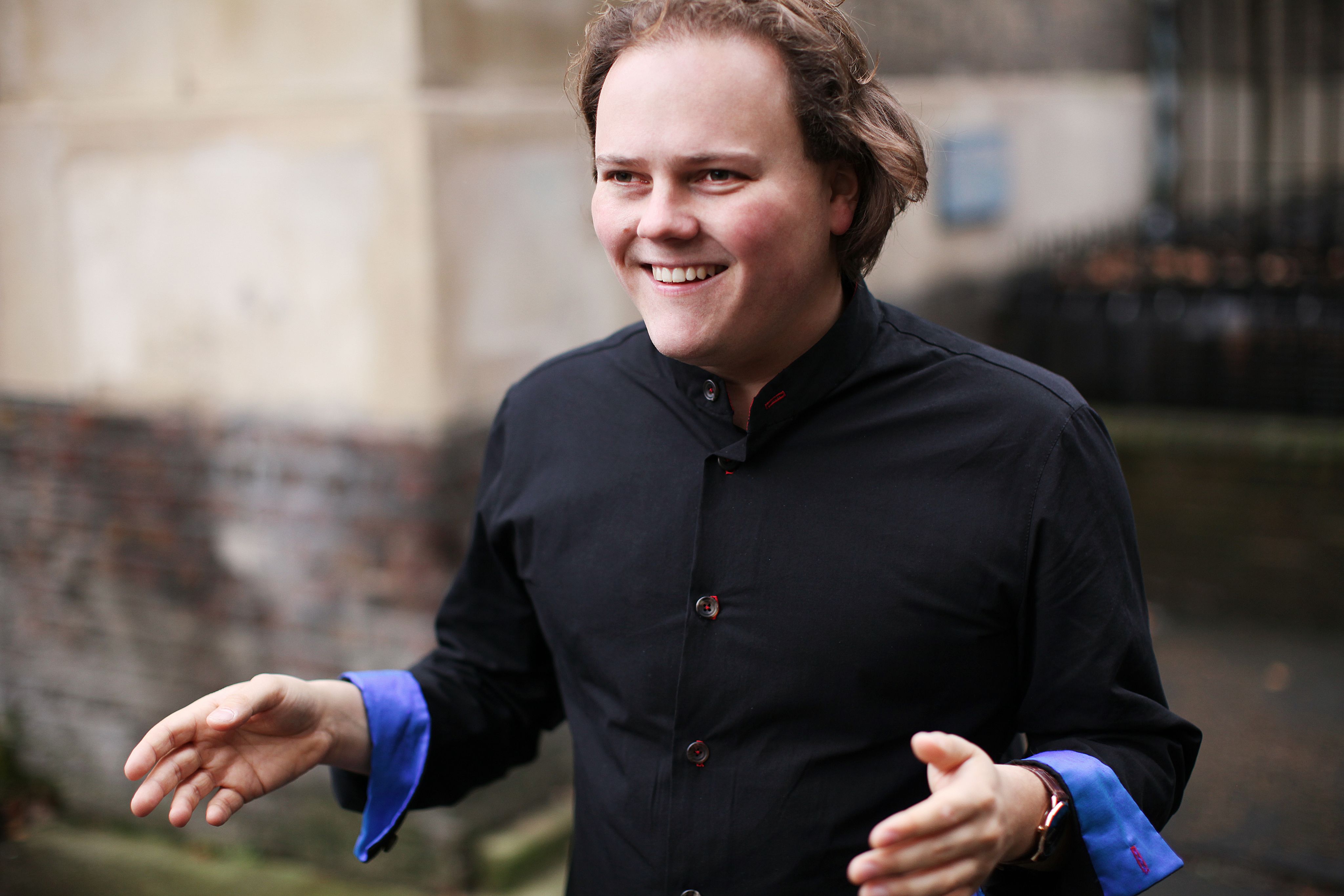
Photo: George Garnier
Photo: George Garnier
Jonathan Berman has established a reputation as a conductor with wide-ranging achievements both on and off the podium.
He is a champion of the music of Franz Schmidt and Oliver Knussen, but conducts a wide-ranging repertoire, and is particularly acclaimed in contemporary music. He has received return invitations from the Lithuanian National, London and Rotterdam Philharmonic orchestras, Royal Scottish National Orchestra, RTÉ National Symphony Orchestra, Filarmonica ‘George Enescu’, Bucharest, Sinfonietta Riga, Southbank Sinfonia and the City Chamber Orchestra of Hong Kong, as well as to the Aldeburgh and Tanglewood festivals.
Forthcoming and recent debuts include the Cleveland Orchestra, Bilkent, BBC, BBC Scottish and City of Birmingham Symphony orchestras, Orchestre de Picardie, Orchestra di Padova e Veneto, Britten Sinfonia, Hagen and Turku Philharmonic orchestras, London Mozart Players, City of London Sinfonia and the Nash Ensemble.
In February this year he stood in at very short notice to conduct the London Philharmonic Orchestra at the Royal Festival Hall in repertoire including the world premiere of a piano concerto by Jimmy Lopez.
As a champion of new music he regularly works with the London Sinfonietta, Ensemble Modern, Birmingham Contemporary Music Group, New European Ensemble, Crash Ensemble Dublin and the Britten Pears Ensemble.
As an opera conductor he has conducted productions for the Nationale Reisopera, English Touring Opera, Aldeburgh Festival, Grachten Festival, Anghiari Festival, Dartington International Festival, Jerwood Opera Course, Opera Studio Netherlands, Dutch National Opera Academy, Mahogany Opera and the Centre for Opera Studies in Italy.
Matthew Featherstone flute

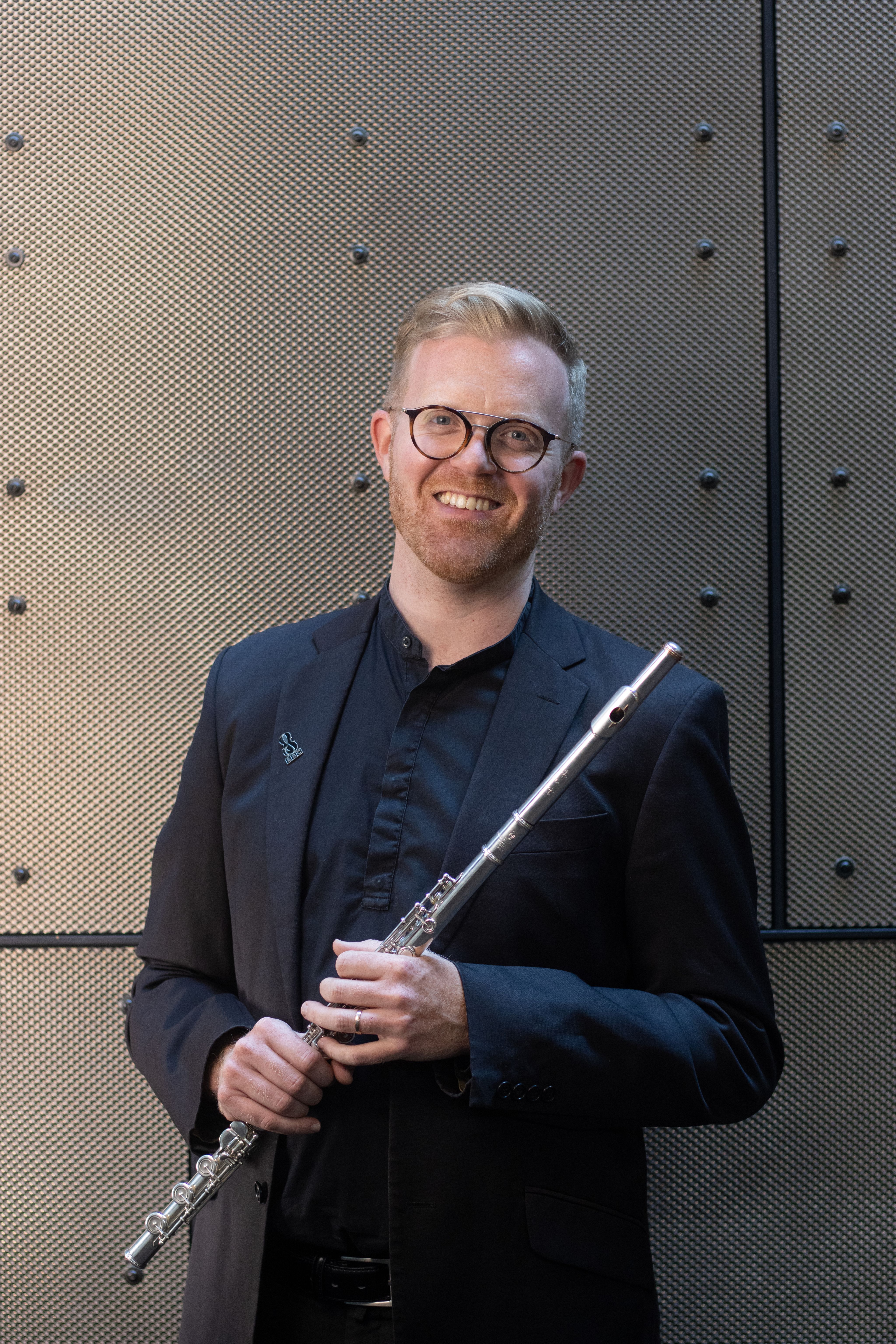
Matthew Featherstone is Principal Flute of BBC National Orchestra of Wales and has also appeared as Guest Principal Flute with Britten Sinfonia, BBC Symphony Orchestra, BBC and London Philharmonic orchestras, Royal Scottish National Orchestra, Ulster Orchestra, RTÉ Concert Orchestra and the Academy of St Martin in the Fields.
He was awarded the Royal Over-Seas League Wind Prize in 2012 and has travelled around the UK giving flute and piano recitals. He has made concerto appearances with various orchestras, including the Nielsen Flute Concerto with BBC NOW and the Mozart Concerto for flute and harp with Catrin Finch. A keen chamber musician, he enjoys performing with his ensemble for flute, harp and viola – Trio Anima, whose debut album Between Earth and Sea is released next month.
He also works as a beatboxer, session singer and songwriter, and released his debut EP in 2019.
BBC National Orchestra of Wales
For over 90 years, BBC National Orchestra of Wales has played an integral part in the cultural landscape of Wales, occupying a distinctive role as both broadcast and national symphony orchestra. Part of BBC Wales and supported by the Arts Council of Wales, it has a busy schedule of live concerts throughout Wales and the rest of the UK. The orchestra is an ambassador of Welsh music and champions the works of contemporary composers.
It performs annually at the BBC Proms and biennially at the BBC Cardiff Singer of the World competition, and can be heard regularly across the BBC: on Radio 3, Radio Wales and Radio Cymru, as well as providing the soundtracks for some of your favourite television programmes.
Highlights of this season include the Elemental Explorations concerts in Brecon and Newport with Nil Venditti, Disney’s Fantasia in concert, Britten and Elgar with the orchestra’s much-loved Conductor Laureate Tadaaki Otaka, an all-new Gaming concert with gaming music legend Eímear Noone and a CoLaboratory concert with the sensational cellist Abel Selaocoe.
Alongside its busy schedule of live concerts, BBC NOW works closely with schools and music organisations throughout Wales, regularly delivering workshops, side-by-side performances and young composer initiatives to inspire and encourage the next generation of performers, composers and arts leaders and make music accessible to all. To find out more visit bbc.co.uk/bbcnow
Patron
HM King Charles III KG KT PC GCB
Principal Conductor
Ryan Bancroft
Conductor Laureate
Tadaaki Otaka CBE
Composer-in-Association
Gavin Higgins
Composer Affiliate
Sarah Lianne Lewis
First Violins
Nick Whiting Leader
Martin Gwilym- Jones Sub-Leader
Gwenllian Hâf MacDonald
Terry Porteus
Suzanne Casey
Juan Gonzalez
Ruth Heney
Anna Cleworth
Carmel Barber
Kerry Gordon-Smith
Gary George-Veale
Claudia Fuller
Eve Kennedy
Second Violins
Anna Smith *
Emre Engin
Ros Butler
Jane Sinclair
Sheila Smith
Lydia Caines
Sellena Leony
Vickie Ringguth
Michael Topping
Joseph Williams
Beverley Wescott
Elizabeth Whittam
Laurence Kempton
Violas
Paul Silverthorne ‡
Alex Thorndike #
Tetsuumi Nagata
Peter Taylor
Ania Leadbeater
Robert Gibbons
Catherine Palmer
Laura Sinnerton
Dáire Roberts
Cellos
Alice Neary *
Keith Hewitt #
Raphael Lang
Sandy Bartai
Alistair Howes
Carolyn Hewitt
Kathryn Graham
Double Basses
David Stark *
Alexander Jones
Christopher Wescott
Richard Gibbons
Claire Whitson
David F. C. Johnson
Flutes
John Hall
Charlotte Thomas
Oliver Roberts
Piccolo
Elizabeth May
Oboes
Steve Hudson *
Amy McKean †
Sarah-Jayne Porsmoguer
Cor Anglais
Sarah-Jayne Porsmoguer †
Clarinets
Nick Carpenter ‡
Jennie Joy Porton
Emily Wilson
E Flat Clarinet
Rhys Taylor
Bass Clarinet
Lenny Sayers †
Bassoons
Sarah Sesu ‡
Alexandra Davidson
Contra-Bassoon
David Buckland †
Horns
Tim Thorpe *
James Mildred
Neil Shewan †
Dave Ransom
John Davy
Ed Griffiths
Hugh Seenan
William Haskins
Marcus Bates
Trumpets
Philippe Schartz *
Robert Samuel
Corey Morris
Edward Burfield
Trombones
Donal Bannister*
Adam Hanna
Bass Trombone
Darren Smith †
Tuba
Daniel Trodden †
Timpani
Steve Barnard *
Christina Slominska
Percussion
Chris Stock *
Mark Walker †
Phil Girling
Christina Slominska
Harp
Valerie Aldrich-Smith †
Piano
Catherine Roe Williams
* Section Principal
† Principal
‡ Guest Principal
# Assistant Principal
The list of players was correct at the time of publication
Director Lisa Tregale +
Orchestra Manager Zoe Poyser +
Assistant Orchestra Manager Vicky James **
Orchestra Administrator Nick Olsen
Orchestra Coordinator, Operations Kevin Myers
Business Coordinator Caryl Evans
Head of Artistic Production Matthew Wood
Artists and Projects Manager Eleanor Phillips
Orchestra Librarian Eugene Monteith **
Producer Mike Sims
Broadcast Assistant Jacob Perkins
Head of Marketing and Audiences Sassy Hicks
Marketing Coordinator Amy Campbell +
Digital Producer Yusef Bastawy
Social Media Coordinator Harriet Baugh
Education Producers Beatrice Carey, Rhonwen Jones **
Audio Supervisors Simon Smith, Andrew Smillie
Production Business Manager Lisa Blofeld
Stage and Technical Manager Steven Brown
Assistant Stage and Technical Manager Dave Rees
+ Green Team member
** Diversity & Inclusion Forum