
Reformation & Invigoration
Thursday 15/5/25, 7.30pm
BBC Hoddinott Hall, Cardiff


Wolfgang Amadeus Mozart The Marriage of Figaro – overture 4’
Jörg Widmann ViolinConcerto No. 2 UK premiere 35’
INTERVAL: 20 minutes
Felix Mendelssohn Symphony No. 5, ‘Reformation’ 27’
Jörg Widmann conductor
Carolin Widmann violin
BBC Hoddinott Hall is certified by EcoAudio and we’re proud to be supporting the BBC in becoming a more sustainable organisation. For more information on the BBC’s net-zero transition plan and sustainability strategy please visit https://www.bbc.co.uk/aboutthebbc/documents/bbc-net-zero-transition-plan-2024.pdf




This concert is being recorded by BBC Radio 3 for future broadcast in Classical Live and is being livestreamed via the BBC NOW website; it will be available for 30 days after broadcast via BBC Sounds, where you can also find podcasts and music mixes.
Introduction
Welcome to tonight’s concert, for which we’re delighted to welcome Jörg Widmann for this, his conducting debut with BBC NOW.
Jörg Widmann also appears as composer in the UK premiere of his Second Violin Concerto, a highly personal work, written for and tonight performed by his sister – the acclaimed Carolin Widmann.
That forms the centrepiece of a programme which begins in uproarious mood with Mozart’s glorious overture to The Marriage of Figaro, the first of his great trilogy of operas to librettos by Lorenzo da Ponte.
We end with Mendelssohn’s ‘Reformation’ Symphony, a work written to mark the 300th anniversary of the founding of German Protestantism, and one in which he effortlessly combines the sacred and the secular, to irresistible effect.
Enjoy!
Lisa Tregale
Director
Please respect your fellow audience members and those listening at home: mobile phones may be kept on but on silent and with the brightness turned down; other electronic devices should be switched off during the performance. Photography and recording are not permitted.
Wolfgang Amadeus Mozart (1756–91)
The Marriage of Figaro (1785–6) – overture

Mozart would not have been surprised to hear one of his opera overtures performed at an orchestral concert. In most Italian operas of his day, the overture was simply a call to attention, a detachable reminder that the opera was about to begin rather than a prologue-style comment on the ensuing drama. As late as 1816 we find that the overture to Rossini’s The Barber of Seville had been used twice before, in one case for a rather more serious drama about Elizabeth I and the Earl of Leicester. This should not worry the modern listener any more than it did audiences of the time; plenty of these works make excellent concert pieces in their own right, and the fact that many concerts today begin with an opera overture is evidence that, to a degree, their original function remains.
The overture to The Marriage of Figaro – the first of Mozart’s three comic masterpieces to librettos by Lorenzo da Ponte – is no real exception. The opera, based on Beaumarchais’s contentiously anti-aristocratic play, depicts the outwitting by his servants of a nobleman’s attempts to exercise his droit du seigneur. There is a hint of the intrigues to follow in the overture’s unusual opening, perhaps, but all that really need concern us here is the exciting surge of energy this little piece represents, right through to the drawn-out crescendo with which it ends.
Programme note © Lindsay Kemp
Jörg Widmann (born 1973)
Violin Concerto No. 2
(2018)
UK premiere
1 Una ricerca
2 Romanze
3 Mobile
Carolin Widmannviolin
The violin concerto is a ‘sacred’ genre – one that invites the expression of deeply personal feelings. This is especially true of this one, which is dedicated to my sister, Carolin. In it, the singing instrument of the violin becomes a vessel for the widest range of human emotions.
The first movement, ‘Una ricerca’, is a search – the violin’s search for itself, for its own voice. It is a quest for sounds, gestures, shapes and connections. The orchestra responds only sporadically, but with sounds and figures that will become dominant in the subsequent movements. This first one, lasting about five minutes, is as short – or as concise – as the final one, ‘Mobile’. Here, patterns from the previous movements are propelled into a state of relentless high-speed motion and pushed to their limits. The overall character, however, remains almost consistently light.
The central and by far the longest movement is titled ‘Romanze’. This unfolds a sprawling emotional cosmos – a journey into the inner self. It traverses a variety of emotional realms: lyrical and delicate moments exist alongside heavier textures and explosive, brutal outbursts. Yet the violin always remains the narrator.
Compositionally, the concerto is characterised by constant, playful variation across all three movements. Despite the richness of sound and colour, the tonal material and gestural vocabulary are fundamentally tightly constrained. The invention itself – the tone colours, the harmonies – has always been part of my musical language. However, the focus on reduction and form is something new, seemingly emerging from this, my second engagement with the genre of the violin concerto.
Programme note © Jörg Widmann
INTERVAL: 20 minutes
Felix Mendelssohn (1809–47)
Symphony No. 5 in D major, ‘Reformation’(1829–30)
1 Andante – Allegro con fuoco
2 Allegro vivace
3 Andante
4 Andante con moto
Felix Mendelssohn, grandson of the famed Jewish philosopher Moses Mendelssohn, was a practising Lutheran. His parents, Abraham and Leah Mendelssohn, took the decision to give their son a Christian baptism when he was seven – several years, in fact, before they themselves converted in 1822. Upon their own baptism, they added ‘Bartholdy’ to the family surname. The appellation was far from glamorous: it had been adopted from the name of a farm owned by Felix’s uncle. But it was helpful in demonstrating some distance from their Jewish roots. ‘There can no more be a Christian Mendelssohn than there can be a Jewish Confucius!’, Abraham memorably declared. He even wanted Felix to drop the ‘Mendelssohn’ from his surname altogether, but his son resisted. Felix saw no contradiction between acknowledging his Jewish ancestry and committed adherence to the Christian faith.
Given this, it’s no surprise that Mendelssohn should have been inspired to write a celebratory ‘Reformation’ Symphony to mark the 300th anniversary of one of the foundational documents of German Protestantism, the 1530 ‘Augsburg Confession’. He had started work on the piece in 1829 – the same year as his pioneering revival of Bach’s equally Protestant St Matthew Passion – in the hope that it would be premiered during festivities in Berlin the following year. But progress on the work was slow, and Mendelssohn missed the deadline. Undeterred, he carried on – and the ending of the finale occurred to him in Wales, in the somewhat unlikely environs of the Coed Du lead mine. The symphony was premiered in 1832, but not published until 1868, when it was erroneously described as Symphony No. 5. It would more accurately have been No. 2 (or even No. 14, if you take a whole host of then unpublished early symphonies into account). The composer had remained dissatisfied with it during his lifetime, calling it mere ‘juvenilia’, which hardly does it justice.
There were possibly other grounds for Mendelssohn’s hesitation to publish the symphony. The ultra-fastidious composer was frequently unhappy with his own music, but in this case an additional factor may have been the extensive employment of Martin Luther’s chorale ‘Eine feste Burg ist unser Gott’ (A mighty fortress is our God) in the symphony’s triumphant closing movement. That was unproblematic in 1832, but only a few years later Meyerbeer’s hugely influential opera Les Huguenots (1836) scored a massive hit in Paris. It was promptly produced in Germany, too, where its ‘blasphemous’ use of the chorale caused heated controversy. Mendelssohn’s friend and fellow composer Robert Schumann inveighed against the supposedly sacrilegious stage-work with especial vitriol. In such discordant circumstances, you can understand why Mendelssohn might have wanted to steer clear of publishing a symphony with exactly the same tune.
The chorale isn’t the only sacred melody Mendelssohn employs. In its eloquently ecclesiastic slow introduction, the symphony features the ‘Dresden Amen’ by Johann Gottlieb Neumann (1741–1801), then widely sung in churches throughout Saxony (perhaps best known nowadays as the ‘Grail’ motif from Wagner’s Parsifal). This is contrasted with defiantly secular music in an aggressively energetic Allegro con fuoco section. But even here, the ‘Dresden Amen’ makes a calming reappearance just before the recapitulation.
The remainder of the symphony offers the most rigidly pious souls no cause for complaint. Neither the dainty dance of the Allegro vivace second movement, nor the soulful song-without-words of the third, have any religious references at all – indeed they could well be from a different work altogether. Possibly this lack of conceptual ‘unity’ was another reason for the composer’s reluctance to publish. Nevertheless, regardless of religious affiliation, and irrespective of interest in the Augsburg Confession, modern audiences will find plenty to enjoy in the ‘Reformation’ Symphony.
Programme note © Monika Hennemann
Help Us Improve Our Online Programmes.
Please take this 5-minute survey and let us know what you think of these notes.
Programme Survey
You may also like:
Notes of Love
Thursday 29/5/25, 7.00pm
Symphony Hall, Birmingham
Friday 30/5/25, 7.30pm
Brangwyn Hall, Swansea
Bartók Violin Concerto No. 1
Mahler Symphony No. 5
Ryan Bancroftconductor
James Ehnes violin
CAPTIVATING | WHIMSICAL | SPELLBINDING
There has been a long history of composers writing musical gifts for the women they loved, and tonight’s Season-Closing Concert features two of the finest.
Unrequited love pervades in Bartók’s Violin Concerto. Written for the great Hungarian violinist Stefi Geyer, who was Bartók’s muse, this two-movement concerto is a musical showcase of her personality – lamenting melodies and whimsical leaps abound in this deeply personal rhapsodic outpouring. To perform it, world-renowned violinist James Ehnes returns to BBC NOW by popular demand.
Unlike Bartók, Mahler’s love was met, and in a token of love for his new wife, Alma, his Fifth Symphony blazes with trumpet fanfares, dance and joy – not to mention the radiant slow movement, surely his love song for his beloved.
Songs of Destiny
BSL Interpretation
Friday 20/6/25, 7.30pm
BBC Hoddinott Hall, Cardiff
Brahms Serenade No. 2
Brahms Schicksalslied
Stravinsky Symphony of Psalms
Ryan Bancroft conductor
BBC National Chorus of Wales
EXQUISITE | FERVENT | PICTORIAL
If historically serenades were intended as music for entertainment, then Brahms has most definitely excelled in his Serenade No. 2. This early work oozes Brahmsian character from the outset with its lilting warmth, lively cross rhythms, and plenteous melody to charm the listener.
Similarly characteristic, but more brooding in nature is Brahms’s heady setting of the poem Schicksalslied by Friedrich Hölderlin. In two verses contrasting the lives of the eternally blissful with those subjected to cruel fate, Brahms moves between the light and airy versus the tempestuous. Stravinsky, by contrast, uses modes reminiscent of traditional Gregorian chant, paired with fugal writing and ecstatic dance motifs, to portray the text of psalms in a pure work of genius, his Symphony of Psalms! To conduct BBC National Orchestra and Chorus of Wales in their final concert of the Cardiff season we’re delighted to welcome back Principal Conductor, Ryan Bancroft.
Biographies
Jörg Widmann conductor

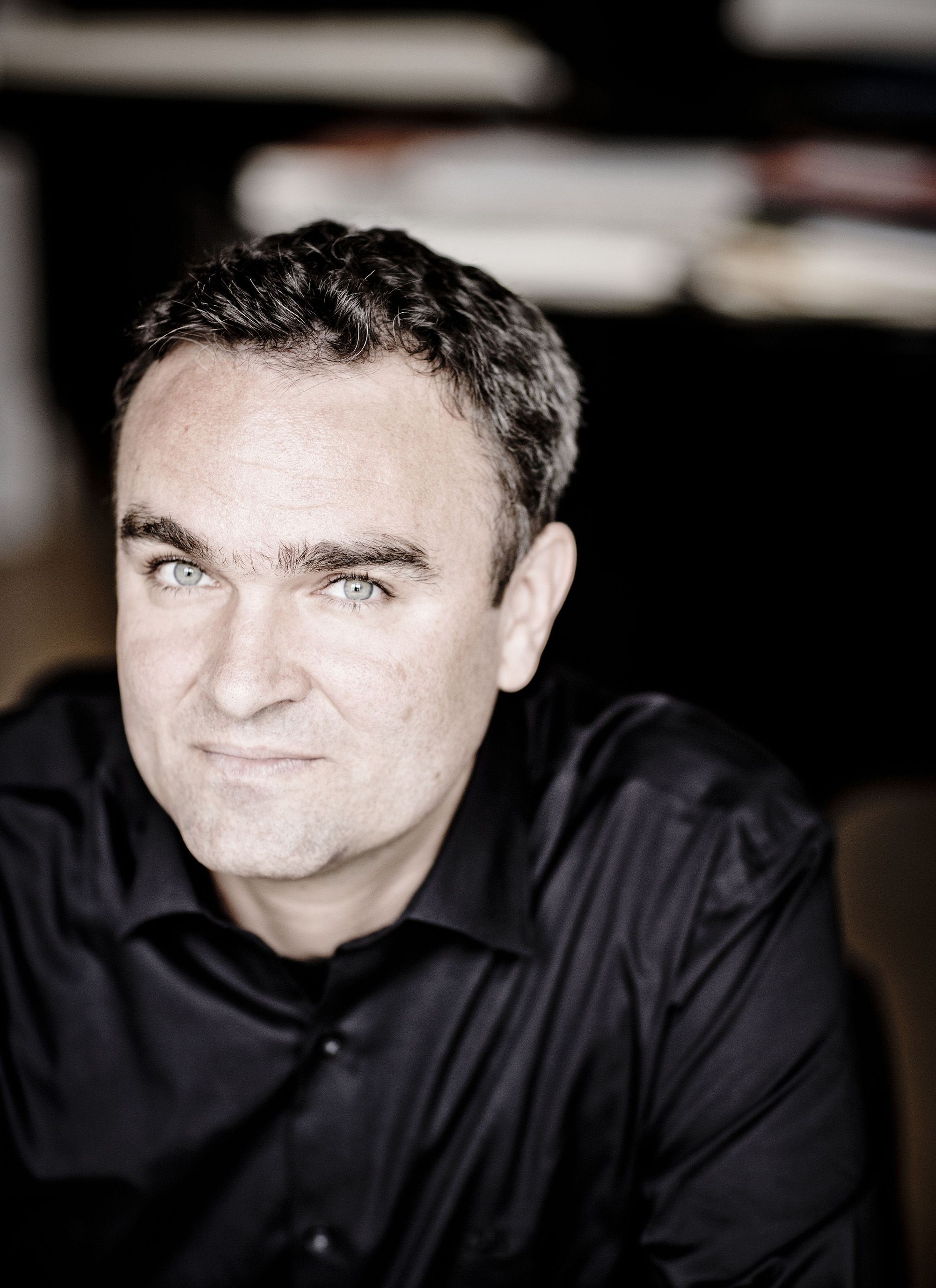
Marco Borggreve
Marco Borggreve
Jörg Widmann is considered one of the most versatile artists of his generation. This season sees him appear in all facets of his work, as a clarinettist, conductor and composer, including his second season as Principal Guest Conductor of the NDR Radiophilharmonie, Creative Partner of Deutsche Radio Philharmonie, Artistic Partner of Riga Sinfonietta and Associate Conductor of the Munich Chamber Orchestra.
Following recent notable conducting projects with orchestras such as the Berlin Philharmonic and Bavarian Radio Symphony Orchestra, this season he appears with Seoul Philharmonic Orchestra and the Barcelona and Taiwan National Symphony orchestras. Other highlights include a residency with the Stavanger Symphony Orchestra; the Spanish premiere of his work Danse macabre, given by the Spanish National Orchestra under his baton; and his debut with the NHK Symphony Orchestra. Re-invitations take him to the Finnish Radio Symphony Orchestra, Irish Chamber Orchestra and Orchestra Ensemble Kanazawa, among others.
Jörg Widmann also continues longstanding chamber music partnerships with renowned artists such as Antoine Tamestit, Sir András Schiff, Carolin Widmann, Sarah Aristidou, Nicolas Altstaedt, Dénes Várjon and the Hagen Quartet, giving chamber music recitals at the Vienna Musikverein, Pierre Boulez Saal in Berlin and Alte Oper Frankfurt.
His compositions are performed regularly by eminent conductors including Daniel Barenboim, Daniel Harding, Kent Nagano, Franz Welser-Möst, Christian Thielemann, Iván Fischer, Andris Nelsons and Sir Simon Rattle, and premiered by ensembles such as the Berlin, New York and Vienna Philharmonic orchestras, Royal Concertgebouw Orchestra, Cleveland Orchestra, Orchestre de Paris and London Symphony Orchestra.
Jörg Widmann studied clarinet with Gerd Starke in Munich and Charles Neidich at the Juilliard School in New York and later became Professor of Clarinet and Composition, first at University of Music Freiburg and, since 2017, as Chair Professor for Composition at the Barenboim-Said Academy Berlin. In 2024 he was named a member of the Royal Swedish Academy of Music.
He studied composition with Kay Westermann, Wilfried Hiller, Hans Werner Henze and Wolfgang Rihm. His works continue to receive many awards, most recently the Bach-Preis der Freien und Hansestadt Hamburg, as well as Musikpreis der Landeshauptstadt München.
Carolin Widmannviolin

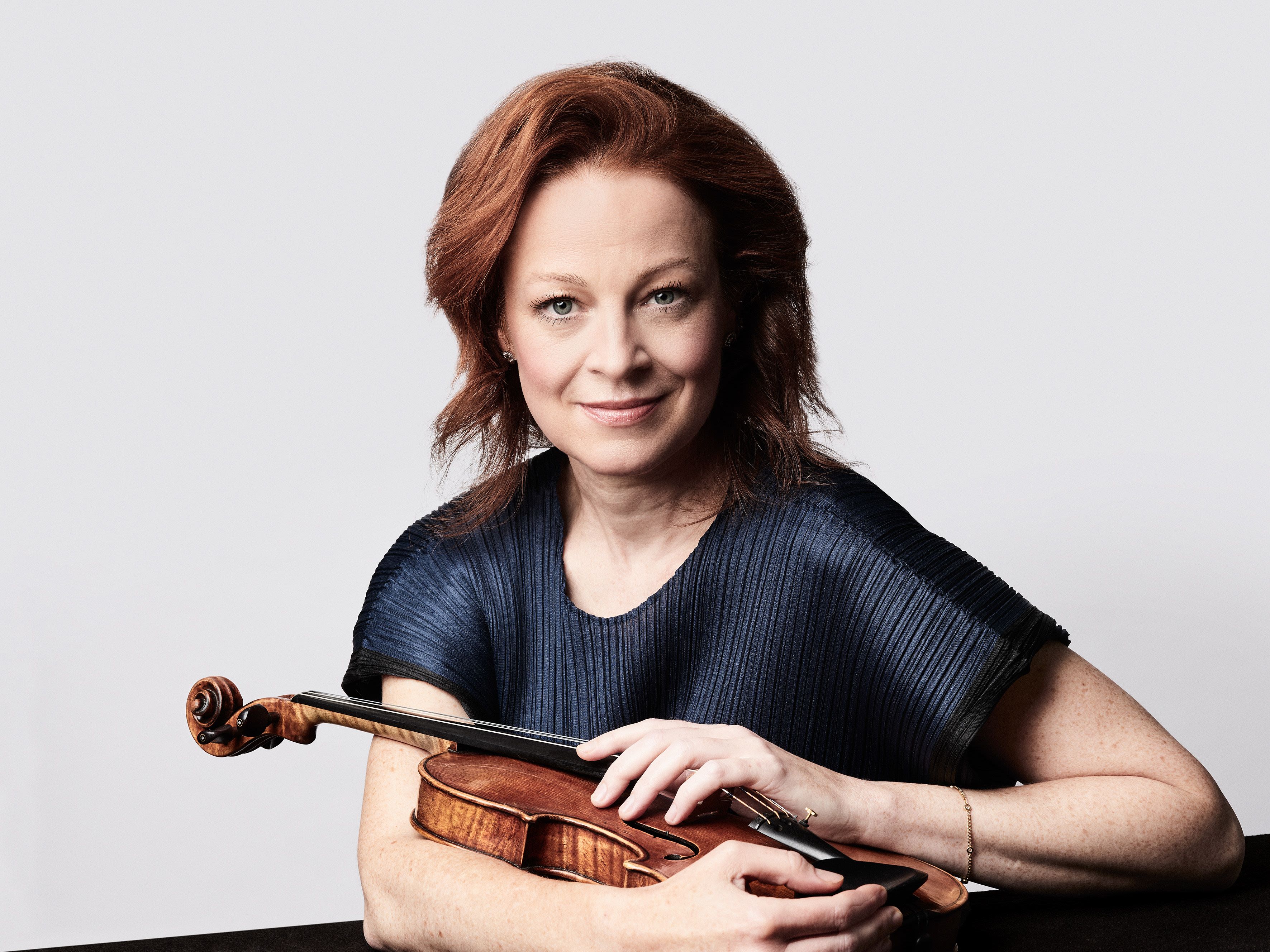
Lennard Ruehle
Lennard Ruehle
Carolin Widmann’s activities span the great classical concertos, new commissions specially written for her, solo recitals and a wide variety of chamber music and period-instrument performances.
She was awarded the Bayerischer Staatspreis for music in 2017, as well as winning the Concerto category of the International Classical Music Awards for her recording of the Mendelssohn and Schumann violin concertos with the Chamber Orchestra of Europe.
She has played with the Berlin, Czech and London Philharmonic orchestras, Orchestre de Paris, Orchestre National de France, Bavarian, Swedish and Vienna Radio Symphony orchestras and BBC Symphony Orchestra, appearing with distinguished conductors, including Sir Simon Rattle, Riccardo Chailly, Edward Gardner, Vladimir Jurowski, Sakari Oramo, Daniel Harding, François-Xavier Roth, Santtu-Matias Rouvali and Jukka-Pekka Saraste. She also appears at leading festivals, including the Berlin, Salzburg, Lucerne, Edinburgh, Prague Spring, Pablo Casals and Paris Autumn, among others.
Recent highlights have included concerts with the Berlin, Los Angeles, Munich and Royal Stockholm Philharmonic orchestras, Deutsches Symphonie-Orchester Berlin, Irish Chamber Orchestra, the Hallé and the Netherlands and Vienna Radio Symphony orchestras and City of Birmingham Symphony Orchestra.
This season she makes debuts with the Danish National Symphony Orchestra, Helsinki and Seoul Philharmonic orchestras, Royal Scottish National Orchestra and the Philadelphia Orchestra. Other highlights include performing the Roberto Gerhard Violin Concerto with the Barcelona Symphony Orchestra, a Kurt-Weill inspired play-direct programme with the Paris Chamber Orchestra and a tribute to Kaija Saariaho with the SWR Symphonieorchester. She is also the Fondazione Arturo Toscanini’s artist-in-residence for the season.
Chamber music performances this season include two recitals at Berlin’s Pierre Boulez Saal; a quartet programme with Nils Mönkemeyer, Julian Steckel and William Youn; a project for violin and electronics; and a return to the Alte Oper Frankfurt.
Carolin Widmann plays a G. B. Guadagnini violin from 1782, on loan from a charitable trust.
BBC National Orchestra of Wales
For over 90 years, the BBC National Orchestra of Wales, the only professional symphony orchestra in Wales, has played an integral part in the cultural landscape of the country, occupying a distinctive role as both a broadcast and national orchestra, and serving as an ambassador of Welsh culture, regularly performing music created in Wales and championing Welsh composers and artists.
Part of BBC Cymru Wales and supported by the Arts Council of Wales, BBC NOW performs a busy schedule of concerts and broadcasts, working with acclaimed conductors and soloists from across the world, including its Principal Conductor, the award-winning Ryan Bancroft.
The orchestra is committed to working in partnership with community groups and charities, taking music out of the concert hall and into settings such as schools and hospitals to enable others to experience and be empowered by music. It undertakes workshops, concerts and side-by-side performances to inspire and encourage the next generation of performers, composers and arts leaders, and welcomes thousands of young people and community members annually through its outreach and education projects.
BBC NOW performs annually at the BBC Proms and biennially at the BBC Cardiff Singer of the World competition, and its concerts can be heard regularly across the BBC – on Radio 3, Radio Wales and Radio Cymru. On screen, music performed by BBC NOW can be heard widely across the BBC and other global channels, including the soundtrack and theme tune for Doctor Who, Planet Earth III, Prehistoric Planet, The Pact and Children in Need.
Based at BBC Hoddinott Hall, Cardiff Bay, BBC NOW utilises a state-of-the-art recording studio with a camera system for livestreams and TV broadcasts to bring BBC NOW’s music to a broader audience across Wales and the world. For more information about BBC NOW please visit bbc.co.uk/now
Patron
HM King Charles III KG KT PC GCB
Principal Conductor
Ryan Bancroft
PrincipalGuest Conductor
Jaime Martín
Conductor Laureate
Tadaaki Otaka CBE
Composer-in-Association
Gavin Higgins
First Violins
Martin Gwilym-Jones sub-leader
Gwenllian Hâf MacDonald
Terry Porteus
Carmel Barber
Alejandro Trigo
Emilie Godden
Juan Gonzalez
Ruth Heney
Kerry Gordon-Smith
Anna Cleworth
Žanete Uškāne
Amy Fletcher
Emma Menzies
Second Violins
Anna Smith *
Ros Butler
Beverley Wescott
Lydia Caines **
Joseph Williams
Michael Topping
Elizabeth Whittam
Violas
Alex Thorndike #
Tetsuumi Nagata
Peter Taylor
Robert Gibbons
Catherine Palmer
Laura Sinnerton
Lowri Taffinder
Lydia Abell
Anna Growns
Cellos
Joely Koos ‡
Raphael Lang
Sandy Bartai
Alistair Howes
Keith Hewitt
Carolyn Hewitt
Rachel Ford
Kathryn Graham
Double Basses
Fabián Galeana
Christopher Wescott
Emma Prince
Yat Hei Lee
Georgina McGrath
Flutes
John Hall †
Lindsey Ellis
Piccolo
Oboes
Amy McKean †
Flic Cowell
Cor anglais
Flic Cowell
Clarinets
Lenny Sayers
Scott Lygate
Bass Clarinet
Lenny Sayers †
Contrabass Clarinet
Scott Lygate
Bassoons
Llinos Owen
Alex Davidson
Contrabassoon
Alex Davidson
Horns
Meilyr Hughes
John Davy
Tom Taffinder
Ed Griffiths
Trumpets
Robert Samuel
Corey Morris †
Trombones
Dafydd Thomas †
Bass Trombone
Tuba
Brian Kingsley
Timpani
Steve Barnard *
Percussion
Phil Girling
Andrea Porter
Harp
Elen Hydref
Celesta
Catherine Roe Williams
* Section Principal
† Principal
‡ Guest Principal
# Assistant String Principal
The list of players was correct at the time of publication
Director Lisa Tregale
Orchestra Manager Liz Williams
Assistant Orchestra Manager Nick Olsen **
Orchestra Personnel ManagerKevin Myers
Business Coordinator Georgia Dandy **
Orchestra Administrator Eleanor Hall +**
Head of Artistic Planning and Productionvacancy
Artists and Projects Manager Victoria Massocchi **
Orchestra Librarian Naomi Roberts **
Producer Mike Sims
Broadcast Assistant Emily Preston
Head of Marketing and Audiences Sassy Hicks
Marketing Coordinator Amy Campbell-Nichols +
Digital Producer vacancy
Social Media Coordinator Harriet Baugh
Education Producers Beatrice Carey, Rachel Naylor maternity cover
Audio Supervisors Simon Smith, Andrew Smillie
Production Business Manager Lisa Blofeld
Stage and Technical Manager Josh Mead +
Assistant Stage and Technical Manager vacancy
+ Green Team member
** Diversity & Inclusion Forum