Liszt
Saint‐Saëns
Ben-Haim
Saturday 27 November, 7.30pm
The Bridgewater Hall, Manchester

Welcome to tonight’s performance
Happy birthday, Stephen Hough! The brilliant pianist and polymath turned 60 this week and celebrates with one of his party pieces: the fizzing Fourth Piano Concerto by Saint-Saëns. Conductor Carlo Goldstein opens with Liszt’s symphonic poem Les préludes and ends with Paul Ben-Haim’s rich, romantic and deeply rewarding Second Symphony, completed in the aftermath of the Second World War.
Our relationship with BBC Radio 3
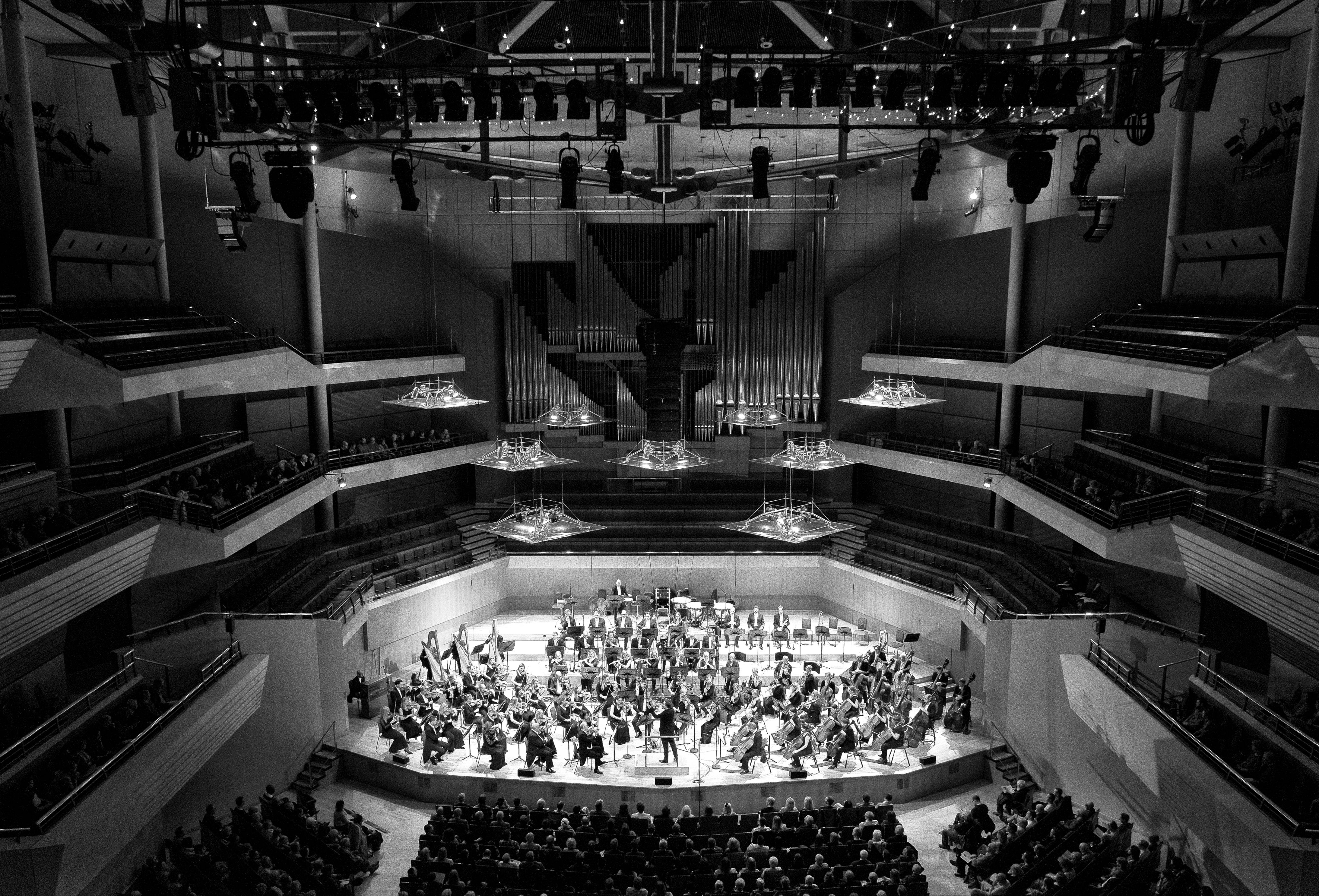
As the BBC’s flagship orchestra for the North, almost all of the BBC Philharmonic’s concerts are recorded for broadcast on Radio 3. Tonight you will see a range of microphones on the stage and suspended above the orchestra. We have a Producer, Assistant Producer and Programme Manager at the orchestra who produce our broadcasts.
We seek to bring a diverse and risk-taking range of repertoire to our audiences, including our concert-goers here in Manchester, as well as the two million listeners who tune in to BBC Radio 3.
Please do not take flash photographs during the performance as this is very distracting to the artists. Audio and video recording is strictly prohibited.
To ensure that everyone can enjoy the concert, please either turn off your phone and any other electronic devices before it begins or ensure that they are turned to silent.

Franz Liszt
Les préludes 15’
Camille Saint-Saëns
Piano Concerto No. 4 in C minor 24’
INTERVAL: 20 minutes
Paul Ben-Haim
Symphony No. 2 41’
Stephen Hough piano
Carlo Goldstein conductor
BBC Philharmonic


Tonight’s concert is being recorded by BBC Radio 3 for broadcast in ‘Radio 3 in Concert’ on Wednesday 1 December at 7.30pm. It will be available for 30 days after broadcast via BBC Sounds, where you can also find podcasts and music mixes.
Franz Liszt (1811–86)
Les préludes (1849–55)

Franz Liszt is perhaps most famous today for the works he composed for solo piano, but he was also responsible for effectively creating a new genre of orchestral music: the symphonic poem, a standalone work generally written in one movement and designed to evoke something very specific in the ears and minds of its listeners. As exemplified by Les préludes, the third of 13 such works he wrote, the symphonic poem was Liszt’s response to the changing musical landscape of the 19th century. In his words, ‘new wine demands new bottles,’ and the symphonic poem was a vessel fit for the music of the future.
A preface to Liszt’s score for Les préludes flagged its source material as an 1823 poem of the same name by French poet-turned-politician Alphonse de Lamartine. ‘What is life but a series of preludes to that unknown hymn,’ suggests the preface, ‘the first solemn note of which is intoned by death?’ It’s a vividly evocative proposition, and wholly disingenuous: Liszt had actually written the music as an overture to a choral cycle called Les quatre élémens (‘The Four Elements’ – earth, air, water and fire), only later repurposing it into this separate work with a very different advertised inspiration. Whatever its origins, it’s a handsome and fluid piece, its opening three-note motif guiding much of the music over some 15 increasingly stirring minutes.
Franz Liszt
Composer, conductor, pianist, womaniser, vagabond: Franz Liszt was among the 19th century’s greatest showmen, a rock star a century before such things existed. But, while Liszt’s technicoloured life has provided grist for biographers’ mills since the 1830s, it’s also served to shade his pioneering achievements.
Born in Hungary and educated in Vienna, Liszt was a child prodigy, performing aged 11 for Beethoven (who allegedly responded by kissing him on the head) and publishing his first piece at 12. He became one of history’s greatest virtuosos, redefining what a performer could do, while essentially inventing the piano recital and touring relentlessly across Europe – and also serving as an influential piano teacher, shaping a generation of pianists who followed in his wake. His immense catalogue of music runs from flamboyant solo showpieces to rich and strange works that still sound ahead of their time, including many informed by his late-life dedication to the Catholic church. He died in 1886, and there’s never been anyone quite like him.
Camille Saint-Saëns (1835–1921)
Piano Concerto No. 4
in C minor, Op. 44 (1875)

1 Allegro moderato – Andante
2 Allegro vivace – Andante – Allegro
Stephen Hough piano
Camille Saint-Saëns’s Fourth Piano Concerto was first heard three weeks after the composer’s 40th birthday, with Saint-Saëns himself – a virtuoso organist and pianist – starring as the soloist in its Paris premiere. However, parts of the concerto’s music appear to have their origins in a much earlier symphonic sketch that the composer wrote and rejected as a 19-year-old, neglected for two decades and then spun out at speed into this invigorating work. It’s the most consistently delightful of his five piano concertos, and a properly showy party-piece for any pianist prepared to take it on.
The concerto is in two movements – but, with each split into distinct sections, it’s just as easily heard in five. The opening Allegro moderato usually feels more moderato than allegro, a slightly cheeky opening melody laying the ground for a pitched battle between piano and orchestra; before the second half, a chorale-like melody serves as the theme for some electrifying variations.
The second movement moves from a firecracker opening via a reflective slower section to an animated finale, the return of the earlier chorale theme (in modified form) heralding a sprint to the finish for piano and orchestra that ends in an honourable tie. Everyone’s a winner.
Camille Saint-Saëns
‘I live in music like a fish in water,’ said Camille Saint-Saëns, and he started swimming at an early age: performing privately at 5 and publicly at 10, studying at the Paris Conservatoire from 13, completing his first symphony by 15. He began his professional life as an organist (the greatest in the world, reckoned Liszt), then took charge of piano studies at a leading music school aged just 25.
His success as a composer came later, and was not always instant: both the exuberant Second Piano Concerto (1868) and the ghoulish Danse macabre (1874) went down poorly at first, but they’re now among his most treasured works. As for the beloved The Carnival of the Animals, Saint-Saëns refused to publish it in his lifetime, fearing it would overshadow his ‘serious’ music – and, to an extent, he’s been proven right. Once seen as radical, he came to be regarded as reactionary by forward thinkers such as Debussy and Stravinsky, whose music he scorned. A lifelong Parisian, he died in his home city almost exactly 100 years ago.
INTERVAL: 20 minutes
Paul Ben-Haim (1897–1984)
Symphony No. 2 (1945)

1 Molto moderato
2 Allegretto vivace
3 Andante affettuoso e languendo
4 Finale: Allegro deciso
‘Wake up with the dawn, O my soul, on the peak of the Carmel above the sea.’
Paul Ben-Haim wrote his First Symphony against the backdrop of the Second World War, completing the orchestrations in 1940 as the Italians bombed his adoptive home city of Tel Aviv. By contrast, Ben-Haim finished his Second (and final) Symphony six weeks after the war had drawn to a close – and from the epigraph on the score (quoted above), borrowed from Polish-born Jewish poet Shin Shalom, it’s clear the composer is facing the future with more optimism than he’d found five years earlier at the start of the conflict.
The radiant opening flute melody sets the tone, gradually unfolding into more expansive territory before returning to its peaceful origins. The lively second movement borrows from a folk-song arrangement Ben-Haim made for pioneering Yemenite Jewish singer Bracha Zefira, though any lyricism that might once have defined the melody is pushed aside by the jumpy, agitated orchestration. The slow third movement – at first melancholy, then almost harrowingly intense – gives way to the Finale’s button-bright opening, which bleeds into a dance before finding its way to a triumphant conclusion. Or, perhaps, to a new beginning – is this, at last, the dawn?
Paul Ben-Haim
Born Paul Frankenburger in Munich, Paul Ben-Haim found early success as an opera conductor in his native Bavaria following his service in the First World War. But the young man’s progress was checked by rising anti-Semitism in Germany – and in 1933, two years after his contract at the Augsburg Opera was abruptly terminated, he emigrated to Tel Aviv in what was then the British Mandate of Palestine, where he dedicated himself to teaching and composition under his newly Hebraized surname.
In the words of his biographer Jehoash Hirshberg, Ben-Haim the composer ‘wanted to express a new Jewish nationalism yet maintain the great heritage of the West’. He did so in a series of orchestral and chamber works – two symphonies, several concertos, chamber music and a wealth of songs – that found international audiences only after the 1948 establishment of the State of Israel, of which Ben-Haim instantly became a citizen. He made his home there until his death, in Tel Aviv, at the age of 86.
Notes and profiles © Will Fulford-Jones
Will Fulford-Jones is a writer and editor who works widely across music and the arts.
BBC Philharmonic
The BBC Philharmonic is reimagining the orchestral experience for a new generation – challenging perceptions, championing innovation and taking a rich variety of music to the widest range of audiences.
The orchestra usually performs around 100 concerts every year, the vast majority broadcast on BBC Radio 3. Along with around 35 free concerts a year at its MediaCityUK studio in Salford and a series of concerts at Manchester’s Bridgewater Hall, the orchestra performs across the North of England, at the BBC Proms and internationally, and records regularly for the Chandos label.
The BBC Philharmonic’s Chief Conductor is Omer Meir Wellber. Described by The Times’s Richard Morrison as ‘arguably the most inspired musical appointment the BBC has made for years’, Israeli-born Wellber burst into his new role at the 2019 BBC Proms and has quickly built an international reputation as one of the most exciting young conductors working today. The orchestra also has strong ongoing relationships with its Chief Guest Conductor John Storgårds and Associate Artist Ludovic Morlot. In May the orchestra announced young British composer and rising star Tom Coult as its Composer in Association.
The scope of the orchestra’s programme extends far beyond standard repertoire. Over the past few years it has collaborated with artists as varied as Clean Bandit, Jarvis Cocker and The Wombats; played previously unheard music by writer-composer Anthony Burgess in a unique dramatisation of A Clockwork Orange; joined forces with chart-toppers The 1975 at Blackpool’s Tower Ballroom; premiered The Arsonists by composer Alan Edward Williams and poet Ian McMillan, the first opera ever written to be sung entirely in a Northern English dialect; and broadcast on all seven BBC national radio networks, from BBC Radio 1 to BBC Radio 6 Music and the BBC Asian Network. Last year the orchestra also entered the UK Top 40 singles chart with ‘Four Notes: Paul’s Tune’.
The BBC Philharmonic is pioneering new ways for audiences to engage with music and places learning and education at the heart of its mission. Outside of the concert hall, it is passionate about taking music off the page and into the ears, hearts and lives of listeners of all ages and musical backgrounds – whether in award-winning interactive performances, schools’ concerts, Higher Education work with the Royal Northern College of Music or the creation of teacher resources for the BBC’s acclaimed Ten Pieces project. Through all its activities, the BBC Philharmonic is bringing life-changing musical experiences to audiences across Greater Manchester, the North of England, the UK and around the world.
First Violins
Yuri Torchinsky Leader
Midori Sugiyama Assistant Leader
Thomas Bangbala Sub Leader
Alison Fletcher *
Kevin Flynn †
Anna Banaszkiewicz-Maher
Martin Clark
Julian Gregory
Karen Mainwaring
Catherine Mandelbaum
Toby Tramaseur
Ian Flower
Second Violins
Lisa Obert *
Glen Perry ‡
Rachel Porteous
Lucy Flynn
Sophie Szabo
Christina Knox
Rebecca Mathews
Claire Sledd
Matthew Watson
Lily Whitehurst
Adam Riding
Oliver Morris
Violas
Kim Makino ‡
Bernadette Anguige †
Kathryn Anstey
Matthew Compton
Ruth Montgomery
Nicholas Howson
Rachel Janes
Roisin Ni Dhuill
Fiona Dunkley
Carolyn Tregaskis
Cellos
Maria Zachariadou ‡
Jessica Schaefer
Rebecca Aldersea
Melissa Edwards
Elinor Gow
Marina Vidal Valle
Elise Wild
Miriam Skinner
Double Basses
Ronan Dunne *
Alice Durrant †
Miriam Shaftoe
Peter Willmott
Lisa Featherston
Mhairi Simpson
Flutes
Victoria Daniel †
Claire Duggan
Piccolo
Jennifer Hutchinson
Oboes
Jennifer Galloway *
Kenny Sturgeon
Cor Anglais
Gillian Callow
Clarinets
John Bradbury *
Daniel Bayley
Bass Clarinet
Colin Pownall
Bassoons
Roberto Giaccagli *
Corinne Crowley
Contrabassoon
Bill Anderson
Horns
Ben Hulme *
Rebecca Hill ¥
Tom Kane
Jonathan Barrett
Jonathan Harris
Trumpets
David Geoghegan §
Gary Farr †
Tim Barber
Trombones
Richard Brown *
Gary MacPhee
Bass Trombone
Russell Taylor
Tuba
Christopher Evans
Timpani
Paul Turner *
Percussion
Paul Patrick *
Geraint Daniel
Emma Crossley
Harry Percy
Edward Cervenka
Harp
Clifford Lantaff *
* Principal
† Sub Principal
‡ Guest Principal
¥ Associate Principal
The list of players was correct at the time of publication
Keep up to date with the
BBC Philharmonic
Listen to our BBC Radio 3 broadcasts via the BBC Sounds app. Visit our website and follow us on Twitter, Facebook and Instagram and sign up to the newsletter
To help us improve our online concert programmes, please take this 5-minute survey
Produced by BBC Proms Publications