
Marches & Melodies
Thursday 25/9/25, 7.30pm
BBC Hoddinott Hall, Cardiff


Robert Schumann, arr. Donal Bannister
Four Marches 18’
Gerald Finzi Clarinet Concerto in C minor 30’
INTERVAL: 20 minutes
César Franck
Symphony in D minor 37’
Gergely Madaras conductor
Nicholas Carpenter clarinet
BBC Hoddinott Hall is certified by EcoAudio and we’re proud to be supporting the BBC in becoming a more sustainable organisation. For more information on the BBC’s net-zero transition plan and sustainability strategy please visit https://www.bbc.co.uk/aboutthebbc/documents/bbc-net-zero-transition-plan-2024.pdf


The concert is being recorded by BBC Radio 3 for broadcast on 25 November in In Concert; it will be available for 30 days after broadcast via BBC Sounds, where you can also find podcasts and music mixes.
Introduction
Welcome to tonight’s concert,the first of the new season at BBC Hoddinott Hall. To conduct it, we’re delighted to welcome back Gergely Madaras for a programme that celebrates our own extraordinary musicians within BBC NOW in music of the 19th and 20th centuries.
Donal Bannister, longtime Principal Trombone of BBC NOW, demonstrates his skills as an arranger with his reworking of Four Marches by Robert Schumann, transforming pieces originally for piano into stirring essays for brass ensemble.
Nicholas Carpenter has been Principal Clarinet of BBC NOW since 2024 and here he shows his skills in Finzi’s gorgeous Clarinet Concerto, a work that balances lyricism with grittier elements.
To finish, one of the greatest of all French symphonies, that of César Franck, who found inspiration in the music of Richard Wagner and transformed it into a sonic spectacular.
Enjoy!
Lisa Tregale
Director
Please respect your fellow audience members and those listening at home: mobile phones may be kept on but on silent and with the brightness turned down; other electronic devices should be switched off during the performance. Photography and recording are not permitted.
Robert Schumann (1810–56) , arr. Donal Bannister
Four Marches, Op. 76(1849)

1 Mit grosser Energie
2 Sehr kräftig
3 Sehr mässig, ‘Lager Scene’
4 Mit kraft und feuer
Schumann’s Four Marches, Op.76 date from 1849 and are a direct response to his witnessing the political unrest in Dresden that year; ‘I did not know of a better way to give vent to my feelings - I wrote them in a fervour’. As such they are highly emotionally charged, tumultuous pieces, containing instructions such as ‘With great energy’ and ‘With power and fire’, the only respite from the drama being the third, ‘Camp Scene’. To call them Marches is actually misleading, they are far more subtle than that, and would be impossible to actually march to. It seems likely that as a personal response to a dramatic event, Schumann felt the need to write them for himself to play.
I have been arranging music for brass ensemble since my student days, and have always found the process of reimagining a piece in a new format fascinating. The most successful arrangements are often those that immediately leap out at you in their new form. The way Schumann notated his piano originals it is almost as if he were including instructions on how to transfer them to an instrumental ensemble; I simply had to follow his instructions and they appeared in their new form. As an orchestral composer, Schumann was progressive in his writing for brass, enthusiastically embracing the new technology of valved instruments, so I hope he would have approved of this reimagining.
Programme note © Donal Bannister
Gerald Finzi (1901–56)
Clarinet Concerto in C minor, Op. 31(1948–9)
1 Allegro vigoroso
2 Adagio, ma senza rigore
3 Rondo: Allegro giocoso
Nicholas Carpenter clarinet
In a helpful round-up of clarinet concertos published in 1962, Burnet C. Tuthill remarked that Finzi’s Clarinet Concerto was ‘One of the best new works’, adding that it was ‘Up to date but not forbiddingly dissonant’. This supposed lack of dissonance (in truth it is not entirely absent) perhaps lent the concerto an immediate appeal at its 1949 premiere; ‘always unpretentious and engaging’ enthused ‘F.H.’ in the Musical Times. It has been understandably popular with generations of clarinettists ever since and – despite not being recorded until the 1970s – remains one of Finzi’s most-performed orchestral works.
Given the above comments about the piece, the opening orchestral salvo may come as a surprise: it is decidedly gritty and forceful, with some cross-sounding leaps up and down the octave and a general atmosphere of foreboding. The soloist arrives as if from another musical universe, smoothing the jagged edges of the orchestra with a quietly lyrical statement. The clarinet does, though, allow itself to get drawn periodically into the spikier mood of the strings. While the first movement had originally concluded with more stabs from the orchestra, Finzi added a brief cadenza for the soloist (suggested by Vaughan Williams after the premiere) along with its own snarly octave leaps.
The touching Adagio, ma senza rigore – the longest movement – is lyrical and melancholy. The opening exchange between first and second violins forms the main material of the movement including the clarinet’s opening, ruminative cadenzas. Soloist and orchestra pass the material back and forth throughout, elaborating on it, sometimes concealing it within a dense texture. The Adagio concludes with a simple, meditative statement before fading into silence.
The dynamic between strings and soloist from the Allegro vigoroso returns, to some degree, in the finale: bristling dissonance from the strings yields to a more playful atmosphere thanks to the clarinettist’s jaunty melodies. Towards the end of the movement, as if to further emphasise the clarinet’s lyrical supremacy, the strings clear a space for echoes of the first movement’s melody. However, the piece concludes with a show-stopping final flourish: trills and flamboyant displays from the soloist, a sparkling cascade from the strings, with everyone hurtling towards an emphatic major chord.
Programme note © Lucy Walker
INTERVAL: 20 minutes
César Franck (1822–90)
Symphony in D minor(1887–8)
1 Lento – Allegro ma non troppo
2 Allegretto
3 Allegro non troppo
Completed in August 1888, the Symphony in D minor belongs to the great compositional flowering of Franck’s final years which also represented the period of his deepest immersion in the music of Wagner. The rich chromaticism reveals an indebtedness to Tristan und Isolde that unleashed a new intensity of expression. Shaking off the shackles of his earlier, more reserved style, Franck found a means of combining the brooding and the monumental with an impassioned sensuality that attracted the admiration and encouragement of his pupils in the ‘bande à Franck’ – d’Indy, Chausson, Holmès and Duparc – composers who, together with Franck, formed the kernel of late 19th-century French Wagnérisme of which the young Debussy was also a part.
When Franck began sketching his symphony in 1887, the writing of such a work was something of a novelty in his native country as French composers had long favoured opera as the genre of international prestige. But, following the humiliating defeat of the Franco-Prussian War of 1870-71, thinking changed: calls for French political and cultural renewal catalysed a new patriotic fervour that led Franck and Saint-Saëns to found the Société Nationale de Musique with the express intention of encouraging their French contemporaries to overturn the traditional dominance of Austro-German composers in symphonic forms.
Inspired by the success of Saint-Saëns’s ‘Organ’ Symphony (1886), Franck decided to try his own hand at a symphony similarly cast in a minor key that transforms into a glowing and triumphant assertion of the major but crafted as a three-movement plan rather than the more classical four. Like Saint-Saëns, Franck also drew substantially on the lessons of his Germanic predecessors but in a different way. While celebrating the innovations of Wagner at every turn, Franck’s preoccupation with cyclic form (where individual themes connect not only each movement, but often the complete work) owed much to his contemplation of late Beethoven, Schubert’s Wanderer Fantasy and Liszt’s thematic transformation. Indeed, the darkly brooding theme that opens the symphony, and on which so much of the work is based, nods at the questioning phrase ‘Muss es sein’ from the enigmatic finale of Beethoven’s last String Quartet, Op. 135.
Although this symphony initially had a mixed reception at its premiere on 17 February 1889 – being unfairly criticised for its complexity of ideas, lumpy orchestration, over-heavy brass and what some considered the extraordinary innovation of a cor anglais solo in the second movement, an idea previously championed by Rossini, Berlioz and Wagner – it soon achieved widespread international success. Debussy accorded the piece significant praise, describing it as ‘a beautiful work of countless wonders’.
Programme note © Caroline Rae
Help Us Improve Our Online Programmes.
Please take this 5-minute survey and let us know what you think of these notes.
Programme Survey
You may also like:
If you’ve enjoyed the concert today, bring friends and family and come along to these forthcoming concerts. As an existing audience member, you can buy tickets for these for £7 using promotion code NOWYOU when buying online.
Celebrating Shostakovich
Friday 03/10/25, 7:30pm
Brangwyn Hall, Swansea
Shostakovich Violin Concerto No. 1
Shostakovich Symphony No. 7, ‘Leningrad’
Ryan Bancroft conductor
Clara-Jumi Kangviolin
POWERFUL | HEROIC | MASTERFUL
Fifty years after his death we celebrate the mastery of Shostakovich in a concert featuring his First Violin Concerto and the mighty Seventh Symphony under the baton of our much-loved Principal Conductor, Ryan Bancroft.
The concerto is an artistic showcase on a mighty scale, from its broodingly dark opening Nocturne to an almost demonic Scherzo complete with a Jewish Klezmer-style dance for clarinet, and a grand Passacaglia to the brilliantly virtuosic Burlesque. Similarly powerful is his ‘Leningrad’ Symphony: this weightily eloquent work treads the line between Stalinist expectation and personal expression surrounding war.
Themes & Variations
Thursday 16/10/25, 7:30pm
BBC Hoddinott Hall, Cardiff
Shostakovich Theme and Variations
Shostakovich Piano Concerto No. 2
Haydn Symphony No. 6, ‘Le Matin’
Brahms Variations on a Theme of Joseph Haydn
Jaime Martín conductor
Alim Beisembayevpiano
INVENTIVE | CHARMING | DISTINGUISHED
In a second nod to Shostakovich in the 50th-anniversary year of his death BBC NOW’s Principal Guest Conductor Jaime Martín presents a programme including his Theme and Variations and Second Piano Concerto.
Written in his teens, the Theme and Variations reveals a fresh, confident voice, while the later concerto bursts with his trademark wit, colour and lyricism – composed as a playful birthday gift for his son Maxim.
Exploring further sets of themes and variations, Brahms’s Variations on a Theme of Haydn show his fascination with musical lineage, while Haydn’s own Symphony No. 6, ‘Le Matin’ opens the programme with brightness and charm.
Biographies
Gergely Madaras conductor

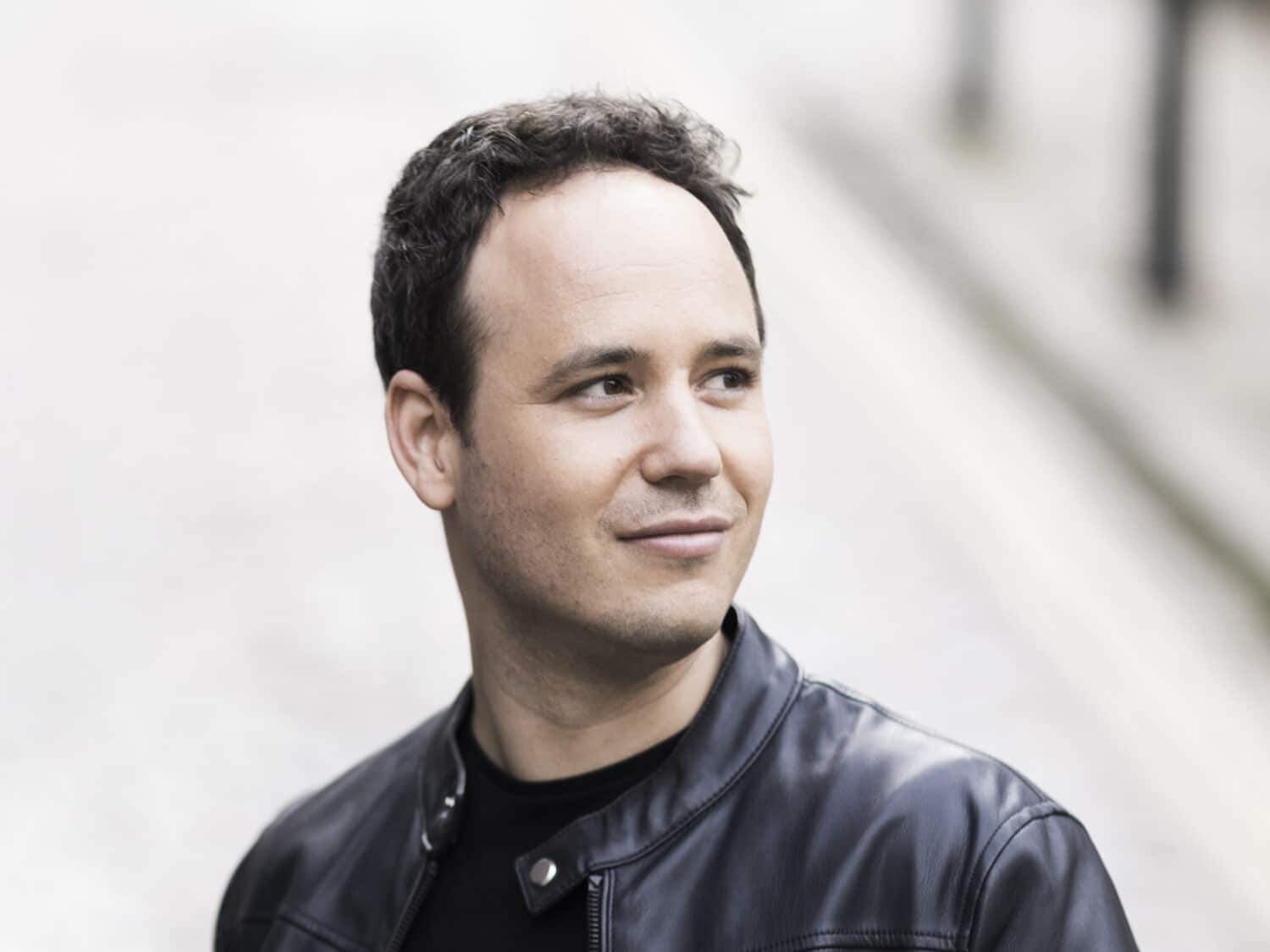
Benjamin Ealovega
Benjamin Ealovega
Hungarian conductor Gergely Madaras was named 2025 Conductor of the Year at the Bartók Radio Awards. He served as Music Director of the Liège Royal Philharmonic Orchestra from 2019 to 2025 where his successful tenure was recently marked by him being named an Honorary Citizen of the City.
This season includes high-profile debuts with the Dresden, Hong Kong and Tampere Philharmonic orchestras, NDR Elbphilharmonie, Dresden Staatskapelle, Palau de la Música, Valencia, Mulhouse and Trondheim Symphony orchestras, as well as with Welsh National Opera (Tosca). He returns to the Bournemouth and NHK Symphony orchestras, Luxembourg, Oslo, Turku and Warsaw Philharmonic orchestras, as well as Hungarian State Opera and a special project with Hungarian Radio Symphony celebrating the 100th birthday of György Kurtág in 2026.
Recent symphonic highlights include performances with the BBC, London, Monte-Carlo, Oslo and Royal Philharmonic orchestras, Budapest Festival Orchestra, BBC, City of Birmingham and São Paulo State Symphony orchestras, Hallé, Jewish World Orchestra, Orchestre Philharmonique de Radio France, Toulouse Capitole Orchestra, Orchestra Sinfonica Nazionale della RAI and a tour with Il Pomo d’Oro and Joyce DiDonato.
Gergely Madaras was the inaugural Sir Charles Mackerras Fellow at the English National Opera. In recent seasons he has conducted critically acclaimed productions at the Dutch National Opera, Geneva’s Grand Théâtre and La Monnaie, Brussels, and Hungarian State Opera.
Nicholas Carpenterclarinet


Nicholas Carpenter studied the clarinet at the Royal College of Music with Thea King and John McCaw. Immediately upon leaving, he joined the Bournemouth Sinfonietta as Principal Clarinet and held that position for 10 years.
In 1995 he was invited to join the London Philharmonic Orchestra, where he remained for the next 18 years playing Principal, E flat and Sub-principal Clarinet. While there he also appeared as guest principal clarinet with virtually every professional orchestra in England.
Chamber music has also been an integral part of his career, particularly with members of the London Philharmonic and Academy of St Martin in the Fields. He has appeared many times at the Wigmore Hall as well as venues around UK and internationally, and his recording of Mozart’s Clarinet Quintet was chosen as Best Recording in BBC Radio 3’s Building a Library.
He is much in demand as a teacher and woodwind coach and has regularly given masterclasses throughout the UK and abroad. He taught at the Guildhall School of Music & Drama (2006–17), was Head of Woodwind at the Royal Welsh College of Music & Drama (2017–20) and now teaches the clarinet at RWCMD and Trinity College, London.
Recent appearances as guest principal clarinet have included with Royal Opera, Covent Garden, Royal Philharmonic Orchestra and Royal Liverpool Philharmonic Orchestra and Philharmonia. He also appears on many contemporary soundtracks, such as the films Fantastic Beasts and Where to Find Them and Avengers: Endgame.
In 2021 he was appointed Principal Clarinet with the BBC Concert Orchestra and last year he was appointed Principal Clarinet with BBC National Orchestra of Wales.
BBC National Orchestra of Wales
For over 90 years, the BBC National Orchestra of Wales, the only professional symphony orchestra in Wales, has played an integral part in the cultural landscape of the country, occupying a distinctive role as both a broadcast and national orchestra, and serving as an ambassador of Welsh culture, regularly performing music created in Wales and championing Welsh composers and artists.
Part of BBC Cymru Wales and supported by the Arts Council of Wales, BBC NOW performs a busy schedule of concerts and broadcasts, working with acclaimed conductors and soloists from across the world, including its Principal Conductor, the award-winning Ryan Bancroft.
The orchestra is committed to working in partnership with community groups and charities, taking music out of the concert hall and into settings such as schools and hospitals to enable others to experience and be empowered by music. It undertakes workshops, concerts and side-by-side performances to inspire and encourage the next generation of performers, composers and arts leaders, and welcomes thousands of young people and community members annually through its outreach and education projects.
BBC NOW performs annually at the BBC Proms and biennially at the BBC Cardiff Singer of the World competition, and its concerts can be heard regularly across the BBC – on Radio 3, Radio Wales and Radio Cymru. On screen, music performed by BBC NOW can be heard widely across the BBC and other global channels, including the soundtrack and theme tune for Doctor Who, Planet Earth III, Prehistoric Planet, The Pact and Children in Need.
Based at BBC Hoddinott Hall, Cardiff Bay, BBC NOW utilises a state-of-the-art recording studio with a camera system for livestreams and TV broadcasts to bring BBC NOW’s music to a broader audience across Wales and the world. For more information about BBC NOW please visit bbc.co.uk/now
Patron
HM King Charles III KG KT PC GCB
Principal Conductor
Ryan Bancroft
PrincipalGuest Conductor
Jaime Martín
Conductor Laureate
Tadaaki Otaka CBE
Composer-in-Association
Gavin Higgins
First Violins
Suzanne Casey
Žanete Uškāne
Alejandro Trigo
Emilie Godden
Ruth Heney **
Kerry Gordon-Smith
Anna Cleworth
Carmel Barber
Gary George-Veale
Rebecca Totterdell
Zhivko Georgiev
Second Violins
Emily Davis ‡
Ros Butler
Sheila Smith
Roussanka Karatchivieva
Joseph Williams
Michael Topping
Vickie Ringguth
Katherine Miller
Lydia Caines **
Beverley Wescott
Laurence Kempton
Elizabeth Whittam
Violas
Lowri Taffinder
Robert Gibbons
Lucy Theo
Sharada Mack
Cellos
Morwenna Del Mar
Raphael Lang
Sandy Bartai
Keith Hewitt
Rachel Ford
Carolyn Hewitt
Alistair Howes
Kathryn Graham
Double Basses
David Stark *
Emma Prince
Christopher Wescott
Phoebe Clarke
Imogen Fernando
Oboes
Amy McKean †
Peter Facer
Cor anglais
Clarinets
Jennie Joy Porton
Bass Clarinet
Bassoons
Jarosław Augustyniak *
Dominic Tyler
Dave Ransom
Tom Taffinder
Trumpets
Will Morley
Corey Morris †
Cornets
Corey Morris
Carys Wood
Trombones
Simon Wills
Bass Trombone
Tuba
Timpani
Harp
* Section Principal
† Principal
‡ Guest Principal
# Assistant String Principal
The list of players was correct at the time of publication
Director Lisa Tregale
+ Green Team member
Keep up to date with BBC National Orchestra of Wales
Listen to our BBC Radio 3 broadcasts via the BBC Sounds app. Visit our website and follow us on Facebook and Instagram
To help us improve our online concert programmes, please take this 5-minute survey
Produced by BBC Proms Publications


