
Bartók’s Concerto for Orchestra
Thursday 9/5/24, 7.30pm
BBC Hoddinott Hall, Cardiff
Friday 10/5/24, 7.30pm
Brangwyn Hall, Swansea


Caroline Shaw
The Observatory UK premiere 16’
Maurice Ravel
Piano Concerto in G major25’
INTERVAL: 20 minutes
Béla Bartók
Concerto for Orchestra 36’
Giancarlo Guerreroconductor
Sergio Tiempo piano


The concert in Cardiff is being recorded by BBC Radio 3 for future broadcast in Radio 3 in Concertand filmed for future release in the BBC National Orchestra of Wales Digital Concert Series. The concert in Swansea is being recorded by BBC Radio 3 for future broadcast in BBC Radio 3’s Afternoon Concert. They will be available for 30 days after broadcast via BBC Sounds, where you can also find podcasts and music mixes.
Introduction

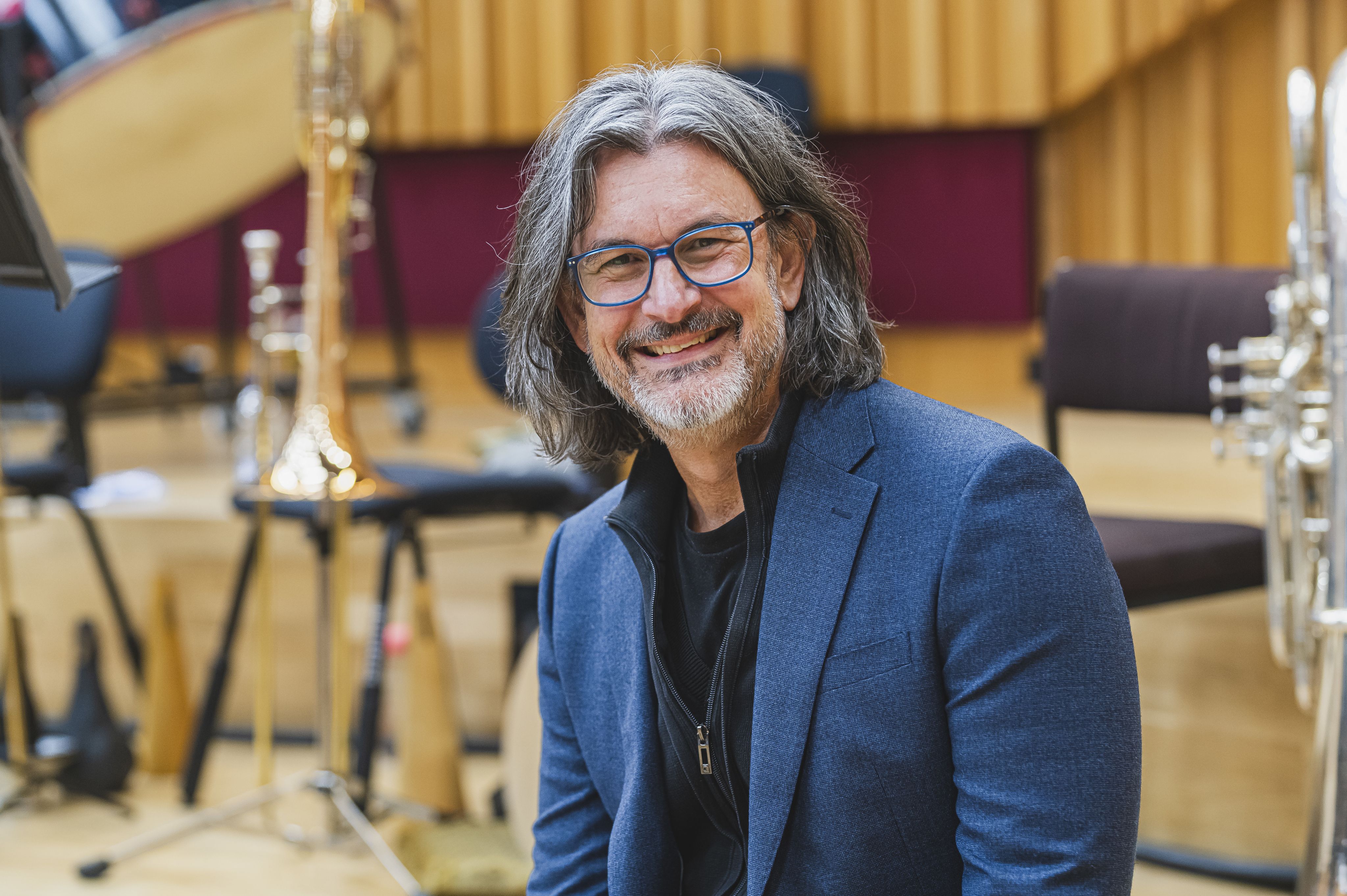
Photo: Kirsten McTernan
Photo: Kirsten McTernan
For tonight’s concert we’re delighted to welcome Grammy Award-winning conductor Giancarlo Guerrero.
He has a particular passion for contemporary music, so it’s fitting that the programme begins with the UK premiere of The Observatory by Caroline Shaw. It was written for the Los Angeles Philharmonic and she found herself drawing on influences as diverse as cosmology, the skyline of Los Angeles and sci-fi soundtracks to create a work that is full of colour and energy.
Those qualities apply equally to Bartók’s last orchestral work, his genre-bending Concerto for Orchestra. He wrote it in the USA, after being forced by the rise of Nazism to leave his beloved Hungary. It’s a work that travels from seriousness in its opening movement to an irrepressible optimism in the last one, and along the way every instrumental group gets an opportunity to shine.
In between comes Ravel’s Piano Concerto in G major, for which we’re delighted to welcome Sergio Tiempo. Like the other works tonight, this piece has a connection to America, having been written after a US tour Ravel undertook where, as well as performing as pianist, he found time to listen to jazz with George Gershwin and bandleader Paul Whiteman. Back home in France, he proceeded to work jazz elements into this dazzling concerto, which contrasts extreme virtuosity in the outer movements with a slow movement that is as movingly songful as anything he composed.
Enjoy!
Matthew Wood
Head of Artistic Planning and Production
Please respect your fellow audience members and those listening at home. Turn off all mobile phones and electronic devices during the performance. Photography and recording are not permitted.
Caroline Shaw(born 1982)
The Observatory(2019)
UK premiere

Creating a score for full orchestra can feel like simultaneously standing on a mountaintop, scrubbing your kitchen floor, swimming in the middle of a lake, riding on the subway during rush hour and gently holding someone’s hand. It’s not a medium that I work in very often. I always try to write for the particular environment (place, ensemble or person, time of year, etc.) in which the music will first be heard (in this case: the Hollywood Bowl, the LA Phil, the brilliant Xian Zhang, the heat of August 2019). It’s a fun constraint, and it helps keep the writing personal and connected to the real world. The first and only time I had ever been to the Hollywood Bowl was in September 2015, singing with Kanye at the 808s & Heartbreak show. It was a wild ride, and I remember feeling like an observer of a mysterious workshop that somehow churned beauty out of chaos. There is also something about writing an orchestral work for a summer evening in Hollywood that got me thinking about my favourite genre of film and storytelling: sci-fi. I love the way epic tales of the beyond can zoom in and out, using grand imagined alternate universes to tell stories about ourselves. And I love the way the music in these films carves and colours our attention to those worlds.
While writing music, I often imagine some kind of visual element (usually abstract, sometimes figurative, rarely narrative) as a guide for myself and sometimes as a thing to write against. There’s an invisible counterpoint here, but I’d rather someone simply listen and create their own contrapuntal narrative adventure than read an account of mine – to leave space for one’s own observation and reflection, whether it be of the music or their neighbour’s T-shirt or cosmology or tomorrow’s grocery list. (The grand story arcs of our lives sometimes play out in minutiae and the mundane.) And often the imagined visuals that I write to are nothing more than shifts in colour or a quick cut between undefined scenes. (Sometimes the juxtapositions and transitions [and parentheticals] are where the stories are.)
I was in the midst of writing The Observatory while in LA earlier in 2019 to record some vocals (hi, Teddy Shapiro!). So one morning before our session I went up to the Griffith Observatory to clear my head. I looked down at the city with all its curves and edges (thanks, John Legend) and up at the sky, which has been observed and wondered about since the beginning of consciousness. I had been thinking about my friend Kendrick Smith, a cosmologist at the Perimeter Institute (and also my favourite grill master). Kendrick is at the cutting edge of the ancient tradition of stargazing, constructing new frameworks for analysing data collected by the CHIME radio telescope. My simplistic distillation of his work: Kendrick develops ways of looking at ways of looking at the universe. Sometimes I think maybe that’s what music is. Or maybe it’s just a way to acknowledge and pass the time.
If you’ve got this far in the programme note, you’re probably wondering if I’ll actually talk about the music you will hear in The Observatory. OK. There are some very large chords, and some very large spaces. There are patterns and details of movements of patterns (thanks, T. S.). There are motifs that appear in diminution and augmentation simultaneously, like objects in orbit at different phases. There is foreground and background. There is love for Andrew Norman. There are references to Richard Strauss’s Don Juan, Bach’s Brandenburg Concerto No. 3, Sibelius’s Symphony No. 2, Brahms’s Symphony No. 1 and even the arpeggiated chimes used to summon audiences to their seats at orchestral concerts. There is celebration and criticism of systems. There is chaos and clarity. The very large chords return at the end, but their behaviour is not the same as when we began. Welcome to The Observatory.
Programme note © Caroline Shaw
Maurice Ravel(1875–1937)
Piano Concerto in G major(1929–31)
1 Allegramente
2 Adagio assai
3 Presto
Sergio Tiempo piano
In 1928 Ravel went on a four-month concert tour of North America, during which he played his Sonatine and excerpts from Miroirs, and was generally feted at performances of his music by other musicians. In Hollywood he posed for pictures with Douglas Fairbanks and Mary Pickford and spent several evenings in Harlem listening to jazz with George Gershwin and the bandleader Paul Whiteman. Jazz was not new to Ravel, but after his American tour he absorbed it more deeply than before and found an outlet for his enthusiasm in two very different works, both piano concertos.
He began the Piano Concerto in G major in 1929 but interrupted work on it when commissioned to compose a second concerto, for left hand only, by the Austrian pianist Paul Wittgenstein (brother of the philosopher Ludwig), who had lost his right arm in the First World War. Ravel deliberately made that a grander, heavier piece to compensate for its technical limitations, in contrast to which the G major Concerto was, he said, written in the spirit of Mozart and Saint-Saëns. Yet, despite the transparency of the piano part and the relatively modest-sized orchestra, the G major Concerto is in fact tremendously demanding, the outer movements calling for spectacular agility, not only from the pianist but also from the woodwind and brass players.
A far from complete pianist, Ravel caused his friends and colleagues considerable anxiety by announcing that he intended to play the solo part himself and wanted to take the concerto on a world tour. Declining health modified his ambitions, and so he conducted the first performance, in Paris in January 1932 with Marguerite Long as soloist, after which they played the work in some 20 European cities, including London.
A crack of a whip sets the brilliant first movement spinning – the piccolo playing a jaunty tune against the piano’s glittering accompaniment, right hand on white notes, left on black. The circus atmosphere is well and truly clinched when sprays of piano glissandos cue in the trumpet, which takes over the tune from the piccolo. Abruptly, the buoyant mood collapses and the pace slackens in a sultry jazz style, with blue notes and swoons. But, just as Ravel starts getting tender, he recovers his wits and the brittle, syncopated activity of the opening. The entire movement is a dialogue of these contrasts, alternating fast and slow, and brimming with melodies. The solo cadenza is short and fully written-out, continuous trills in the right hand slithering around in imitation of a flexatone or musical saw, and leading to the grandest moment, when the piano decks out one of the slow themes in sonorous textures – the closest Ravel gets to the Romantic style of concerto.
There’s none of that in the slow movement, but a sober reconstruction of the Classical style – although no 18th-century composer would have composed such a seemingly endless melody as the piano’s opening solo. (Ravel said his model was Mozart’s Clarinet Quintet.) Its purity is then gradually sullied until the tune is recovered by the cor anglais.
The finale returns to the spirit of entertainment, framed by four cheeky, emphatic chords, and punctuated throughout with throwaway fanfares, shrieks and cackles on the woodwind and brass, partly inspired by the example of jazz bands, while the piano races on, challenged at one point by two very athletic bassoons.
Programme note © Adrian Jack
INTERVAL: 20 minutes
Béla Bartók (1881–1945)
Concerto for Orchestra (1943, rev. 1945)
1 Introduzione (Introduction)
2 Giuoco delle coppie (Game of Pairs)
3 Elegia (Elegy)
4 Intermezzo interrotto (Interrupted Intermezzo)
5 Finale
Acolourful showpiece, and probably the most popular of Bartók’s orchestral works, the Concerto for Orchestra was composed in the USA, where Bartók and his wife, the pianist Ditta Pásztory, had moved in 1940 to escape fascism and war in their native Hungary. At this time, Bartók’s career, health and finances were in decline. His 60th birthday in 1941 had passed by unhonoured in his adopted home country.
While in hospital with suspected tuberculosis in May 1943, Bartók was visited by the conductor and patron Serge Koussevitzky, who offered him $1,000 for a new orchestral piece. Bartók wrote most of the work over two months while staying at a ‘cure cottage’ near Lake Saranac in upstate New York, shielded from the hubbub of New York City.
Bartók may have deliberately set out to avoid writing a ‘symphony’, regarding that as an outdated form and, while the concerto model had existed for more than two centuries, the idea of a concerto for orchestra was quite new. His aim was ‘to treat the single instruments or instrumental groups in a concertant or soloistic manner’. It is this that gives rise to a rich variety of orchestral textures. Bartók noted: ‘The general mood of the work represents, apart from the jesting second movement, a gradual transition from the sternness of the first movement and the lugubrious death-song of the third, to the life-assertion of the last one.’
After the ‘Introduction’ comes the jesting ‘Game of Pairs’ in which, in the manner of Noah’s Ark, instruments enter two by two, playing at fixed intervals apart: bassoons in sixths, oboes in thirds, clarinets in sevenths, and so on. The central ‘death-song’ features elements of Bartók’s ‘night-music’ style: nocturnal, magical, occasionally disturbing. (It’s hard to believe Bernard Herrmann didn’t borrow elements of this for his Hitchcock film scores.) The uncharacteristically nostalgic, lyrical tune on violas in the fourth movement quotes a popular nationalistic song, ‘You are lovely, you are beautiful, Hungary’. A whooping call on horns opens the finale, a fizzing series of dances that show off the orchestra’s flair and virtuosity as individuals and as a collective.
Programme note © Edward Bhesania
Help Us Improve Our Online Programmes.
Please take this 5-minute survey and let us know what you think of these notes.
Programme Survey
You may also like:
A Little Night Music
Thursday 16/5/24, 7.30pm
BBC Hoddinott Hall, Cardiff
Fauré Pelléas et Mélisande – suite
Stephen McNeff The Celestial Stranger world premiere
Schoenberg Verklärte Nacht (1943 version)
Joana Carneiro conductor
Gavan Ring tenor
REVOLUTIONARY | PROFOUND | ILLUMINATING
Celestial, sparkling lights glitter in this evening of ground-breaking music. Fauré’s suite from Pelléas et Mélisande opens in resplendent yet tumultuous style – the first musical setting of Maurice Maeterlinck’s play of the same name, which would inspire other composing greats, including Debussy, Sibelius and Schoenberg.
We move to more ethereal heights with the world premiere of Stephen McNeff’s The Celestial Stranger; then, 150 years since the birth of Schoenberg, we celebrate this radical composer with a performance of Verklärte Nacht (Transfigured Night), an early work that first made the name of a man who would change the course of musical history when he created dodecaphonic music, more commonly known as serialism. To conduct BBC NOW for the first time we welcome the wonderful Portuguese conductor Joana Carneiro.
Season Closing Concert
Thursday 6/6/24, 7.30pm
BBC Hoddinott Hall, Cardiff
Friday 7/6/24, 7.30pm
Brangwyn Hall, Swansea
Dvořák Cello Concerto
Jennifer Higdon Blue Cathedral
Dawson Negro Folk Symphony
Ryan Bancroft conductor
Alisa Weilerstein cello
INSPIRING | ICONIC | MULTIFARIOUS
Globally renowned cellist Alisa Weilerstein joins BBC NOW in this season-closing concert for one of the most beloved of all cello concertos. Melodic genius, irrepressible energy and a love of his native folk music radiate as Dvořák looks back on a life well lived, one of joy but also of deep loss. Similarly, intuitive musical invention, rich orchestration and an exploration of the cathedral ‘as a symbolic doorway into and out of this world’ form a platform for floating and contemplative other-worldly atmospheres in Jennifer Higdon’s Blue Cathedral.
Picture the scene: November 1934, Carnegie Hall and a brand-new symphony is unveiled, receiving rapturous applause from the audience and multiple bows from its unassuming composer. That composer was William Dawson, a 35-year-old African American man who had run away from home aged 13 to follow his dream of studying music; and the piece – the Negro Folk Symphony. With melodies that ooze both sensuousness and directness, Dawson set out to compose music that was ‘unmistakably not the work of a white man’ and found his inspiration in the African American folk music he had learnt as a small child growing up in the Deep South. Who better to conduct this expertly crafted and highly emotionally charged symphony than our American-born Principal Conductor Ryan Bancroft?
Biographies
Giancarlo Guerreroconductor

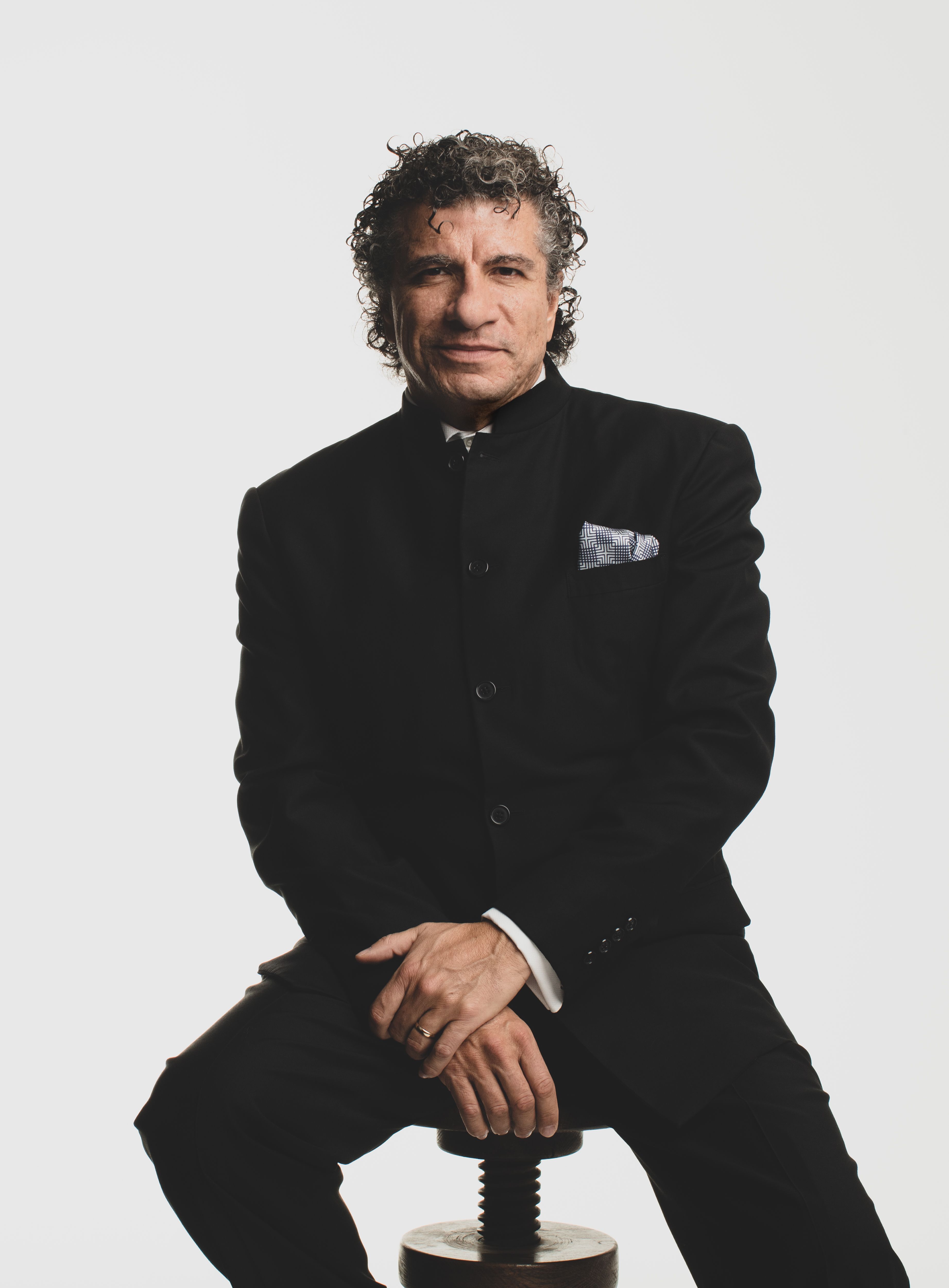
Photo: Lukasz Rajchert
Photo: Lukasz Rajchert
Giancarlo Guerrero is a six-time Grammy Award-winning conductor and Music Director of the Nashville Symphony Orchestra.
Through commissions, recordings and world premieres, he has championed the music of prominent American composers. He has led the Nashville Symphony in 11 world premieres and 15 recordings of American music, including works by Michael Daugherty, Terry Riley, Jonathan Leshnoff and John Adams.
Together with composer Aaron Jay Kernis, he founded the Nashville Symphony’s biannual Composer Lab and Workshop for young and emerging composers.
This season he returns to the Bilbao, Chicago and New Zealand Symphony orchestras, Brussels Philharmonic, Gulbenkian Orchestra and Civic Orchestra of Chicago.
Highlights of recent seasons include concerts with the London, Los Angeles, Netherlands and New York Philharmonic orchestras, Boston, Baltimore, Cincinnati, Dallas, Detroit, Frankfurt Radio, Galicia, Houston, Indianapolis, Milwaukee, Montreal, Queensland, San Francisco, Seattle, Sydney, Toronto and Vancouver Symphony orchestras and National Symphony Orchestra, Washington DC, Cleveland, Philadelphia, Deutsches Symphonie-Orchester Berlin, Orchestre Philharmonique de Radio France, NDR Radiophilharmonie and Deutsche Radio Philharmonie, among others.
He recently completed a six-season tenure as Music Director of the NFM Wrocław Philharmonic, with which he made three albums, including repertoire by Brahms, Poulenc and Jongen.
He previously held posts as the Principal Guest Conductor of both the Cleveland Orchestra Miami Residency and the Gulbenkian Orchestra, Music Director of the Eugene Symphony Orchestra and Associate Conductor of the Minnesota Orchestra.
Giancarlo Guerrero was born in Nicaragua and emigrated as a child to Costa Rica, where he joined the local youth orchestra. He studied percussion and conducting at Baylor University in Texas and earned his master’s in conducting at Northwestern University. He has a particular passion for working with youth orchestras and has worked with the Curtis Institute, Colburn School in Los Angeles, National Youth Orchestra (NYO2) and Yale Philharmonia, as well as with the Nashville Symphony Orchestra’s Accelerando programme, which provides an intensive music education to promising young students from diverse ethnic backgrounds.
Sergio Tiempo piano


Photo: Sussie Ahlburg
Photo: Sussie Ahlburg
Sergio Tiempo is admired for interpretations that combine insight and virtuosity, performing repertoire that ranges from Beethoven to Ginastera.
His career began more than 35 years ago, when he made his professional debut at Amsterdam’s Concertgebouw at the age of 14. He has since performed with leading orchestras worldwide, including, in the past five years, the Berlin, Los Angeles and New York Philharmonic orchestras, Boston, Montreal and São Paulo Symphony orchestras and Philadelphia Orchestra.
Born in Caracas, Venezuela, he began his piano studies with his mother, Lyl Tiempo. He paid tribute to her and some of his other closest musical influences in his latest album Hommage (released last year). Among these are his sister and regular recital partner Karin Lechner, Martha Argerich, Nelson Freire, Mischa Maisky and his teacher Alan Weiss.
Additionally, he has worked with Dmitri Bashkirov, Fou Ts’ong, Murray Perahia and Dietrich Fischer-Dieskau. He has performed with conductors such as Claudio Abbado, Marin Alsop, Myung-Whun Chung, Sir Mark Elder, Christoph Eschenbach, Thierry Fischer, Emmanuel Krivine, Ken-David Masur, Ludovic Morlot, Yannick Nézet-Séguin, Alondra de la Parra, Rafael Payare, Alexander Prior, Leonard Slatkin, Michael Tilson Thomas, Xian Zhang and, most notably, with his fellow countryman Gustavo Dudamel; highlights with Dudamel have included the premiere of Esteban Benzecry’s piano concerto Universos Infinitos and Ginastera’s Piano Concerto No. 1, with which he made his debut with the Berlin Philharmonic.
As a recitalist Sergio Tiempo has appeared at London’s Queen Elizabeth Hall and Wigmore Hall, Vienna Konzerthaus and Berlin Philharmonie. He has performed at leading festivals, including Edinburgh, Klavier Festival Ruhr, George Enescu, Oslo Chamber, Warsaw Chopin and Lugano; he has also given recital tours across China, Korea, Italy and North and South America.
BBC National Orchestra of Wales
For over 90 years, BBC National Orchestra of Wales has played an integral part in the cultural landscape of Wales, occupying a distinctive role as both broadcast and national symphony orchestra. Part of BBC Wales and supported by the Arts Council of Wales, it has a busy schedule of live concerts throughout Wales, the rest of the UK and the world.
The orchestra is an ambassador of Welsh music and champions contemporary composers and musicians; its concerts can be heard regularly across the BBC – on Radio 3, Radio Wales and Radio Cymru.
BBC NOW works closely with schools and music organisations throughout Wales and regularly undertakes workshops, side-by-side performances and young composer initiatives to inspire and encourage the next generation of performers, composers and arts leaders.
The orchestra is based at BBC Hoddinott Hall in Cardiff Bay, where its purpose-built studio not only provides the perfect concert space, but also acts as a broadcast centre from where its live-streamed concerts and pre-recorded content are presented as part of its popular Digital Concert Series.
For further information please visit the BBC National Orchestra and Chorus of Wales’s website: bbc.co.uk/now
Patron
HM King Charles III KG KT PC GCB
Principal Conductor
Ryan Bancroft
Conductor Laureate
Tadaaki Otaka CBE
Composer-in-Association
Gavin Higgins
Composer Affiliate
Sarah Lianne Lewis
First Violins
Lesley Hatfield leader
Nick Whiting associate leader
Gwenllian Hâf MacDonald
Terry Porteus
Suzanne Casey
Juan Gonzalez
Žanete Uškāne
Ruth Heney
Carmel Barber
Anna Cleworth
Emilie Godden
Amy Fletcher **
Paul Mann **
Marike Kruup **
SecondViolins
Martyn Jackson ‡
Sheila Smith
Beverley Wescott
Ilze Abola
Vickie Ringguth
Roussanka Karatchivieva
Joseph Williams
Lydia Caines
Michael Topping
Elizabeth Whittam **
Gary George-Veale **
Laurence Kempton **
Violas
Joel Hunter ‡
Alex Thorndike #
Tetsuumi Nagata
Peter Taylor
Robert Gibbons
Lydia Abell
Anna Growns
Lowri Taffinder
Catherine Palmer
Charlotte Limb **
Cellos
Alice Neary *
Jessica Feaver
Sandy Bartai
Carolyn Hewitt **
Keith Hewitt
Alistair Howes
Rachel Ford
Kathryn Graham **
Double Basses
Alexander Jones #
Georgia Lloyd
Christopher Wescott
Richard Gibbons
Antonia Bakewell **
Thea Sayer **
Flutes
Matthew Featherstone *
John Hall †
Lindsey Ellis
Piccolo
Lindsey Ellis †
Oboes
Adrian Wilson ‡
Amy McKean †
Patrick Flanagan
Cor anglais
Patrick Flanagan
Clarinets
Nick Carpenter *
Robert Digney
Lenny Sayers
Bass Clarinet
Lenny Sayers †
Bassoons
Jarosław Augustiniak *
Lois Au
David Buckland
Contrabassoon
David Buckland †
Horns
Tim Thorpe *
Meilyr Hughes
Neil Shewan †
Jack Sewter
John Davy
Trumpets
Philippe Schartz *
Robert Samuel
Corey Morris †
Trombones
Donal Bannister *
Jake Durham
Bass Trombone
Darren Smith †
Tuba
Daniel Trodden †
Timpani
Steve Barnard *
Percussion
Phil Girling
Max Ireland
Rhydian Griffiths
Harps
Elen Hydref
Emily Harris
Piano
Catherine Roe Williams
* Section Principal
† Principal
‡ Guest Principal
# Assistant String Principal
** not in Ravel
The list of players was correct at the time of publication
Director Lisa Tregale
Orchestra Manager appointment in progress
Assistant Orchestra Manager Nick Olsen
Orchestra Personnel ManagerKevin Myers
Business Coordinator Caryl Evans
Orchestra Administrator Eleanor Hall +
Head of Artistic Planning and ProductionMatthew Wood
Artists and Projects Manager Victoria Massocchi **
Orchestra Librarian Eugene Monteith
Producer Mike Sims
Broadcast Assistant Kate Marsden
Head of Marketing and Audiences Sassy Hicks
Marketing Coordinator Amy Campbell-Nichols +
Digital Producer Yusef Bastawy
Social Media Coordinator Harriet Baugh
Education Producers Beatrice Carey, Rhonwen Jones **
Audio Supervisors Simon Smith, Andrew Smillie
Production Business Manager Lisa Blofeld
Stage and Technical Manager Steven Brown +
Assistant Stage and Technical Manager Josh Mead
BBC Wales Apprentice Jordan Woodley
+ Green Team member
** Diversity & Inclusion Forum