
Themes & Variations
Thursday 16/10/25, 7.30pm
BBC Hoddinott Hall, Cardiff


Dmitry Shostakovich
Theme and Variations 16’
Dmitry Shostakovich
Piano Concerto No. 2 in F major 20’
INTERVAL: 20 minutes
Joseph Haydn
Symphony No. 6 in D major, ‘Le matin’ 24’
JohannesBrahms
Variations on a Theme by Haydn 19’
Jaime Martín conductor
Alim Beisembayev piano
BBC Hoddinott Hall is certified by EcoAudio and we’re proud to be supporting the BBC in becoming a more sustainable organisation. For more information on the BBC’s net-zero transition plan and sustainability strategy please visit https://www.bbc.co.uk/aboutthebbc/documents/bbc-net-zero-transition-plan-2024.pdf




The concert is being recorded by BBC Radio 3 for future broadcast in Classical Live; it will be available for 30 days after broadcast via BBC Sounds, where you can also find podcasts and music mixes.
Introduction
Welcome to tonight’s concert, for which we’re delighted to welcome back our Principal Guest Conductor Jaime Martín. The programme takes us from Shostakovich, in this, the 50th-anniversary year of his death, to Brahms and Haydn at their most bucolic.
Shostakovich’s composing gifts showed themselves precociously early, as his teenage Theme and Variations demonstrate. From more than three decades later we have his Second Piano Concerto, written for his teenage son Maxim to perform. Tonight it’s the turn of Leeds Piano Competition winner and current Radio 3 New Generation Artist Alim Beisembayev to take the solo spot.
Haydn’s Sixth Symphony, ‘Le matin’, was the opening one in a trio of works designed to illustrate the times of day. It opens with a beautifully evocative sunrise and proceeds to make the most of the virtuoso chamber orchestra he had at his disposal courtesy of his new employer, Prince Paul Anton Esterházy.
Haydn links us to the last piece on the programme too, for in Brahms’s Variations he takes a theme purportedly by his great Classical predecessor and proceeds to show his absolute mastery of the form.
Enjoy!
Lisa Tregale
Director
Please respect your fellow audience members and those listening at home: mobile phones may be kept on but on silent and with the brightness turned down; other electronic devices should be switched off during the performance. Photography and recording are not permitted.
Dmitry Shostakovich (1906–75)
Theme and Variations, Op. 3(1921)

‘Some people sense music superficially and by instinct, whereas I can perceive the tiniest details, and everything in music is comprehensible to me – “music is my soul”. Isn’t that delightful?’ Shostakovich wrote these words to a girlfriend when he was 17 and eager for her to understand that he was equipped with a superpower. These dazzling orchestral Variations were actually written two years before the letter, while he was a student at Petrograd Conservatoire, and it was most likely an assignment for his course in musical form.
The placid theme is very modest, placing all the burden on the variations to win over the listener. These pass through diverse tempos and moods until we arrive at an extended finale in an elaborate and thrilling ‘Russian’ metre of 5+7 beats. The coursework was most likely focused on Tchaikovsky at that point, since Shostakovich repeatedly demonstrates that he can recreate key aspects of Tchaikovskian style. A simple example comes in Variations 2 and 6, which both end with a sudden loud chord, like an exclamation mark, which is a gesture Tchaikovsky employed in several ballet numbers.
Glazunov, reviewing the coursework, gave it the top classification, and added a ‘plus’ sign. He commented that the piece was evidence of ‘an exceptional gift that has manifested itself early. Astonishing and worthy of admiration.’ The Variations are dedicated to the memory of Nikolai Sokolov, a Rimsky-Korsakov disciple who was one of Shostakovich’s professors – he died just before the Variations were completed.
Programme note © Marina Frolova-Walker
Dmitry Shostakovich
Piano Concerto No. 2 in F major, Op. 102(1956–7)
1 Allegro
2 Andante –
3 Allegro
Alim Beisembayev piano
After Stalin’s death in 1953, Shostakovich was able to arrange for the long-delayed premiere of his 10th Symphony, a monument to the dark era that had now passed. With the loosening of Soviet cultural life, he was at last free to forge ahead with a new style. But instead, difficulties in his personal life absorbed all his attention in the mid-1950s. His wife Nina died in 1954, and he struggled to organise the everyday life of his two teenagers. He hastily entered into a second marriage, but instead of solving his problems, it only created more of them.
His son Maxim was studying piano at a prestigious Moscow music college, and Shostakovich had already written a piece that they could play together, the Concertino for two pianos (1954). Maxim ‘pleaded’ for a piano concerto that he could play for his graduation, and also for his Moscow Conservatory entrance exam. Shostakovich delivered, and the premiere with orchestra was timed to coincide with Maxim’s 19th birthday.
As a birthday present, it was lavish, and Shostakovich had taken care not to place excessive demands on the young pianist, while still allowing him to shine in a variety of technically effective and expressive passages. In stylistic terms, the concerto didn’t break new ground, and it was partly built on ideas from the Concertino. At first, Shostakovich was quite dismissive of the piece, but it pleased performers and public alike. His own virtuosity at the piano was progressively diminished by illness, but this was a piece he could still play, and he gave it many airings in public.
The first movement’s cheery little marches are tainted by sarcasm and grotesquerie. By the middle of the movement, the piano part has become violent and even brutal. In the slow movement, the orchestra plays a mournful sarabande, while the piano attempts to dispel the gloom with a Romantic melody that would not be out of place in a film score. The minor key returns, and the coda contains subtle allusions to the ending of the Fourth Symphony, which the composer had had to withdraw in 1936 (it had to wait until 1961 for its premiere). The finale laughs off the seriousness, and launches into a comic polka, a parody of a piano finger exercise, a pompous march and a tricky passage with seven beats in the bar to make the conductor sweat.
Programme note © Marina Frolova-Walker
INTERVAL: 20 minutes
Joseph Haydn (1732–1809)
Symphony No. 6 in F major, ‘Le matin’ (1761)
1 Adagio – Allegro
2 Adagio – Andante – Adagio
3 Menuet – Trio
4 Finale: Allegro
Early in 1761, the fabulously rich Prince Paul Anton Esterházy was searching for a bright young composer to take on some of the duties of his ageing and ailing Kapellmeister, Gregor Werner (1693–1766). At the same time, Joseph Haydn found himself without a position after his erstwhile employer, the playboy Count Morzin, had burnt through his fortune and disbanded his orchestra. The stars aligned, and Paul Anton appointed Haydn on 1 May 1761, placing him in charge of the virtuoso orchestra at his palaces in Vienna and Eisenstadt, 50km to the south of the capital.
Paul Anton’s passion was for the music of the Italian Baroque, and Vivaldi’s Four Seasons was among his favourite works. It’s likely that it was his idea for Haydn to compose a companion cycle depicting the passage of a day at the prince’s court, opening with a sunrise and closing with an evening storm. Haydn responded with a trio of symphonies, Nos. 6, 7 and 8, which he called (in French) ‘Le matin’, ‘Le midi’ and ‘Le soir’. Not only did Haydn fulfil his brief to reflect the prince’s daily routine back to him in music but he also paid tribute to the brilliant musicians in charge of whom he found himself. Starting with the orchestra’s leader, Luigi Tomasini, he gave each of his principal players in turn their own moment in the spotlight. Not only violin but also flute, horn, bassoon and cello have solo moments, and even the tenebrous tones of the violone, the forerunner of the modern double bass, are featured in the Trio of the Menuet.
The sunrise in ‘Le matin’ develops from violins alone, pianissimo, to full orchestra, fortissimo, in the space of six bars, before the lively Allegro depicts the bustle of a working morning, with a flute melody answered by oboes. There’s a solo opportunity for horn, too, pre-empting the return of the flute tune at the movement’s recapitulation. The slow movement is a music lesson for the children, the violin showing them how to play an ascending scale before being joined by a solo cello for a mellifluous duet. The Menuet shows off flute and oboes, its minor-key Trio bringing bassoon and double bass out of the shadows in a comically serious partnership with a solo cello. All but the double basses chip into the conversation in the vivacious finale, rounding off the morning in jubilant high spirits.
Programme note © David Threasher
Johannes Brahms (1833–97)
Variations on a Theme by Haydn, Op. 56a(1873)
In 1872 Johannes Brahms became the artistic director and conductor of Vienna’s Gesellschaft der Musikfreunde. Over the next three years, he programmed and led six concerts each season, taking full advantage of the society’s excellent choir and orchestra. The Viennese public found itself listening not only to contemporary works by Berlioz, Bruch, Rheinberger and others, but also ‘early music’, from Bach’s St Matthew Passion to Handel’s Alexander’s Feast. And then there were the pieces by Brahms himself.
The ‘Haydn’ Variations were composed in the summer of 1873, first for two pianos and then full orchestra. (Crucially, the two versions were of equal importance in Brahms’s mind: he told his publisher that he did not want the piano score presented as an ‘arrangement’, hence the ‘a’ and ‘b’ iterations of this work’s opus number.) Vienna was playing host to the World Fair in 1873, a huge industrial and cultural affair that saw over seven million visitors to the Austro-Hungarian capital. On 2 November, to coincide with the Fair’s final day, Brahms introduced his brand new ‘Variations for Orchestra on a Theme of Joseph Haydn’ to a warmly enthusiastic audience.
Brahms found his theme courtesy of the Haydn scholar Carl Ferdinand Pohl, who had recently discovered an unknown set of Six Divertimenti for woodwind. The first of these contained the ‘Chorale St. Antonii’ – hence Brahms’s piece beginning with the spotlight firmly on the wind section, strings plucking along discreetly.
It has since transpired that the divertimenti are probably not by Haydn – but crucially for Brahms, Haydn’s name conjured a particular way of treating the material, as well as providing the initial inspiration. Supple string figurations, perkily dancing clarinets, mournfully sinuous suspensions, a graceful ‘sicilienne’ – these are just some of his many inventive transformations of the opening idea, made all the more colourful through the inclusion of a piccolo, contrabassoon and sparkling triangle within the standard Beethovenian orchestral set-up.
The finale is based on a repeating five-bar bassline which gradually travels through the ensemble, the volume increasing until we are finally granted a triumphant return of the theme and an energetic conclusion. As one reviewer remarked, ‘It’s a pity that so few people today still enjoy things like the basso ostinato, over which half of this final movement artfully builds, because they won’t even notice it. Nevertheless, that is also the highest tribute one can pay to such a technical masterpiece: that one hasn’t noticed it.’
Programme note © Katy Hamilton
Help Us Improve Our Online Programmes.
Please take this 5-minute survey and let us know what you think of these notes.
Programme Survey
You may also like:
If you’ve enjoyed the concert today, bring friends and family and come along to this forthcoming concert. As an existing audience member, you can buy tickets for it for £7 using promotion code NOWYOU when buying online.
‘Grace’
Thursday 20/11/25, 7.30pm
BBC Hoddinott Hall, Cardiff
Grace Williams Ballads for Orchestra
Elizabeth Maconchy Serenata concertante
Anna Semple The Gates
Julia Wolfe Pretty
Stephanie Childressconductor
Geneva Lewis violin
INNOVATIVE | FRESH | PICTORIC
In our annual ‘Grace’ series exploring both the music of Grace Williams and modern women in music, this November we showcase works by living composers Anna Semple and Julia Wolfe, under the baton of Stephanie Childress.
Anna Semple’s The Gates was written for the Malcolm Street Orchestra and plays with the ideas of recall and memory, specifically the musical illustration of an image of a set of gates seen up close, then reimagined from afar but not remembered exactly. Julia Wolfe’s Pretty is inspired by the distortions and reverberations of rock and roll and is a raucous celebration of the connotations of what being ‘pretty’ means.
In a change to the previously advertised repertoire, BBC NOW will perform Elizabeth Maconchy’s Serenata concertante, with its contrast between lyrical, slower movements and more rhythmic, vigorous ones.
But first we turn to the series’ namesake, Grace Williams and her Ballads for Orchestra.
Book tickets for just £7 using promotion code NOWYOU https://www.bbc.co.uk/events/evr6gw
Biographies
Jaime Martín conductor

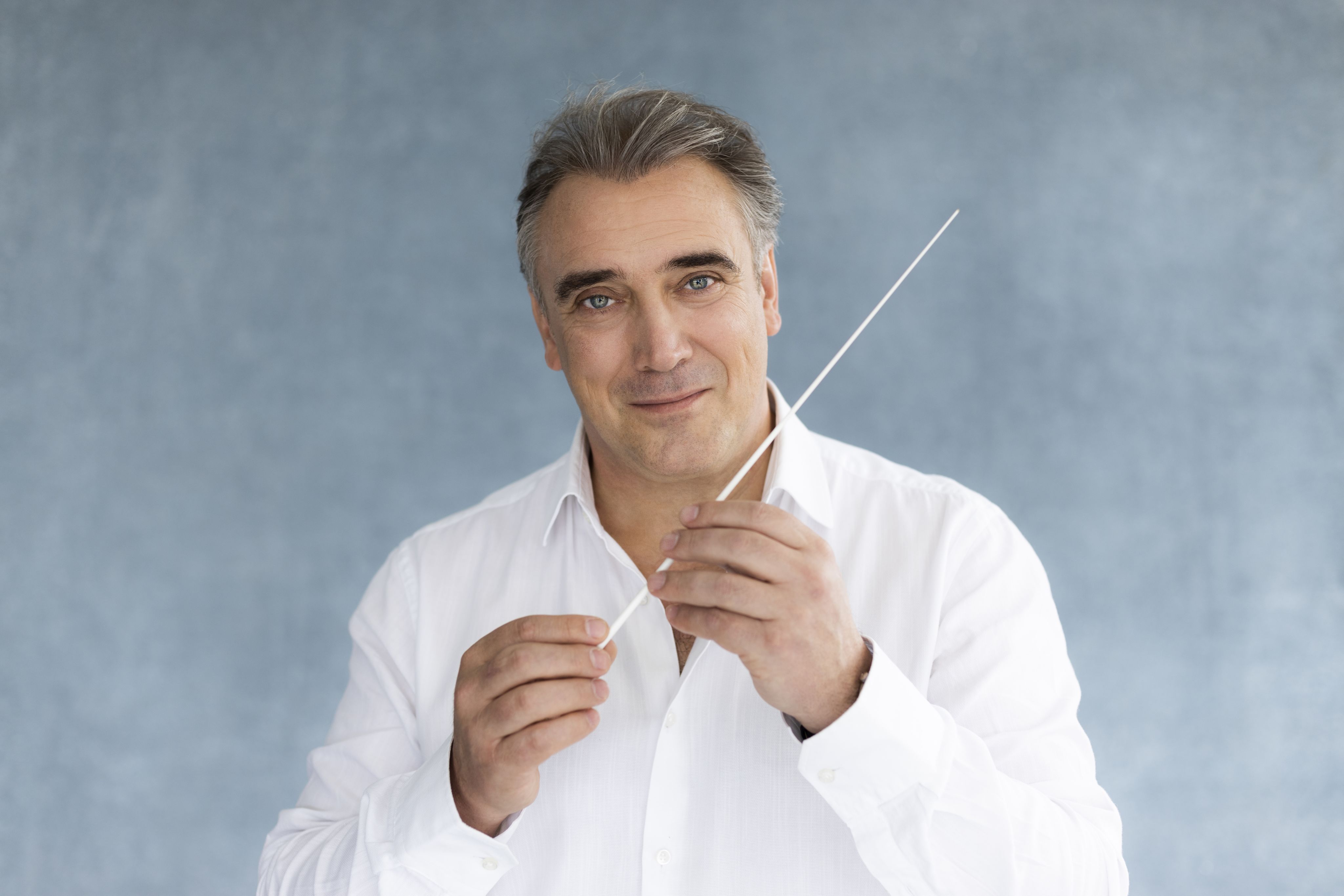
Paul Marc Mitchell
Paul Marc Mitchell
Spanish conductor Jaime Martín is currently Music Director of the Los Angeles Chamber Orchestra, Chief Conductor of the Melbourne Symphony Orchestra and Principal Guest Conductor of the BBC National Orchestra of Wales. He has also held the positions of Chief Conductor of the National Symphony Orchestra of Ireland (2019–24), Principal Guest Conductor of the Spanish National Orchestra (2022–24) and Artistic Director and Principal Conductor of Gävle Symphony Orchestra (2013–22).
Having spent many years as a highly regarded flautist, he turned to conducting full-time in 2013 and quickly became sought after at the highest level.
Highlights of the last season have included an 11-day Beethoven Festival with the Melbourne Symphony Orchestra, conducting all nine symphonies. He also returned to conduct orchestras in Spain, the UK and Australia and undertook a UK and European tour with the Melbourne SO that included appearances at the BBC Proms and the Edinburgh International Festival.
In the 2025/26 season he conducts the Aalborg, Colorado, Euskadi, Gothenburg, New Zealand and Queensland Symphony orchestras, Budapest Festival Orchestra, George Enescu and Strasbourg Philharmonic orchestras, Berlin Radio Symphony Orchestra and RTVE Madrid.
His extensive discography includes recordings with the Barcelona, Gävle and Melbourne Symphony orchestras, Cadaqués Orchestra and London Philharmonic Orchestra.
Jaime Martín is Artistic Advisor and former Artistic Director of the Santander Festival and a Fellow of the Royal College of Music, where he was a flute professor.
Alim Beisembayevpiano

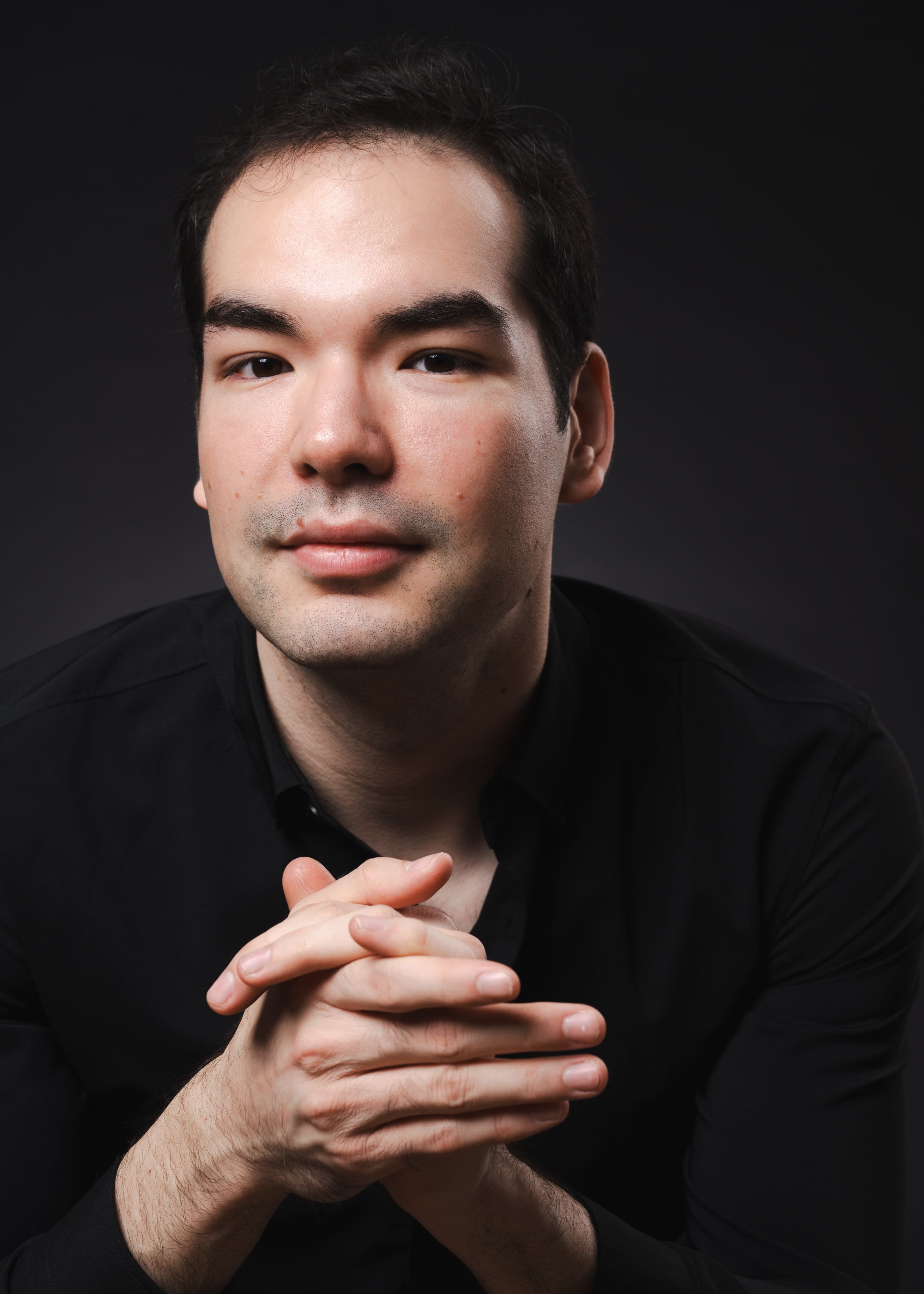
Andrew Mason
Andrew Mason
Alim Beisembayev won First Prize at the 2021 Leeds International Piano Competition, performing Rachmaninov’s Rhapsody on a Theme of Paganini with the Royal Liverpool Philharmonic Orchestra and Andrew Manze. He also took home the medici.tv Audience Prize and the Royal Liverpool Philharmonic Society Prize for contemporary performance.
He is a BBC Radio 3 New Generation Artist (2023–5) and made his debut at the BBC Proms with the Sinfonia of London and John Wilson on two days’ notice, bringing him to international attention. Other highlights include the world premiere of Eleanor Alberga’s Piano Concerto with the RLPO and concertos with the BBC Symphony, BBC Philharmonic, Czech Philharmonic, Barcelona Symphony Orchestra, SWR Symphony Orchestra Stuttgart, National Symphony Orchestra of India, State Academic Symphony Orchestra of Russia and Fort Worth Symphony, among others.
Concerto highlights in the 2024–25 season included debuts with the BBC Scottish Symphony Orchestra, Xiamen Philharmonic Orchestra, Sinfonietta Cracovia and Janáček Philharmonic in Ostrava.
As a recitalist, he has made notable debuts at the BBC Proms at Truro, Amsterdam Concertgebouw, Wigmore Hall, Seoul Arts Centre, Carnegie Hall, Victoria Concert Hall, Singapore, Chopin Institute in Warsaw, Oxford Piano Festival and Fondation Louis Vuitton, Paris, in addition to a tour of Europe in association with the Steinway Prizewinner Concerts Network, and Korea, with the World Culture Network. Forthcoming highlights include multiple returns to Wigmore Hall, as well as his debut performance at the Queen Elizabeth Hall, Southbank Centre.
He released his debut album of Liszt Transcendental Études in 2022.
Alim Beisembayev was born in Kazakhstan in 1998, and he studied initially at the Purcell School and latterly at the Royal Academy of Music and Royal College of Music.
BBC National Orchestra of Wales
For over 90 years, the BBC National Orchestra of Wales, the only professional symphony orchestra in Wales, has played an integral part in the cultural landscape of the country, occupying a distinctive role as both a broadcast and national orchestra, and serving as an ambassador of Welsh culture, regularly performing music created in Wales and championing Welsh composers and artists.
Part of BBC Cymru Wales and supported by the Arts Council of Wales, BBC NOW performs a busy schedule of concerts and broadcasts, working with acclaimed conductors and soloists from across the world, including its Principal Conductor, the award-winning Ryan Bancroft.
The orchestra is committed to working in partnership with community groups and charities, taking music out of the concert hall and into settings such as schools and hospitals to enable others to experience and be empowered by music. It undertakes workshops, concerts and side-by-side performances to inspire and encourage the next generation of performers, composers and arts leaders, and welcomes thousands of young people and community members annually through its outreach and education projects.
BBC NOW performs annually at the BBC Proms and biennially at the BBC Cardiff Singer of the World competition, and its concerts can be heard regularly across the BBC – on Radio 3, Radio Wales and Radio Cymru. On screen, music performed by BBC NOW can be heard widely across the BBC and other global channels, including the soundtrack and theme tune for Doctor Who, Planet Earth III, Prehistoric Planet, The Pact and Children in Need.
Based at BBC Hoddinott Hall, Cardiff Bay, BBC NOW utilises a state-of-the-art recording studio with a camera system for livestreams and TV broadcasts to bring BBC NOW’s music to a broader audience across Wales and the world. For more information about BBC NOW please visit bbc.co.uk/now
Patron
HM King Charles III KG KT PC GCB
Principal Conductor
Ryan Bancroft
PrincipalGuest Conductor
Jaime Martín
Conductor Laureate
Tadaaki Otaka CBE
Composer-in-Association
Gavin Higgins
First Violins
Martin Gwilym-Jones sub-leader
Gwenllian Hâf MacDonald
Terry Porteus
Suzanne Casey
Ruth Heney **
Kerry Gordon-Smith
Anna Cleworth
Carmel Barber
Alejandro Trigo
Juan Gonzalez
Žanete Uškāne
Zhivko Georgiev
Gary George-Veale
Second Violins
Anna Smith *
Kirsty Lovie #
Ros Butler
Sheila Smith
Roussanka Karatchivieva
Lydia Caines **
Beverley Wescott
Vickie Ringguth
Katherine Miller
Joseph Williams
Michael Topping
Elizabeth Whittam
Violas
Alex Thorndike #
Tetsuumi Nagata
Peter Taylor
Lowri Taffinder
Lydia Abell
Robert Gibbons
Catherine Palmer
Laura Sinnerton
Anna Growns
Cellos
Miwa Rosso ‡
Raphael Lang
Sandy Bartai
Carolyn Hewitt
Rachel Ford
Keith Hewitt
Alistair Howes
Kathryn Graham
Double Basses
David Stark *
Christopher Wescott
Emma Prince
Phoebe Clarke
William Cole
Antonia Bakewell
John Hall †
Lindsey Ellis
Piccolo
Lindsey Ellis †
Oboes
Amy McKean †
Clarinets
William White
Bassoons
Dominic Tyler
David Buckland
Contrabassoon
David Buckland †
Horns
Meilyr Hughes
Dave Ransom
Flora Bain
Tom Taffinder
Trumpets
Robert Samuel
Corey Morris †
Trombones
Stephen Turton
Bass Trombone
Tuba
Timpani
Percussion
Rhydian Griffiths ‡
Andrea Porter
Max Ireland
* Section Principal
The list of players was correct at the time of publication
Director Lisa Tregale
+ Green Team member
Keep up to date with BBC National Orchestra of Wales
Listen to our BBC Radio 3 broadcasts via the BBC Sounds app. Visit our website and follow us on Facebook and Instagram
To help us improve our online concert programmes, please take this 5-minute survey
Produced by BBC Proms Publications